Check the winners The Grow Awards 2026 🏆
Likes
Comments
Share
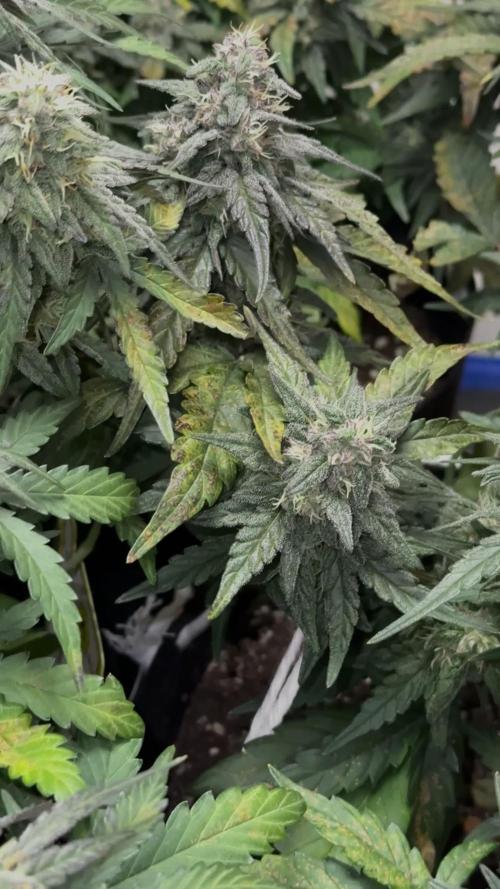
Dec 2: Backed off the liquid weight, only giving 1x per week, rusty spots have stopped spreading I believe. Bulking going well, one girl drinks significantly faster due to her size. Prolly week 12 finishers. These are some frosty ass girls I cannot wait to smell the cure transformation.
Processing
Likes
6
Share
Germination: Started regular 10 seeds. 5- Sour 76 (sour diesel x 76 Afghani) 5- Platunum Yeti F3 (Platinum cookies x Yeti Og) These are "tester" seeds given to me free courtesy of Humboldt Seed Organization. They are testing to see what phenos and germ rates testers have before deciding to launch a line or not. Here we go! Of 10 started, 6 survived. 4 out of 5 sour 76 successfully germinated. 2 out of 5 Platinum yeti successfully germinated. 1 yeti never cracked and I probably could've taken scissors to rough the shell and get it to germ, but it didnt pop in root riot after days so I tossed it! one plat yeti germed and as it rise up got a white furry fungus of some kind. I tried to save it but it ended up dying off. despite it actually germinating initially. 6 lived in their rooter plugs and got transfered to 3.5 x 3.5 inch square pots with coco coir / perlite (70 /30 mix) at 4 days old. I start week 1 with germination which isn't truly veg for time sake, but with a short veg indoors (34 days before flip this run) I'm uploading these all one after another as I've just harvest. I started off
Likes
26
Share
@darb35
Follow
Day 57 - 660 ml water with calmag (ph 6.4)(92-97 cm) Day 58 - 1L water with half dose according to biobizz schedule (ph 6.3)(93-97 cm) Day 59 - No water (93-98 cm) Day 60 - 1L water with calmag (ph 6.3)(93-98 cm) Day 61 - 1L water with half dose according to biobizz schedule (ph 6.2)(93-98 cm) Day 62 - 1L water with calmag (ph 6.3)(93-98 cm) Day 63 - 1.3L water with half dose according to biobizz schedule (ph 6.4)(93-98 cm)
Likes
9
Share
@GYOweed
Follow
Gave it extra week and 2 days dark ending 9 hours day cycle. Very slight pine, kush, and delicious limonene flavor. No skunk or harsh earthyness at all. Will post more pics. Very potent!
Likes
56
Share
What's in the soil? What's not in the soil would be an easier question to answer. 16-18 DLI @ the minute. +++ as she grows. Probably not recommended, but to get to where it needs to be, I need to start now. Vegetative @1400ppm 0.8–1.2 kPa 80–86°F (26.7–30°C) 65–75%, LST Day 10, Fim'd Day 11 CEC (Cation Exchange Capacity): This is a measure of a soil's ability to hold and exchange positively charged nutrients, like calcium, magnesium, and potassium. Soils with high CEC (more clay and organic matter) have more negative charges that attract and hold these essential nutrients, preventing them from leaching away. Biochar is highly efficient at increasing cation exchange capacity (CEC) compared to many other amendments. Biochar's high CEC potential stems from its negatively charged functional groups, and studies show it can increase CEC by over 90%. Amendments like compost also increase CEC but are often more prone to rapid biodegradation, which can make biochar's effect more long-lasting. biochar acts as a long-lasting Cation Exchange Capacity (CEC) enhancer because its porous, carbon-rich structure provides sites for nutrients to bind to, effectively improving nutrient retention in soil without relying on the short-term benefits of fresh organic matter like compost or manure. Biochar's stability means these benefits last much longer than those from traditional organic amendments, making it a sustainable way to improve soil fertility, water retention, and structure over time. Needs to be charged first, similar to Coco, or it will immobilize cations, but at a much higher ratio. a high cation exchange capacity (CEC) results in a high buffer protection, meaning the soil can better resist changes in pH and nutrient availability. This is because a high CEC soil has more negatively charged sites to hold onto essential positively charged nutrients, like calcium and magnesium, and to buffer against acid ions, such as hydrogen. EC (Electrical Conductivity): This measures the amount of soluble salts in the soil. High EC levels indicate a high concentration of dissolved salts and can be a sign of potential salinity issues that can harm plants. The stored cations associated with a medium's cation exchange capacity (CEC) do not directly contribute to a real-time electrical conductivity (EC) reading. A real-time EC measurement reflects only the concentration of free, dissolved salt ions in the water solution within the medium. 98% of a plants nutrients comes directly from the water solution. 2% come directly from soil particles. CEC is a mediums storage capacity for cations. These stored cations do not contribute to a mediums EC directly. Electrical Conductivity (EC) does not measure salt ions adsorbed (stored) onto a Cation Exchange Capacity (CEC) site, as EC measures the conductivity of ions in solution within a soil or water sample, not those held on soil particles. A medium releases stored cations to water by ion exchange, where a new, more desirable ion from the water solution temporarily displaces the stored cation from the medium's surface, a process also seen in plants absorbing nutrients via mass flow. For example, in water softeners, sodium ions are released from resin beads to bond with the medium's surface, displacing calcium and magnesium ions which then enter the water. This same principle applies when plants take up nutrients from the soil solution: the cations are released from the soil particles into the water in response to a concentration equilibrium, and then moved to the root surface via mass flow. An example of ion exchange within the context of Cation Exchange Capacity (CEC) is a soil particle with a negative charge attracting and holding positively charged nutrient ions, like potassium (K+) or calcium (Ca2+), and then exchanging them for other positive ions present in the soil solution. For instance, a negatively charged clay particle in soil can hold a K+ ion and later release it to a plant's roots when a different cation, such as calcium (Ca2+), is abundant and replaces the potassium. This process of holding and swapping positively charged ions is fundamental to soil fertility, as it provides plants with essential nutrients. Negative charges on soil particles: Soil particles, particularly clay and organic matter, have negatively charged surfaces due to their chemical structure. Attraction of cations: These negative charges attract and hold positively charged ions, or cations, such as: Potassium (K+) Calcium (Ca2+) Magnesium (Mg2+) Sodium (Na+) Ammonium (NH4+) Plant roots excrete hydrogen ions (H+) through the action of proton pumps embedded in the root cell membranes, which use ATP (energy) to actively transport H+ ions from inside the root cell into the surrounding soil. This process lowers the pH of the soil, which helps to make certain mineral nutrients, such as iron, more available for uptake by the plant. Mechanism of H+ Excretion Proton Pumps: Root cells contain specialized proteins called proton pumps (H+-ATPases) in their cell membranes. Active Transport: These proton pumps use energy from ATP to actively move H+ ions from the cytoplasm of the root cell into the soil, against their concentration gradient. Role in pH Regulation: This active excretion of H+ is a major way plants regulate their internal cytoplasmic pH. Nutrient Availability: The resulting decrease in soil pH makes certain essential mineral nutrients, like iron, more soluble and available for the root cells to absorb. Ion Exchange: The H+ ions also displace positively charged mineral cations from the soil particles, making them available for uptake. Iron Uptake: In response to iron deficiency stress, plants enhance H+ excretion and reductant release to lower the pH and convert Fe3+ to the more available form Fe2+. The altered pH can influence the activity and composition of beneficial microbes in the soil. The H+ gradient created by the proton pumps can also be used for other vital cell functions, such as ATP synthesis and the transport of other solutes. The hydrogen ions (H+) excreted during photosynthesis come from the splitting of water molecules. This splitting, called photolysis, occurs in Photosystem II to replace the electrons used in the light-dependent reactions. The released hydrogen ions are then pumped into the thylakoid lumen, creating a proton gradient that drives ATP synthesis. Plants release hydrogen ions (H+) from their roots into the soil, a process that occurs in conjunction with nutrient uptake and photosynthesis. These H+ ions compete with mineral cations for the negatively charged sites on soil particles, a phenomenon known as cation exchange. By displacing beneficial mineral cations, the excreted H+ ions make these nutrients available for the plant to absorb, which can also lower the soil pH and indirectly affect its Cation Exchange Capacity (CEC) by altering the pool of exchangeable cations in the soil solution. Plants use proton (H+) exudation, driven by the H+-ATPase enzyme, to release H+ ions into the soil, creating a more acidic rhizosphere, which enhances nutrient availability and influences nutrient cycling processes. This acidification mobilizes insoluble nutrients like iron (Fe) by breaking them down, while also facilitating the activity of beneficial microbes involved in the nutrient cycle. Therefore, H+ exudation is a critical plant strategy for nutrient acquisition and management, allowing plants to improve their access to essential elements from the soil. A lack of water splitting during photosynthesis can affect iron uptake because the resulting energy imbalance disrupts the plant's ability to produce ATP and NADPH, which are crucial for overall photosynthetic energy conversion and can trigger a deficiency in iron homeostasis pathways. While photosynthesis uses hydrogen ions produced from water splitting for the Calvin cycle, not to create a hydrogen gas deficiency, the overall process is sensitive to nutrient availability, and iron is essential for chloroplast function. In photosynthesis, water is split to provide electrons to replace those lost in Photosystem II, which is triggered by light absorption. These electrons then travel along a transport chain to generate ATP (energy currency) and NADPH (reducing power). Carbon Fixation: The generated ATP and NADPH are then used to convert carbon dioxide into carbohydrates in the Calvin cycle. Impaired water splitting (via water in or out) breaks the chain reaction of photosynthesis. This leads to an imbalance in ATP and NADPH levels, which disrupts the Calvin cycle and overall energy production in the plant. Plants require a sufficient supply of essential mineral elements like iron for photosynthesis. Iron is vital for chlorophyll formation and plays a crucial role in electron transport within the chloroplasts. The complex relationship between nutrient status and photosynthesis is evident when iron deficiency can be reverted by depleting other micronutrients like manganese. This highlights how nutrient homeostasis influences photosynthetic function. A lack of adequate energy and reducing power from photosynthesis, which is directly linked to water splitting, can trigger complex adaptive responses in the plant's iron uptake and distribution systems. Plants possess receptors called transceptors that can directly detect specific nutrient concentrations in the soil or within the plant's tissues. These receptors trigger signaling pathways, sometimes involving calcium influx or changes in protein complex activity, that then influence nutrient uptake by the roots. Plants use this information to make long-term adjustments, such as Increasing root biomass to explore more soil for nutrients. Modifying metabolic pathways to make better use of available resources. Adjusting the rate of nutrient transport into the roots. That's why I keep a high EC. Abundance resonates Abundance.
Likes
98
Share
It's been a big week for my lady! She got more space for the roots :D The lower fan leaves were getting yellow faster than I would have liked them so that meant transplant time has come! I was also suspecting salt build-up at the roots, but the last run-off I checked was on 1.5 EC which is the same as what I was feeding her. Anyways, I flushed her just in case(as suggested by Mrs_Larimar) with 30l tap water, and gave her a 10l feed right after transplant. There was no mark about the size of the pot, but I finished a 50l All-mix soil bag on her, so... I would say she's in a 45l pot right now.
Likes
Comments
Share

She stretched a little bit more in the last week, everything very healthy.
Processing
Likes
10
Share
@mkrmkr
Follow
Completing the sixth week. Plant 1 - Completing the sixth week of life. Plant 2 - Completing the fifth week of life. Plant 3 - Completing the fifth week of life. Plant 4 - Completing the fourth week of life.
Likes
2
Share
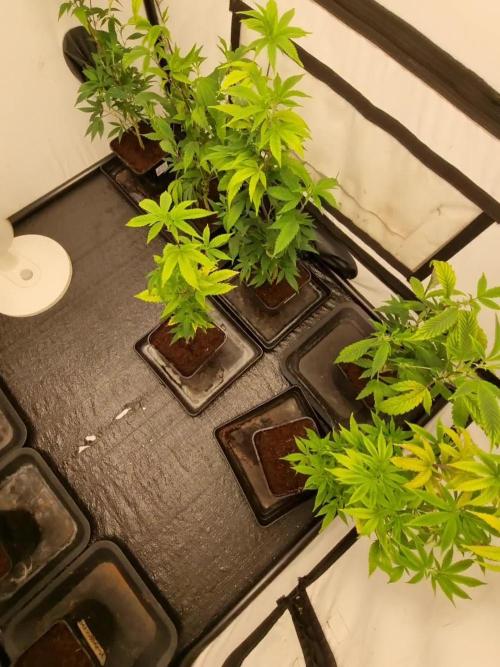
They've doubled in size again. I might end up having to take them out of the tent if they keep stretching like this 😆. All in all very happy with these free seeds. They look like they're going into preflower so hopefully the up growth will be done.
Likes
24
Share
Kommen jetzt langsam in die Wachstumsphase. Beginne leicht mit 2ml pro Liter Root juice. Hauptlichter auch an, aber mit 50cm Abstand. Update 15.12.2020 Sie wachsen alle sehr gut.
Likes
3
Share
These are very awesome genetics These budz are almost ready to chop
Likes
15
Share
Iused clone x on the clones. No picture this week. Enjoy my cat instead.
Likes
12
Share
Starting to form shape to get the first layer of netting, I made my own trellis using pvc pipe
Likes
15
Share
To grow shes a pleasure , looked healthy all the way to crop ,, solid buds what absolute stink , its air dryin at roof hight and im still convinced everyone can smell it ,,,, honestly am drewlin knowin i got the summer time chedder
Likes
4
Share
@Aleks555
Follow
Harvest — Creamy Beast Turbo Feminized by Seeds Mafia After 117 days from seed, our Creamy Beast Turbo has finally reached harvest! She’s matured beautifully — dense, resin-coated buds, a rich fruity aroma, and a powerful structure under the SCRoG net. Throughout the grow, we maintained stable conditions: 🌡️ Day temp: 25–26°C 🌙 Night temp: 20–21°C 💧 Humidity: ~45% 💡 Light cycle: 12/12 💨 CO₂ supplementation 🌱 Feeding: Xpert Nutrients all the way We even tried a quick sample — dried in the microwave — and the effect was incredibly strong, possibly one of the most potent strains I’ve ever grown. And that was just a fast-dried tester! Huge thanks to Seeds Mafia for the amazing genetics and to Xpert Nutrients for the high-quality fertilizers. This journey was a pleasure from start to finish — and now we can't wait to enjoy the final results!
Likes
19
Share
1/4 is being harvested 2/4 being flushed Runt is a giant and her buds are getting there
Likes
4
Share
En la segunda semana de vegetación fertilizamos con un estimulante de crecimiento, aplicando 1.5ml / litro con p.h regulado en 5.8.
Likes
1
Share
You can see the girls on week 4 right at the end of video aprry didn't get much time with plants this week will update more in the coming days Ones in tent are day 5 flower the larger ones outside tent are week4 the smaller ones sitting at window are going into week 3 and need some nuits to kick start them
Likes
2
Share
Had a slow growth due to my veg tent had very low humidity but they starting to bounce back to life