


Likes
Comments
Share

@All_our_small_plants
Follow
2000 ml alle 2 Tage
pH-Wert: 6,1
EC-Wert: 1,2
Temperatur: 22ºC
Luftfeuchtigkeit 62%
Schädlingsbekämpfung:
PPFD: 500 µmol/m²/s
DLI: 33
Düngemittel: Mineralischer Dünger 3.5-6-6 PK 13/14
Besonderheiten: Wurden direkt in die erde gepflanzt in einer Kokos-Quelltabletten.
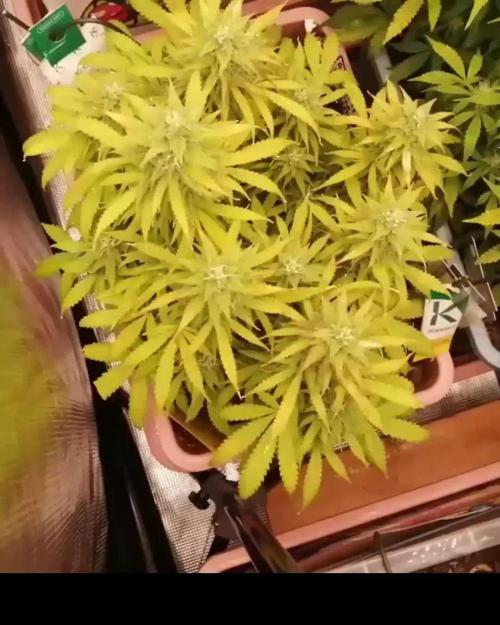
-Tag 65 Heute haben wir ihr wieder Wasser und Mikroorganismen gegeben. Wir haben sie auch wieder stark entlaubt damit die luft besser zirkulieren kann und sich kein Schimmel bildet.
-Tag 67 Heute haben wir sie mit 2000 ml Wasser gegossen, versetzt mit 1,5 ml Calmag, 5 ml Canna PK 13/14, 1 ml Plagron Green Sensation und 1 ml Plagron Power Buds. Der EC-Wert lag bei 1.460 mS/cm und der pH-Wert bei 6,2. 👽
-Tag 69 Heute haben wir sie mit 2000 ml Wasser gegossen, angereichert mit 1,5 ml Calmag, 6,5 ml Canna PK 13/14, 1 ml HY-PRO Epic Blast sowie 0,32 ml HY-PRO Generator. Der EC-Wert betrug 1,480 mS/cm und der pH-Wert lag bei 6,2. 😎

Likes
72
Share


@DreamIT
Follow
🐩👤Sirius Black👤🐩 by 🌍🌱WeedSeedsExpress🌱🌍
👤 22.3 ...
👤 23.3 ...
👤 24.3 ...
👤 25.3 beautiful plant, large and vigorous, I hope it takes a dark / red color, it would be fantastic. but I'll try with other seeds eventually 😀 the lamp is really cool, the plants look just fine under Viparspectra
👤 26.3 ...
👤 27.3 All very well, I can't wait for it to start releasing perfumes
👤 28.3
__________________________________________
👀Are you looking for a good lamp to start?👀
Viparspectra in my opinion has something more than the others, take a look at their site.
➡️ http://bit.ly/pro-seriesproductspro-series-p1500
⏩Use " GDVIP " for an extra discount💯
____________________________________________________________________________________
📜👀 A look at the details of what I'm growing 👀📜
🐩👤Sirius Black👤🐩 by 🌍🌱WeedSeedsExpress🌱🌍
📋 Details 📋
⚧ Gender
▪️ Feminised
➰ Genes
▪️ 70% Indica / 30% Sativa
🎄 Genetics
▪️ Sirius Black
🚜Harvest
▪️ 450 g / m²
🌷Flowering
▪️ 63 - 70 days
✨THC
▪️ 25.0%
✅CBD
▪️ 0.5%
🏡Room Type
▪️ Indoor
🌄Room Type
▪️ Outdoor
🕋Room Type
▪️ Greenhouse
🎂Release Year
▪️ 2020
____________________________________________________________________________________
👀📷 Follow the best photos on instagram 📷👀
https://www.instagram.com/dreamit420/
🔻Leave a comment with your opinions if you pass by here🔻
🤟🤗💚Thanks and Enjoy growth 💚🤗🤟

Likes
27
Share


@AsNoriu
Follow
Day 79 since seed touched soil. Found some bud rot on other strains yesterday, so made early chop for #2 and #3. Both needed time, #2 needed like 3 more weeks, would be huge ;)))
Day 112 since seed touched soil. last one is done. Ganja Farmer 2024 project is over.
Happy Growing !!!

Likes
10
Share


@Stickygreens420
Follow
1/8/2024: so far the grow is not off to a great start. The browning that started on the cotyledon has spread to the other leaves and her growth has definitely slowed a bit. I used some water that sat out for a few days, so that may have been the issue, but I'm not sure why that would cause a problem. The ph was at 6.2. I also foiler fed them with some Tweetmint, which i think is the issue. I may hav3 not diluted it enough, causing the buring. I'm laying off anymore IPM until the olants bounce back. I also turned the lights down until i can get the plants back on track. It may just be the soil is too hot, but I have other plants in different soil that are showing the same symptoms, so it makes me think it's not the soil. I'm not giving up yet, but if things don't improve soon, I may just pop a new seed. This is my biggest issue with auto flowers. If the grow isn't perfect I could end up stunting the plant too much. I guess we will find out.
1/10/2024: Day 10 - the new growth is coming in healthy. I'm pretty sure the foiler spay I used last week is what caused the issue. I went back and realized I used way more of the concentrate than I should have, which likely burned the leaves. Let's hope that is the only mistake I make on this grow and it doesn't stunt the plant too much.
1/14/2024 - Day 14: she is looking so much better. All the new growth is as healthy as can be. I added a new light today. Replaced the Spider Farmer SF2000 with the AC Infinity Ionboard S44. I originally had the S44 in my 4x4, but recently bought a light with more Watts and better coverage for the 4x4. The S44 is probably overkill for the 2x4, but it fit, so I figured I'd give it a try. Only have it on at 60% at the moment and I'm getting about 500 ppfd, with a DLI of 30. Dropped the light cycle down to 18 on and 6 off as well. I have some photo period plants in the 2x4 as well, and I wanted to shift them to 18/6, so the auto is going along for the ride.

Likes
152
Share


@EBxAH
Follow
This was such an amazing experience! The outcome could have been better but I'm happy and the quality is definitely there!!!!! Such a sweet tasting smoke with very relaxing, very creative highlights! I finally got to try this strain and I immediately see why it's a legend!!!
Happy growing everyone ✌️🍀✌️

Likes
57
Share


@MadeInGermany
Follow
Hey everyone 😃.
Both phenotypes are beautiful, the Pehno 1 is of course the more beautiful due to its red color 😍.
Both smell really delicious 😃.
Now to the weekly overview.
Days of flowering 42
Since the water was only poured on day 41, both were only checked for their health today.
Flowering day 43
Today both were poured with 1 l each, completely without additives as they should use up their remaining nutrients :-).
Flowering day 44
The tent was cleaned and the humidifier refilled.
Flowering day 45
Today both were checked for health and sprayed.
Flowering day 46
Today everything in the tent was tested for functionality (fans, etc.).
The humidifier has been refilled.
Flowering day 47
Again today it was poured with 1.2 l each time, and the tent was cleaned.
Flowering day 48
Both plants were checked to see how wide their trichomes were (70% milky, 20% clear and 10% amber).
The plants are really extremely fast 👍.
Everything was cleaned again and the humidifier was filled.
That was it pushed with this week, and I have to say the Fast Version lives up to its name 😳😃.
I wish you all a lot of fun updating these beautiful phenotypes, stay healthy and let it grow 🙏🏻🍀
You can buy this Strain at :
https://sweetseeds.es/de/red-mandarine-f1-fast-version/
Type:
Red Mandarine F1 Fast Version
☝️🏼
Genetics:
Red Poison Auto®️ (SWS39)
X
Tangie (California Orange x Hybrid Skunk)
👍
Vega lamp:
2 x Todogrow Led
Quantum Board 100 W
💡
Bloom Lamp :
2 x Todogrow Led
Cxb 3590 COB 3500 K 205W
💡💡☝️🏼
Soil :
Canna Coco Professional +
☝️🏼
Fertilizer:
Green House Powder Feeding
☝️🏼🌱
Water:
Osmosis water mixed with normal water (24 hours stale that the chlorine evaporates) to 0.2 EC. Add Cal / Mag to 0.4 Ec Ph with Organic Ph - to 5.5 - 5.8 .

Likes
20
Share


@French__flair
Follow
First Week of flowering
Week without too much hassle. A small excess of fertilizer but nothing serious. Uniform color. High water consumption (10L every 2 days), you can feel that they are in good shape.
Semaine sans trop d'encombre. Un petit excès de fertilisant mais rien de grave. Couleur uniforme. Grosse consommation en eau (10L tous les 2 jours), on sent qu'elles sont en forme.
Una semana sin demasiados problemas. Un poco de exceso de fertilizante pero nada serio. Color uniforme. El alto consumo de agua (10L cada 2 días), se puede sentir que están en buena forma.


Likes
11
Share

@BlaKX
Follow
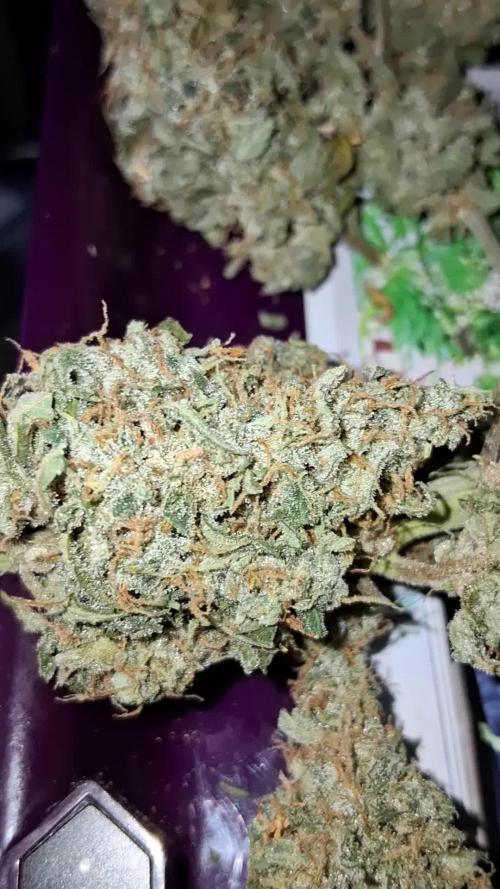
Die end Höhe mit 69cm und 75g Dry Buds in nur 7 Wochen! Dank der 3 Wochen vorzucht weder der post transport noch Hitze Stress setze ihr zu .
Ich hätte nur eher mit LST starten müssen und entlauben am Ende ist Pflicht für die Luftzufuhr.

Likes
Comments
Share


@Yiyis_Grow
Follow
Buen aumento en el volumen de las flores.
Una planta no está tomando agua, revisé y no es botritis, la regaré con agua solamente cuando esté seca .
La planta con manchas en la hojas sigue igual , ya ella no se recuperará, no tiene tiempo.
Semana con nutriente de floración al 100% y potenciadores.
Se cambió de lámpara por otra del doble de potencia 2000W. BESTVA
- Luz: Bestva Pro 2000W / 18 h/d
-FloraNova Bloom G.Hydroponics: 0.7ml/l
- Bio Bud G. Hydroponics 2.5ml/l
- Armour SI G. Hydroponics 0.4ml/l
- C4 Mills 1ml/l
- Everest: 0.5 ml/l
Control biológico:
-Solution (bioinsecticida generalista: Beauveria, Metarhizium, Lecanicillium y
Cladosporium + esencia de ajo y chile).
-Acaridox (bioacaricida: Metarhizium e Hirsutella + esencia de canela)
- Scamin (control escama y cochinilla) Cladosporium Herbarum
-Bioprotection BD Plus (microorganismos bioestimulantes y bioprotectores: Trichoderma + actinomicetos + Lactobacillus)
- Bioprotection TR + BSLIN
(biofungicida generalista: Bacillus subtilis + Trichoderma y metabolitos).

Likes
18
Share


@Wakesk8
Follow
9 week flowering..Runtz Auto is almost ready and it’s beautiful!
Balance plants are going well


Likes
1
Share


@HoneyBlunt42
Follow
Day 94 - today the temperature inside the tent dropped to 10-12 degrees Celsius. So it's harvest time.
I trimmed almost all the leaves and hung the plant in a dark place to dry at a temperature of 12 degrees. This is not enough, but unfortunately there are no other conditions. Drying may take longer than the usual 10-12 days.
The plant itself has stretched almost a meter in height, the roots are also impressive.
Likes
4
Share


@vilahaze
Follow
tiene un olor muy fuerte y agradable que te cautiva y noquea al mismo tiempo


Likes
28
Share


@BillMonroe
Follow
Nice! Let's say I look forward more to smoking it than trimming it
The tops have some different shapes because I used the "back building" technique
I'll add some more pictures on tuesday. You can right click and open the image in a new window to get a better look


Likes
14
Share


@ThatoneAKguy
Follow
The blue kush is a savage auto from dinafem. This plant almost died in week one of flower and I missed that weeks entry because I was more interested in saving it than that weeks diary. She’s at week three day four and a beast. Filling out nicely even though her neighbor is crowding her. She’s required very minimal pruning and all of her bud sites are producing worthy keepers.


Likes
10
Share


@Raizativa
Follow
Riego:
1L
1ml Bio grow
1ml calmag
1ml Bio Heaven
1ml top max
1ml Bio bloom
1ml bud candy
0.5 Micorrizas colectivo científico
Se han ido ajustando los amarres de LST cada día por medio aprox.
Comenzaron los primeros pistilos y con ellos aparecieron algunas carencias, se agregan fertilizantes de flora.
Likes
5
Share


@skaf420
Follow
small side project: Rebegging some branches to preserve this pheno for the future. Hopefully they will root soon.