Check the winners The Grow Awards 2026 🏆
Likes
Comments
Share
@nonick123
Follow
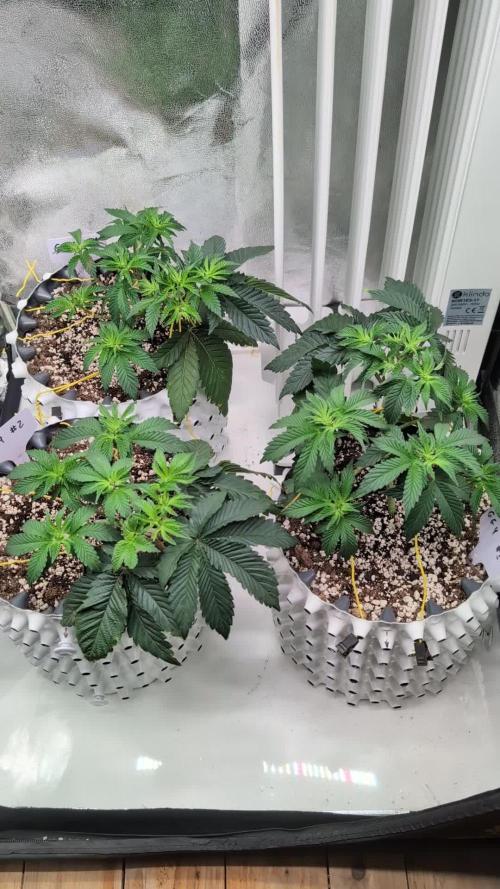
Día 22 (20/10) Pequeños ajustes de LST Día 23 (21/10) Topping! Riego 250 ml H2O RO Día 24 (22/10) N/A Día 25 (23/10) Riego 500 ml de H2O RO 30 grados por aquí! Día 26 (24/10) Riego 250 ml H2O RO Elimino un par de hojas de abanico. Continúan los 30 grados! 🚀 FastBuds 15% DISCOUNT code "NONICK" fastbuds.com 💦 Nutrients BioTabs 15% DISCOUNT code "GDBT420" biotabs.nl/en/shop/ 🌱Substrate PRO-MIX HP BACILLUS + MYCORRHIZAE - www.pthorticulture.com/en-us/products/pro-mix-hp-biofungicide-plus-mycorrhizae Día 27 (25/10) N/A Día 28 (26/10) Lollipopping
Likes
62
Share
Esta es una de las semanas mas bonita del cultivo si llegas sin carencias ni excesos obviamente. Las plantas empiezan a definir el cogollo. La parte izquierda se a definido como un fenotipo xativo mas alto y con muchas ramas. En cambio el lado derecho a sacado un fenotipo mucho mas indico con plantas mas cortas y que seguro generaran un gran central. La temperatura se mantiene entre 25 y 26 grados. Ya hemos empezado a anadirle co2 a 1000 ppm.
Likes
47
Share
What's in the soil? What's not in the soil would be an easier question to answer. 16-18 DLI @ the minute. +++ as she grows. Probably not recommended, but to get to where it needs to be, I need to start now. Vegetative @1400ppm 0.8–1.2 kPa 80–86°F (26.7–30°C) 65–75%, LST Day 10, Fim'd Day 11 CEC (Cation Exchange Capacity): This is a measure of a soil's ability to hold and exchange positively charged nutrients, like calcium, magnesium, and potassium. Soils with high CEC (more clay and organic matter) have more negative charges that attract and hold these essential nutrients, preventing them from leaching away. Biochar is highly efficient at increasing cation exchange capacity (CEC) compared to many other amendments. Biochar's high CEC potential stems from its negatively charged functional groups, and studies show it can increase CEC by over 90%. Amendments like compost also increase CEC but are often more prone to rapid biodegradation, which can make biochar's effect more long-lasting. biochar acts as a long-lasting Cation Exchange Capacity (CEC) enhancer because its porous, carbon-rich structure provides sites for nutrients to bind to, effectively improving nutrient retention in soil without relying on the short-term benefits of fresh organic matter like compost or manure. Biochar's stability means these benefits last much longer than those from traditional organic amendments, making it a sustainable way to improve soil fertility, water retention, and structure over time. Needs to be charged first, similar to Coco, or it will immobilize cations, but at a much higher ratio. a high cation exchange capacity (CEC) results in a high buffer protection, meaning the soil can better resist changes in pH and nutrient availability. This is because a high CEC soil has more negatively charged sites to hold onto essential positively charged nutrients, like calcium and magnesium, and to buffer against acid ions, such as hydrogen. EC (Electrical Conductivity): This measures the amount of soluble salts in the soil. High EC levels indicate a high concentration of dissolved salts and can be a sign of potential salinity issues that can harm plants. The stored cations associated with a medium's cation exchange capacity (CEC) do not directly contribute to a real-time electrical conductivity (EC) reading. A real-time EC measurement reflects only the concentration of free, dissolved salt ions in the water solution within the medium. 98% of a plants nutrients comes directly from the water solution. 2% come directly from soil particles. CEC is a mediums storage capacity for cations. These stored cations do not contribute to a mediums EC directly. Electrical Conductivity (EC) does not measure salt ions adsorbed (stored) onto a Cation Exchange Capacity (CEC) site, as EC measures the conductivity of ions in solution within a soil or water sample, not those held on soil particles. A medium releases stored cations to water by ion exchange, where a new, more desirable ion from the water solution temporarily displaces the stored cation from the medium's surface, a process also seen in plants absorbing nutrients via mass flow. For example, in water softeners, sodium ions are released from resin beads to bond with the medium's surface, displacing calcium and magnesium ions which then enter the water. This same principle applies when plants take up nutrients from the soil solution: the cations are released from the soil particles into the water in response to a concentration equilibrium, and then moved to the root surface via mass flow. An example of ion exchange within the context of Cation Exchange Capacity (CEC) is a soil particle with a negative charge attracting and holding positively charged nutrient ions, like potassium (K+) or calcium (Ca2+), and then exchanging them for other positive ions present in the soil solution. For instance, a negatively charged clay particle in soil can hold a K+ ion and later release it to a plant's roots when a different cation, such as calcium (Ca2+), is abundant and replaces the potassium. This process of holding and swapping positively charged ions is fundamental to soil fertility, as it provides plants with essential nutrients. Negative charges on soil particles: Soil particles, particularly clay and organic matter, have negatively charged surfaces due to their chemical structure. Attraction of cations: These negative charges attract and hold positively charged ions, or cations, such as: Potassium (K+) Calcium (Ca2+) Magnesium (Mg2+) Sodium (Na+) Ammonium (NH4+) Plant roots excrete hydrogen ions (H+) through the action of proton pumps embedded in the root cell membranes, which use ATP (energy) to actively transport H+ ions from inside the root cell into the surrounding soil. This process lowers the pH of the soil, which helps to make certain mineral nutrients, such as iron, more available for uptake by the plant. Mechanism of H+ Excretion Proton Pumps: Root cells contain specialized proteins called proton pumps (H+-ATPases) in their cell membranes. Active Transport: These proton pumps use energy from ATP to actively move H+ ions from the cytoplasm of the root cell into the soil, against their concentration gradient. Role in pH Regulation: This active excretion of H+ is a major way plants regulate their internal cytoplasmic pH. Nutrient Availability: The resulting decrease in soil pH makes certain essential mineral nutrients, like iron, more soluble and available for the root cells to absorb. Ion Exchange: The H+ ions also displace positively charged mineral cations from the soil particles, making them available for uptake. Iron Uptake: In response to iron deficiency stress, plants enhance H+ excretion and reductant release to lower the pH and convert Fe3+ to the more available form Fe2+. The altered pH can influence the activity and composition of beneficial microbes in the soil. The H+ gradient created by the proton pumps can also be used for other vital cell functions, such as ATP synthesis and the transport of other solutes. The hydrogen ions (H+) excreted during photosynthesis come from the splitting of water molecules. This splitting, called photolysis, occurs in Photosystem II to replace the electrons used in the light-dependent reactions. The released hydrogen ions are then pumped into the thylakoid lumen, creating a proton gradient that drives ATP synthesis. Plants release hydrogen ions (H+) from their roots into the soil, a process that occurs in conjunction with nutrient uptake and photosynthesis. These H+ ions compete with mineral cations for the negatively charged sites on soil particles, a phenomenon known as cation exchange. By displacing beneficial mineral cations, the excreted H+ ions make these nutrients available for the plant to absorb, which can also lower the soil pH and indirectly affect its Cation Exchange Capacity (CEC) by altering the pool of exchangeable cations in the soil solution. Plants use proton (H+) exudation, driven by the H+-ATPase enzyme, to release H+ ions into the soil, creating a more acidic rhizosphere, which enhances nutrient availability and influences nutrient cycling processes. This acidification mobilizes insoluble nutrients like iron (Fe) by breaking them down, while also facilitating the activity of beneficial microbes involved in the nutrient cycle. Therefore, H+ exudation is a critical plant strategy for nutrient acquisition and management, allowing plants to improve their access to essential elements from the soil. A lack of water splitting during photosynthesis can affect iron uptake because the resulting energy imbalance disrupts the plant's ability to produce ATP and NADPH, which are crucial for overall photosynthetic energy conversion and can trigger a deficiency in iron homeostasis pathways. While photosynthesis uses hydrogen ions produced from water splitting for the Calvin cycle, not to create a hydrogen gas deficiency, the overall process is sensitive to nutrient availability, and iron is essential for chloroplast function. In photosynthesis, water is split to provide electrons to replace those lost in Photosystem II, which is triggered by light absorption. These electrons then travel along a transport chain to generate ATP (energy currency) and NADPH (reducing power). Carbon Fixation: The generated ATP and NADPH are then used to convert carbon dioxide into carbohydrates in the Calvin cycle. Impaired water splitting (via water in or out) breaks the chain reaction of photosynthesis. This leads to an imbalance in ATP and NADPH levels, which disrupts the Calvin cycle and overall energy production in the plant. Plants require a sufficient supply of essential mineral elements like iron for photosynthesis. Iron is vital for chlorophyll formation and plays a crucial role in electron transport within the chloroplasts. The complex relationship between nutrient status and photosynthesis is evident when iron deficiency can be reverted by depleting other micronutrients like manganese. This highlights how nutrient homeostasis influences photosynthetic function. A lack of adequate energy and reducing power from photosynthesis, which is directly linked to water splitting, can trigger complex adaptive responses in the plant's iron uptake and distribution systems. Plants possess receptors called transceptors that can directly detect specific nutrient concentrations in the soil or within the plant's tissues. These receptors trigger signaling pathways, sometimes involving calcium influx or changes in protein complex activity, that then influence nutrient uptake by the roots. Plants use this information to make long-term adjustments, such as Increasing root biomass to explore more soil for nutrients. Modifying metabolic pathways to make better use of available resources. Adjusting the rate of nutrient transport into the roots. That's why I keep a high EC. Abundance resonates Abundance.
Likes
6
Share
@Simba732
Follow
Week 11 has been completed for wa Lady 🍌🍇 She’s taking on weight nicely so this week I removed any of the lowest buds that won’t really make it big either way. Some shade of purple have started showing out here and there, she’s a cutie indeed 😍 I’m thinking of pushing her for two more weeks, most of the trichomes are still clear and she seems pretty happy with her current conditions. Onto the next weeks Happy growing 💚
Processing
Likes
22
Share
@Hawkbo
Follow
Finally got my buddy to come out and add in a 20 amp outlet so I can fire up a better light. Still using quantum boards but with a 4500k spectrum. Got in a foliar with the Growzyme from green buzz liquids. Fed them right before I took the pics they look a little sad but hopefully they bounce back quickly. Not much else going on. The code bangdang will get you discounts at.. Gorillagrowtent.com Rainsciencegrowbags.com KindLEDgrowlights.com and more (see Instagram Bio for @bangdangbuds) Also check out my Instagram if your interested in entering a giveaway for a green buzz liquids starter kit including some living organics, fast plants spray and some seeds of the winner choice.
Likes
253
Share
@Ju_Bps
Follow
Hello growmies 👩‍🌾👨‍🌾🌲🌲, 👋 Girls have a great stretch and coming along nicely with hedgehogs 🦔🦔 Weather is better 👍 💪 Continue training, Working on the scrog. 💧 Give water each 2/3 day 2 l Water + Roots + Bloom + Zym + Sugar Royal (1 + 3 + 1 + 1 ml/l) 2 l Water + Roots + Bloom + Zym + Sugar Royal (1 + 3 + 1 + 1 ml/l) PH @6 💡Mars Hydro - FC 3000 50% - 40 cm Mars Hydro Fan kit Setting 7 Have a good week and see you next week 👋 Thanks community for follow, likes, comments, always a pleasure 👩‍🌾👨‍🌾❤️🌲 Mars Hydro - Smart FC3000 300W Samsung LM301B LED Grow Light💡💡 https://www.mars-hydro.com/fc-3000-samsung-lm301b-led-grow-light Mars Hydro - 6 Inch Inline Fan And Carbon Filter Combo With Thermostat Controller 💨💨 https://www.mars-hydro.com/6-inch-inline-duct-fan-and-carbon-filter-combo-with-thermostat-controller Fast Buds - GG4 Sherbet FF🌲🌲 https://2fast4buds.com/us/seeds/gg4-sherbet-fast-flowering
Likes
6
Share
@FAF420
Follow
Good week no nutrients still but had to cut a branch down to lowest nodes on shogun, it responded well and I don’t think I will lose much on her just a little weird shape, next week will be using home made compost and marine cuisine to boost veg while I can, they small greattt!
Likes
16
Share
03-09-2025 I have found some white hairs in my buds and it scared the shit out of me 😱☠️ I immediately thought of bud rot, again. A close examination of the bud helped me find the culprit: a caterpillar 🐛!! I saw it’s arse sticking out my bud. I poked it with my scissors ✂️ and it fell out of my bud, hanging by its wire. I fed him to the chickens. Some leaves are turning yellow. I cut them off. The plant is reaching its end and I should watch it closely.
Likes
7
Share
@Coughy
Follow
Supercropped, they are still recovering from a magnesium deficiency, really purple stems coming out of propagation tent, it also started to have a potassium deficiency but both were corrected with new growth taking off. New reservoir has; 32 grams Calcium Nitrate 20 grams Jack’s Hydro 25 grams magnesium sulphate 100mL regen a root 50mL Mighty Growth Enhancer 75mL of Humic and Fulvic Since writing, I realize I forgot to add 3% hydrogen peroxide USP ... I’ll add 250mL tomorrow... pH is high at 6.5 atm PPM is 1100
Likes
96
Share
We got some Z & Z 🚗 🚘 🚗 🚘 👉 From Exotic Seeds and I was super happy with her the more she went into flower the more the frost would build up , and that's when the terps came out and they came out strong , Buds are tight and full of frost 👈 Couldn't of asked for better Genetics 😉 The smell coming from this girl during the entire grow was just dreamy 👈 Amazing 👉 Big thanks to all my Growmies out there in GD land 👈 Much appreciated 🙏 Thanks To MarsHydro for the FC4800 www.marshydro.ca Big thanks to Agrogardens for there Nutrients www.agrogardens.com
Likes
10
Share
Likes
3
Share
Today we started to Flush 20Liter at ph range 5.77 Added 10ml HAIFA Stim Energy on it
Likes
16
Share
Let’s see , humidity is an issue . It’s higher than I’d like it to be . I added drip pans & two different miniature forms of dehumidifiers one electronic and the other passive . I need recommendations on affordable dehumidifiers before I run into mold issues . After breaking the apical dominance there was one or two issues but it gave me all the more admiration for the genetics to take a beating and still remain unbothered & WHOLE . A main top was bound too tightly & broke in half trying to pull itself back up . It remained broken and unnoticed for atleast 3 days before I saw the damage and taped it . She is now almost fully scarred over & healed . Vertical growth was decent this week I wouldn’t describe it as fast or explosive. Still watering to activate the dry amendments I can tell they haven’t began taking it up quite yet. Holy shit do they stink when not premixed into the soil before planting ! Just monitoring & trying to get as much dense continuous resin packed bud stacked up in there .
Likes
17
Share
Misses Blue is on a 12/12 schedule atm Gave her some extra blooming nutrients a couple of times this week. She stretched a little bit more, and seems to be packing on buds quite well
Likes
11
Share
harvest after 64 days! | next one is gonna be the same strain again 😎
Likes
5
Share
Week start: ScarJo has taken really well to the mainline and will need to be topped again later this week. Berry however is still behind. I'm sure she'll bounce back soon, but I've learned my lesson on too much stress too soon. Day 4: All of the girls got some LST done, with ScarJo getting defoliated and topped once more to finish the MainLine. now we'll be topping her every few nodes until flower. Baskin bounced back well from super crop, though is still recovering. Merry Berry is almost ready to be topped again in a day or two. Supercropped her tops like I did for ScarJo so we should be seeing some more bud sites the grow goes. Miguel had two side branches at 3 nodes and I topped them. LST was done to spread the branches out more. I'll do more have defoliation on Miguel once they've bushed up again. Goldilocks had their top leaves defoliated. Janet because she is so bushy actually had no training outside if 2 leaves being snipped. I'll do more defoliation and lollipopping on on Janet and Baskin (the two autos) once they start preflowers. I also switched to using the Green Gro nutrients as a top dress. Topdressing is going to be done on Saturday (day 3) or Sunday (day 4).
Processing
Likes
3
Share
Likes
128
Share
@PapaNugs
Follow
Huge week in the tent. Lollipopping. Defoliation. Redid the LST ties. Added height to the plants to level the canopy. Added the blumats self watering setup. The tent got a total makeover. They look healthy otherwise.
Likes
23
Share
Switched the plants to flower this week and have noticed tons of growth since. Both plants have turned out to be female and are both producing pistils. Have run into a potential problem while defoliating I noticed a couple leaves on one stem that look like they were burnt almost. They weren’t bad but I haven’t noticed it anywhere else. I looked over a lot of the leaves with a healers loupe under 60x magnification and didn’t notice and insects, the leaves were also growing into the side of the tent so that might be what cause it but not too sure.
Likes
26
Share
Three weeks into flower and things are moving along. I defoliated some of the lower branches and spread out a few branches here and there. Other than that it's the same situation as always. Nutrients are pumping and lights are beaming. Everything is running smooth and all is well with the world. Like some namaste shit going on around here at the moment. Could very well just be the calm before the storm...