


Processing
Likes
Comments
Share


@DankBudz
Follow
Well day 63 in flower and still maybe only 25% red hairs.
022320 - day 68 flower, still 50% white hairs, almost time to start watching trichs 😁.

Likes
25
Share


@Highone420
Follow
hello fellow growers!
it's the last couple weeks of this run and i couldn't be happier with the results, it's been a learning curve that shoots to the sky,
amazing genetics that helps a lot, resistant and sturdy plants with a lot of terps and easy to grow, it's not hard to get to know them and they will tell you what the issues is and quick!
they will let you know if sum wrong!
they don't like PH flux and high EC (a lot of nutes).
i'd say any of the fast buds line is a great starting plant for beginners but you still have the possibility to really cream these babies out and maximize yields n quality. i'm really happy and can't wait until next run!✅❤️
bless!!
//Highone420

Likes
8
Share


@Skinnytalls420
Follow
Damnnnn this was so nice im going to grow it twice 😂 Day 1-26/04/22 I’ve placed 22 of the 25 seeds in glass of water for 24hours!!!!!
-
Day 2-27/04/22 seed been placed on wet paper towel!!!!
-
Day 3-28/04/22 most of them have popped gonna start putting them in soil today and tomorrow.
-
Day 6-01/05/22 nearly all of them have popped out the soil 20 of the 22 so hopefully the other two are out by tomorrow!!!
-
Day 7-02/04/22 everything looking good will start giving them abit of root juice tomorrow 21 of the 22 are out. 1 is still behind we will see if ur comes out tomorrow!!!!


Likes
1
Share


@Growing_Spartan
Follow
May 8th, the trellis is getting filled out but the biggest plant is still looking bare and small

Likes
20
Share

@Reudiger_Grower
Follow
Nach 18 langen Wochen ist die letzte Pflanze endlich fertig! Alle Sorten waren richtig lecker
Am besten waren euforia und Passionsfrucht.
Auf zum nächsten grow 💪💪


Likes
2
Share


Likes
7
Share


@Mr_nugs_lover_David
Follow
The seeds have germinated after around 59 hours to be exact very strongly I started to germinate the seeds on January 12th however it was 00:00 Am so it's almost like saying January 13th, the 2 out of 2 seeds have germinated very well without any problem! Quick germination, let's go for it! Stay tuned, this is a strain I love for her absolutely amazing terp profile!! Don't miss it👨🌾💚🔝♥️💛
Likes
28
Share


@Heregrowsnothing
Follow
I've enjoyed every minute of this and I'm really pleased with how they turned out . I've learned quite a bit. I decided to dry them for 10 days leaving the stalks as long as I could to absorb more flavour, also I had to give them a light trim as I found a small amount of bud rot but I think I caught it really early. All in all I'm very pleased with all the products I used and will be using them again without a doubt. Thanks for reading my ramblings lol ✌️🏻

Likes
1
Share


@Organic473
Follow
Transplanted her/him who knows to a 10 Gallon pot. I will veg her for another week or more the flower.

Processing
Likes
3
Share


@Elysian_Canada
Follow
I added a few bamboo stakes in each pot and wrapped some garden wire around them to support the branches. The flowers are starting to get a little heavier now and some of the branches will need some support. Everything got a good feeding a couple days ago and have responded well. One of the plants got burnt by the light for a couple of days, killing a few of the top fan leaves. The top flowers on that plant are a little more fluffy than the other plants, but it has been moved to a cooler spot in the tent now.

Likes
14
Share


@IrishGaelicHighKing
Follow
Amazing progress it terns of growth. Gorilla glue has shown to be very impressive so far it grows so fast, i check many times a day and the growth is very noticeable, it sure loves a good feed i advise to actually feed more nutrients than you usually woukd as it really is a hungry plant
Likes
5
Share
@AvadaKedavra
Follow
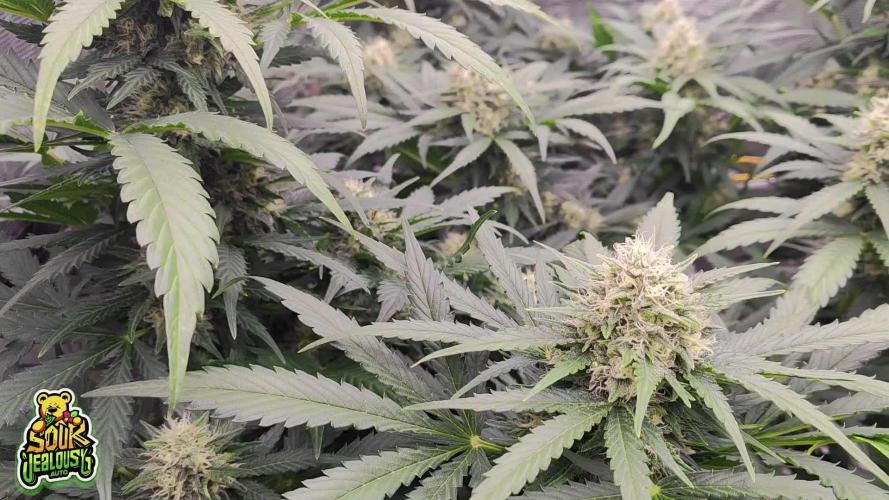
Howdy, here's a brief Week 9 update:
It's become autumn in the tent! Temps are dropping, plants are showing signs of senescence one by one (although some reluctantly so, am I right SJ?).
Headbanger, as expected, is finishing up first. Leaves are crisping up, colors are showing a slow, clean fade. I was pretty sure I burned her a little juding by the green tips, but Mephisto previously described this on the profile page, so maybe a little bit of both?
Mango, finally cut out of the scrog net and turned 180°, got light-burned AGAIN and I am since giving her as many stable days as possible to get off the stress-edge, to retain those remaining beautiful terps. She is finishing faster due to a troubled history, but I am very proud to have her (alive at this point) and already learned a LOT about sativas.
SJ is still watching the show from the corner, has settled building her rainforest canopy, and is just slowly bulking every day. Most content plant (well, as indica representation more resilient anyway), is hesitantly absorbing some Nitrogen from her fluffy, roughy, textured canopy. She'll let me know when things go south.
Not gonna lie, OSMH, after some reasearch into her "natural" soil conditions, already caused me to try and wrap my hot dehumidifier exhaust around the pots, in order to avoid scary root temp collapses during nights towards 15°C. I am giving the plants warm-ish waterings to raise soil temps slightly, but watching her suffer more is driving me a little nuts. She definitely managed to take a scratch at the little pride I still had remaining 😂
I clipped some videos from my personal vid log, enjoy. I think I have a LOT of larf incoming 😓. Don't be greedy.

Processing
Likes
7
Share


@Yukagrls
Follow
It seems like she needed to be closer to the light so I moved her a closer. She is growing very tall and fast. I water her once every two days or when I see the soil is dry. :)
Likes
21
Share


@Excalibur
Follow
02 October 2018 -
Day 99
3rd day of flush and we see her begin to grow nicely.
Day 100 -
Happy lady as she gets densier and begins to really smell.
Day 101 -
She is maturing lovely.
Day 102 -
Orange pistols curl. She is on her way.
Day 103 -
Mature and ready. has thickened up significantly.
Day 104 -
Water topped up and pH balanced 5.4
Day 105 -
Trimmed after the video.

Likes
18
Share


@Ultraviolet
Follow
Green light is radiation with wavelengths between 520 and 560 nm and it affects photosynthesis, plant height, and flowering. Plants reflect green light and this is why they appear green to our eyes. As a result, some growers think that plants don’t use green wavelengths, but they actually do!
In fact, only around 5 – 10% of green light is reflected from leaves and the rest (90 – 95 %) is absorbed or transmitted to lower leaves [1].
Green wavelengths get used in photosynthesis. Chlorophyll pigments absorb small amounts of green wavelengths. Light that doesn’t get absorbed is transmitted to leaves that are shaded out from direct light. This means that leaves at the bottom of the canopy get more green light than leaves at the top. A high proportion of green wavelengths compared to other colors tells lower leaves that they are being shaded out, so they are able to react accordingly. Lower leaves may react by opening or closing their stomata or growing longer stems that help the leaves reach brighter light [1, 2, 3].
When it comes to growing cannabis, many cultivators are interested in the quality of light used for the flowering stage. In many plants, flowering is regulated by two main photoreceptors: cryptochrome and phytochrome. Both photoreceptors primarily respond to blue light but can also respond to green, although to a lesser extent. Green can accelerate the start of flowering in several species (although cannabis has yet to be tested) [1, 4, 5]. However, once flowering has begun, it’s important to provide plants with a “full spectrum” light that has high amounts of blue and red light, and moderate amounts of green, in order for photosynthesis to be optimized.
Green light mediates seed germination in some species. Seeds use green wavelengths to decide whether the environment is good for germination. Shade environments are enriched in green relative to red and blue light, so a plant can tell if it is shady or sunny. A seed that senses a shaded environment may stay dormant to avoid poor growing conditions [1]. Some examples of plant species where researchers have documented this response are: ryegrass (a grass that grows in tufts) and Chondrilla (a plant related to dandelion) [1, 6].
Although green wavelengths generally tell plants NOT to germinate, there are some exceptions! Surprisingly, green wavelengths can stimulate seed germination in some species like Aeschynomene, Tephrosia, Solidago, Cyrtopodium, and Atriplex [1, 6, 7].
Of course, light is not the only factor affecting seed germination – it’s a combination of many factors, such as soil moisture, soil type, temperature, photoperiod, and light quality.
When combined with red and blue light, green can really enhance plant growth [1, 8]. However, too much green light (more than 50% of the total light) can actually reduce plant growth [8]. Based on the most current research, the ideal ratio of green, red, and blue light is thought to be around 1:2:1 for green:blue:red [9]. When choosing a horticultural light, choose one that has high amounts of blue and red light and moderate amounts of green and other colors of light.
Not many studies can be found about the effect of green light on cannabis growth or metabolism. However, if one reads carefully, there are clues and data available even from the very early papers.
Mahlberg and Hemphill (1983) used colored filters in their study to alter the sunlight spectrum and study green light among others. They concluded that the green filter, which makes the environment green by cutting other wavelengths out, reduced the THC concentration significantly compared to the daylight control treatment. It has been demonstrated that green color can reduce secondary metabolite activity with other species as well. For example, the addition of green to a light spectrum decreases anthocyanin concentration in lettuce (Zhang and Folta 2012).
If green light only reverses the biosynthesis of some secondary metabolites, then why put green light into a growth spectrum at all? Well, there are a couple of good reasons. One is that green penetrates leaf layers effectively. Conversely red and blue light is almost completely absorbed by the first leaf layer.
Green travels through the first, second, and even third layers effectively (Figure 2). Lower leaf layers can utilize green light in photosynthesis and therefore produce yields as well.
Even though a green light-specific photoreceptor has not yet been found, it is known that green light has effects independent from the cryptochrome but then again, also cryptochrome-dependent ones, just like blue light. It is known that green light in low light intensity conditions can enhance far red stimulating secondary metabolite production in microgreens and then again, counteracts the production of these compounds in high-intensity light conditions (Kim et al. 2004). In many cases, green light promoted physiological changes in plants that are opposite to the actions of blue light. In the study by Kim et al. blue light-induced anthocyanin accumulation was inhibited by green light. In another study it has been found that blue light promotes stomatal opening whereas green light promotes stomatal closure (Frechilla et al. 2000). Blue light inhibits the early stem elongation in the seedling stage whereas green light promotes it (Folta 2004). Also, blue light results in flowering induction, and green light inhibits it (Banerjee et al., 2007). As you can see, green light works very closely with blue light, and therefore not only the amount of these two wavelengths separately is important but also the ratio (Blue: Green) between these two in the designed spectrum. Furthermore, green light has been found to affect the elongation of petioles and upward leaf reorientation with the model plant Arabidopsis thaliana both of which are a sign of shade avoidance symptoms (Zhang et al. 2011) and also gene expression in the same plant (Dhingra et al. 2006).
As mentioned before, green light produces shade avoidance symptoms which are quite intuitive if you consider the natural conditions where the plants grow. Not all the green light is reflected from the highest canopy leaves in nature but a lot of it (50-90%) has been estimated to penetrate the upper leaves at the plant level ((Terashima et al., 2009; Nishio, 2000). For the plant growing in the understory of the forest green light is a signal for the plant of being in the shade of a bigger plant. Then again, the plants growing under unobstructed sunlight can take advantage of the green photons that can more easily penetrate the upper leaves than the red and blue photons. From the photosynthetic pigments in higher plants, chlorophyll is crucial for plant growth. Dissolved chlorophyll and absorb maximally in the red (λ600–700 nm) and blue (λ400–500 nm) regions of the spectrum and not as easily in the green (λ500–600 nm) regions. Up to 80% of all green light is thought to be transmitted through the chloroplast (Terashima et al., 2009) and this allows more green photons to pass deeper into the leaf mesophyll layer than red and blue photons. When the green light is scattered in the vertical leaf profile its journey is lengthened and therefore photons have a higher chance of hitting and being absorbed by chloroplasts on their passage through the leaf to the lower leaves of the plant.
Photons of PPFD (photosynthetic photon flux density) are captured by chlorophyll causing an excitation of an electron to enter a higher energy state in which the energy is immediately passed on to the neighboring chlorophyll molecule by resonance transfer or released to the electron transport chain (PSII and PSI). Despite the low extinction coefficient of chlorophyll in the green 500–600 nm region it needs to be noted that the absorbance can be significant if the pigment (chlorophyll) concentration in the leaf is high enough.
The research available clearly shows that plants use green wavelengths to promote higher biomass and yield (photosynthetic activity), and that it is a crucial signal for long-term developmental and short-term dynamic acclimation (Blue:Green ratio) to the environment. It should not be dismissed but studied more because it brings more opportunities to control plant gene expression and physiology in plant production.
REFERENCES
Banerjee R., Schleicher E., Meier S. Viana R. M., Pokorny R., Ahmad M., Bittl R., Batschauer. 2007. The signaling state of Arabidopsis cryptochrome 2 contains flavin semiquinone. The Journal of Biological Chemistry 282, 14916–14922.
Dhingra, A., Bies, D. H., Lehner, K. R., and Folta, K. M. 2006. Green light adjusts the plastic transcriptome during early photomorphogenic development. Plant Physiol. 142, 1256-1266.
Folta, K. M. 2004. Green light stimulates early stem elongation, antagonizing light-mediated growth inhibition. Plant Physiol. 135, 1407-1416.
Frechilla, S., Talbott, L. D., Bogomolmi, R. A., and Zeiger, E. 2000. Reversal of blue light -stimulated stomatal opening by green light. Plant Cell Physiol. 41, 171-176.
Kim, H.H., Goins, G. D., Wheeler, R. M., and Sager, J. C. 2004.Green-light supplementation for enhanced lettuce growth under red- and blue-light emitting diodes. HortScience 39, 1617-1622.
Nishio, J.N. 2000. Why are higher plants green? Evolution of the higher plant photosynthetic pigment complement. Plant Cell and Environment 23, 539–548.
Terashima I., Fujita T., Inoue T., Chow W.S., Oguchi R. 2009. Green light drives leaf photosynthesis more efficiently than red light in strong white light: revisiting the enigmatic question of why leaves are green. Plant & Cell Physiology 50, 684–697.
Zhang, T., Maruhnich, S. A., and Folta, K. M. 2011. Green light induces shade avoidance symptoms. Plant Physiol. 157, 1528-156.
Wang, Y. & Folta, K. M. Contributions of green light to plant growth and development. Am. J. Bot. 100, 70–78 (2013).
Zhang, T. & Folta, K. M. Green light signaling and adaptive response. Plant Signal. Behav. 7, 75–78 (2012).
Johkan, M. et al. Blue light-emitting diode light irradiation of seedlings improves seedling quality and growth after transplanting in red leaf lettuce. HortScience 45, 1809–1814 (2010).
Kasajima, S., et al. Effect of Light Quality on Developmental Rate of Wheat under Continuous Light at a Constant Temperature. Plant Prod. Sci. 10, 286–291 (2007).
Banerjee, R. et al. The signaling state of Arabidopsis cryptochrome 2 contains flavin semiquinone. J. Biol. Chem. 282, 14916–14922 (2007).
Goggin, D. E. & Steadman, K. J. Blue and green are frequently seen: responses of seeds to short- and mid-wavelength light. Seed Sci. Res. 22, 27–35 (2012).
Mandák, B. & Pyšek, P. The effects of light quality, nitrate concentration and presence of bracteoles on germination of different fruit types in the heterocarpous Atriplex sagittata. J. Ecol. 89, 149–158 (2001).
Darko, E. et al. Photosynthesis under artificial light: the shift in primary and secondary metabolism. Philos. Trans. R. Soc. B Biol. Sci. 369 (2014).
Lu, N. et al. Effects of Supplemental Lighting with Light-Emitting Diodes (LEDs) on Tomato Yield and Quality of Single-Truss Tomato Plants Grown at High Planting Density. Environ. Control Biol. 50, 63–74 (2012).

Likes
11
Share


@THe_Cannadaddy
Follow
This is my 2nd ever grow, went from seed / soil to coco / clones LOL
(If I can organize my first grow pictures I will upload that at some point. It was definitely a learning experience and I dealt with mites and a hermie but managed to beat the odds and came out with some amazing bud - all from bag seed.)
*** Clones purchased and replanted same night Feb 28, 2021 @cloneguyindustries ****
- HEPA FPR 10 filter installed in the only air inlet at the bottom
- Using AC Infinity Cloudline T4 - 4" exhaust with digital controller (thermometer / hygrometer) and carbon filter
- 1 bluetooth thermometer / hygrometer
- 1 8 inch fan above lights running 24/7
- 1 dehumidifier running 24/7
- 2 cameras - one monitoring inside the tent and one the AC Infinity controller outside the tent so I can check them on my phone wherever I am
- I am not measuring / monitoring my EC, PPM or VPD levels
- 3 gallon felt pots - NO TRANSPLANT GROW 🤷♂️
Likes
46
Share


@Merrymoosefamilyfarms
Follow
Hey hey everybody! I hope you all had a fantastic week and I am excited to be back for our latest update which marks the end of week 15 and the beginning of week 16!
Now I don’t know if it’s just me or the beginning of the year can be explained off as Mercury being in retrograde (I’m not saying it is, that’s more my wife’s deal- I wouldn’t know either way) but things have been absolutely nuts over here and I needed a little something good to help level out the crazy…
I have some awesome things in the mail (still rolling in from the spending spree I went on) but truth be told we were between deliveries, and I needed instant gratification- soo I may have accidentally brushed up against the timer and flipped to flower ( and by accidentally brushed up against, of course I mean I fully intentionally programmed the time to flip to flower in a moment of weakness…🤷♂️🏻)
Am I sorry? No… will it slightly kill me from an aspect of my struggle with occasional OCD? Oh yes…. Ohhhh yesssss…. That little corner is/was driving me nuts but I figured it was time to just let it do it’s thing- honestly once I noticed I picked a pot that was too small for what I was trying to do, I should have just there in the towel, flipped and taken it as a learning lesson for next time…. Buuuuut alas, I am stubborn and that is NOT how that went down… I’m still excited for what’s to come, we should have some (hopefully) pretty impressive things developing soon so I am stoked!
That being said however, I have also had some unimpressive things happen, for instance- yesterday, I go in to feed the girls and my light is off! I (obviously) must have screwed something up when I went to change the light schedule- specifically, due to the fact that there are 9 or 10 possible lighting schedules you can set, I think I had correctly set the on/off times BUUUUUT I think after I had switched to the next programmed on/off times which were incorrect-
I noticed when I saw that the lights were off, they should have been on for another three hours (give or take) - so I immediately started messing with the timer and turned the lights back on and continued to tend to those lovely ladies. I then went and made dinner- after, I just had this feeling that I should check on the tent, just in case- and sure enough, an hour after the lights were supposed to be turned off, there they were, on like grey poupon (I apologize I haven’t heard that in like a decade or more, had to
Likes
16
Share


@Gewaltmann
Follow
Ja es geht hier noch schneller als bei der Runtz. Das färben der Pistillhärchen ist so schnell fortgeschritten inklusive der reife der Trichome, ebenfalls, diesen Freitag ist es soweit. Denn demnächst sind die Temperaturen noch super zum trocknen, bevor die nächste Hitzewelle anrollt. Inklusive das wir hier auf dem Peak ernten können.
Wenn ihr mehr über die Sundae und ihr Terpen Profile wissen wollt, schaut gerne hier rein und ihr bekommt einen deep dive:
https://youtu.be/AiAm4sy586U?si=Y8rqYcJVnqks_hGQ
Und, schaut bei meinem Growmie mit rein - Bei dem ist immer Eskalation angesagt:
https://growdiaries.com/grower/stimpson
Likes
37
Share


@JohnnyBlaz3
Follow
😍😍😋 still got 3-4 weeks to go is my guess and the serious plumping should begin right about now. starting to get that caked look with trichs. the smell is amazing as well! time to start taking those glamour pics hahah show off the ladies and make them feel special. Might not be obvious to everyone so i'll mention its best to run the 12 hours on at night so the room temp is lower around the tent. It does get a couple degrees hotter in the tent in the summer with the same set up.