


Likes
Comments
Share

@Grow_bob
Follow
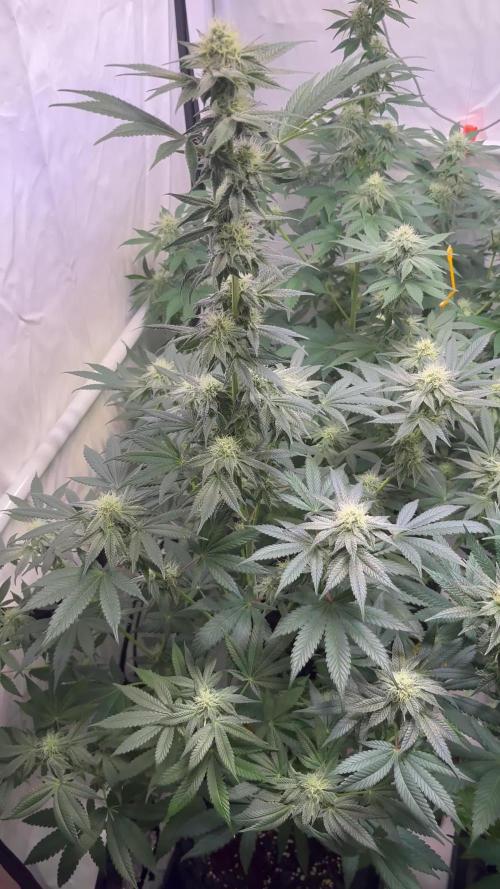
Habe die letzten Tage mal bissel entlaubt paar Fächerblätter und kleinzeug so das auch mehr Licht ankommt 🏽


Likes
169
Share


@SlowpokeFuegobud
Follow
🍊 🐶 💜 🍊 🐶 💜 🍊 🐶 💜 🍊 🐶 💜🍊 🐶 💜 🍊 🐶 💜 🍊 🐶 💜 🍊 🐶 💜
Welcome to week 7, my fellow growmies!! 💚 💚 💚
I have nothing much to say, just that I'm in love! ❤️
DAY 45
Watered with 2ml bloom + more pk + 4 ml humics+ growzyme + 2ml calmag 💧
DAY 48
Watered with 3ml more roots + 4 ml humics + growzymes + 2ml calmag + epsom 💧
Thanks for stopping by, it's a true pleasure to have you as visitors!! 💚 💚 💚 😘
💜 🐘
______________________________________________________________
About Sour Tangie Dawg cannabis seeds
Sour Tangie Dawg is a sativa dominant cross between the famous Tangie and Chemdawg. Expect a combination of sweet & fruity mixed with a gassy, jet-fuel flavour. The amazing mix of citrus, tangerine, pine and gasoline produces uniquely rich, dank buds. The powerful sativa high is strong, uplifting and long lasting, great for creativity and socialising.
Chemdawg is the parent of OG Kush, all Diesel strain originate from Chemdawg. The Tangie is originally a Skunk hybrid strain but extremely fruity with the trademark Tangerine flavour. This strain is potent with THC-levels over 20% alongside very generous yields of top quality weed, very suited for hash and rosin producers. If you’re looking for a strain to produce the best tasting concentrates this Sour Tangie Dawg is a proven winner! She easy to grow and the perfect choice for SCROG growing due to her growth speed and stretch. We advise switching to 12/12 light when 75% of the net is filled. For outdoor growers the harvest period is early October. Indoors she’s finished after 9 weeks of flower - fast for a sativa dominant strain. We recommend growing in soil with organic nutrients for the best tasting weed.
Get some fantastic genetics here: https://supersativaseedclub.com/ 💜 🐘
___________________________________________________________________________
SETUP:
80x80x180 cm Zelsius
240W Full Spectrum LED IR UV dimmable
DW240H-A6-HS
Heatsink color red
LED Chips:
512pcs SAMSUNG LM301H + 24pcs Osram 660nm + 8pcs Osram IR 730nm + 8pcs UV 385nm
Color mix: 2700K + 4000K
2,8umol/J
Driver HLG-240H-C2100B
Coverage: veg 5x3ft / flower 4x2ft
Product size: 628x205x68mm
Green Buzz Nutrients
Shouts go out to my sponsors @GreenBuzzNutrients, thanks so much for your support! ❤️
If anyone would like to try their amazing organic products, use code GD42025 for generous 25% discount (for orders of minimum 75€) ✨
https://greenbuzznutrients.com/
Biobizz Lightmix
custom exhaust fan 320/270cm³/h
Carbon Active Granulate 240cm³/h
tab water pH 8 - EC 0,25 with Calmag to 0,5
Advanced Hydroponics pH minus Grow + Bloom to pH 6.2
🍊 🐶 💜 🍊 🐶 💜 🍊 🐶 💜 🍊 🐶 💜🍊 🐶 💜 🍊 🐶 💜 🍊 🐶 💜 🍊 🐶 💜

Likes
Comments
Share


@RatmanJR
Follow
June 21st update. 28 days since flip.
Plant is growing phenomenal. Was able to crank the lights up to 80% for the first time in this grow without her throwing a fit.
All of the banana peels I’ve fed her the last few weeks have disappeared and have been feeding my soil mites and my worms. I have not had any bad pests since I started using these predator mites I love it.
I can’t even begin to describe the smell of this thing. It’s like a raspberry tart mixed with just a little hint of gas. I’m so excited to give this a try when the time comes
Noticing Trichomes going all the way down some of the fan leaves so that is always cool to see.
Also I noticed this is common with living soil but I’m done bothering trying to defoliate. I will do one more in two weeks at day 42. But anything I remove at this point is just going to come right back.
As always nothing but water. Will give her some tea tmmr like every Sunday with some big 6, worm castings, molasses, and some cow cal 24.
Likes
10
Share


@Colectivegrow
Follow
Hoy es el día 1 (día 35 desde la germinación) de floración de nuestras 3 plantas de Tropicanna Poison XL AUTO. Las plantas han sido sometidas a un entrenamiento LTS con piezas 3D para ver cómo funciona este tipo de entrenamiento.
Los 3 fenotipos se diferencian claramente a simple vista, dada la diferencia de portes de cada una. La primera planta es la más alta y tiene un porte muy abierto. La segunda planta es más baja y tiene un porte más compacto. La tercera planta es de tamaño intermedio y tiene un porte intermedio.
Esperamos que este entrenamiento ayude a las plantas a desarrollar su máximo potencial. Seguiremos publicando actualizaciones sobre su evolución.

Likes
Comments
Share


@gr3g4l
Follow
A los 16 dias, pasados 7 de la última poda volví a quitar algunas pocas y así no hacer sombra sobre los botones, inicio de cogollo
la herramienta más útil del cultivo en estos momentos , sin duda la regadera lanza xd.
Dia 17 obté por el supercropping del apical de la nº5 visto que había estirado mucho, en general esa planta está creciendo mejor. La nº5 la que en un principio descartaba y luego decidí cambiarla por la nº2 . véase en las semanas 4 y 7

Likes
7
Share


@Organic473
Follow
I’ve been experimenting with solar powered lights for an extended vegetative period…so far she looks extremely healthy…I Defoliated the lower branches and moulded her also.

Likes
6
Share


Likes
4
Share


Likes
121
Share


@Tropicannibis_Todd
Follow
Well growmies ive been looking forward to the FastBud Tester 2307 , the more she went into flower the more the frost would build up , and that's when the terps came out 👉 Sweet , fruity 👈 Buds are tight and full of frost 👈 Couldn't of asked for better Genetics 😉
The smell coming from this girl during the entire grow was just dreamy 👈. Of course I have no clue to what she is but I like it...... Maybe FASTBUDS attempt at a Watermelon 🍉 Strain????
Amazing Job FASTBUDS 👏 I would definitely recommend once they release this one 👍
👉 Big thanks to all my Growmies out there in GD land 👈 Much appreciated 🙏
Thanks To MarsHydro for the TS1000
👉I used NutriNPK for nutrients for my grows and welcome anyone to give them a try .👈
👉 www.nutrinpk.com 👈
NutriNPK Cal MAG 14-0-14👉 All Weeks
NutriNPK Grow 28-14-14👉 Weeks 2 & 3
NutriNPK Bloom 8-20-30👉 Weeks 4 to 8
NutriNPK Bloom Booster 0-52-34👉 Weeks 4 & 9 👌👌

Likes
10
Share


@DarbGrowDiaries
Follow
Very golden in colour, has a beautiful structure and a spicy smell.
I really liked how even the bottom buds became chunky (:
Def happy I tried this one
Likes
84
Share


@Doc_Homegrow
Follow
I removed all of the LST strings, to let her grow more freely in her last week. She looks amazing and i am very happy with my first grow. I will harvest her next week or the end of the week. I won't do flushing, because I only use organic fertilizer and want her to grow till her last day.
Some crazy Things are happening right now. She ist growing new buds on her buds! I decided to give her another extra week, just to see how this experiment will turn out.

Likes
11
Share


@CanarianGrow92
Follow
Week 2 for our banana purple punch from the fastbuds family
All looks good and the buds are forming real quick, we continue for now with master root and master bloom, next week we start to add some more addictives
Some plants had a little to much nutrients but we corrected the dosis and continue with a little less bloom nutrients! For the rest all good!!
Likes
14
Share


@ConspiracyFly
Follow
Gorilla Glue Auto day 69 - 4.3.2023
This week it stopped growing and is getting fatter, the smell is more active when I open the tent, it took more water than last week and I added PK 13/14
I also removed some leaves for better light penetration but I didn't undress it because it's cold :)
0,2 Bio-Grow
0,4 Top Max
0,4 Bio-Bloom
0,8 Calmag
2,0 PK 13 /14 Plagron
1.5 gr Pandora Powder MYCOTERRA
Gorilla Glue Photo
I made LST
Regards and see you next week


Likes
11
Share

@cangrowz
Follow
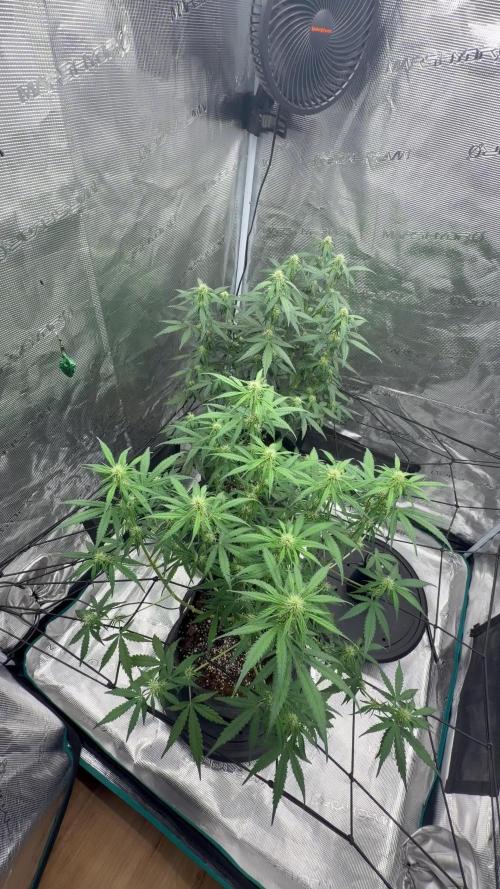
Ende Woche 4 / Anfang Woche 5 – Grow Diary Mimosa x 🍊👊🏻 Barney’s Farm
Die beiden haben nochmal ordentlich Stretch hingelegt 💪 Seit die Runtz raus ist (Ernte lief sauber durch), wirkt das Zelt jetzt etwas leer – aber gibt den Mimosas schön Platz, sich voll zu entfalten.
Die ersten Blütenstempel kommen jetzt richtig stabil durch, genau so will man das sehen 🔥 Wenn das so weitergeht, werden das am Ende richtig schöne Ladies.
Klima bleibt weiterhin im sweet spot – weder zu feucht noch zu trocken, Temperatur passt auch konstant. Genau so hält man sie happy in der Phase.
Bis jetzt wieder mal sehr zufrieden mit dem Run und der Genetik von Barney’s 👌
Happy Growing Growmies 🌱?💚
Likes
13
Share


@CaptainPrynce
Follow
Last week of flush.
It was 9 weeks of flower and now it's the most antecipated time for me, HARVEST!! :D
Will hang them now for 10-15 days at 50% RH and 23ºC
Likes
200
Share


@Ferenc
Follow
Day 72, 21st of November 2020:
Hi! Wao this is what I can say and luckily stoppe streching....
All LST has been removed as the plants remain the same so no need to keep them in "chains".
Those Original Sensible girls 3 of them (Gelato, Runtz Gum, Do-Si-Dos OG)went crazy, except Black Ghost OG she did not strech much typical little indica lady. And the THC crystals alrady on the leaves on the Runtz Gum and Do-Si-Dos OG just simply beautiful.
Buds are coming getting thick they are gorgeous only I can see some some sort of deficiency on Do-Si-Dos OG a bit on some leaves.
The fertilization schedula isnthe same every 2nd day and happens with the mix and ratio above.
Wedding Gelato is beautiful also I hope the nice purple colour will come out as well in late flowering stage. :)
The lamp is on 11.30 min and off 12.30 min.
Last week was 15 min longer light cycle....
So every week 15 min shorter light cycle until the 5th week. So far -30 min. It switches on at 6 am and off at 17.30 pm.
Likes
4
Share

@MrGreenToe
Follow
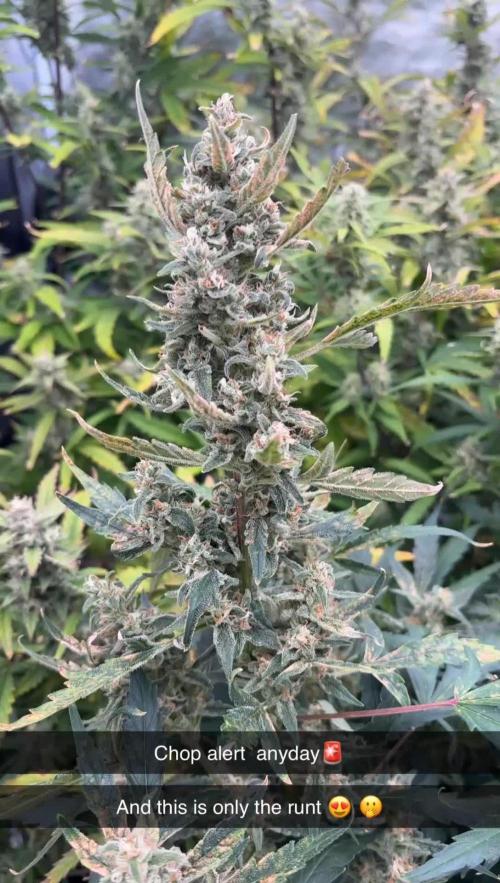
This next week one of my plants really got its first trichome coating. This plant also recieved a small addition of gaia greens bloom amendment. The rest remained slighly behind. After I examined the stems I found many interesting results from the first toxicity burn early in vegative. One of the plants stems grow as if it was FIM’ed with many more small branches shooting out. Seemed like a top site turned into 6 main branches. I removed that plant due to its height and lack of stem size from being an auto-flower. The second oldest looking plant began to juice up this week. The second oldest also was the only plant that received a proper topping and has many side branches as large as main colas of other plants.
Processing
Likes
7
Share


@NorthernFrostCannabis
Follow
Note: Little chem-burn this week. Feed just water for 4 days with correct PH and they jumped back. Was not that bad though.
Day 21 on flower!
Likes
32
Share


@JKent19
Follow
Great week! Buds are fattening up even better than I'd hoped. Some hairs are starting to turn red, and the buds are covered in a thick layer of trichomes! I have no choice but to harvest July 1st, so I'm keeping my fingers crossed that they will ripen enough by then. I will start my flush/harvest prep 10 days in advance, so in about 10 days. I am really looking forward to this one, can't wait for purple lemonade to be my daily smoke!
Likes
42
Share


@Ginger_gnome
Follow
So to start, I did a small leaf strip a few days ago. I like to do small leaf strips ones a week the last few weeks of flower. Now not big, Im Talking 15-20 leaves tops. Don't want to over stress the plant at this stage but also want to make sure the buds below are getting enough light.
The temperature has dropped a bit outside so the tent is running cooler then it was. Honest it got all week was 22.5c, but also only got up to 20c one night. Unfortunately this tent is right next to the door out of my grow space so all the cold air is coming through. Going to need to look at replacing the door with something that fits a bit better, or look at adding something to this door to help.
Next to that the plant is looking amazing so far. Looking forward to smoking this in the coming weeks.
Well happy growing everyone!!!!
