Processing
Likes
52
Share
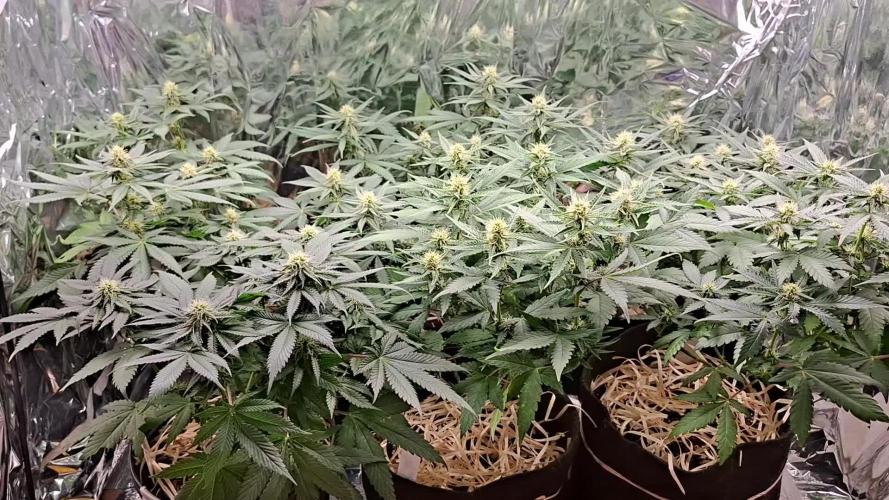
The week starts Monday Jan-27, being day 27 of flowering. Plants are looking very good and healthy, albeit some bigger buds at this stage is missing. Carried out more minor defoliation, only trimming fan leaves on one side of a bud site in alternate fashion. Strategy is to expose more bud sites to light. Leaves are getting sticky and glistening brightly. The canopy has a few branches stretching out typical of Sativa genetics. Hoping the bud sites grow bigger soon filling up the space. Feeding a high EC nutrient mix whilst monitoring run-off EC which remains below feed EC. Light is maintained at 30cm above the canopy, with daily fertigation at lights on - watering just under 3L per day. Maintaining an average RH in the space at 50%. ---- updates for prior 4 weeks -------------------------------------------------------------------------------------------------------------------------------------------------------------------------------------- ----------------------------------------------------------------------------------------------------------------------------------------------------------------------------------------------------------------------- The week starts Monday, Jan-20 still flowering away. Bud sites are beginning to take form and the ScrOG setup looks full, ready for the development of some large buds. Removed a few more leaves from above the canopy which were blocking bud sites below. Also cut small stems (with bud sites) below the canopy from both plants which were unlikely to grow strong. It's now looking clearer below the canopy. The canopy is still thick with beautiful luscious green leaves typical of an Indica. Run-off EC has been slowly rising over the weeks but still under the feed EC - will be keeping my eyes on this. Light is maintained at 30cm distance from canopy, with daily fertigation at lights on - watering almost 2.5L per day. Maintaining an average RH in the space at 50%. ----------------------------------------------------------------------------------------------------------------------------------------------------------------------------------------------------------------------- The week starts Monday, Jan-13 in flowering stage. The plant is growing thick and fast, with very short node intervals creating a thick canopy. Carried out substantial defoliation of almost all the big fan leaves and a few little stems that were not likely to make it above the canopy. Avoided defoliating the major cola branches. This encourages the plant not to waste resources on a node which is only going to produce “popcorn” buds. The plants reacted well to the defoliation and were looking good by the end of the light cycle for the day. The net is completely full and this will be the last week of applying any LST as part of the ScrOG setup. Light is maintained at 30cm distance from canopy, with daily fertigation at lights on - watering almost 2.5L per day. Lowered the average RH in the space to 50%. ----------------------------------------------------------------------------------------------------------------------------------------------------------------------------------------------------------------------- The week starts Monday, Jan-06 in flowering stage. The net is filling up nicely with the ScrOG process being enjoyable - just tucking branches nicely under squares once stretched enough. The Indica dominant strain is really shining with incredible dense growth and thick branches that don't bend as easily as it's Sativa neighbour. Light is maintained at 30cm distance from canopy. ----------------------------------------------------------------------------------------------------------------------------------------------------------------------------------------------------------------------- My grow setup includes; - Secret Jardin DS120W tent (120cm x 60cm x 180cm) placed inside the bedroom. Passive intake of air is from a closed off section of the room where the central heating boiler sits - the intake is warm air (20 degC.) and fairly dry (40% RH) during the winter months. - Mars Hydro SP250 LED light - extraction fan - AC Infinity Cloudline T6 - ventilation fans - aquarium heater - small oil heater - small dehumidifier - 20L Airpots and 3.5L general pots for seedling stage - Canna Coco substrate and nutrients - pH and EC/TDS meters - Thermo/Hygro meter
Likes
17
Share
@Bncgrower
Follow
Harvested last night, truly strong smell, cultivation was absolutely perfect from start to finish. Very happy with the result, anxious for the drying and curing process! Thank you for following along.. 🤜🤛🌱🌿🌲
Likes
4
Share
@Midge
Follow
Much better harvest to end this first greenhouse grow. 48g dry on this plant. Still quite airy, but resinous and great smell. More relaxed effect than harvest 1. I could have done with another week or two with her, but the humidity was regularly into the 90s, there was very little sun and nearby tomato plants were starting to grow mold. I cut and ran, I need these meds to get me through the winter. Final total for both plants 59g. With a bit of luck, this should keep me medicated for a while. Indications are good.
Likes
178
Share
This week has gone fine except for one thing which I’ll come to later on. Still stretching, canopy par level is 900 on average and I don’t have any way of getting the lights up further. Hoping the intense light will slow the stretch down a bit but we will have to wait and see. Worst case I’ll have to dim the lights down a bit. That leads me onto the mystery of this week. The nearly dead plant. I have no idea why it has gone so limp. You can kind of see on the photo lapse how quickly it collapses. Incase it’s some kind of disease I’ll give it another day in there. If it doesn’t recover I’ll have to pull her out and try to train the other plants over her empty spot so I don’t waste any light. EC is around 1.2-1.5 atm, the highest dose I’ll be giving them will be week 4 and 5 of flower when the buds seem to do the most weight gains (visually). Canopy is actually quite even if you overlook the hole in the canopy, maybe a couple inches between highest and lowest. Anyway, thanks for checking in guys, if anyone has any thoughts/comments about the dead plant let me know as I’m struggling to find answers online. 😊
Likes
21
Share
Inizio Terza settimana e tutto va bene,💪🔥 crescere forti belle mie.... Anche loro la prossima settimana entreranno in fioritura.... andiamo belle piantine mie crescete belle e buone
Likes
13
Share
@NSABND
Follow
Day57 hot summer day 😎👍🙏 Day58 cloudy and normal temp 😳😵 Day59 cloudy and cold temp 😵😵😕 Day60 the sun came back but late 😩😵 Day61 sun and warm weather 😁🙏👍 Day62 some sun and warm weather 😁 "Hilde2.0" gettin closer to finish 😏👍🙏 Day63 not too hot and sun close to finish 😎🙏👍
Likes
15
Share
@Siriuz
Follow
Yo guys whats up Check out my videos and lemme know Im trying my best to keep up MY girls are doing very good Im just too busy right now with my son He is 10 months old now and sometimes I have to leave behind the girls thank God I had built over the past months a great setup and I keep improving every time I have budget so it is very kind of you every like you give and every Comment is a blessings for us as a family you guys help us a lot to continue promoting and growing the best medicine in this world, thanks brothers happy growing and keep enjoying our diaries we will keep posting once we get the time and space for sure stay tuned Now this PPM 1000 lowering down to 800/600/400 Until we are done for the remaining weeks Also we stop adding nutes for like 2 weeks now or so We only add water every Day Like 300ml at least to keep them hydrated But for us is best to add one 1.5 liters then wait for them to drain and leave them like that for like 3-4 days until water in the bottom is full absorb this forces the roots to go and drink water which makes the plant grow bigger... I know THESE are autos but you would be impress depending on the genetics of what they're capable of The only thing that really f them up is time They dont go back just forward so yeah Got to be quick Anyways how you doing guys Happy growing thanks for everything
Processing
Likes
8
Share
This is my First Ever Grow, If you have ANY tips for me, please, don’t hesitate to leave me a comment.
Likes
17
Share
Dr greenthumbs bud and bloom doing its thing and i added some inorganic heavy pk fert as you can mix organic with synthetic so google says, so will be interesting to see the results
Likes
199
Share
WELL WELL WELL, FRIENDS! NO PROBLEM WITH THE GERMINATION OF THIS BABY .... I CAN'T WAIT TO OBSERVE HER RED GEMS !!! ---------------------- ------------------- For those interested in buying this fantastic light https://amzn.to/3ttb2j9
Processing
Likes
29
Share
@CANNASIM
Follow
—SETUP— .BOSSLED LED 1800W full spectrum, real power consumption is +-250W. .Grow space 60X100X200(a simple shower box. .AN nutes and other simple additives. .Grow medium is 60% peat, 30% perlite, 10% organic correction(worm castings), 5 gallon fabric pots(18l). —BRIEF— Hi there, I have tried already done this genetic outdoors, in poor lighting and a general purpose nute from Neudorff, yielded 25g dry, in 3gallon pots same medium. So this is a good experiment, lets see indoors how she will compare. —GERMINATION— My germination process always start by scarifying the seeds, i created a little tool for that. I just a little container with sandpaper walls. Shake gently for about 60 secs+, this allows for the water to penetrate better in the seed shell, once you soak. Then i soak overnight from 12 to 20 hours max. From there i either plant straight or use the paper towel method to see the tap root before. If you are a bit on the impatient side seen the tap root is advisable so you see some movement before planting. Lol! —ROYAL QUEEN SEEDS . QUICK ONE . INFO — Chose this strain because is basic and I have to travel for a month soon, and someone else is going to take care for this time. :) Quick One is a fast-growing autoflowering strain. This was one of the first autoflowering strains developed. When it was first released, it was one of the quickest growing strains on the planet. THC: 13% CBD: Low Yield Indoor : 275 - 325 gr/m2 Yield Outdoor: 100 - 150 gr/plant Height Indoor: 50 - 60 cm Height Outdoor: 60 - 100 cm Flowering: 5 - 6 Weeks Harvest month: 8-9 weeks after sprouting Genetic Background: Strong Indica x Ruderalis Type: Sa 10% In 60% Ru 30% Effect: Physical Climate: Mild —RQS QUICK ONE GERMINATION UPDATE— My mood said to me to plant straight, so scarify > soak 18 hours +- > plant straight. Seedlings look a bit odd, with a yellow center, let's give her some days in and see what happens next.
Likes
55
Share
What's in the soil? What's not in the soil would be an easier question to answer. 16-18 DLI @ the minute. +++ as she grows. Probably not recommended, but to get to where it needs to be, I need to start now. Vegetative @1400ppm 0.8–1.2 kPa 80–86°F (26.7–30°C) 65–75%, LST Day 10, Fim'd Day 11 CEC (Cation Exchange Capacity): This is a measure of a soil's ability to hold and exchange positively charged nutrients, like calcium, magnesium, and potassium. Soils with high CEC (more clay and organic matter) have more negative charges that attract and hold these essential nutrients, preventing them from leaching away. Biochar is highly efficient at increasing cation exchange capacity (CEC) compared to many other amendments. Biochar's high CEC potential stems from its negatively charged functional groups, and studies show it can increase CEC by over 90%. Amendments like compost also increase CEC but are often more prone to rapid biodegradation, which can make biochar's effect more long-lasting. biochar acts as a long-lasting Cation Exchange Capacity (CEC) enhancer because its porous, carbon-rich structure provides sites for nutrients to bind to, effectively improving nutrient retention in soil without relying on the short-term benefits of fresh organic matter like compost or manure. Biochar's stability means these benefits last much longer than those from traditional organic amendments, making it a sustainable way to improve soil fertility, water retention, and structure over time. Needs to be charged first, similar to Coco, or it will immobilize cations, but at a much higher ratio. a high cation exchange capacity (CEC) results in a high buffer protection, meaning the soil can better resist changes in pH and nutrient availability. This is because a high CEC soil has more negatively charged sites to hold onto essential positively charged nutrients, like calcium and magnesium, and to buffer against acid ions, such as hydrogen. EC (Electrical Conductivity): This measures the amount of soluble salts in the soil. High EC levels indicate a high concentration of dissolved salts and can be a sign of potential salinity issues that can harm plants. The stored cations associated with a medium's cation exchange capacity (CEC) do not directly contribute to a real-time electrical conductivity (EC) reading. A real-time EC measurement reflects only the concentration of free, dissolved salt ions in the water solution within the medium. 98% of a plants nutrients comes directly from the water solution. 2% come directly from soil particles. CEC is a mediums storage capacity for cations. These stored cations do not contribute to a mediums EC directly. Electrical Conductivity (EC) does not measure salt ions adsorbed (stored) onto a Cation Exchange Capacity (CEC) site, as EC measures the conductivity of ions in solution within a soil or water sample, not those held on soil particles. A medium releases stored cations to water by ion exchange, where a new, more desirable ion from the water solution temporarily displaces the stored cation from the medium's surface, a process also seen in plants absorbing nutrients via mass flow. For example, in water softeners, sodium ions are released from resin beads to bond with the medium's surface, displacing calcium and magnesium ions which then enter the water. This same principle applies when plants take up nutrients from the soil solution: the cations are released from the soil particles into the water in response to a concentration equilibrium, and then moved to the root surface via mass flow. An example of ion exchange within the context of Cation Exchange Capacity (CEC) is a soil particle with a negative charge attracting and holding positively charged nutrient ions, like potassium (K+) or calcium (Ca2+), and then exchanging them for other positive ions present in the soil solution. For instance, a negatively charged clay particle in soil can hold a K+ ion and later release it to a plant's roots when a different cation, such as calcium (Ca2+), is abundant and replaces the potassium. This process of holding and swapping positively charged ions is fundamental to soil fertility, as it provides plants with essential nutrients. Negative charges on soil particles: Soil particles, particularly clay and organic matter, have negatively charged surfaces due to their chemical structure. Attraction of cations: These negative charges attract and hold positively charged ions, or cations, such as: Potassium (K+) Calcium (Ca2+) Magnesium (Mg2+) Sodium (Na+) Ammonium (NH4+) Plant roots excrete hydrogen ions (H+) through the action of proton pumps embedded in the root cell membranes, which use ATP (energy) to actively transport H+ ions from inside the root cell into the surrounding soil. This process lowers the pH of the soil, which helps to make certain mineral nutrients, such as iron, more available for uptake by the plant. Mechanism of H+ Excretion Proton Pumps: Root cells contain specialized proteins called proton pumps (H+-ATPases) in their cell membranes. Active Transport: These proton pumps use energy from ATP to actively move H+ ions from the cytoplasm of the root cell into the soil, against their concentration gradient. Role in pH Regulation: This active excretion of H+ is a major way plants regulate their internal cytoplasmic pH. Nutrient Availability: The resulting decrease in soil pH makes certain essential mineral nutrients, like iron, more soluble and available for the root cells to absorb. Ion Exchange: The H+ ions also displace positively charged mineral cations from the soil particles, making them available for uptake. Iron Uptake: In response to iron deficiency stress, plants enhance H+ excretion and reductant release to lower the pH and convert Fe3+ to the more available form Fe2+. The altered pH can influence the activity and composition of beneficial microbes in the soil. The H+ gradient created by the proton pumps can also be used for other vital cell functions, such as ATP synthesis and the transport of other solutes. The hydrogen ions (H+) excreted during photosynthesis come from the splitting of water molecules. This splitting, called photolysis, occurs in Photosystem II to replace the electrons used in the light-dependent reactions. The released hydrogen ions are then pumped into the thylakoid lumen, creating a proton gradient that drives ATP synthesis. Plants release hydrogen ions (H+) from their roots into the soil, a process that occurs in conjunction with nutrient uptake and photosynthesis. These H+ ions compete with mineral cations for the negatively charged sites on soil particles, a phenomenon known as cation exchange. By displacing beneficial mineral cations, the excreted H+ ions make these nutrients available for the plant to absorb, which can also lower the soil pH and indirectly affect its Cation Exchange Capacity (CEC) by altering the pool of exchangeable cations in the soil solution. Plants use proton (H+) exudation, driven by the H+-ATPase enzyme, to release H+ ions into the soil, creating a more acidic rhizosphere, which enhances nutrient availability and influences nutrient cycling processes. This acidification mobilizes insoluble nutrients like iron (Fe) by breaking them down, while also facilitating the activity of beneficial microbes involved in the nutrient cycle. Therefore, H+ exudation is a critical plant strategy for nutrient acquisition and management, allowing plants to improve their access to essential elements from the soil. A lack of water splitting during photosynthesis can affect iron uptake because the resulting energy imbalance disrupts the plant's ability to produce ATP and NADPH, which are crucial for overall photosynthetic energy conversion and can trigger a deficiency in iron homeostasis pathways. While photosynthesis uses hydrogen ions produced from water splitting for the Calvin cycle, not to create a hydrogen gas deficiency, the overall process is sensitive to nutrient availability, and iron is essential for chloroplast function. In photosynthesis, water is split to provide electrons to replace those lost in Photosystem II, which is triggered by light absorption. These electrons then travel along a transport chain to generate ATP (energy currency) and NADPH (reducing power). Carbon Fixation: The generated ATP and NADPH are then used to convert carbon dioxide into carbohydrates in the Calvin cycle. Impaired water splitting (via water in or out) breaks the chain reaction of photosynthesis. This leads to an imbalance in ATP and NADPH levels, which disrupts the Calvin cycle and overall energy production in the plant. Plants require a sufficient supply of essential mineral elements like iron for photosynthesis. Iron is vital for chlorophyll formation and plays a crucial role in electron transport within the chloroplasts. The complex relationship between nutrient status and photosynthesis is evident when iron deficiency can be reverted by depleting other micronutrients like manganese. This highlights how nutrient homeostasis influences photosynthetic function. A lack of adequate energy and reducing power from photosynthesis, which is directly linked to water splitting, can trigger complex adaptive responses in the plant's iron uptake and distribution systems. Plants possess receptors called transceptors that can directly detect specific nutrient concentrations in the soil or within the plant's tissues. These receptors trigger signaling pathways, sometimes involving calcium influx or changes in protein complex activity, that then influence nutrient uptake by the roots. Plants use this information to make long-term adjustments, such as Increasing root biomass to explore more soil for nutrients. Modifying metabolic pathways to make better use of available resources. Adjusting the rate of nutrient transport into the roots. That's why I keep a high EC. Abundance resonates Abundance.
Likes
134
Share
@Wastent91
Follow
Ehy ragazzi qua tutto bene spero anche a voi lo stesso, le piante di anesia sono magnifiche! Profumi di agrumi della Red pudding e dei buds duri come la roccia! Ho dovuto provvedere a legare tutti i rami con del fil di ferro per sostenere il peso crescente delle cime, purtroppo si vede che all inizio del ciclo non avevo ventilatori etc per poter addestrare i rami in modo che diventassero più solidi e stabili, ora in vece il peso volume di queste cime mi sta piegando l intera pianta! Davvero delle genetiche eccezionali! Con dei profumi davvero complessi da descrivere e non vedo l ora che continuino a maturare per poi avere un finale "di erba perfetta definitiva"! Che purtroppo ancora nn ho mai trovato in circolazione una genetica degna di questo nome... Saranno forse queste di anesia?? Staremo a vedere! Buon 420 a tutti e buon anno nuovo! 😸💪😺🔥💨😎🌱🌿🌲🧑‍🌾💗
Likes
3
Share
@Ninjabuds
Follow
The plant is definitely a large plant with a lot of potential to make big long buds it has some of type leaves. I hope the bud fatten up a little though the plant has a strong gas and nutty cream smell it’s really nice it over powers all the other plants on the smell factor
Likes
19
Share
Let’s go day 72 from seed!!! Another great week it’s been , 2 Ogreberrys an brucy b been flushing for a week, an the 3 others will continue to get there normal feed of nutrients, they are just not quite ready so they will start getting flushed around next week!! Sweet sweet smell of Grapes And gooey frosty nugs is all I can really say, photos do no justice, some of the craziest fruitiest smelling buds I’ve ever had, Real High quality meds !! Hope you all enjoy an have an amazing productive day as well as a great week!! Peace love an positive vibes to all y’all Cheers 😶‍🌫️💨💨💨💨💨🤙🏻If there’s any questions, please ask!! 💚🙏🏻💯
Likes
6
Share
@Scandic
Follow
Smell is getting stronger and buds are developing. Only Bloom nutes from now on until flushing. Crystals are beginning to show the Nature of this strain. Im expecting frosty buds!
Likes
4
Share
@Ibgrowing
Follow
This is the last post with mid quality pictures and video since I will be going home soon 😀. It is a bit rainy back home so she has to be under a roof or inside a lot of the time. The nutes will be upped to 4ml/l for both the grow and the bloom nutes.