Check the winners The Grow Awards 2026 🏆
Processing
Likes
Comments
Share
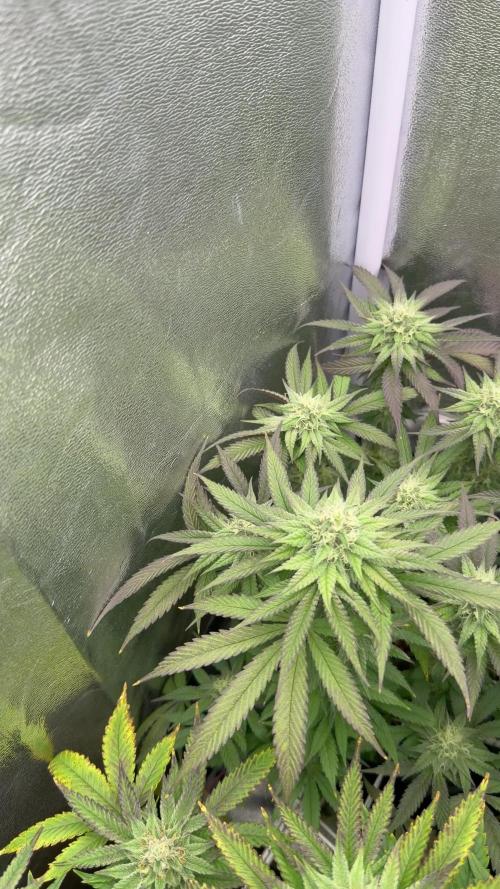
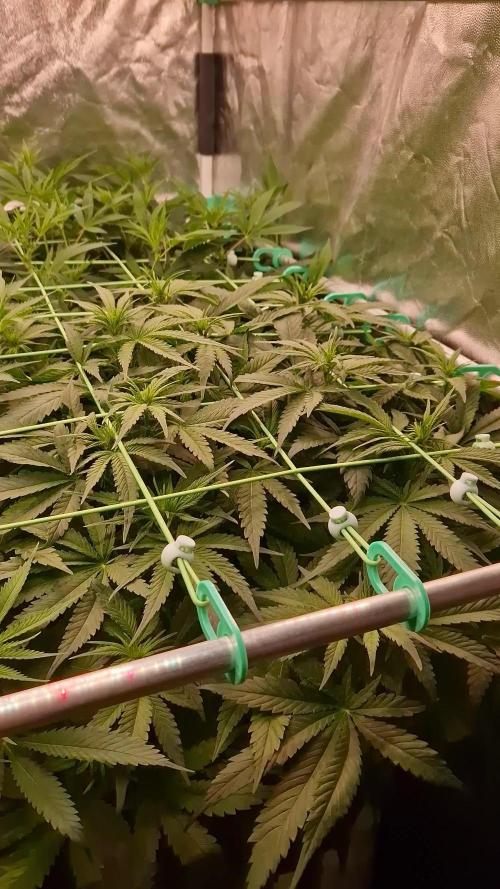
Start of Week 10 and DAMN She Grows Tall. I don't have Room in My Taller Tent so I had to try LST'ing Her. She seems to be Responding Fine but Boy does this Girl get Tall. She was over 2ft n still Growing even after the Manifold. Node Spacing is pretty Tight though so Bud Sites all over. I've tried Counting Sites n always Lose Count around 50. Still no Budding though. If She Produces Dense Buds She should be a Good Yielder.
Likes
8
Share
I just moved the mimosa inside a little growbox i bought 40x40x120 with a mes hydro 600. Let’s see!
Likes
152
Share
@Roberts
Follow
Grew great for a bonsai grow. Just harvested today after a flush and 48 hours of darkness. Now to let it dry. Thanks again AMS it made a beautiful bouquet of buds. 🤜🤛🌱🌱🌱 Www.amsterdammarijuanaseeds.com Thank you grow diaries community for the 👇likes👇, follows, comments, and subscriptions on my YouTube channel👇. ❄️🌱🍻 Happy Growing 🌱🌱🌱 https://youtube.com/channel/UCAhN7yRzWLpcaRHhMIQ7X4g
Likes
8
Share
Es läuft super ich kann nicht klagen habe mir eine neue lampe zugelegt bin jetzt bei 300 W auf 80x80 ich wünsch euch allen noch eine guten grow🌱🙏
Likes
8
Share
@CervantiS
Follow
Diy Growbox: 60*60*160 cm Light: 150w led Light Cycle: 12/12 Soil: CocoPerlite in diy Hydrobucked Extractor: 120mm PC vent Running 24/7 Bloom has begon, together with the Sweet Zombie in a small space. My bro and I are really happy with the results till now with our diy project
Likes
4
Share
@Strife957
Follow
This week was hottt Record breaking temps wer cooking my girls sooo I let them out. I took out their light also (saturday) I also put green celophane on all the house windows (that dont have blinds) because i dont want the house lights to disrupt their sleep. ( i dont know how sensitive they r ) Next week will be their first full week of flower
Likes
20
Share
Now here we go !!! This girl is just starting to take off, as for every gorilla glue lineage strain I have done , they really pack on weight at the very end . Just when you start to feel disappointed, it will explode. More notes to follow as I am just getting things posted up !!! *** My phone glitched out and added last week's photos, not a clue why but no stress, 💖. Y'all better get ready to see some special!!!
Likes
48
Share
@AsNoriu
Follow
Day 57. Statement : Even with hard beginning - thats my best run ! Zamnesia is AMAZING !!! With veg hiccups, they still bushout to really nice plants in less than 7 weeks. Now Blue Dream is targeting my roof, Kalini Asias are thick as f@ck. Runtz very dense plants, thought they would be a bit bigger ... They drink every 36 hours, hard to keep up with work, but i do my best not to screw up with them ;) This week : feed, water, water. Defoliation too !!! Day 59. That game - "who will reach sealings" - I don't like !!!! Moved lights two days ago ... Soon i will need axe for my roof !!! ;)) That Monster Blue Dream is insane !!! Hope will do heavy defoliation in two days, maybe this will shock her ;))) other plants keep up with her and canopy is even without all three Blue Dreams. Huge plants. Day 60. Video is showing how less space is left, but they just keep climbing !!! ;)) Day 61. Thinking to defoliate all girls tonight, but maybe i will do it after next watering. Had to reposition them, loads of branches need to be chopped, some didn't see light for last two weeks( Curly, looks like sh$t, will never reach light). Girls are too big for my setup and i really hope it will be enough light and HEIGHT for them... And so Defoliation has started !!! Hope everything will go fine !!! All done !! With the thought " WHAT HAVE I DONE !!!!??????!!!!!" i go to try to fall asleep ;))) Happy Growing !!!
Likes
12
Share
@CheeRz
Follow
Flowering week 5 and we are approaching the finish line. Lady Runtz seems to be developing well, the leaves are still very nice and green. I am sure we will be ready in time for 05/31/25.
Likes
14
Share
@Naujas
Follow
Week 10 is over, the girl is definitely not the most beautiful in general appearance, but I can safely say that her aroma is one of the most delicious to my nose, it is a really sweet smell, I think she is already counting the last days of her life, although I will try to keep her while she is still green :) Yes, in this growth I probably made a mistake by giving her Advancet Nutriens Macro, and before that she was using Biotabs, Lesson for me - Use only one Manufacturer :) the flowers are full of sticky trichomes :) Good luck to everyone.
Likes
32
Share
@Ferenc
Follow
Mini group cute 😍 I like art, bonsai cannabis :) Honestly I had some issues I had to change the soil no choice but all good now they started coming. Cute little bonsai girls. Fetrilization continues the same way on Monday, Wednesday and on Saturday with the mix above :)
Likes
9
Share
@Rizik86
Follow
Day 1 - TC600 is 36 inches from seedling. Veg 100% Flower 100% 17 hours on 7 off. PAR/PPFD 170 DLI 10.05 Day 2 - Mylar Emergency Blanket DIYed into 2 by 3 foot tent. PAR/PPFD 240 (41% increase) DLI 14.5 (44% increase) Nutrients: Advanced Nutrients 2 mL of each Micro Grow Bloom Base Nutrients and 2 mL BotaniCare CalMag. 3 Gallon bucket filled with 2 gallons of RO water. No more notes for rest of the week. The TC600 is 260w from the wall. Not 600w.
Likes
52
Share
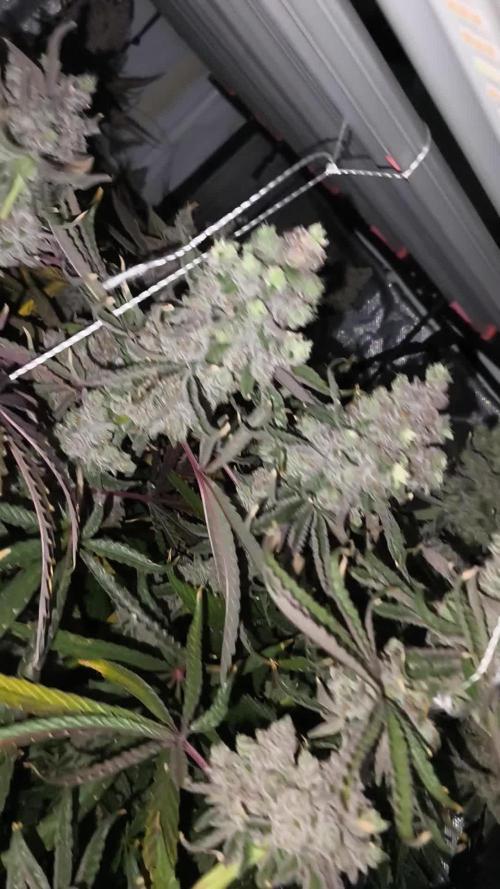
Once again she passes my expectations, late to the show with trichome production. I'm surprised there is purple on the bud, maybe Purpinator does work. I thought I could see hints under the grow lights and thought my eyes were deceiving me, I was just being hopeful. But nah 2 of the 3(under the UV) have developed a beautiful tone of purple. I was never going to bother with a deep freeze but maybe the whole bud will change given conditions, that would be something, fingers crossed. 🤔 was a little skeptical that reducing temps humidity would change density, but it does, buds are solid something I've not been able to achieve before. Rule of thumb is never to surpass 60% RH in the flowering phase and try to progressively reduce it down to 40% in the last 2–3 weeks before harvest. The plant will react as it seeks to protect its flowers, responding by producing denser buds and a higher concentration of resin. Cannabis plants are sensitive to sudden temperature changes, especially in the flowering stage. Extreme heat or cold can impact bud density and overall yields. In nature as a defense mechanism from cold, the plant sensing sudden dips in temperature will attempt to remove the pockets of air within the bud, it achieves this by compacting itself in doing so to better protect itself from cold snaps which are normally indicators in nature that worse weather is on the way. Terpene levels are the highest just before the sun comes out. Ideally, you want as many terpenes present in your plants as possible when you harvest. Cannabis plants soak up the sun during the day and produce resin and other goodies at night. The plant is at its emptiest from "harvest undesirables" so to speak right before the lights on. Boiling cannabis roots during harvesting slows down the drying process. When you boil cannabis roots, it shocks the plant, closing the stomata on the leaves. This prevents massive moisture loss through the leaves, leaving only the floral clusters actively losing moisture at a reduced pace. I've always run a strict 60/60 and it took almost twice as long to dry to a snap than previous grows where I didn't boil for what it's worth. Chlorophyll is good for the plant but not for you. When you harvest the buds, even after you flush them, if you flush them, they’re still filled with chlorophyll. Freshly cut buds are greener than dried buds because they still contain loads of chlorophyll. However, when rushed through the drying process, the buds dry but retain some chlorophyll, and when you smoke it, you will taste it. Chlorophyll-filled buds are smokable, but they aren’t clean. Slow drying gives the buds enough time and favorable conditions to lose the chlorophyll and sugars, giving you a smoother smoke. How the plant disposes of the chlorophyll and sugars by a process of chemically breaking them down and attaching the decomposed matter once small enough to water molecules which then evaporate back into the ether. Time must be given to the process to break down the chlorophyll and sugars. Think of it like optimizing the environment for decay. All the nutrients it could ever need are in abundance, it eats nutrients based on its demand for growth, which is dictated primarily by available light. Plant growth and geographic distribution (where the plant can grow) are greatly affected by the environment. If any environmental factor is less than ideal, it limits a plant's growth and/or distribution. For example, only plants adapted to limited amounts of water can live in deserts. Either directly or indirectly, most plant problems are caused by environmental stress. In some cases, poor environmental conditions (e.g., too little water) damage a plant directly. In other cases, environmental stress weakens a plant and makes it more susceptible to disease or insect attack. Environmental factors that affect plant growth include light, temperature, water, humidity, and nutrition. It's important to understand how these factors affect plant growth and development. With a basic understanding of these factors, you may be able to manipulate plants to meet your needs, whether for increased leaf, flower, or fruit production. By recognizing the roles of these factors, you'll also be better able to diagnose plant problems caused by environmental stress. Water and humidity *Most growing plants contain about 90 percent water. Water plays many roles in plants. It is:* A primary component in photosynthesis and respiration Responsible for turgor pressure in cells (Like the air in an inflated balloon, water is responsible for the fullness and firmness of plant tissue. Turgor is needed to maintain cell shape and ensure cell growth.) A solvent for minerals and carbohydrates moving through the plant Responsible for cooling leaves as it evaporates from leaf tissue during transpiration A regulator of stomatal opening and closing, thus controlling transpiration and, to some degree, photosynthesis The source of pressure to move roots through the soil The medium in which most biochemical reactions take place Relative humidity is the ratio of water vapor in the air to the amount of water the air could hold at the current temperature and pressure. Warm air can hold more water vapor than cold air. Relative humidity (RH) is expressed by the following equation: RH = water in air ÷ water air could hold (at constant temperature and pressure) The relative humidity is given as a percent. For example, if a pound of air at 75°F could hold 4 grams of water vapor, and there are only 3 grams of water in the air, then the relative humidity (RH) is: 3 ÷ 4 = 0.75 = 75% Water vapor moves from an area of high relative humidity to one of low relative humidity. The greater the difference in humidity, the faster water moves. This factor is important because the rate of water movement directly affects a plant's transpiration rate. The relative humidity in the air spaces between leaf cells approaches 100 percent. When a stoma opens, water vapor inside the leaf rushes out into the surrounding air (Figure 2), and a bubble of high humidity forms around the stoma. By saturating this small area of air, the bubble reduces the difference in relative humidity between the air spaces within the leaf and the air adjacent to the leaf. As a result, transpiration slows down. If the wind blows the humidity bubble away, however, transpiration increases. Thus, transpiration usually is at its peak on hot, dry, windy days. On the other hand, transpiration generally is quite slow when temperatures are cool, humidity is high, and there is no wind. Hot, dry conditions generally occur during the summer, which partially explains why plants wilt quickly in the summer. If a constant supply of water is not available to be absorbed by the roots and moved to the leaves, turgor pressure is lost and leaves go limp. Plant Nutrition Plant nutrition often is confused with fertilization. Plant nutrition refers to a plant's need for and use of basic chemical elements. Fertilization is the term used when these materials are added to the environment around a plant. A lot must happen before a chemical element in a fertilizer can be used by a plant. Plants need 17 elements for normal growth. Three of them--carbon, hydrogen, and oxygen--are found in air and water. The rest are found in the soil. Six soil elements are called macronutrients because they are used in relatively large amounts by plants. They are nitrogen, potassium, magnesium, calcium, phosphorus, and sulfur. Eight other soil elements are used in much smaller amounts and are called micronutrients or trace elements. They are iron, zinc, molybdenum, manganese, boron, copper, cobalt, and chlorine. They make up less than 1% of total but are none the less vital. Most of the nutrients a plant needs are dissolved in water and then absorbed by its roots. In fact, 98 percent are absorbed from the soil-water solution, and only about 2 percent are actually extracted from soil particles. Fertilizers Fertilizers are materials containing plant nutrients that are added to the environment around a plant. Generally, they are added to the water or soil, but some can be sprayed on leaves. This method is called foliar fertilization. It should be done carefully with a dilute solution because a high fertilizer concentration can injure leaf cells. The nutrient, however, does need to pass through the thin layer of wax (cutin) on the leaf surface. It is to be noted applying a immobile nutrient via foliar application it will remain immobile within the leaf it was absorbed through. Fertilizers are not plant food! Plants produce their own food from water, carbon dioxide, and solar energy through photosynthesis. This food (sugars and carbohydrates) is combined with plant nutrients to produce proteins, enzymes, vitamins, and other elements essential to growth. Nutrient absorption Anything that reduces or stops sugar production in leaves can lower nutrient absorption. Thus, if a plant is under stress because of low light or extreme temperatures, nutrient deficiency may develop. A plant's developmental stage or rate of growth also may affect the amount of nutrients absorbed. Many plants have a rest (dormant) period during part of the year. During this time, few nutrients are absorbed. Plants also may absorb different nutrients as flower buds begin to develop than they do during periods of rapid vegetative growth. 432 Hz is said to be mathematically consistent with the patterns of the universe. Studies reveal that 432 Hz tuning vibrates with the universe’s golden mean PHI and unifies the properties of light, time, space, matter, gravity and magnetism with biology, the DNA code and consciousness. When our atoms and DNA start to resonate in harmony with the spiraling pattern of nature, our sense of connection to nature is said to be magnified. Another interesting factor to consider is that the A=432 Hz tuning correlates with the color spectrum while the A=440 Hz is off. Audiophiles have also stated that A = 432 Hz music seems to be non-local and can fill an entire room, whereas A=440 Hz can be perceived as directional or linear in sound propagation. Once you adopt the idea that sound (or vibration in general) can have an equalizing and harmonizing effect (as well as a disturbing effect), the science of harmony can be applied to bring greater harmony into ones life or a tune to specific energies. There is a form of absolute and of relative harmony. Absolute harmony can for example be determined by the tuning of an instrument. The ancients tuned their instruments at an A of 432 Hz instead of 440 Hz - and for a good reason. There are plenty of music examples on the internet that you can listen to in order to establish the difference for yourself. Attuning the instrument to 432 Hz results in a more relaxing sound, while 440 Hz slightly tenses up to body. This is because 440 Hz is out of tune with both macro and micro cosmos. On the contrary, 432 Hz is in tune. To give an example of how this is manifested micro cosmically: our breath (0,3 Hz) and our pulse (1,2 Hz) relate to the frequency of the lower octave of an A of 432 Hz (108 Hz) as 1:360 and 1:90. It is interesting to note that 432 Hz was the standard pitch of many old instruments, and that it was only recently (19th and 20th century) the standard pitch was increased. This was done in order to be able to play for bigger audiences. Bigger audiences (more bodies) absorb more of the lower frequencies, so the higher pitch was more likely to “cut through”. One of the oldest instruments of the world is the bell ensemble of Yi Zeng (dated 423 BC), tuned to a standard F4 of 345 Hz which gives an A= 432 Hz. The frequency of 345 Hz is that of the platonic year! Similarly many old organs are tuned in an A=432 as well; for example: St. Peter’s Capella Gregoriana, St. Peter’s Capella Giulia, S. Maria Maggiore in Rome. Maria Renold’s book “Intervals Scales Tones and the Concert Pitch C=128 Hz” claims conclusive evidence that 440 Hz and raising concert pitch above scientific “C” Prime=128 Hz (Concert A=432 Hz) disassociates the connection of consciousness to the body and creates anti-social conditions in humanity. The difference between concert pitch A=440 Hz and Concert A=432 Hz is only 8 cycles per second, but it is a perceptible difference of awareness in the human consciousness experience of the dream we share called existence.
Likes
3
Share
At the beginning of the week both plants were transplanted into their 20L final pots.🌱 During transplant some roots were unfortunately damaged, which resulted in visible stress over the following two days. • Leaves were hanging slightly😕 • First two leaf pairs turned yellowish • Minor dry tips appeared The final soil mix consists of BioBizz Light Mix (peat-free), worm humus, perlite and coco. The medium was amended with Startrex, Silicium Flash and 4 BioTabs per pot. Mycorrhiza was applied directly into the planting hole and around the root zone to support recovery 🌱 The medium was already fairly moist at transplant. First watering (1.5L RO water + Advanced Nutrients CalMag) was done 3 days later 💧 By day 2 post-transplant, healthy green new growth appeared again and recovery became clearly visible 🌿 By the end of the week both plants were pushing strong growth with 4 developed nodes and reaching approximately 14–16 cm in height. • New leaves are deep healthy green 💚 • Light praying observed towards the end of the week ☀️ • Structure stabilizing again Six days after transplant the lowest damaged leaf pairs were removed ✂️ he next larger leaf pair will be gradually removed next week to avoid unnecessary stress while maintaining photosynthetic power. • Light: 18/6 at ~400 PPFD • Environment: 25–26°C / ~58% RH A challenging week due to transplant shock, but both plants recovered impressively and are now back on track 💪 Strong resilience shown here.
Likes
35
Share
Info: Unfortunately, I had to find out that my account is used for fake pages in social media. I am only active here on growdiaries. I am not on facebook instagram twitter etc All accounts except this one are fake. Flowering days 14 since time change to 12/12 h. Hey everyone ☺️. We are in the second week of flowering and she is still developing very well :-). Very nice growth so far :-). This week it was poured twice with 1.2 l each time. The tent was cleaned and the humidifier refilled. I wish you all a lot of fun until the next update. Stay healthy 🙏🏻 You can buy this Strain at : https://www.zamnesia.com/de/3271-zamnesia-seeds-blue-dream-feminisiert.html Type: Blue Dream ☝️🏼 Genetics: Blueberry x Haze 20% Indica / 80% Sativa 👍 Vega lamp: 2 x Todogrow Led Quantum Board 100 W 💡 Bloom Lamp : 2 x Todogrow Led Cxb 3590 COB 3500 K 205W 💡💡☝️🏼 Soil : Canna Coco Professional + ☝️🏼 Fertilizer: Green House Powder Feeding ☝️🏼🌱 Water: Osmosis water mixed with normal water (24 hours stale that the chlorine evaporates) to 0.2 EC. Add Cal / Mag to 0.4 Ec Ph with Organic Ph - to 5.5 - 5.8 .
Likes
15
Share
@BlaKX
Follow
Ajoooooo das ist bzw war mal ne lange check Liste..Gefällt mir definitiv:) Die WW muss noch trocken habe sie Komplett Manikürt da vielen 30g Zucker Blätter nass ab und zu Butter verarbeitet Schätze werden so 75g trocken.
Likes
21
Share
@Rollex420
Follow
Dos Si Dos # 33 ready for drying in the jar, honest weight (53,5g) seeing the structure which was very small I would have expected something less.. but I am very satisfied. the quality of this weed is absolutely at the top, the taste is very well defined.. when smoked it makes your nose tingle,flavor it is mainly pure lemon with a hint of mint in it. even the strong smell induces an entire room in a few seconds without even smoking it yet. I also collected a 0.4g of scissor hash which turned out very well. it is my favorite in this crop because it surprised me in everything both for its unique terpene profile and for its yield that I never expected given its size compared to wedding cakes. the total weight therefore of all three plants is (135.5g) and a total trim of (44.9g) that according to the calculations even of these crops I reached (1g/watt) precisely. (And im not a pro) I am certainly satisfied with that. 🙌🏻💚
Processing
Likes
50
Share
Had to rearrange everything and start using the 5 x 5 tent for all the flowering. Put the 11 Timber Grow Vero cobbs set up in the tent. Had to customize the frame to fit it in. Customize is code work for cut up. Did not change the cobb spacing at all, just trimmed the overall frame so it is slightly smaller. They fit good. The tent is bright. Had to install a 6" exhaust fan to the tent to suck all the warm air out. This gets dumped outside without a charcoal filter, haha. I can smell it in the backyard, I wonder if anyone is going to say something. Who cares though, haha. Installed two small fans above the lights to cool the cobbs and a larger floor fan to keep the air moving around in the tent. The end result is good however the temperature is still slightly higher than I want. I will work on ways to lower it. Plants are doing good, smell is stronger now. The smell is great too. Buds are bulking up and really frosty. The silicate seems to be working fine, Ifeed this every watering. The plants seem to love nutrient, I keep adding it and watching this closely. The one plant is starting to get orange hairs, this is the one that was always under the cobbs. The other two are a week or two behind. Cheers.