




Likes
8
Share

@Greybeardbud
Follow
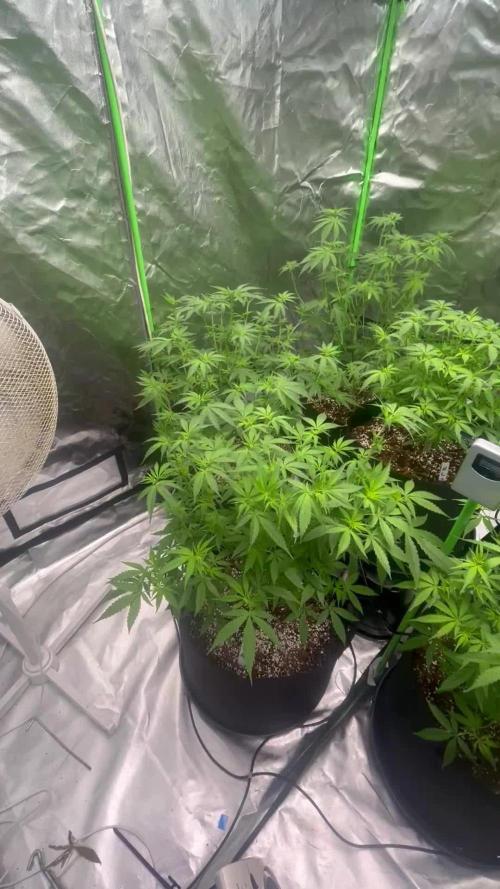
Had a few issues this week mostly with ph runoff, was very high at 8.5 (had been on the rise for a little while given that I have been time poor and a lack of energy this was put on the I’ll do it tomorrow list). Picked up some drip clean and reset the coco. Now getting runoff at 6.4 and improving. The girls have been growing this week some more than others but overall I’m pretty happy with the progress shortest being 36cm tallest 67cm with most averaging 53-55cm. Picked up 2 more fans to keep the air moving and will be hopefully doing some restructuring of the tent to help reduce this humidity and potentially relocating 4 of the girls into the 1.5x1.5 tent to give them all some extra room
Other than that just maintaining the light into the plants and trimming where required all be it in stages when time allows
Potentially too late in this grow but have moved over to filtered water to remove chlorine, tds remains at 87 for tap water and filtered water but filtered there is 0 chlorine
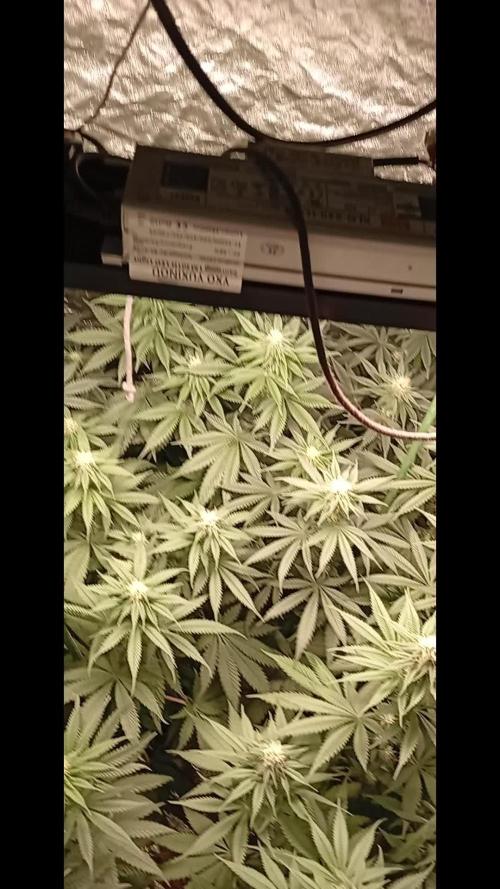
Have dialled up the lights from 45%/45%0% to 45% veg 60% bloom 0% uv for another 6 days if all is looking good will ramp to 60% veg 80% bloom for week 10 and checking for light stress. Have an overlap of 20cm in the hellion vs3 lights which is going to give the centre a bit of punishment. Also looking into putting some co2 grow bags into the tent so the plants can handle the extra light.
After 12 hours of increased light there does not appear to be any light stress yet
Wednesday 28-Jan - pre flowers have appeared! 1 1/2 weeks into flip 7/8 plants have pistils 1 more to go and I can worry less that there’s a rooster amongst the hens hiding amongst the forest.
Have obtained a 20L/day dehumidifier currently stable lights off 25’c 63% lights on 28’c 63% which is a massive improvement from the crazy 80-90%rh we did have. Plants have responded extremely well with their new climate and are well into their stretch (moreso since they have been able to breathe) day 21 defoliation is going to be a big job
Likes
11
Share


@Professor_Daank
Follow
7/20: All three are doing great. I'm hoping to extend Plant 1's vegetation week so that the others catch up to her for the flip, which is eventually coming. I added RapidStart this week. I've heard great things, we shall see. More root, more fruit. Trimmed 2 lower fan leaves that were not getting any light.
7/21: Our time is drawing near for the flip! Are those........ STIPULES?
7/22: LSTing hard. Much good. Nutes niiiice. She's just letting me bend her all sorts of ways for that light.
7/23: LST for you and me, to grow some weed so happily... la la la
7/24: They are just perky tonight!
7/25: Last day of week 4. I started some bloom nutes this morning to prep, and tomorrow I lollipop 'em! I also got a new microscope for the trichomes later on, can't wait to see what's photos and videos I get.

Likes
132
Share


@rhodes68
Follow
2/1 Week 12!
Re-introducing the Peak PK in low dose as I begin to migrate the plant to all Peak and then flush I hope all in less than two weeks.
Will step things daily, tomorrow it will be 10 ml CT 10 ml Peak with an eye on the ppm. You get the idea, she has to finish and fast.
Valuable lesson, don't have anything ever backed up behind a sativa grow waiting on them to finish, it aint worth it. Grow em at the end of a cycle.
2/2 put the feed at 12ml CT 7ml Peak thought maybe its too much of a swing, tomorrow 10 and 10
2/3 10ml of each this morning.
Got to move things along, new plan is to begin flush at start of new week this weekend,
At flush changing lights to 12/12 , binding her back up just a little, then placing one of the testers on a stand in the tent to take pressure off the veg tent.
5-7 days later we harvest based on what we see.
We cannot come up with anything better
As far as growth she is doing great, its a heavy plant and the hairs are still straight and 95% white! Build so fast
2/4 All is well
Tara really seems to like the 10-10 dose so leaving it for now.
Changed light schedule to match the veg tent. This is to accommodate the near arrival of one of the photos.
In a few days the plant will have to finish off at 12-12 so the photo can flip. Not ideal but practical from our point of view.
Keeping our hopes up here and uttering my characteristic prayer... Please God dont let me foul this up... Amen
2/5 Feeding as before
Had to bind her up a bit, she is so heavy we were afraid of her toppling over. Seriously this plant is TOP HEAVY.
Which is good I guess 😬
Not flushing till I see it is time, not messing this one up.
Dont get plants like this everyday.
2/7 Ending the week with a full tent again
Switched lights to 12-12 and bound her up to fit in half the tent, we literally could not come up with anything else for this.
She just keeps going and going lol
DRY WEIGHT ON RIPLEY!
261 grams
Hoped for more but meh sativas.
Still nothing to sneeze at 😇


Processing
Likes
15
Share


@Deli_Weed
Follow
Va muy bien hasta el momento, engordando cada día, eh tenido que amarrar algunas ramas al tronco principal porque empezaban a caer con el peso, eso es buena señal 💪🏻🌲

Likes
3
Share


@bigsmoke42069
Follow
Week 5 of flower 9/6/24
After neglecting to check runoff EC, the reading was 3 and PH 4.7, it's crazy that the plant did not show any signs of damage besides one branch.
After flushing the growing medium with RO water + FloraKleen + H2O2 (PH 6.5), the runoff PH was still to high.
The problem persisted after watering with 50% dilution nutrient solution and still getting low PH readings and high EC.
The solution was to put something underneath the fabric pot, to create a gap for the runoff water to drain freely from the bottom part.
Before, the fabric pot was sitting on the plate and the runoff was draining from 2 little holes in the middle to the drain compartment.
Right after creating the gap and watering, all the readings were corrected.
Fortunately, all salt build up got washed away, and the plant showed no more problems. :)
On day 26 days of flower, the nutrient schedule was changed to fit the fifth week of flower.
Note to self: check PH and EC every 3 waterings.

Likes
5
Share


@glenk222
Follow
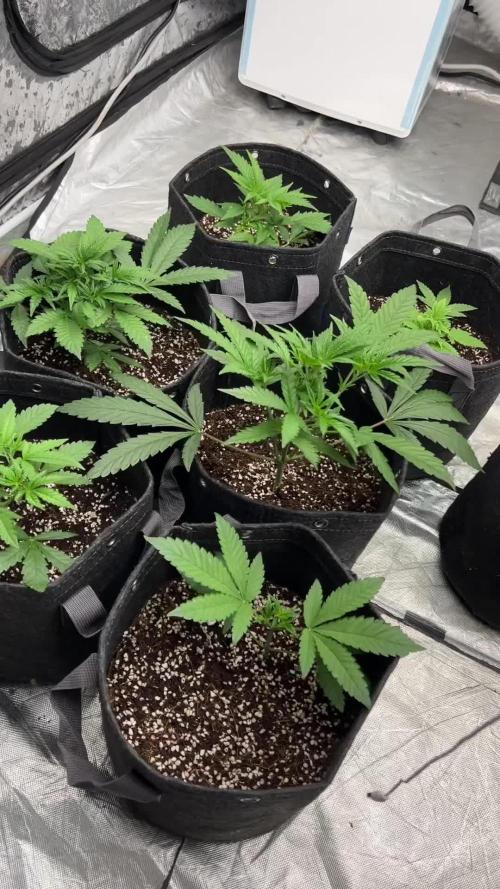
Transplanted week 5 put it 3 gal cloth pots 1/3 strawberry fields soil, 2/3 Happy frog, 1/2 cup rice hulls total, mixed into both soils. watered with recharge mix 1/4 tsp to a gallon of water. Back in to the veg tent.
Processing
Likes
11
Share


@GreeneRecluse86
Follow
Well all these ladies had a major growth spurt. My lights are at the max height now so I hope they are done. Good news though the Gorilla zkittles and Red diesel are showing bud forming, so hopefully I can count on them to be done stretching now.
Started them
I defoliated pretty good on day 7
I started them on the rhino skin once I got something to keep it turning in my reservoir.
I also top dressed 1/2 cup of compost mix and hit them with a light top feed of recharge.
Looking forward to seeing these ladies pack on weight in the new few weeks.
Likes
15
Share


@Medup75
Follow
Learnt some hard lessons this round! Next time I'm adding dolomitic lime to buffer soil aswell as always pHing from now on! Other than the lockout mid flower and slightly smaller buds as a result I'm happy with my first attempt at a actual tent grow. The buds look dense and frosty and under a scope a few are starting to turn cloudy. Next round is gonna be only three as I'm not comfortable with it being so cramped! I reckon I'll let her go another week with feed the I'll do a two week water only flush!
Happy growing to all ✌️


Likes
7
Share


@Chronnoisseur
Follow
Well she seemed to slow down and now her roommates have over taken her. But fingers crossed she still put out some nice buds
The cheese candy is starting to become more smelly this week stay tuned....
Likes
29
Share


@Pr3m_85
Follow
I'm back to home 🙂 !!! I was hospitalized for my Crohn 😔. The next time, I'm good at having a piece of my stomach cut off ✂️✂️✂️
If not, girls seems to be fine without my presence 🤷🏼🙂.
Peace to all ✌️✌️🏼✌️🏿✌️🏾✌️🏻✌️🏽
Likes
6
Share


@Plantinator
Follow
Bud sites are getting ready now. I did a bit more LST and removed a few side shoots which never gonna make it due to lack of light.
I replaced the light, under the TS 1000 she was praying all day long.
On the previous run I had problems with the FC3000, it was turning itself off at random times. Mars Hydro was kindly sent me a replacement controller, so far it seems like this problem has been solved.
However, I tried to use the app again and it’s still shite. 💩😂 So I just use the light in manual mode. Such a shame for the extra features I cannot use.
For DLI I will use the following chart:
AUTO FLOWER LED LIGHT INTENSITY
Recommended LED PPF/PAR Values / DLI Based on 20 hrs. of light.
Seedlings 150 - 200 umol / DLI 10.80 - 14.4 moles per day
Veg up to 9" 450 umol / DLI 32.40 moles per day
Early bloom 500 umol / DLI 36.00 moles per day
Mid bloom 650 umol / DLI 46.80 moles per day
Late bloom 750 umol / DLI 54.00 moles per day
Ripen 400 umol / DLI 28.80 moles per day
*** Use extreme caution going 700 umol or higher @ 20 hrs/day this could cause leaf burn***
The only difference is that I will keep this run in 18/6, so I ignore the PAR values above.
IMO the best thing you can do is to read the leaves all the time and use the charts as a guidance.


Likes
3
Share


@High_Grade_Dadli
Follow
Lil younging coming good towards the end of the week jus decided to send dem to flower...get a lil smoke and allow the mother to continue do their thing until cut day...other than that everything is going accordingly also got back 1 of the plants that I had sent on a breeder project she's full of pollen sack now(female chromosome only) should have some feminized seeds once all goes well...gonna double up the breed and also do a

Processing
Likes
15
Share


@Fabii
Follow
To be Completely honest , I’ve Heard a lot of great things about The Cali Connection, but this Strawberrry OG Is not really impressing me at all and as been a pain to gro w , very delicate to anything, Great cloning tho, at this point it has no Trichomes at which I think it’s upsetting for me but its my first grow so idk if they will come eventually if Most OGS ARE LIKE THAT I know know . Any help would kindly appreciated

Likes
1
Share


@AMNESIA1100
Follow
Not sure if these 2 are auto plants? The blackberry are flowering quiet obviously, but these 2 are either really slow or I accidentally bought non autos. Anybody help? Cheers


Likes
15
Share


@DudeGrowsWeed
Follow
Week 2- All 4 Cream Cookies are looking good. Very similar looking seeedings at this point. I harvested the larger plants that were in last weeks diary and moved all seedlings under my 315w CMH fixture. The fixture is 24" above the plants. I'm going to keep all 4 indoors in my tent for another week, then move 2 to the outdoor garden. I'd like to see 2-3 nodes before transplanting. I also have 3 gallon self-watering pots ready for transplanting the 2 that are staying in the tent. I've never used self-watering pots before, but 'The Rev' (from Skunk magazine and True Living Organics) swears by them. They don't actually water themselves, I'll still have to add water manually. But there is a reservoir at the bottom for the roots to be able to feed off of. Supposedly, once the root network is established to the bottom I'll be able to add water to the reservoir only.
I'm following the Fox Farm feeding schedule, but at 1/2 strength. So this week is Big Bloom only. I also added CalMag and some Recharge.
I'm starting another diary in a few minutes for the other plants I have going on. Look for it soon! 😉
Likes
5
Share


@GrowFunMD
Follow
Plants are coming along. Looking good. Getting big/bushy. 6 Weeks (12/25/2024)

Likes
31
Share


@Tenacious_Trichomes
Follow
She's into flush mode now and good thing I got a new filter and fan!! She is a stinker!! Gas stink galore!! ⛽⛽⛽ Not sure how I can edit these weeks...won't let me put multiple week 11's?? @growdiaries @grow_diaries @GrowDiaries