


Likes
Comments
Share

@DogDoctorOfficial
Follow
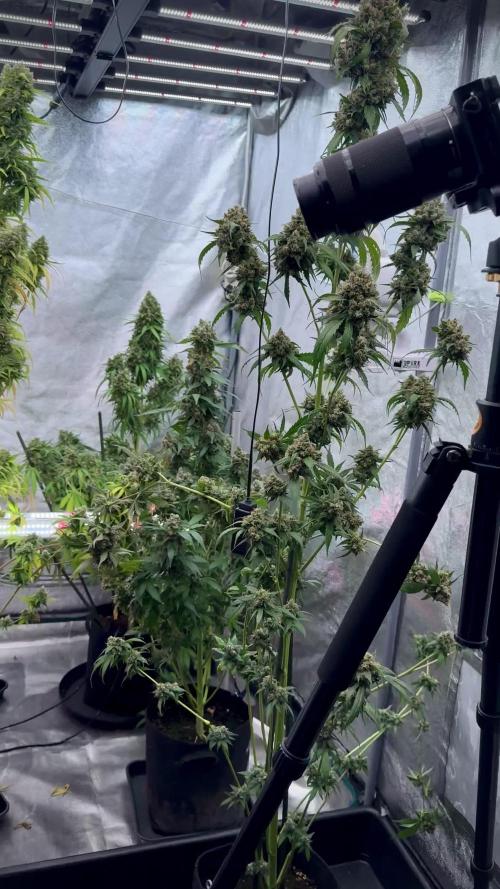
🌸 White Widow — Week 7 Flower (Week 11 from seed)
Status: Full flower, bulking rapidly.
Vibe: Dark foliage, compact form, heavy frost, 90s aroma profile.
Feeding: Aptus + Plagron lineup (Power Buds, Sugar Royal, Green Sensation, Regulator, CalMag, All-in-One)
Photos: Sony a6000 — loyal workhorse for studio shots. 📷
⸻
🧠 Deep dive — Why 12/12-from-seed makes a plant “go hard”
Plants evolved to reproduce. Their primary biological drive is to make seeds. Photoperiod (day length) is one of the most reliable seasonal cues plants use to decide: is it time to flower?
Mechanisms at play (simple → nerdy):
• Photoperiod sensing: Leaves detect day length via phytochrome systems (Pr Pfr). Short days (or the 11/13 rhythm) flip the hormonal cascade toward flowering.
• Florigen & flowering hormones: When the plant senses “short days,” it produces mobile signals (florigen) that travel to the shoot apex and shift gene expression from vegetative growth to reproductive development.
• Carbohydrate reallocation: Energy stops making more leaves/branches and is directed into calyxes, resin synthesis, terpene pathways, and seed/flower tissues.
• Result: A plant that thinks “the season’s ending — reproduce now!” goes all-in: denser flowers, rapid calyx swelling, intense trichome production.
Important point: they don’t know about pollination. The plant can’t tell you whether pollinators exist or whether pollen will land — it simply invests in attractive, resinous flowers to maximize reproductive success. As growers, we exploit that drive to produce potent sensimilla (unpollinated) flowers.
⸻
🔬 Why your White Widow is exploding in quality right now
• Immediate reproductive programming: Starting floral signals early (12/12 from seed) forces the plant to prioritize flower formation rather than vegetative mass. That yields compact, dense colas.
• High PPFD + short day = strong DLI in less time: With fewer hours of light, your lamp intensity is higher in those hours → powerful photosynthesis during the window the plant has chosen.
• Nutrition tuned to flower: the Aptus + Plagron stack feeds the metabolic surge — PK + biostimulators for bulking, sugar stimulators for terpene pathways, Ca/Mg for structural health.
• Genetics: White Widow is resin-happy; give it the right cues and it will frost up like a sugar cookie.
⸻
🌈 Why her colors are going dark (and why that’s beautiful)
Leaf & bud color comes from a balance of chlorophyll + accessory pigments (anthocyanins, carotenoids) and is influenced by:
• Genetic propensity (some phenos are naturally darker)
• Temperature swings (cooler nights often increase anthocyanin expression)
• pH / nutrient balance (some deficits/ratios nudge color pathways)
• Light spectrum intensity (strong red/far-red influence can shift pigment expression)
Dark phenos often correlate with high terpene and anthocyanin expression — visually stunning and often highly aromatic.
⸻
🔁 Quick timeline recap (for newcomers)
• Germination & early mistakes: initial heat-mat loss → restarted, one strong survivor.
• Veg: compact, short internodes under the 11/13/12-12 shuttle → stacked nodes.
• Early flower: slow to show, but once she flipped she committed.
• Now – Week 7 flower (Week 11 from seed): heavy bulking, thick trichomes, deepening color, classic White Widow aroma emerging.
⸻
🔭 What to expect next (this week → next week)
Expect:
• Continued bulking of calyxes and cola weight.
• Explosion of trichome coverage — white, cloudy glands multiply.
• Stronger terpene smell (earthy, spicy, resinous 90s profile).
• Possible color intensification — deeper greens, potential purples depending on phenotype & nights.
Do not expect:
• Major new stretch — she’s committed to flower and will remain compact.
• Immediate harvest — typical White Widow still wants its weeks; plan for patience (mid-late flower bulking happens over several more weeks).
⸻
⚖️ Should you run all seeds 12/12 next cycle? (pros & cons)
You asked if you might run every seed 12/12 — here’s the honest rabbit-hole:
Pros
• Much faster cycle → less time to harvest.
• Compact plants → ideal for small spaces or stealth grows.
• Often denser single-plant yields; less training needed.
• Great for experimentation, multi-strain rapid rotation.
Cons
• Generally lower total biomass per plant vs. long veg runs.
• Some genetics need veg time to express full canopy & branching; yields may be lower for those strains.
• Root systems can remain smaller → may stress under high PPFD if not supported.
• Less flexible for heavy-topping/lst/manipulation strategies.
Bottom line: for strains with good genetics for flowers (like White Widow), 12/12-from-seed can be very rewarding. For sativa-dominant, tall strains you might lose yield without long veg.
⸻
📷 Gear love — Sony a6000 shoutout
I’ve got to echo it: that camera is a workhorse for growers. Compact, responsive, great color fidelity, and perfect for low-light studio shots when paired with proper exposure. The a6000 captures the leaf texture, color depth, and bud gloss in a way phones struggle to match. Long live the loyal shooter. 📸✨
⸻
🙏 Gratitude — the usual and the real
Thank you to:
• Zamnesia — for the genetics & the nostalgia.
• Aptus & Plagron — the chemical & biological push that lets the plant sing.
• ThinkGrow / Future of Grow / TrolMaster — lighting, control, and environment orchestration.
• You — the makers, lovers, critics, curious readers — your energy fuels this diary.
And to our White Widow — for showing up, forgiving mistakes, and giving back in beauty. 💚
⸻
Week 7 flower — Week 11 from seed. Darker colors, heavy frost, the classic 90s scent, and a compact structure that proves 12/12-from-seed can produce absolute fire. We went full-in on Aptus + Plagron, kept the Emerson red-lead sunrise/sunset, and trusted the genetics. Watching her build is pure joy. Come see the series in 4K on YouTube — every detail, every shimmer. 🌿🔥📷 #WhiteWidow #Zamnesia #GrowDiaries #12fromSeed #EmersonEffect #Aptus #Plagron
📲 Don’t forget to Subscribe and follow me on Instagram and YouTube @DogDoctorOfficial for exclusive content, real-time updates, and behind-the-scenes magic. We’ve got so much more coming. You won’t want to miss it.
• GrowDiaries Journal: https://growdiaries.com/grower/dogdoctorofficial
• Instagram: https://www.instagram.com/dogdoctorofficial/
• YouTube: https://www.youtube.com/@dogdoctorofficial
⸻
Explore the Gear that Powers My Grow
If you’re curious about the tech I’m using, check out these links:
• Genetics, gear, nutrients, and more – Zamnesia: https://www.zamnesia.com/
• Environmental control & automation – TrolMaster: https://www.trolmaster.eu/
• Advanced LED lighting – Future of Grow: https://www.futureofgrow.com/
• Root and growth nutrition – Aptus Holland: https://aptus-holland.com/
• Nutrient systems & boosters – Plagron: https://plagron.com/en/
• Soil & substrate excellence – PRO-MIX BX: https://www.pthorticulture.com/en-us/products/pro-mix-bx-mycorrhizae
• Curing and storage – Grove Bags: https://grovebags.com/
⸻
We’ve got much more coming as we move through the grow cycles. Trust me, you won’t want to miss the next steps, let’s push the boundaries of indoor horticulture together!
As always, this is shared for educational purposes, aiming to spread understanding and appreciation for this plant. Let’s celebrate it responsibly and continue to learn and grow together.
Friendly reminder all you see here is pure research and for educational purposes only,
With true love comes happiness. Always believe in yourself, and always do things expecting nothing and with an open heart. Be a giver, and the universe will give back in ways you could never imagine.
💚 Growers love to all
P.S. — Deep dive on DLI (Daily Light Integral) — short, clear, and a little nerdy (in the best way). 🌞🌿
1) What is DLI, simply?
DLI = the total amount of photosynthetic light (photons) a plant receives over one day.
It’s expressed in moles of photons per square metre per day (mol·m⁻²·day⁻¹).
While PPFD (μmol·m⁻²·s⁻¹) tells you instantaneous light intensity, DLI tells you how much light the plant actually used that day.
⸻
2) The formula (how to calculate it)
Use this exact formula:
text{DLI (mol·m}^{-2}text{·day}^{-1}) = frac{text{PPFD (μmol·m}^{-2}text{·s}^{-1}) times text{seconds of light per day}}{1{,}000{,}000}
Where seconds of light per day = hours of light × 3600.
I’ll show worked examples so it’s easy to follow.
⸻
3) Worked examples (digit-by-digit so it’s crystal clear)
Example A — your reported PPFD ≈ 766 μmol·m⁻²·s⁻¹ and 11 hours light
• seconds of light = 11 × 3600 = 39,600 s
• photons per day = 766 × 39,600 = 30,333,600 μmol·m⁻²·day⁻¹
• convert to moles: 30,333,600 ÷ 1,000,000 = 30.3336 mol·m⁻²·day⁻¹
So: 766 μmol·m⁻²·s⁻¹ × 11 h → DLI ≈ 30.3 mol·m⁻²·day⁻¹
Example B — same PPFD but 12 hours
• seconds = 12 × 3600 = 43,200
• photons = 766 × 43,200 = 33,091,200
• DLI = 33,091,200 ÷ 1,000,000 = 33.0912 mol·m⁻²·day⁻¹
Example C — other quick refs
• 700 μmol × 11 h → DLI ≈ 27.72
• 800 μmol × 11 h → DLI ≈ 31.68
• 400 μmol × 11 h → DLI ≈ 15.84
• 1000 μmol × 12 h → DLI ≈ 43.2
(You can plug any PPFD and hours into the formula — those are ready-made reference points.)
⸻
4) What DLI targets are useful for cannabis?
• Vegetative (gentle): ~12–25 mol·m⁻²·day⁻¹
• Flower (typical good range): ~25–40 mol·m⁻²·day⁻¹ — most home/pro growers aim here
• High-intensity/CO₂-enriched commercial: 40–60+ mol·m⁻²·day⁻¹ (needs CO₂, stronger conditioning)
So your example (≈30 mol·m⁻²·day⁻¹ at ~766 PPFD × 11h) sits very nicely in the flower range. That explains the dense bulking + heavy resin you’re seeing — our DLI is right where White Widow loves to convert energy into flowers.
⸻
5) Practical implications — what DLI affects and what to watch
• Higher DLI → higher photosynthesis → more carbohydrate to drive bud bulking and terpene/trichome production.
• Higher DLI requires more water and nutrients. Plants transpire more and pull more minerals; be ready to feed and irrigate appropriately.
• Leaf temperature / heat stress: pushing PPFD up increases canopy energy/heat — keep airflow, VPD, and room temps under control.
• CO₂ matters: if aiming beyond ~40 mol/day, elevated CO₂ (e.g., 800–1200 ppm) becomes productive; otherwise additional light won’t be used efficiently.
• Distribution matters: DLI is an average over the canopy. Hotspots or shaded pockets mean some flowers get too much or too little — even light spread (and PAR mapping) matters.
⸻
6) Actionable tips for your run (based on your 11/13 / 12/12 experiment)
• We’re hitting excellent flower DLI (≈30 mol/day at 766 μmol × 11 h). That’s why buds are dense/frosty — keep the rhythm.
• If you shorten hours (e.g., 11 h) keep PPFD high to maintain target DLI. If you lengthen hours (12 h) you can reduce peak PPFD slightly and still hit the same DLI.
• If you raise PPFD to chase more DLI, ramp slowly (a few μmol/sec per day) to let stomata and roots acclimate — avoid sudden bleaching.
• Watch watering & EC — higher DLI → faster uptake → more frequent but measured feeding.
• If you ever push DLI 40 mol/day consider CO₂ enrichment and perfect VPD control to have that extra light used efficiently.
⸻
7) Quick rules of thumb
• Want to hit ~30 mol/day with 11 hours on the clock → aim for roughly 700–800 μmol·m⁻²·s⁻¹.
• Want ~33 mol/day at 12 hours → ~766 μmol·m⁻²·s⁻¹ matches that nicely.
• If you see leaf cupping/bleaching, you’ve likely exceeded safe PPFD for that canopy or temps are too high — back off, check VPD.

Likes
2
Share


Likes
30
Share

@For2itous
Follow
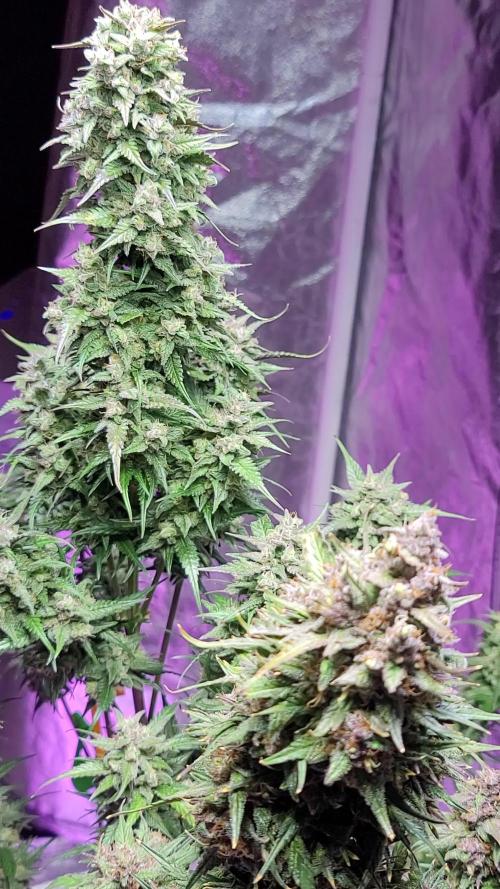
Flushing and cutting out some leaves. Smaller plant will probably be cut down in a few days & wil let taller go a couple extra. Love the smell on these girls definitely will run again. Goodluck everyone and happy growing 🌴

Likes
48
Share


@pifflestikkz
Follow
Day 57
26/08/24 Monday
Feed today using de-chlorinated tap water pH 6.
Day 59
28/08/24 Wednesday
De-chlorinated tap water pH 6 only today, 1.5L with little to no run off.
Day. 61
30/08/24 Friday
Another feed today using de-chlorinated tap water pH 6 with Plagron products.
Picture and videos now 📸💚
Day 63
01/09/24 Sunday ( end of week)
De-chlorinated tap water pH 6 only today. 2L no run off but moist container all around.
She's now full flower mode 💪💚

Likes
3
Share


@CanarianGrow92
Follow
Reviewing the plants i noted some small dots on the leaves which looked like typical bites from mites, so i sprayed some spidermite and we placed around 6 spical ulti-mite bags to prevent any further damage, lets hope it dont get worse but i think I've detected them just on time 😁
For the rest the plants are looking good, the buds are getting bigger and more thc is being produced 😁 we still have around 4 weeks to go 😅


Likes
6
Share


@GrowzWithZee
Follow
This is actually my first time growing in Coco, so had a few issues in feeding at first.


Likes
12
Share


@yd_grows
Follow
Essa semana alimentei as plantas (45 dias após transplante). Utilizei fertilizante Forth Flor regulando seu PH para 6.8 utilizando bicarbonato de sódio.
Flores continuam desenvolvendo muito rápido e novos pequenos buds continuam aparecendo por toda parte.
A planta ainda continua crescendo verticalmente, o que é impressionante, mas ruim pois está muito perto dos LEDs.
Likes
18
Share


@eLBowAutoGrows
Follow
Day 50. Still a lot larger than I anticipated. But the good news is she still fits in the 3x3 and is showing signs of slowing down the stretch. Iv heard people burning up their plants using canna PH13/14. So I’m going to mess around with a couple dosages and see how she handles it.
So far this method has done almost exactly what I wanted. Stayed about a foot shorter with a much more even canopy. In about 10 days she will be getting another heavy defoliation.
Update day 54. Heavy defoliation under way to expose bud sites. In about 6 days I’m going for mt first schwazzing. Should be a good time
Update: As week 8 comes to an end I and very happy with the progress. I’ve bumped the ec up to 2.8. Will continue on that for a little bit longer. Day 60 about I will do my first “schwazzing” pretty excited about that.

Likes
20
Share


@hawkeye_diesel66
Follow
The week went well. She is getting so fat and chunky. She has a very lemony and sweet smell when you brush up on a bud. I lowered the light schedule to 10/14 a few days ago. More pistils are begining to change now each day. We're coming down the backstretch now. The viedo is probably not so good quality.

Likes
14
Share


@Patillac31
Follow
Made it 67 days before the chop.
•••03/21/2020 After a 6 day hang I've trimmed and started to jar cure. Had a total flower weight of 85 grams. Over all I'm pleased. Will update with a smoke report in about 3 weeks.

Likes
30
Share


@coyote2thick
Follow
Coming in a day early and all is well in the tent. She grows roughly a node every two to three days. I literally watch her grow it’s crazy! I defoliated just a little bit and her smell is getting stronger, no pistils yet which means she’s gonna be huge “hopefully”. This is day 36 and I’m expecting to see some pistils by day 45. I won’t change up her nute schedule until I start seeing some pre-flowering only then I will cut back on the Gro and implement some KoolBloom alone with upping the Bloom. I’m excited to see this next week brings!

Likes
24
Share


@Zegr8
Follow
Harvested a week early because of bud rot caused by calcium deficiency. I did a triple wash with hydrogen peroxide, baking soda and plain water to rinse.
Note for future
Coco needs a lot of calcium and magnesium.
With constant drip system you need way less nutrients in solution.
Check PH if you use calcium sulfate or silica!!!
Once cured the weed has a good nutty smell with a little berry. It’s not very
resinous, it has a good mind numbing effect but doesn’t lost more than one hour for 3/4 puffs, this is because of early harvest for sure because my previous crop was lot more potent.


Likes
4
Share


@AustinRon
Follow
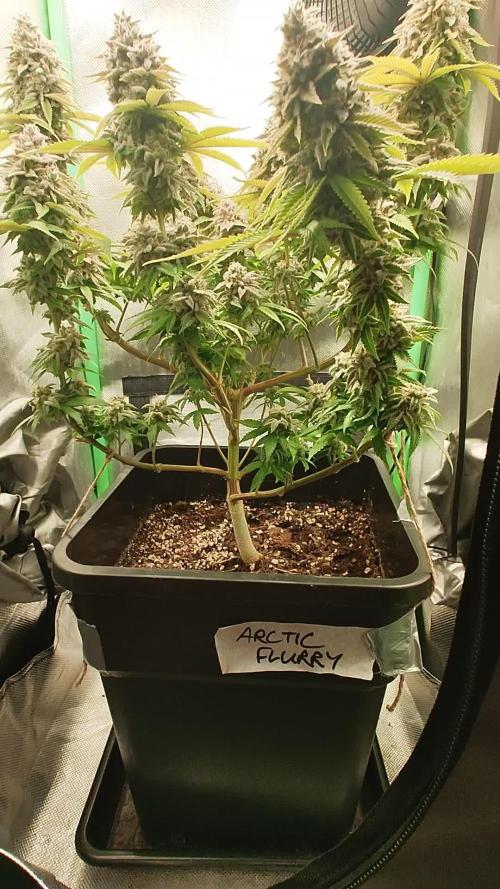
OG 4Q24 Flower Week 7
Orangegasm (Fem) [ IRIE Genetics ]
12/12 @ Bolt (Day 21)
Germination: 20 November 2024
#3A Earliest Harvest Date: 9 February 2025
#3B Latest Harvest Date: 19 February 2025
_________________________________________
Start of Week: [Wed Jan 22,
2024 CR2 4Q24 43:F:6:1]
End of Week: [Tue Jan 28, 2024 CR2 4Q24 49:F:6:7]
OrangeGasm Fertigation:
- MAX: EC: [ 2.4, mS]
- LightIntensity MAX: [ 850, µMol/m2/s]
______________________________________
__
Wed Jan 22, 2025
OG 4Q24 43:F:6:1
- [x] R&R Each Drip Ring Assembly (Assure NO Fertigation/Bio Build up)
Runoff
- Amount: [ .5, l]
- EC: [ 3.8, mS/cm]
- EC∆: [ 1.2, mS/cm] # Danger!
Refresh Res (Filtered, pH’d Tap Water)
- [x] Amount: [ 2, gal]
- [x] Primer A&B: [ 35, ml]
- [x] SLF-100: [ 10, ml]
__
Thu Jan 23, 2025
OG 4Q24 44:F:6:2
Refresh Res (Distilled Water, pH: 7, EC: 0.0)
- [x] Amount: [ 2, gal]
- [x] Primer A&B: [ 39, ml]
- [x] SLF-100
Runoff
- Amount: [ 1.2, gal]
- EC: [ 4.3, mS/cm]
- EC∆: [ 1.6, mS/cm] # DANGER
__
Fri Jan 24, 2025
OG 4Q24 45:F:6:3
Runoff
- Amount: [ 0.3, gal]
- EC: [ 4.1, mS/cm]
- EC∆: [ 1.4, mS/cm] # DANGER

__
Sat Jan 25, 2025
OG 4Q24 46:F:6:4
Dump Res
- [x] Remove Chiller and Fertigation Pumps
- [x] Dump and CLEAN Reservoir, Note Sediment
- [x] Detach Main Feedline
- [x] Clean Chiller Pump
- [x] Clean Fertigation Pump
- [x] Dry ALL Components
- [x] REASSEMBLE When Dry
- [x] Clean 1/2” Fertigation Mainline
Watered In Primer A&B, CalMag Fuel, Silica Skin
- Amount: [ 1.9, l]
- EC: [ 2.7, mS/cm]
Refresh Res w/ Full Hydro (Primer A&B, Silica Skin)
- [x] Amount: [ 4, gal]
- [x] EC: [ 2.7, mS/cm]
- [x] Primer A & B: [ 73.1, ml]
- [x] SLF-100: [ 40, ml]
Runoff
- Amount: [ 0.25, gal]
- EC: [ 4.1, mS/cm]
- EC∆: [ 1.4, mS/cm] # DANGER
__
Sun Jan 26, 2025
OG 4Q24 47:F:6:5
Refresh Reservoir - 2 Gal, EC: 2.7
- [ ] Check, R&R Fertigation Manifold Filter as Needed
- [x] SLF-100: [ 10, ml]
- [x] Primer A & B: [ 40, ml]
Runoff
- Amount: [ 1.25, gal]
- EC: [ 4.2, mS/cm]
- EC∆: [ tbd, mS/cm]
__
Mon Jan 27, 2025
OG 4Q24 48:F:6:6

Watered In Primer A&B, CalMag Fuel, Silica Skin
- [x] Amount: [ 1.9, l]
- [x] EC: [ 2.7, mS/cm]
IPM
- [x] Spray sides - cover Air holes of Airpot
- [x] Spray tops of pots to drench
- [x] Dr. Zymes, 28ml/quart @ 85°F
- [x] APPLY Mosquito Bits to Top of Containers
Runoff
- [x] Amount: [ 1.5, gal]
- [x] EC: [ 4.9., mS/cm]
- [x] EC∆: [ 2.2, mS/cm] # *** Plants Should Be Fried!
Need to R&R Pre-Filter again. Fan Flow significantly diminished.
__
Tue Jan 28, 2025
OG 4Q24 49:F:6:7

Replace ACI Pre-Filter
- [x] Remove Plants
- [x] Disconnect Irrigation Emitters
- [x] Remove and Rinse Drain Tray
- [x] Drop Front of Light
- [x] Remove & Replace Pre-Filter
- [x] Verify Airflow (Make sure we don’t need to change the carbon in the filter)
- [x] Raise front of light to run position
- [x] Replace Drain Tray - Reposition Shims
- [x] Replace Plants AS THEY WERE
- [x] Replace Emitters
- [x] Verify Irrigation
Runoff
- [x] Amount: [ 0.5, gal]
- [x] EC: [ 4.8, mS/cm]
- [x] EC∆: [ 2.6, mS/cm] # *** Plants Should Be Fried!

Likes
7
Share


@Hash268
Follow
From the start the sour zkittlez show me nothing really outside the fact that she's fine I didn't really see much at her seedling stage but down in flower is where this lady shines, she is just really a good strain. She smells amazing, the buds get a beautiful color in the last part of flowering, got no issues while growing unless you count I had to support her and to me that's fine because the final product I got from the sour zkittlez and how she was grown I would definitely recommend to friends and family and also do a few more rounds with her.

Likes
7
Share


Likes
35
Share


@PapasGrow
Follow
Northern Lights (fem) ✨✨✨✨
105 days from seed to harvest.
Flowering week 9.
Before she goes into 24hrs of darkness.
Magnificent plant, very relaxing body high with calm head buzz. Love this strain, she is a special girl.

Likes
14
Share


@Kakui
Follow
22 Enero(F55): Solo queda una semana para terminar el cultivo, en estos últimos días se está usando Fade de Athena Nutrients, para ayudar con la maduración y mejorar sabores y olores. La luz de los LED se bajó a un 50% y la temperatura del agua de riego también se disminuyó. Los olores están demasiado potentes, tuve que poner filtro de carbono. Los últimos 4 días se regará solo con agua de osmosis + Cleanse.

Likes
2
Share


@JBOrganix
Follow
A bit burnt lol. Ooops I'll still finish her off and hope for the best. Should still be some decent smoke 👌This thing is the creature if I ever seen one in the garden. What a chunk of lettuce 🤣🤣🤣👏 Should be an interesting turn out!