Processing
Likes
Comments
Share
@
Follow
Likes
7
Share
Likes
9
Share
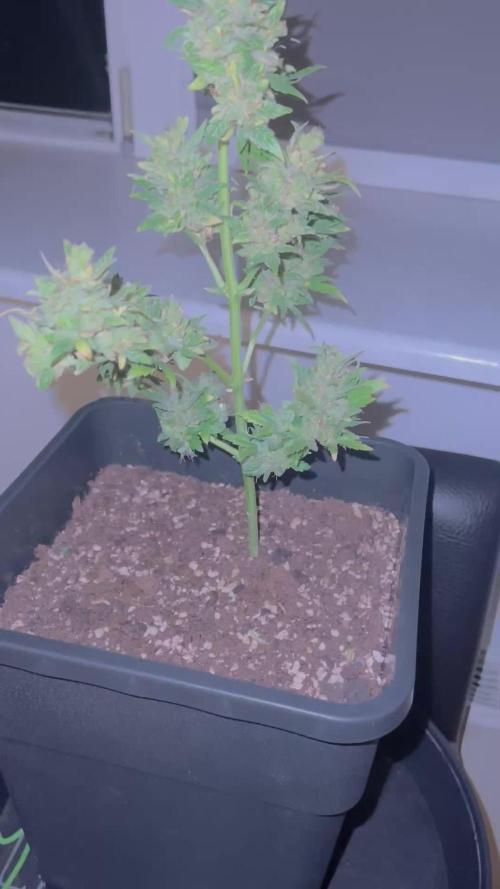
Ich war letzte Woche ziemlich im Stress weshalb ich die kleine Prinzessin, bis auf tägliches gießen natürlich, sich selbst überlassen habe. Ich habe jetzt nochmal die größeren Blätter entfernt und frische Erde ausgefüllt, damit sie jetzt ins Finale starte kann. Ich bin froh, trotz der wenigen Vorerfahrung zu diesem Punkt gekommen zu sein. Nun dauert es nichtmehr lange 😬
Likes
16
Share
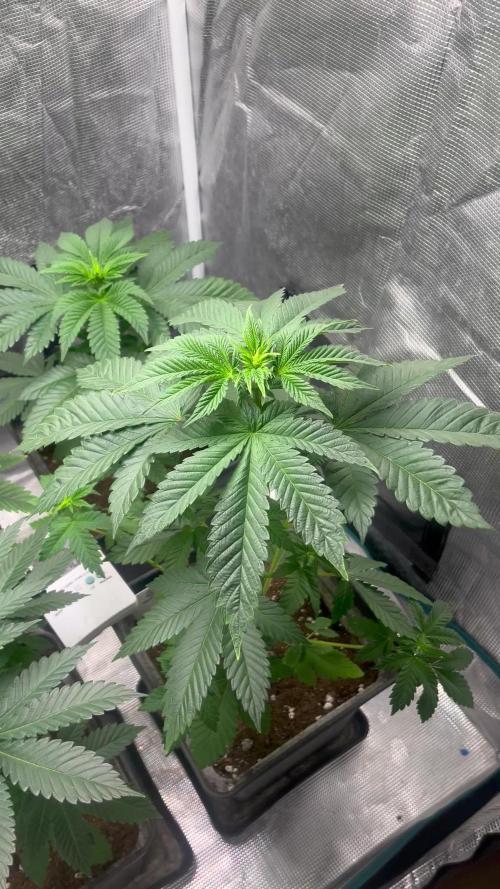
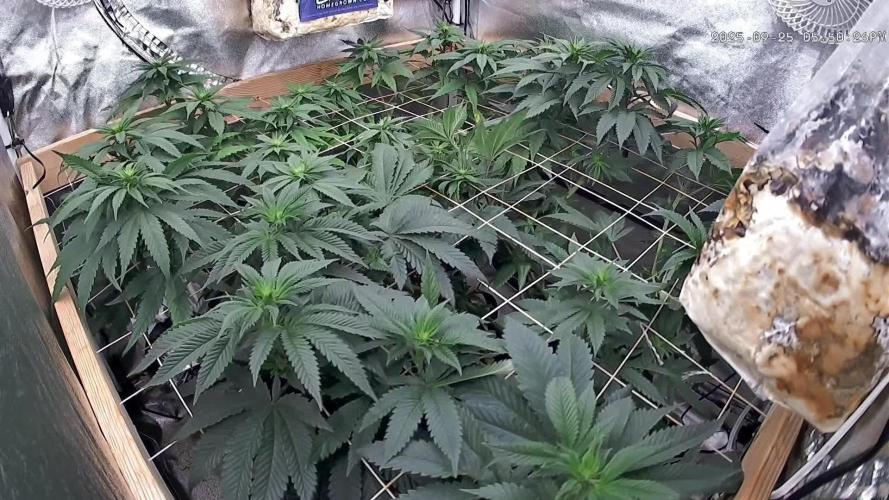
Die fünfte Woche startet mit einer (Teil-)Entlaubung, das Blätterdach ist wieder sehr dicht gewachsen. Die Blätter bekommen wieder ein satteres grün. Irgendwann innerhalb der nächsten Wochen sollten sie ihr Geschlecht zu erkennen geben, noch sind sie etwas schüchtern. Ich sehe die ersten Anzeichen, kann es aber noch nicht klar deuten - abwarten und Tee trinken. Ich habe dem Wassertank meines Autopot Systems einen Luftstein hinzugefügt. Wird das einen großen Effekt bringen? - keine Ahnung. Kann es schaden? - ich denke nicht. So langsam zeigen sich die ersten weiblichen Vorblüten, ich kann aber noch nicht bei allen 13 Pflanzen mit Sicherheit das Geschlecht bestimmen.
Likes
6
Share
💚 Amnesia Haze Auto by Zamnesia – Pheno B Week 6 | Quiet Confidence Begins to Bloom Welcome back to another chapter of the 8×8 Adventure! Growing multiple phenotypes side by side is one of my favourite parts of this project because every week nature reminds us that there is no such thing as a "correct" way for a plant to grow. Pheno B has chosen a completely different rhythm from her sister. While Pheno A stretches toward the ceiling with long internodes and a very expressive narrow-leaf structure, this lady prefers patience. She's shorter, more compact, and slightly behind in her overall flowering development, yet she's thriving under exactly the same conditions. Same room. Same lighting. Same nutrients. Same watering. Same training. The only thing that's different is the genetics expressing themselves in their own unique way. And that's exactly why phenotype hunting is so fascinating. 🌱 The 12/12 From Seed Journey For anyone joining this diary for the first time, welcome! Every plant in this project has been grown under a 12 hours on / 12 hours off light schedule from the day the seeds germinated. Rather than extending the vegetative stage, this method allows every phenotype to reveal its natural growth habits much earlier, making it easier to compare structure, stretch, flowering speed, and overall efficiency. Watching sisters grow into completely different plants while sharing the exact same environment is one of the biggest rewards of this experiment. Pheno B is proving that slower doesn't mean weaker—it simply means different. 🌿 A Compact Personality Standing at around 69 cm, she's noticeably shorter than her sister, but she's beginning to develop a personality all her own. Her internodes remain tighter. Her branching is beautifully balanced. The canopy is naturally organised, giving every future flower plenty of access to light without requiring much intervention. The overall impression is of a plant that's taking her time, investing in structure before committing fully to flower production. The first pistils are now multiplying across every growing tip, and although she's still stretching slightly, it's clear that flowering has become her main priority. Sometimes genetics prefer to build slowly before rewarding us later. This may very well be one of those plants. 🌸 Flower Production Is Taking Over This week marks an important shift. The explosive vegetative growth is beginning to slow, while clusters of fresh white pistils continue appearing across every branch. Instead of producing dramatic vertical growth, she's now directing more of her energy toward building the framework that will eventually support her flowers. Watching this transition happen is always exciting because it's the point where each phenotype begins revealing how it intends to build its harvest. Every week, her own personality becomes a little clearer. 🍃 Gentle Training, Natural Development Training continues to be intentionally minimal. Low Stress Training performed earlier in the grow has already created a balanced structure, so this week only occasional leaf tucking was needed to keep developing flower sites exposed. Rather than removing healthy leaves, I prefer allowing them to continue acting as efficient solar panels while simply repositioning them whenever necessary. Healthy leaves mean more energy. More energy means stronger flowers. Sometimes the best decision is knowing when to leave the plant alone. 💧 Feeding the Transition Into Bloom As with the rest of the room, Pheno B is now receiving a flowering-focused feeding program while still supporting the final stages of stretch. This week's nutrient schedule includes: • Plagron Terra Bloom • Plagron Power Buds • Plagron Sugar Royal • Plagron Pure Zym • Plagron Green Sensation • pH adjustment using pH Plus and Lemon Kick This week also introduces one of my favourite bloom additives: Green Sensation. Rather than simply boosting phosphorus and potassium, Green Sensation is designed as a complete flowering enhancer, supporting flower development, nutrient efficiency, resin production, and overall plant vitality during the final weeks of bloom. I like introducing it gradually as the plants begin committing fully to flowering, allowing them to transition naturally while preparing for the heavier bud-building phase that's still to come. So far, she's responding beautifully. 🌡️ A Stable Environment Every phenotype in this room continues sharing the exact same environmental conditions, allowing genetics—not environmental fluctuations—to tell the story. Current conditions include: • Day temperature: 29°C • Night temperature: 25°C • Relative humidity: 60% • pH: 6.0 • EC: 1.78 mS/cm • Root zone temperature: 21°C • Nutrient solution temperature: 21°C • CO₂ concentration: 639 ppm Consistency remains one of the most valuable tools in any grow room. When the environment stays stable, the plants can dedicate their energy to growing instead of constantly adapting. 📸 This Week's Gallery This week's photographs perfectly capture the personality that's beginning to emerge. The full-plant portraits showcase a compact, balanced structure with excellent branch spacing and a strong central leader that's quietly taking command of the canopy. The close-ups reveal fresh clusters of white pistils forming at nearly every growing tip, signalling that flowering is now well underway. One detail I particularly enjoy is how organised her architecture feels. Nothing appears forced. Every branch has found its place naturally, creating a canopy that's both easy to manage and full of future potential. She's not trying to compete with her sister. She's simply becoming herself. And that's exactly what makes phenotype hunting so rewarding. 🔮 Looking Ahead Over the coming weeks I expect Pheno B to continue slowing her vertical growth while shifting more and more energy into flower production. If her current structure is any indication, she could develop into one of those wonderfully manageable plants that quietly surprises everyone at harvest with dense, beautifully stacked colas. Every week her confidence grows a little more. Now it's time to watch those flowers do the same. 💚 Thank You Thank you so much for following another chapter of this 8×8 Adventure. Watching two sisters grow side by side, sharing the exact same environment while expressing completely different personalities, continues to remind me why growing from seed never stops being exciting. A huge thank you to: 💚 GrowDiaries for providing an incredible platform where growers from around the world can learn, inspire one another, and document every stage of their journeys. 🌱 Zamnesia for providing the outstanding genetics that make this phenotype hunt possible. 💜 Plagron for supplying the nutrition supporting these ladies from seed to harvest. 💡 Future of Grow LED for delivering the consistent light powering every day of this grow. 🌿 TrolMaster for helping maintain a stable environment where each phenotype can express its full genetic potential. And finally, growers love to everyone following these diaries, leaving comments, sharing knowledge, and joining me on this adventure. Every phenotype has its own story. Pheno B may be telling hers a little more quietly... ...but she's making sure it's worth listening to. Growers Love 💚🌿
Likes
44
Share
Today is day 10 of flower, and this girl is stretchin as she should... this grow has been flawless from the second I dropped the seed in the medium.. Great vigor all she wants to do is grow .. i love Maxibloom...Zamnesia Seeds is 2 for 2 i think.. The watermelon candy turned out to be a banger, and this Sundae Driver 🍨 is looking like she's gonna be the same. She has a smell coming from her already, and there's not even a bract in site.. Thank you to everybody stopping by given a like in saying hi, I hope and pray everybody's doing well. And as always thank you to Zamnesia Seeds for sponsoring this grow.. definitely check them out.. God bless everybody and happy growing ✌️https://www.zamnesia.com/us/35-cannabis-seeds/368-zamnesia-seeds
Likes
25
Share
End of the fourth week of flowering. The stretch being finished and the buds starting to grow, I added a little PK 13/14 to the soup Shark. They are the most advancing in flowering. The buds start to form well, the plant although rather small develop buds that promise to be very interresting.
Processing
Likes
5
Share
@Mrg7667
Follow
Smoke is still present here in colorado! Blocking some sun later in the day definitely in the atmosphere you can smell it. Not sure how bad its affevting the babies! They look and smell great really starting to get a candied chem smell 🙏 going to pluck next week for light penetration Also biogrow was expired swapped for fishmix! Seemed to handle okay so far
Likes
14
Share
@TOMI08
Follow
74.nap A videón az első egy special kush kush Tegnap ketté lehúztam a lombkoronát mert sűrű volt..így több a fény és a levegő... Mindig 3.napon itatom
Likes
13
Share
Eccoci qui... Tutto va per il meglio, questa settimana si inizia a vedere la resina e ora si inizieranno a formare le cime, per questo aggiungo Sugar Shot di @xpertnutrients vedremo l'evoluzione settimana prossima. Odore intenso di Big Bubble, strato di resina pazzesco e numero di cime formate più alto di tutto il ciclo, sono molto curioso di questa varietà.... STRAORDINARIA Grazie a tutti per il supporto🔥🌲❤️
Likes
16
Share
Watered 1 gallon plain ro each Flip next week Top dressed friday
Likes
20
Share
Harvest week! Awesome smell! Coco wins big time vs the peat! Just hoping that there are not too many seeds :)
Likes
6
Share
Likes
19
Share
@BB_US
Follow
These ladies are doing amazing things and swelling up day by day. Smells so sweet 🌿💚
Likes
2
Share
67 days since April 16th, 2026 We become aware at such times of man's wonderful ability to bring seemingly unrelated elements into harmonic balance, and receive a glimpse into a world where everything exists in conscious sympathetic attunement to everything else. When we listen to a piece of music that seems to strike a beautiful chord somewhere inside us, or view a painting that simply glows with harmonic awareness well executed, we probably do not spare much time to contemplate the wonderfully intricate combination of vibrations that our sensors make it possible for us to perceive. We tend to appreciate the relationship between the parts of something by an awareness of the harmony or dissonance of the whole. This ability enables us to say "what a beautiful house!" instead of "analysis has proven that this collection of building materials exhibits certain elements of harmonic proportion." While this ability to instinctively appreciate the beauty of true harmony has an important role to play in evolution, a more analytical understanding of the laws involved can be most useful. This is especially so if we wish to create works of art where each part exists in true harmony, not only with the other part of that particular whole, but with the universe within which the creator and the created exist. Everything vibrates. From the most dense matter to the most subtle cosmic rays, everything which our senses allow our thoughts to become aware of, can be specified in terms of wavelength or frequency of vibration. These two terms define the same thing, but from different points of view. The following are the approximate wavelengths of various energy carriers: Cosmic rays 0.000,000,001 mm Gamma rays 0.000,000,1 mm X rays 0.000,500 mm Ultraviolet rays 0.003 mm Visible light 0.006 mm Infrared 0.01 mm Sound waves 1 meter Radio waves 300 meters Violet light 400 nm to 450 nm Blue light 450 nm to 500 nm Green light 500 nm to 570 nm Yellow light 570 nm to 590 nm Orange light 590 nm to 610 nm Red light 610 to 700 nm 1 nanometer (nm) = 0.000,000,1 cm = 1/10,000,000 cm If a guitar string is plucked and we hear a sound, it is not too difficult for the human mind to associate this sound with the vibration of the guitar string. With color it is quite different. It is difficult for us to conceive that the color of a substance is not an inherent property of the substance itself, but an indication picked up by our senses of that substance's ability to absorb or reflect the light which happens to be shining on it at that moment. Neither the matter nor the light is colored. What happens is that the brain learns to differentiate between the frequencies reflected or transmitted by the substance the eyes are focused on. The same thing happens with sound. When we say "Oh! Listen, they're playing my favorite song," what we really mean is: "My brain has stored within it a particular pattern of frequencies. I have compared the new information being received with this stored pattern and have deduced the answer that the two patterns are similar within certain specified tolerances." The 'pleasure' involved could have something to do with our running the pre-recorded pattern at the same time, in 'sympathy' with the new pattern as it is received. The word sympathy describes very well our ability to appreciate color and sound. It also describes the reason behind certain elements of harmony. For instance, if a substance vibrating at 100 cycles per second (tone 1) is in the proximity of another substance vibrating at 200 cycles per second (tone 2), we could perceive, if we had the right equipment, a certain sympathetic relationship between the two. We will see from this that there is a uniform doubling of the first tone seen in the second. At various points along the waves, the two are the same in amplitude. At other points, they are at opposite poles to each other. This doubled frequency has more points of similarity to the original than any other frequency except the original itself. If the equipment we had available for measuring these two frequencies was a soundboard amplifier and a pair of ears, then we would hear what would sound to us like one tone. If we had the opportunity to hear one at a time, we would hear that although they sound the same, one is higher in pitch than the other. This characteristic of 'the same but different in pitch', musicians have called the octave. Any two tones produced where one has exactly doubled the frequency of the other is called an octave. Speaking in ratios, an octave would appear then as the ratio 2:1 or 1:2, depending on whether we are talking of an octave up or down. A single note produced by almost any instrument will contain more than one wavelength or frequency. It will have a dominant frequency, the wavelength of which we would call the note's 'fundamental' or 1st harmonic. It will also have a varying number of upper harmonics, gradually fading in intensity into infinity or silence. Natural harmonics always have the same pattern of intervals between them. The interval between the 1st and 2nd harmonic is a perfect octave; between the 2nd and 3rd a perfect fifth; between the 3rd and 4th a perfect 4th; and so on, the intervals becoming smaller and smaller until they lose any relationship with the western 12 tone scale as it exists at the moment. Just as an octave has certain elements of sympathy with its fundamental, so some intervals have been noted to be more perfectly in sympathy with the fundamental than others. The ratio of the 'perfect 5th' or interval of 7 semitones, as it occurs in the harmonic series, is 3:2 or 2:3, while that of the 'perfect fourth" is 4:3 or 3:4. All the tones in the western 12 tone scale can be expressed in terms of the ratio between the upper tone and its fundamental. This would seem to be an ideal way of generating a scale from any given fundamental and several attempts have been made to do this, the Pythagorean system being probably the most well known. Although when working with a single tone instrument playing on its own, the Pythagorean formula works wonderfully well, if we had several instruments tuned this way together and asked them to play almost any western music, we would find that at times they sounded quite out of tune to each other. The lack of flexibility of the various scale systems based on the harmonic series has led to what is known as the 'tempered' scale. This uses as its primary unit of interval the ratio of the octave or 2:1. It then proceeds to divide the interval between any fundamental and its upper octave into 12 smaller intervals by applying the ratio: two to the one-twelfth power, to one (21/12:1). This equals 1.059463094, so by multiplying any frequency by this number, we will obtain the tempered semitone next up from our fundamental. We will also find that any tone twelve semitones up from any other tone, in a scale generated in this way, will have exactly double the frequency. If we took the note middle C on a piano and halved the wavelength, we would have the note C one octave above. If we halved this, we would have the C above, and so on. However, within about 6 octaves, we would find that although a 'sound' was being produced, no human ear could perceive it. If we kept on going, halving and producing upper octaves of our fundamental C, we would proceed through the infrared band, into the visible light spectrum. If we happened to be outside during the day, we would, for one octave only, see the note C with our eyes. The next octave above would already be in the ultraviolet band, and outside the eye's sensitivity range. If we can think of color as being an indication of a substance's vibratory rate or wavelength, we may begin to see a relationship that could exist between the color and sound spectrums. The logical extension of what has so far been said is that there exists a scale in the color spectrum that corresponds exactly to the scale in the sound spectrum, each color tone being an octave of the equivalent note in the sound range. This is not the end of the story but only the beginning. If we can for the moment accept that any wavelength in one band has upper and lower octave stretching out to infinity, then the next question is 'fine, but what shall we use as our fundamental? A particular color? A particular sound frequency?' The musicians among us will probably say 'A 440'. This means that the note A should vibrate at 440 Hertz, or 440 times per second. They would tell us that this is standard pitch has been adopted by most orchestras around the world; pianos are tuned to it, instruments are constructed to formulas based on it, and so to them it would probably seem the most appropriate place to begin. Some of these musicians may know of the battle that is still raging with regards to this being the standard, but few would know why A = 440 Hz was chosen except that it worked when it was set to be a suitable compromise between the many different pitches in use at the time. 432 Hz is said to be mathematically consistent with the patterns of the universe. Studies reveal that 432 Hz tuning vibrates with the universe’s golden mean PHI and unifies the properties of light, time, space, matter, gravity, and magnetism with biology, the DNA code, and consciousness. When our atoms and DNA start to resonate in harmony with the spiraling pattern of nature, our sense of connection to nature is said to be magnified. Another interesting factor to consider is that the A=432 Hz tuning correlates with the color spectrum, while the A=440 Hz is off. Audiophiles have also stated that A = 432 Hz music seems to be non-local and can fill an entire room, whereas A=440 Hz can be perceived as directional or linear in sound propagation. Once you adopt the idea that sound (or vibration in general) can have an equalizing and harmonizing effect (as well as a disturbing effect), the science of harmony can be applied to bring greater harmony into one's life or tune to specific energies. There is a form of absolute and relative harmony. Absolute harmony can, for example, be determined by the tuning of an instrument. The ancients tuned their instruments at an A of 432 Hz instead of 440 Hz - and for a good reason. There are plenty of music examples on the internet that you can listen to in order to establish the difference for yourself. Attuning the instrument to 432 Hz results in a more relaxing sound, while 440 Hz slightly tenses up the body. This is because 440 Hz is out of tune with both macro and micro cosmos. On the contrary, 432 Hz is in tune. To give an example of how this is manifested microcosmically: our breath (0,3 Hz) and our pulse (1,2 Hz) relate to the frequency of the lower octave of an A of 432 Hz (108 Hz) as 1:360 and 1:90. It is interesting to note that 432 Hz was the standard pitch of many old instruments and that it was only recently (19th and 20th century) the standard pitch was increased. This was done in order to be able to play for bigger audiences. Bigger audiences (more bodies) absorb more of the lower frequencies, so the higher pitch was more likely to “cut through”. One of the oldest instruments of the world is the bell ensemble of Yi Zeng (dated 423 BC), tuned to a standard F4 of 345 Hz, which gives an A= 432 Hz. The frequency of 345 Hz is that of the platonic year! Similarly, many old organs are tuned in A=432 as well; for example, St. Peter’s Capella Gregoriana, St. Peter’s Capella Giulia, S. Maria Maggiore in Rome. Maria Renold’s book “Intervals Scales Tones and the Concert Pitch C=128 Hz” claims conclusive evidence that 440 Hz and raising concert pitch above scientific “C” Prime=128 Hz (Concert A=432 Hz) disassociates the connection of consciousness to the body and creates anti-social conditions in humanity. The difference between concert pitch A=440 Hz and Concert A=432 Hz is only 8 cycles per second, but it is a perceptible difference of awareness in the human consciousness experience of the dream we share called existence.
Likes
Comments
Share
This week the new growth of the plants transitioned from looking relatively healthy to droopy and yellowed. I wasn't sure what the issue was at first and thought it might be light stress. After more research, I determined that I had what looked very much like a zinc deficiency, which is almost always a symptom of over-watering, which is the most common mistake for new growers, i.e. "Me". I had assumed that adding a good amount of perlite to my soil and using smart pots would prevent me from running in to any drainage issues but I guess not. I was up to 1.5 liters per plant when I realized that it was too much. I also realized I was misreading my syringe which I use to mix nutrients, and that i had been giving only 1/10 of the liquid nutrients that I thought. I'm super embarrassed about the mistake but I'm going for full transparency here, so there it is. Course correction takes places after day 31.
Likes
7
Share
@Jason420
Follow
Eine Genetik die mir echt Spaß bereitet hat groß zu ziehen. Extrem schöne Headbuds und extrem Starkes Trichomenbild. Die Trichome überzeugen nicht nur in der menge sogar noch in der größe, so riesige teilweise dazwischen was mir einfach ein lächeln auf den Mund zaubern. Der geruch als auch der geschmack ähneln sich sehr. Eine Blumige Tropische Note mit einem leichten Herben Kiefer Hintergrund. Cinderella Jack zu rauchen knallt stark und hält lange an. Die Sativa richtung kommt eher raus mit einem schönen Kopf high und einem angenehm entspannten Körper.