

Likes
5
Share

@sunshinegroww
Follow
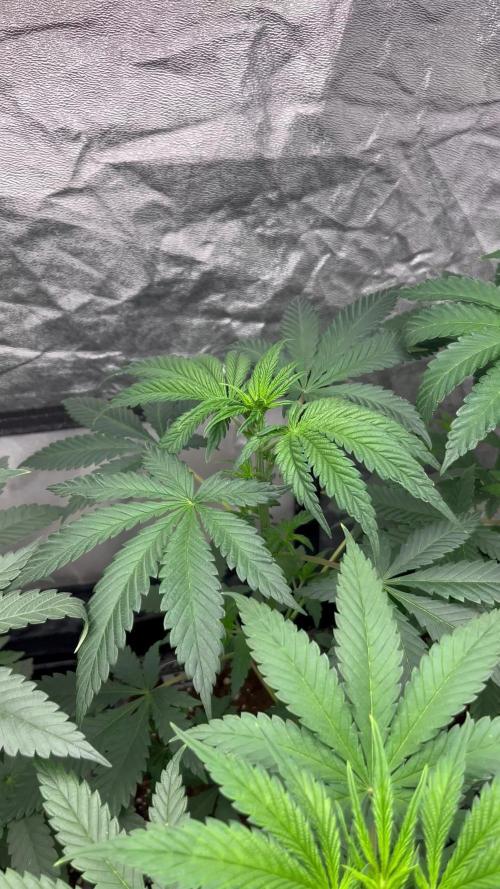
Flowers starting to appear now very happy indeed and thirsty currently 1.2l every 2 days i like it nice open structure leta goooooo
Processing
Likes
37
Share


@MG2009
Follow
09/12/2018
Purple tip cutting seems to be taking .#1 is filling out well lots of fresh flowers stacking up nicely.#2,#3,#4 all doing well👍hope they finish up in 4weeks🙏 No feeding this week just molasses for soil microbes,
09/17/2019
Did some defoiliating and green tie 's to spread out lower branches on #1 . she is a beast. Seeing, some differences between #2,#3,#4 .#4 being darker green, #3 is paler green #2 not as pale, #1 lighter green but not pale at all. Given deep soaking today, and I noticed phase 3 flowering is starting!🙏 should start stacking them fat buds for next couple of weeks hope she done at 10 weeks fingers crossed.


Likes
5
Share


@Ninjabuds
Follow
Man, that plant is really taking off. It's finally starting to look just like the good old Gas House Parent. I can almost smell it already. Can't wait to see how much bigger it gets!
Well, another year has come and gone. Yesterday was New Year's Eve, and I want to wish all of you a happy and healthy 2025. May this year bring you all the things you've been wishing for. Let's make this the best year yet!
Likes
28
Share


@cyberkyd
Follow
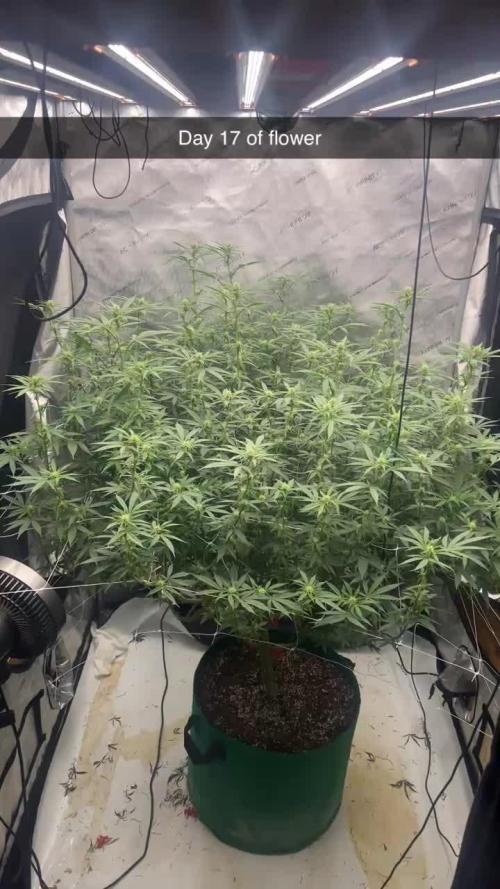
Week 5 Updates : -
Plants are in their stretching and 3 out of 4 grows are not in flower yet. I took this opportunity to do Some LST with minor defoliation by bending branches and about 1 day before writing this I used proper LST equipments rather than DIY. Almost all have got 9 Branches. And my attempt is to at least have them stretch wider and healthier if not bushiest. But has definitely gone benefiting and I can already see the difference since I left one of the OG plant completely Untrained and you can see the difference which one is which. Mars Hydro Dimmer after working for a while Broke again( third time it fixed and broke again) throwing 100% light again so I ended up restoring the Light height to almost Max 110cm from plants top to distribute about 350-400 PPFD here and there.
Hoping my 2*2 to arrive soon so I can fit these new batch of 3 plants into that tent.
PEACE.

Likes
7
Share


@Skinnytalls420
Follow
Day 73-25/5/23 So only got 3.30g wet of this tiny pot! It’s a very small pot probably a joint after drying 😅😂 we will try again!!! But does smell amazing 🤩
Likes
4
Share


@Kronen
Follow
Mohawk Meds: Banana Flambe (BF): Week 4 (28 Days from seed) looking healthy and growing like triplets. Received results from Genetic gender testing and BF #1, #2, #3 are all Females, #5 Male and was culled. All were transplanted to 1-Gal Pots in Sohum Living soil for Cannabis with Wollastonite mineral (Silica/Cal) & Mycorrhizae fungi additive. Slightly light green from a bit of overwatering otherwise healthy. Environment: 78F, 52% RH, 600ppm CO2, & 750-850ppfd. 👌
Likes
Comments
Share

@Darsilius
Follow
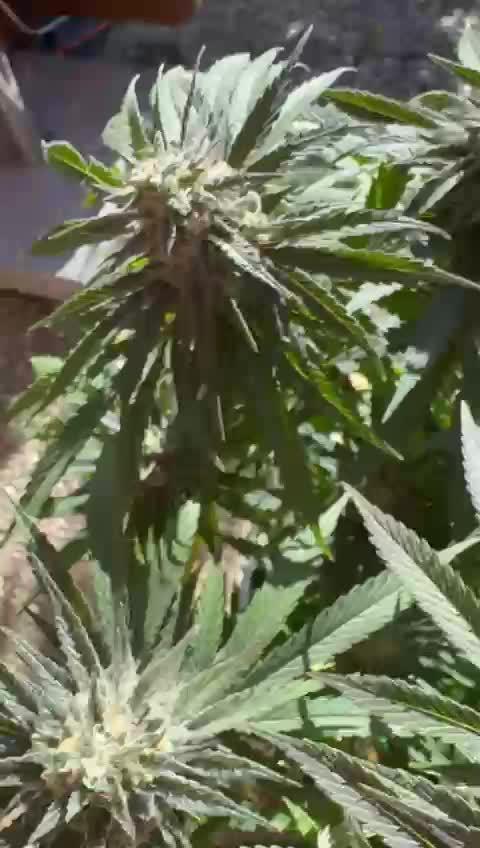
Next week of flowering
Some of girs are preparing for the final ferts
I add more grams and katana dragon force to the tank and now U will see thje magic of SHOGUN !
😁


Likes
57
Share


@PEAKYPLANTERS
Follow
Oh yes, my friends .... Peaky is back stronger than before to compete with the best!
Take a look at my updates
The best crops and
best regards


Likes
11
Share


@ButterfliesLittleFarm
Follow
Hello Diary,
In the end I can only say well done Royal Queen Seeds.
I have grown a total of 4 out of 8 new hybrid F1 strains so far and all of them exceeded my expectations.
Apollo F1 is no exception, although it was the smallest on the Farm, the flowers are the hardest and incredibly fragrant.
During the entire cycle of growth and development, it proved to be very resistant, so that the plant looked impressive until the very end.
The effect of Apollo F1 is relaxing, so I can consume it during my free time as well as when I am engaged in some creative work. It certainly removes stress and bad mood.
At the end of drying, I got a little less than 50g, 49g to be exact, which is satisfactory especially because of the high quality flowers.
I think I have mostly written everything that I thought was important, if anyone reading this text has any questions about Apollo F1, feel free to ask, I will be happy to answer.
I would like to thank everyone for their support and comments, and especially Royal Queen Seeds for their many years of support.


Likes
15
Share


@Drgreenthumb627
Follow
smells deeply of mandarin oranges, buds are frosting nicely but still quite small
Likes
Comments
Share

@eldruida_lamota
Follow
Que pasa familia, vamos con la quinta semana de vida de estas Forbidden Mochi feminizadas de Seedstockers.
Vamos al lío, las plantas se trasplantaron a macetas de 7 litros.
El ph se controla en 6.5, la temperatura la tenemos entre 24/22 grados y la humedad ronda el 70%.
El ciclo de crecimiento puse 20h de luz, el foco está al 50% de potencia.
Me gustaría estar más encima este cultivo pero la salud me está impidiendo un poco este 100% con el proyecto. Con suerte la semana que viene andaré mejor.
- os dejo por aquí un CÓDIGO: Eldruida
Descuento para la tienda de MARS HYDRO.
https://www.mars-hydro.com
Hasta aquí todo, Buenos humos 💨💨💨

Processing
Likes
13
Share


@DrewbieDoobieNoobie
Follow
Dear Grow diaries, I have to listen to what the plants are telling me. looking at the the yellowing of the fans and the trichomes cloudy and amber I think its time to flush as I am 2 weeks out from harvest. This will put the Think different at 77days of flower and as I off set the Fast buds and MSNL by 14 days they should "Theoretically" finish at the same time. I needed this to happen because I only have one tent and it will serve as a drying and curing area. I replace my filter this year and my filter exhaust fan fell on the tangie matic I thought I killed it but its still hanging in there. I flushed with the Clean Fruits from Green Buzz today just over a gallon in each plant. I will flush again with 5 gallons in each pot tomorrow. The tangie and the Carmelicious were very dry the smoothie and the think different were still kind of heavy they are more Indica. I don't know if that has anything to do with it or not. 2 more weeks till 48hrs of darkness and then the chop. The End Has Begun.


Likes
11
Share


@Microsun
Follow
This strain has a very interesting high, I and my girlfriend did a test on her at about week 2 of cure and found she has a very sweet minty mango tinge, but a more of a minty tea smell with a bit of sour tinge once you crack that bud open to put it in the grinder. She smokes amazing all white ash and a very dense but romantic softness to her. At first I was bummed smoking this strain because knowing it only peaks at around 17% supposedly I did not expect a very strong bud already, but when I smoked her I got almost a very gradual increase after a few minuets of puffing almost like a euphoric wave was slowly rushing over my eyes and head like a tide coming in on a beautiful night after a long day at the beach. I felt quite sativa stoned with it growing in intensity in my face and eyes, then after I finished my joint I went inside for a glass of water and as soon as I sat down, it really hit me and my girlfriend right in the ass, I was couch locked and so was she, but in a very odd way, I was not indica deep, but I was more a good hybrid deep, a very relaxing eye and face buzz with quite relieving muscle tension I felt amazing, my body was so bloody relaxed! I felt just comfortable like a cozy blanket and a fire on a cold December day, hot chocolate in hand. This strain from start of smoke, to burn out was a very calm and needed high for me and my lady. We both burned out and slept like rocks, like someone had just given the worlds best massage in my brain and bones. I woke up the next morning feeling quite refreshed after that eye relaxing euphoric head high and my back and legs felt very relaxed and ready for a great day! So in my opinion! A good 6/10 for max potency but a 10/10 for flavour and enjoyment. Over all I give this strain a 8/10 in my books, a 17% is all I need and I’m betting she came out around that, of course without lab testing I can not prove that. But I love this strain and the high it gives, one single 0.5 joint got me fried, and the next day I finished off 3 bowls and went to fucking muchie land so he’ll yeah! Give candy cane a try!! Also! Sorry about the lack of info! I did not have a scale when it was in wet weight, I also had a whole half a plant chopped to branches and the big buds left on the plant to hang dry slow, so I was not able to get it on a scale until dried a week later due to my work schedule and having stores open as I’m in the shop and close as I leave.

Likes
11
Share


@Skunkiest_bender39
Follow
Ende von Woche 4 ist zu sehen, die Mädels wurden geFIMt allerdings mit einer Rasierklinge.
Die beiden krumble brauchten dringend Dünger, der verbrauch steigt deutlich an. Habe von 5 auf 7 ml/L erhöhen müssen auch bei den Zake.

Likes
11
Share


@NachoTheDog46
Follow
30 Jan 2022
Grow tent running now 30 days now.
Oldest plant is about 20 days old and youngest plant is about 10 days old. Of the 9 plants 8 plants are doing great only the 2nd Blueberry Banana is suffering a bit, i'll keep an eye on it if don't get better in a few i'll remove and I change it with a new seed.
In the pass week i moved the lamp at 40cm from the ground and till yesterday i runned the lap at 75% of his power , from today 30-1 the lamp is running at 100% of his power.
Light regime ☀️21/3🌑 temp ☀️25/28.5 🌑 17.5/24
🌧️☀️🌧️

Auto Blueberry Banana · Anesia Seeds

Wedding Cake Automatic · Zamnesia Seeds
Do-Si-Dos Automatic · Zamnesia Seeds
Girl Scout Cookies Automatic · Zamnesia Seeds

White Choco Autoflower · Amsterdam Genetics

Californian Snow Auto · Fast Buds
Diesel Automatic · Zamnesia Seeds

Purple Power Auto · Amsterdam Marijuana Seeds AMS