


Processing
Likes
Comments
Share


@Ferenc
Follow
No more fertilization. They will be harvested in 2 weeks very stinky ones.... Alll good just keep flushing them and removing upcoming yellow leaves. :) They are quote wet so just giving them 200ml.of water a day to.not to over water them.


Processing
Likes
6
Share


@MissSolasolita
Follow
End of week 6 flower
Time to flush I think
She looks done already and I have had to string all the buds up
as she was falling over
There's a ton of bud on this plant
Roll on the next couple of weeks

Likes
25
Share


@Belverde
Follow
Ola guys.. First day of flowering for this two super Cookies Kush plant..
For now they aren't directly under the Black Dog light😍, because I don't have much space...but in a couple of days I want to put they in better and definitely position..
I cut off some leafs and small branches, and I spraying they with a mix of 2 ml Acti-vera and 2 ml Fish-mix..and they, apparently, responds well..
I never do it before..so..we will to see what's append..
Hope the best, and.. Thanks for the time to reading🙏..
See you next week.. bye 😊✌️

Likes
20
Share


@LaGrassaFarm
Follow
Muy buenas, otra semana más por aquí!
Pues ya está la floración bien encaminada para el éxito!🙏
Esta semana le hemos dado la máxima dosis del fertilizante Basis, y le hemos subido también la dosis del C4.
Ya han empezado a mostrar sus lindos aromas, y a cambiar un poco el tono de sus hojas.
Un saludo y buenos humos!👋

Likes
3
Share


@maxpain
Follow
Missed one week off uploads was real busy but this one coming along good ...smells real strong ..cant wait...the orgainic way......
Likes
31
Share


@Mrs_Larimar
Follow
This Spring I was asking @James from RQS, wich recommendations he can give for Good Outdoor Performer in my Country. ( Northern Europe)
Because most of the Year i have to Harvest earlier due bad Weatherconditions.
Because in 3rd .of September, weather changes, and big Rain begins
He recommended me Honey Cream and Speedy Chile
So I started Grows with this Strains
And its a Superstrain!! for my Conditions,
That means they get ready in Time, before everything gets worse
Great growing Strain, very big and stable Branches, .........When they started Flowering they go in Overdrive
The Result is a wonderful strong Plant, filled on and on with Buds
Today we harvested The Lady in the 75l Growpot
On Sunday the Lady into the ground, gets Harvested
We made some Photoshooting and Videos to show her Beauty, but its nearly impossible To catch her in Pictures
but we tried
Luckyly ii nvented in a wet trimming machine, and the Lady was cut down in short Time,
and gave us a good Number ( i have no cluehow much,,,Iam guessing for 300 g)
Sunday October 4th
Second Honey Cream was Harvested, She had agood shot Of Purple due Cold nights.
She was so fresh , when I took of the Bif Leaves, they made asmacking Sound
Plant Number 2 was sitting in The Ground, I started fertilising her late( 2 weeks before Harvest), but not tooo Late
She nearly catched up , in Budbuiding her Sister.
So Thank you for those Gentics... its for me a "must to grow again Plant"
Iam going to write more on Sunday, about buds smell and resinousness

Likes
18
Share


@lino06000
Follow
en générale la stardawg auto de chez fastbud 420 a été très facile du début a la fin en gros une plante easy pour les amateurs

Likes
26
Share


@Gunnen
Follow
This week will be mostly keeping an eye on tying down new shoots as we progress into early flower and things are still able to be bent. Also as we are going into a total of week 6 from seed, I am amending the top soil with 3 tablespoons per pot (7 gal) of the 2-8-4, for the flowering stage. Also adding 1 tablespoon of the 4-4-4 all purpose per pot.
I originally messed up my measurements of nutrients. So the original medium had 6 tablespoons of 4-4-4 all purpose for a 7 gal pot with 1 tablespoon of 2-8-4 bloom. I have corrected those this week as well.
As I continue through the week I will be keeping an eye on the environment, keeping humidity lower and watering top soil to keep moist. Also some light defoliation where necessary to increase light penetration while I continue to LST.
So far things still seem healthy, aiming water to be with a PH of between 6.2-6.6 and dechlorinating for 24 hours. Strain is sitting lower and bushy, but quite a few bud sites.

Processing
Likes
21
Share


@Tuilejuggle
Follow
Well 🍪🍪🍪 that's my first one and hopefully I will manage to grow a big healthy girl without too much hassle.
I planted the seed on the last day of 2019 and germinated on 4th of January with some emotions. After two days in the germination room I transferred it in the smart pot from RQS which they say it's for 11 l but I managed to fill it with 20 l of organic soil mixed with GROW CAPS.
Follow my journey and help me with your advices.
What do you think? It's a good start or not so?
Likes
50
Share


@6ix6ix6ix
Follow
07/09 - 3 days after breaking ground
On the second day had to remove the residue of the seed that was gluing the leaves together. Video attached
Turned the light to 50% and around 50cm from the plants.
All systems - check

Likes
22
Share


@715creeks
Follow
First grow using Fast Buds seeds, really looking forward to seeing this one for myself
Likes
60
Share


@Roberts
Follow
Alaskan Purple auto has sprouted, and is getting acclimated. She is under the Medical Grow Mini Sun 2. 🤞🏻for a killer plant for the contest. Thank you Medic Grow, and Seedsman. 🤜🏻🤛🏻🌱🌱🌱
Thank you grow diaries community for the 👇likes👇, follows, comments, and subscriptions on my YouTube channel👇. ❄️🌱🍻
Happy Growing 🌱🌱🌱
https://youtube.com/channel/UCAhN7yRzWLpcaRHhMIQ7X4g



Likes
60
Share


@BOMbolenath
Follow
The plant is developing well despite the high temperature.
During the week the weather got better, the plant is growing well.


Likes
Comments
Share


@Lily_Bloom
Follow
Noticed a little late that the plant needs more water than nutrients. Burned Frankensteins tips a little.
Likes
47
Share


@Ultraviolet
Follow
What's in the soil? What's not in the soil would be an easier question to answer. 16-18 DLI @ the minute. +++ as she grows.
Probably not recommended, but to get to where it needs to be, I need to start now.
Vegetative @1400ppm 0.8–1.2 kPa 80–86°F (26.7–30°C) 65–75%, LST Day 10, Fim'd Day 11
CEC (Cation Exchange Capacity):
This is a measure of a soil's ability to hold and exchange positively charged nutrients, like calcium, magnesium, and potassium. Soils with high CEC (more clay and organic matter) have more negative charges that attract and hold these essential nutrients, preventing them from leaching away.
Biochar is highly efficient at increasing cation exchange capacity (CEC) compared to many other amendments. Biochar's high CEC potential stems from its negatively charged functional groups, and studies show it can increase CEC by over 90%. Amendments like compost also increase CEC but are often more prone to rapid biodegradation, which can make biochar's effect more long-lasting. biochar acts as a long-lasting Cation Exchange Capacity (CEC) enhancer because its porous, carbon-rich structure provides sites for nutrients to bind to, effectively improving nutrient retention in soil without relying on the short-term benefits of fresh organic matter like compost or manure. Biochar's stability means these benefits last much longer than those from traditional organic amendments, making it a sustainable way to improve soil fertility, water retention, and structure over time. Needs to be charged first, similar to Coco, or it will immobilize cations, but at a much higher ratio.
a high cation exchange capacity (CEC) results in a high buffer protection, meaning the soil can better resist changes in pH and nutrient availability. This is because a high CEC soil has more negatively charged sites to hold onto essential positively charged nutrients, like calcium and magnesium, and to buffer against acid ions, such as hydrogen.
EC (Electrical Conductivity):
This measures the amount of soluble salts in the soil. High EC levels indicate a high concentration of dissolved salts and can be a sign of potential salinity issues that can harm plants.
The stored cations associated with a medium's cation exchange capacity (CEC) do not directly contribute to a real-time electrical conductivity (EC) reading. A real-time EC measurement reflects only the concentration of free, dissolved salt ions in the water solution within the medium.
98% of a plants nutrients comes directly from the water solution.
2% come directly from soil particles.
CEC is a mediums storage capacity for cations. These stored cations do not contribute to a mediums EC directly.
Electrical Conductivity (EC) does not measure salt ions adsorbed (stored) onto a Cation Exchange Capacity (CEC) site, as EC measures the conductivity of ions in solution within a soil or water sample, not those held on soil particles.
A medium releases stored cations to water by ion exchange, where a new, more desirable ion from the water solution temporarily displaces the stored cation from the medium's surface, a process also seen in plants absorbing nutrients via mass flow. For example, in water softeners, sodium ions are released from resin beads to bond with the medium's surface, displacing calcium and magnesium ions which then enter the water. This same principle applies when plants take up nutrients from the soil solution: the cations are released from the soil particles into the water in response to a concentration equilibrium, and then moved to the root surface via mass flow.
An example of ion exchange within the context of Cation Exchange Capacity (CEC) is a soil particle with a negative charge attracting and holding positively charged nutrient ions, like potassium (K+) or calcium (Ca2+), and then exchanging them for other positive ions present in the soil solution. For instance, a negatively charged clay particle in soil can hold a K+ ion and later release it to a plant's roots when a different cation, such as calcium (Ca2+), is abundant and replaces the potassium. This process of holding and swapping positively charged ions is fundamental to soil fertility, as it provides plants with essential nutrients.
Negative charges on soil particles: Soil particles, particularly clay and organic matter, have negatively charged surfaces due to their chemical structure.
Attraction of cations: These negative charges attract and hold positively charged ions, or cations, such as:
Potassium (K+)
Calcium (Ca2+)
Magnesium (Mg2+)
Sodium (Na+)
Ammonium (NH4+)
Plant roots excrete hydrogen ions (H+) through the action of proton pumps embedded in the root cell membranes, which use ATP (energy) to actively transport H+ ions from inside the root cell into the surrounding soil. This process lowers the pH of the soil, which helps to make certain mineral nutrients, such as iron, more available for uptake by the plant.
Mechanism of H+ Excretion
Proton Pumps: Root cells contain specialized proteins called proton pumps (H+-ATPases) in their cell membranes.
Active Transport: These proton pumps use energy from ATP to actively move H+ ions from the cytoplasm of the root cell into the soil, against their concentration gradient.
Role in pH Regulation: This active excretion of H+ is a major way plants regulate their internal cytoplasmic pH.
Nutrient Availability: The resulting decrease in soil pH makes certain essential mineral nutrients, like iron, more soluble and available for the root cells to absorb.
Ion Exchange: The H+ ions also displace positively charged mineral cations from the soil particles, making them available for uptake.
Iron Uptake: In response to iron deficiency stress, plants enhance H+ excretion and reductant release to lower the pH and convert Fe3+ to the more available form Fe2+. The altered pH can influence the activity and composition of beneficial microbes in the soil. The H+ gradient created by the proton pumps can also be used for other vital cell functions, such as ATP synthesis and the transport of other solutes. The hydrogen ions (H+) excreted during photosynthesis come from the splitting of water molecules. This splitting, called photolysis, occurs in Photosystem II to replace the electrons used in the light-dependent reactions. The released hydrogen ions are then pumped into the thylakoid lumen, creating a proton gradient that drives ATP synthesis.
Plants release hydrogen ions (H+) from their roots into the soil, a process that occurs in conjunction with nutrient uptake and photosynthesis. These H+ ions compete with mineral cations for the negatively charged sites on soil particles, a phenomenon known as cation exchange. By displacing beneficial mineral cations, the excreted H+ ions make these nutrients available for the plant to absorb, which can also lower the soil pH and indirectly affect its Cation Exchange Capacity (CEC) by altering the pool of exchangeable cations in the soil solution.
Plants use proton (H+) exudation, driven by the H+-ATPase enzyme, to release H+ ions into the soil, creating a more acidic rhizosphere, which enhances nutrient availability and influences nutrient cycling processes. This acidification mobilizes insoluble nutrients like iron (Fe) by breaking them down, while also facilitating the activity of beneficial microbes involved in the nutrient cycle. Therefore, H+ exudation is a critical plant strategy for nutrient acquisition and management, allowing plants to improve their access to essential elements from the soil.
A lack of water splitting during photosynthesis can affect iron uptake because the resulting energy imbalance disrupts the plant's ability to produce ATP and NADPH, which are crucial for overall photosynthetic energy conversion and can trigger a deficiency in iron homeostasis pathways. While photosynthesis uses hydrogen ions produced from water splitting for the Calvin cycle, not to create a hydrogen gas deficiency, the overall process is sensitive to nutrient availability, and iron is essential for chloroplast function.
In photosynthesis, water is split to provide electrons to replace those lost in Photosystem II, which is triggered by light absorption. These electrons then travel along a transport chain to generate ATP (energy currency) and NADPH (reducing power). Carbon Fixation: The generated ATP and NADPH are then used to convert carbon dioxide into carbohydrates in the Calvin cycle. Impaired water splitting (via water in or out) breaks the chain reaction of photosynthesis. This leads to an imbalance in ATP and NADPH levels, which disrupts the Calvin cycle and overall energy production in the plant. Plants require a sufficient supply of essential mineral elements like iron for photosynthesis. Iron is vital for chlorophyll formation and plays a crucial role in electron transport within the chloroplasts. The complex relationship between nutrient status and photosynthesis is evident when iron deficiency can be reverted by depleting other micronutrients like manganese. This highlights how nutrient homeostasis influences photosynthetic function. A lack of adequate energy and reducing power from photosynthesis, which is directly linked to water splitting, can trigger complex adaptive responses in the plant's iron uptake and distribution systems.
Plants possess receptors called transceptors that can directly detect specific nutrient concentrations in the soil or within the plant's tissues. These receptors trigger signaling pathways, sometimes involving calcium influx or changes in protein complex activity, that then influence nutrient uptake by the roots. Plants use this information to make long-term adjustments, such as Increasing root biomass to explore more soil for nutrients. Modifying metabolic pathways to make better use of available resources. Adjusting the rate of nutrient transport into the roots. That's why I keep a high EC. Abundance resonates Abundance.


Likes
13
Share


@YOUNGSTERBR
Follow
exagerei na rega até o meio da semana, deixei 4 dias sem rega e recuperaram, umas pelo estresse começaram mostrar défice de fósforo, fiz uma cobertura com torta de mamona, farinha de ossos, esterco de aves, humus de minhoca e calcário.
Qual foto colocariam de capa dessa semana?
Likes
71
Share

@Roberts
Follow
Quebec Blast is growing good still. She got heavy training today. A good defoliation to open center up, and lst has been steady on extending branches. Looking at about 3 weeks as this is the start of week 6 before light change. They are getting big fast so might be sooner. As long as I can keep the nutrition level in check since it is so little. The SE5000 should provide a good room of colas in the end. Light intensity is at 60 percent just with more distance between plant, and light. I just been adjusting to a lot of changes. New light and finding the spot the plants like. Which I believe I found the vegging sweet spot I might be just a little too strong on light intensity. Going off what the leaves were saying before defoliation. Plant seems fairly happy, and has really long roots going. Been changing the solution about once a week since it is only a gallon I use. Plus have been trying to get a good tds level the plant likes. Think I found it or am really close. She is in a New Level Hydro bucket. All is going good for now. Thank you Quebec Seeds, Spider Farmer, and New Level Hydro. Links below 🌱🤜🤛🌱
Thank you grow diaries community for the 👇likes👇, follows, comments, and subscriptions on my YouTube channel👇. ❄️🌱🍻 Happy Growing 🌱🌱🌱
https://youtube.com/channel/UCAhN7yRzWLpcaRHhMIQ7X4g
SE5000
https://amzn.to/3qFpAML
Spider Farmer Official Website Links:
US&Worldwide: https://www.spider-farmer.com
UK: https://spiderfarmer.co.uk
CA: https://spiderfarmer.ca
EU: https://spiderfarmer.eu
AU: https://spiderfarmer.com.au
Coupon Code: saveurcash
Www.newlevelhydro.com
Www.hygrozyme.com

Likes
4
Share


@alexb420
Follow
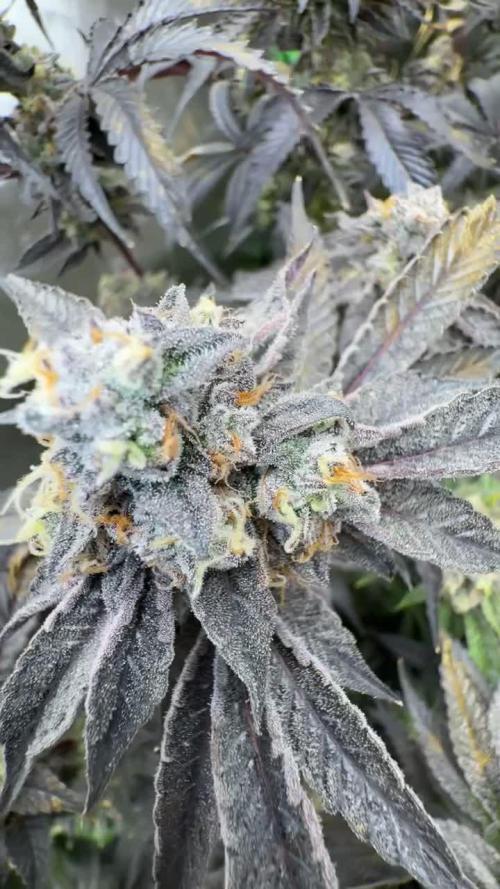
buds starting to get shape and trichs coming in nice. the blueberry muffin has such a unique berry pastry smell. no dank weed smell at all. the khalifa mintz x (bcc x jealousy) is still pretty gassy, with stronger fruit profiles on both strains now that the buds are starting to get fuller. update in a bother 2-3 weeks lol.
