


Likes
Comments
Share

@LueRootsGrowGermany
Follow
Hallo liebe Gartenfreunde,
Ein aufregendes Tagebuch geht fast Glücklich zu Ende. Alle eigen erwarteten Ziele wurden zwar nicht vollständig erreicht, Strainbedingt werden wir aber nicht noch mehr Energie dort hineingeben egal in welcher Form. Die Buds sind zwar schön fest und ansehnlich groß (hier bei Höchstleistung 400 Watt) aber insgesamt nicht ganz unser. Die Buds sehen fast identisch aus wie bei der crop Mutter aus dem letztenJahr. Die unterschiedliche Anbaumethode lässt jedoch keine genauen Schlüsse zu, was das vergleichen betrifft. Das Autopot System hatte jedoch zu anfang Probleme mit der Kappilare, wahrscheinlich daher da der Pott erst verspätet in das Autopot System kam und auch etwas zu trocken war. Sie sind ja vom Balkon draußen, in den innenbereich gezogen.
Ja ansonsten haben wir sie schön über 7 Tage gespült und über Kopf aufgehangen. Die Trichome sind von der Reife her soweit akzeptabel. Wir konnten einige Erfahrungen gut schreiben. Wir wissen jetzt was bei nur 400 Watt circa rumkommt. Da es ein auslaufgrow ist, haben wir Absichtlich aufgrund der Strain und vorereignisse nicht soviel Energie in sie investiert. Wie schon mal angemerkt, hatte sie auf den letzten Metern durch Stress angefangen ab und zu ein Samen zu produzieren. Wir haben nie einen Pollensack gefunden. Aber sie genau wie die Haupt- Mutter hatte diesen Mangel in der Blütephase aufgezeigt. Aber wir hatten durchweg kein Stammschimmel, was aussagt, das wir sie vegetaionsmäßig ein stückweit regenerieren konnten. Augenscheinlich sind auf manchen Mainbuds 4- 5 Samen verteilt zu sehen. Hoffen wir mal, dass es nicht schlimmer ist wie es gerade den Anschein bis hierher macht. Hätte aber auch definitiv noch wilder ausgehen können über solche ein Zeitraum. Ein paar andere pflanzen hatten wir ab und an mal betreut 😅
Ein bissen haben wir noch mit der Kamera einfangen können.
In diesem Sinne pünktlich gestern zum B-day (des männlichen parts) geerntet. Egal wie, ein tolles Geschenk


Likes
8
Share


@JohnnyBarrel
Follow
Week 8
Growing gradually, healthy. All plants are enlarging; forming structures with lot of branches.
Just a difference around 5/10 cm height between the 4 strains. The biggest at this point are the Break pad Breath and the Flash Back#2….the GMO x Zombie Kush is beautiful too.
?I’m questioning about a 2nd topping?
Daylight 15h43 : 6h13/22h
Bad weather conditions during June: rainy, cold, poor luminosity, with just a few sunny days.
The greenhouse is a good solution this days: less humidity with ventilation.
Plants are daily controlled for Pests or diseases .
Sprayed Neem oil 1 time - mix manure: horsetail (prêle), comfrey (consoude), fern (fougère), nettle (or tie) 1 time.
I suspect the presence of “leaf miner flies” around.
Low feeding: just roots stimulator and enzymes. I sprayed some fish mix 1 time on all plants.


Likes
Comments
Share

@Joshmane001
Follow
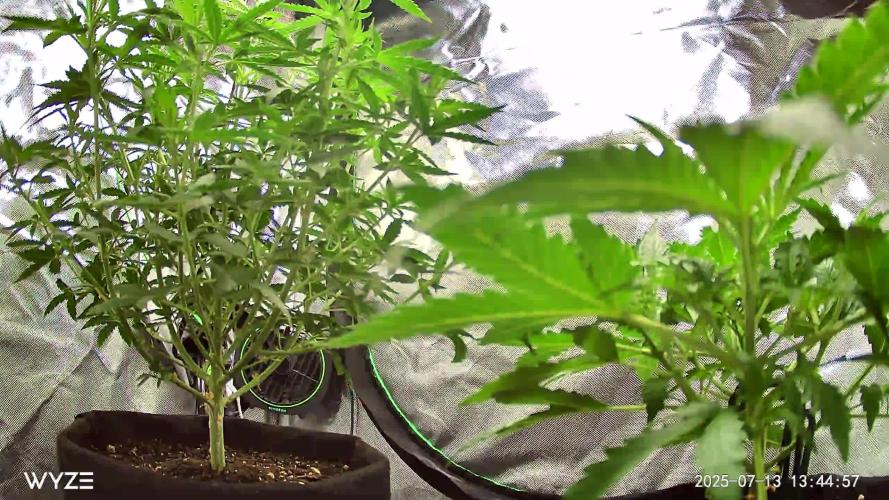
The growth is getting crazy idk if we're finally getting some pistil Hairs lol. This was a long veg but itll be worth it in the end lol .had to raise the lights she's almost 2 ft now
Likes
9
Share


@DeepRootsGrowTrees
Follow
KICKASS AUTO by KANNABIA
Week #13 Overall
Week #7 Flower
This week it got over 100° outside so it kinda took a little toll on her but she's still producing buds still growing and getting dense. Stay Growing!!
Kannabia.com KICKASS AUTO

Likes
15
Share


@the_big_pink_place
Follow
Plants are doing way better then any grow I've done in the past. Trying something because of what I seen on growboss, I defoliated the blueberry but didn't Defoliate the stone cold diesel he states I will get more dense nuggets on the the plant I don't Defoliate so let's see what happens, so far the blueberry started budding way faster.

Likes
26
Share


@MrHightimes
Follow
not gonna be a big grow, but i think the nugs are gonna be fantastic and i'm always happy with that!
i'm sorta fed up with monster autos. i'll take these little girls anyday
really starting to take on some color too!
Likes
5
Share


@Falcon123
Follow
Gelly Cream Cake & Slurricane #7 S1 from seeds
Platinum S1 & King Sherbet are clones
Gelly Cream Cake & Slurricane #7 S1 techniques were used: Topping + LST + Defoliation
Platinum S1 & King Sherbet techniques were used: LST + Defoliation

Likes
4
Share


@buzbun
Follow
smoke is really good.strong taste and effect that you feel imideately.some times i catch a good paranoia with this strain.good psy effect. maybe it cause 11/13 light cycle. few hours after smoke good to sleep or eat smth good.not for day smoking.somy buds i stored in vacuum bags they very dense after this

Likes
17
Share


@420DeepGrow
Follow
Gracias al equipo de Zamnesia, Marshydro, XpertNutrients y Trolmaster sin ellos esto no sería posible.
💐🍁 Frosted Guava:
La Frosted Guava es una cepa índica dominante y súper resinosa, que es un cruce de la Guava y la Frosted Skywalker. Con unas características de cultivo muy versátiles, un aroma exótico y afrutado, y un subidón relajante y lúcido, la Frosted Guava es ideal para cualquier plantación de marihuana.
🌻🚀 Consigue aqui tus semillas:
Código Descuento 20%: ZAMMIGD2023
💡TS-3000 + TS-1000: se usaran dos de las lámparas de la serie TS de Marshydro, para cubrir todas las necesidades de las plantas durante el ciclo de cultivo, uso las dos lámparas en floracion para llegar a toda la carpa de 1.50 x 1.50 x 1.80.
https://marshydro.eu/products/mars-hydro-ts-3000-led-grow-light/
🏠 : Marshydro 1.50 x 1.50 x 1.80, carpa 100% estanca con ventanas laterales para llegar a todos los lugares durante el grow
https://marshydro.eu/products/diy-150x150x200cm-grow-tent-kit
🌬️💨 Marshydro 6inch + filtro carbon para evitar olores indeseables.
https://marshydro.eu/products/ifresh-smart-6inch-filter-kits/
🍣🍦🌴 Xpert Nutrients es una empresa especializada en la producción y comercialización de fertilizantes líquidos y tierras, que garantizan excelentes cosechas y un crecimiento activo para sus plantas durante todas las fases de cultivo.
Consigue aqui tus Nutrientes:
https://xpertnutrients.com/es/shop/
💻 Trolmaster Tent-X TCS-1 como controlador de luz, optimiza tu cultivo con la última tecnología del mercado, desde donde puedes controlar todos los parametros.
https://www.trolmaster.com/Products/Details/TCS-1
📆 Semana 9:
Se han detectado algunas flores macho, las he eliminado y la he sacado al exterior hasta que se termine. Fotos actualizadas pronto en la semana anterior.
El engorde de los cogollos está prácticamente terminado y solo falta que maduren un poco antes de ser cosechada.
Gran trabajo por parte de mis colaboradores, estoy bastante contento con este grow, el próximo tendré más atención en la etapa de crecimiento, la cual es muy importante si quiero obtener una cosecha de calidad.
A partir de ahora agua hasta el fin.

Likes
16
Share


@osmrducks
Follow
Day 22: Honestly didn't think I would have made it this far. The girls are looking great minus a couple of issues. I have over watered them and over fed too! Not to mention trying to LST too early. I will wait a bit longer before watering this time.
Day 23: MORNING - They were super dry. I have been over watering a bit so I watered maybe 1/2 gallon for all 6. I also did some more LST and took 1 large fan leaf off of each plant. I will update again before lights out.
Day 23: NIGHT - The girls are responding very well to the LST. I don't think they are liking the 80°. I am starting to have issues with lower humidity again. I need to try and figure some sort of ducting out or possibly even get a small AC unit for the grow room.
Day 24: MORNING - I removed a couple more leaves that were covering potential bud sites. I have also done a partial main-line on the smallest girl. It looks to be already showing pistols. I've had to open the tent with a big fan blowing directly in with the humidifier behind it. The girls were getting hot and dry.
Day 24: NIGHT - Well 5 are showing to be female. The biggest plant is showing no signs of sex. I am guessing it will be the mystery seed. I will be doing no more LST to these ladies for at least a week or better. I think I have stressed them out enough the past 2 days.
Day 25: These girls are very resilient!! I tortured them all weekend and the one I nopped off to do a sort of mainline grew by 20% at least.
Day 26: It is the official 3 week mark today and the girls are starting to flower. I tied em down to get light to all bud sights. I will 100% not touch them unless they need it from this point!!!! They are soo small and I need not stunt them any more!! I have removed the Mystery Seed as it looks to be a male and I do not want to take the chance!! Also fed and watered today. Only 200 ppm for the feed.
Day 27: Nothing new to report. These girls are gonna be tiny :| I must've stressed em too much too soon :( Looking good though I think! 💪
Day 28: I never do what I say. Dumb! Broke main stem on one of the best plants. Taking it as a lessons learned. It's been two hours and she looks SICK! Oh well.

Processing
Likes
17
Share


@AmnZhz
Follow
Week 9 24/6/2018 - 30/6/2018, had to lower it cause it reached the lights, full into flowering lots of pistils coming out, buds have started to form.


Likes
15
Share


@SweetheartOG
Follow
The girls started to pre-flower on the 6th of June. They all have a slight smell when you rub the leaves. Kosher cake, Strawberry banana and the Forbidden runtz have a sweet smell to them. The Forbidden runtz reminds me of the smell of skywalker OG which is totally LUSH..!! The blackberry has more of an deep earthy smell with a slight bit of fruitiness. Super excited for the next few weeks with these ladies. Happy toking my peeps 😁
Likes
19
Share


@Mzsnoop2001
Follow
Está semana se siente bastante el aroma de whithe widow y blue moby, mientras que moby Dick sano y viene en viaje entrando en flora. Me quedé sin medidor de ph y sufren un desvalance de ph, más que nada ww pero ya lo voy a solucionar! Muchas Gracias por ver! Acepto críticas y concejos.


Likes
60
Share


@m0use
Follow
Good week overall, The plants are levelling out and getting extra green with the transplant, no more die back :D Still no word from Gaia Green so I think they just don't care after getting bought out. similar to GHE and scotts miracle grow big brands are taking up smaller independent companies to get every aspect of the market then cheapening the product slowly over time.
I have topped them again and waiting for the new shoots to grow in, I have also removed the lower branches and put them into vials to clone out. Will see how they do and if I want to grow them outdoor this year or give em away. I will be looking for a new home for the 4th plant that survived in the smaller container. But it won't be ready for another few months till the weather improves for outdoors or anytime right now if I know a buddy wants a plant in my area. I also topped my peppers in hopes it will bush them out a lot and get a solid plant. Holy basil is also fine, I feel I am going to need to give it some more food in a bit they will be approaching nutrient depletion soon.
The extras I put in the water this week are the same as any other, fulvic acid, potassium silicate, yucca extract, a bacteria pro bio soil product "NOT LABS" and PH adjusters. Trying out critic, ascorbic and malic acids powders as a alternate to phosphoric acid liquid. If it works its an option for PH down and one I can buy in bulk almost anywhere. 85% phosphoric is hard to source unless you got a grow shop close by. I was also reading that critic has a strong affinity for dissolving calcium and might work better on it vs phosphoric and dies out faster. but this needs more looking into before anything concrete is devised.
O I also made some Brownie Cookies, they turned out well. Chewy on the inside and crunch on the outside. I infused them with 15.5G of flower and a quick butter bath only simmering for 30min, 7g CBG ZeroDue from SeedStockers + 7g Dnamed Kush CBD Auto from Dinafem + 1.5g Strawberry Cola Auto from Exotic Seeds. Strained out all the weed and used the butter in the cookies. I would make them again, all cookies got flaked salt as a garnish, They are very light and I can eat a few of them and still be ok, This is what I want, great with reducing inflammation and relaxing the body. If I want a more THC high I'll eat more of them or take a separate THC edible.
Big shoutout to Medic Grow for sponsoring the lighting in my tent, They have provided me with 2x Mini Sun 2's in the 240w configuration, They use the v1 growing spectrum that is a all purpose seed to harvest spectrum so their is no hassle of switching it mid grow. If you interested in learning more about Medic Grow products please visit the web link below.
https://medicgrow.com/
https://growdiaries.com/grower/MedicGrowLED

Likes
15
Share


@420Consinc
Follow
Week 5
----- Day 29 -----
Fed 1100ppm at 6.4ph 23 Liters
Everything's good.
No real updates. Front right Glookies stretched a bit but has stopped.
Plants are perfect, couldn't ask for a better beginning to week 5.
*Update*
Easy day, end of light cycle. 3 new pics.
---- Day 30 -----
Some fun photos today for this easy day.
Humidity in basement FINALLY hit 40% this morning. Within 5 days it should be 30-35% residual basement and 45% tent for a good residual humidity.
The hand shot has my fingers and palm forward from the bud tip, the bud tip is actually past my hand but it's nearly impossible to get a perfect shot with my arm in the tent and my other one far out trying to take a photo i can't see.
The Tropicanna Popcorn nugs are already bigger than my thumb... gonna be fun in 4 weeks to see bud finishing sizes
Wedding Cake - Cherry HubbaBubba smell
Tropicanna Glookies - Pink Bubblegum with a strawberry like hint peaking through.
Tomorrow is feeding.
Today is just emptying water from buckets from dehumidifier.
*knock on wood* it's easy streak from here on out... 35~ days roughly left. here we grow!!
*** Update ***
Took some measurements. Wedding cake is monstrous already. Upto 1.5 inch wide, 14inch long (it was longer than the 12" ruler). Popcorn nugs on Tropicanna Glookies already 1inch wide 3 inch long at the top.
Beaaautiful.
Slow and steady from here on out.
----- Day 31 -----
Beautiful as usual. Fattening up nicely.
1200 ppm 6.4 pH 23 Liters
If anyone is wondering why I switched to Blackstrap Molasses I put up the Nutrition Facts..
in 20 grams you have carbohydrates, potassium, Calcium, Iron, B6 Vitamin, Magnesium, Zinc.. and that's only the "significant" nutrients (Human based for that picture) It also contains micro traces of copper and more.
pH is quite nice too, with the nutrient regiment i'm on, it finishes itself at 6.4pH so I don't have to manipulate it with pH up/down...
Loving everything so far.
Humidity in basement was 39% today, SO damn close. Tent closed at lights on (highest residual humidity point) was at 48% ... woo hoo 3% more to go!!!
------ Day 32 ------
Wow. Wedding Cake larger buds I can't even wrap my hand around.. These buds are going to be mooooonstrous.
Humidity was under 40% in basement, tent was 48% this morning. Great news for me.
Easy day, pretty much standard operating procedures from here on out.. feed, drain dehumidifier, strengthen stems by shaking plants, open/close tents... rinse repeat.
Both plants are amazing, great genetics so far regarding bud structure building/plant size.
----- Day 33 -----
47.5% residual humidity
Fed at 1150ppm 6.4pH 23L
Everything's perfect, 30~ days left.
----- Day 34 -----
48% humidity in tent, i'm a happy camper.
Everything's perfect. Bulk has started, front right Tropicanna Glookies had double in thickness and diameter top buds of most stems.
Wedding cake 14 inch stem I've named Big Bertha. Excited to watch her fatten up on the couch so-to-speak.
I'm now on autopilot. Fed yesterday while half asleep, didn't even remember doing it. Thank god I take pics of ppm/pH before every feeding for data.
One more feeding this week before week 6 happens tomorrow.
This week Liquid Koolbloom ends, KoolBloom Dry begins for maximum bulk on week 6 first feeding (2 days into week 6)
----- Day 35 -----
Last day of week 5!!!
Fed at 1150ppm 6.4ph 23L
Plants are perfect, humidity is great.
Smell is RAMPED up now. Strong candy weed smell.


Likes
26
Share


@Probation2Propagation
Follow
Pheno 1: strong natural tart cherries with a slight candy
Pheno 2: loud cherry candy
Pheno 3: cherry fun dip
Pheno 4: cherries mashed with earthiness
Pheno 5: the strongest cherry pheno I’ve ever smelt. Just loud cherries in your face.
I kept pheno 3 and 5. I pressed both into rosin and the terps were insane it smelt like I worked a double at the marischino cherry factory. The terps on 3 were cherries on the inhale with a candy fun dip exhale (absolutely up my alley). Pheno 5 was the most in your face cherry I’ve ever tasted. It was straight cherries throughout the inhale exhale with a slight tart/candy on the back end. I have found my cherry phenos for my future business. Thank you for riding this journey with me. Harvest results on my YouTube channel link in my bio!
Likes
9
Share


@MaxMo8
Follow
I cut it today and it was a nice plant 🍃 and I faced some difficulties in the beginning, but I had a challenge. I thanks to everyone who supported me . I will keep you posted after dry .

Likes
7
Share


@Budking420
Follow
This is by far one of my largest autoflowers to date. Shes flowering hard now at week 5 and I'm super happy that I used LST on her. Without LST this lady would be about 5 feet tall without a doubt. I'm really happy with how she accepts the 24 hour lighting as other strains clearly don't like it as much. I hope you guys are enjoying this as much as I. I encourage you to check back next week to see just how fast she buds & remember its 4:20 somewhere!!!!