


Likes
Comments
Share

@Liquido
Follow
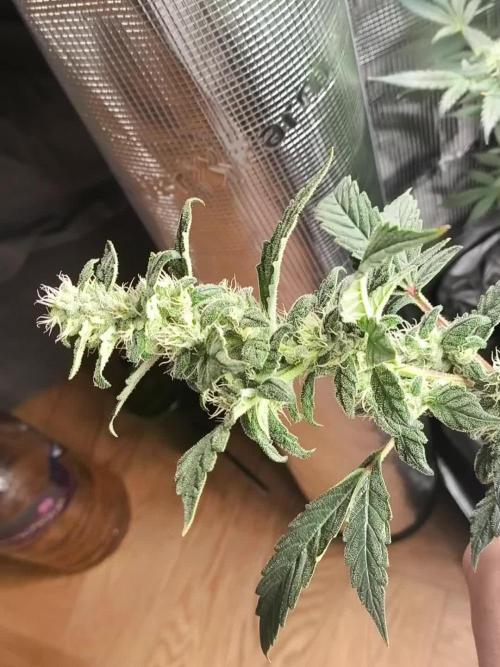
Si prosegue senza molti aggiornamenti, sembrano quasi tutti fenotipi differenti da come si stanno propagando i tricomi e i fiori, la runtz penso sia ultima settimana poi inizio il flush

Likes
16
Share


@BluHaze007
Follow
Soo far I flushed twice. Run off water ppm is 290-319-328 I noticed on all three girlz, the trichomes are milky/cloudy with very little amber on the leaves. I'm waiting for more amber. Hopefully by tuesday when the soil id totally dry more amber will a appear. I purchased another 3x3 tent because I know for sure my 2x2 tent will not be enough holding room. Funny thing, I trimmed the baby buds at the bottom that wasn't going to grow much. I placed it on the side in the tent for two days and decided to roll them up and smoke it. Surprisingly, I did get a high but the tatse was a little strong.
Likes
15
Share


@Siriuz
Follow
Yo guys what's up
I added molasses for the very first time
Take a look, she's doing great
I'm happy for the training we've been giving her and now we are seeing some results
Alright guys let me know what's your advise
I think I'm going to be adding molasses after nutes every two days
********************************
UPDATED 08/03/2021
SHE IS DOING GREAT!
ID SAY SECOND WEEK OF FLOWERING ALREADY
WEEK 11 FROM SEED ' DAY 1 STARTS TOMORROW!
CHECK OUT THE VIDEOS AND PICS FOR BLOOM
TAKE CARE GUYS PEACE OUT!

Likes
2
Share


@7circleshg
Follow
Las flores van agarrando tonalidades muy interesantes, capaz influidas por una ola de frio que azoto a la zona y fue dificl mantener buenas temperaturas, pero siempre dentro de lo optimo. La produccion de resina no decae, el futuro es prometedor, cada vez mas cortas las actualizaciones porque este grupo quiere la copa y me deja sin palabras.

Likes
14
Share


@Gardens_of_Of
Follow
Green House feeded one is growing brown yellow spots so I am suspecting Cal Mag def and Light stress since it is right jn the middle of tent. So I increased Cal Mag and increased the light distance.
Advanced Nutrients one is recovering since the fix in the feeding but the deficiency left some brown spots. The lady is getting greener though which is good news.

Likes
5
Share


@MG2009
Follow
04/04/2021
Starting to shape up nicely and flower has started on both GSC & Blue Dream, time for a banana peel tea 1 tbls to 2 lt. water bottle will try two tbls to 2 liter next week to see if they will tolerate it.👍
Likes
16
Share


@MadeInGermany
Follow
Flowering days 27
since time change
to 12 / 12 h
Hey guys :-)
The ladies look beautiful and are growing very well.
The sweet smell starts to blow through the whole tent :-) .
This week it was watered 3 times with 1l each (nutrients see table above)
Nothing else happened this week. Everything has been checked and verified.
A lot fun and stay healthy 💚🙏🏻
👇🏼👇🏼👇🏼👇🏼👇🏼👇🏼👇🏼👇🏼👇🏼👇🏼👇🏼👇🏼
You can buy this Nutrients at :
https://greenbuzzliquids.com/en/shop/
With the discount code: Made_in_Germany you get a discount of 15% on all products from an order value of 100 euros.
👇🏼👇🏼👇🏼👇🏼👇🏼👇🏼👇🏼👇🏼👇🏼👇🏼👇🏼👇🏼
You can buy this strain at :
https://www.ripperseeds.com/en/feminized/kmintz-feminized-cannabis-seeds
Water 💧 💧💧
Osmosis water mixed with normal water (24 hours stale that the chlorine evaporates) to 0.2 EC. Add Cal / Mag to 0.4 Ec Ph with Organic Ph - to 5.8 - 6.5
MadeInGermany


Likes
1
Share

@zenderman
Follow
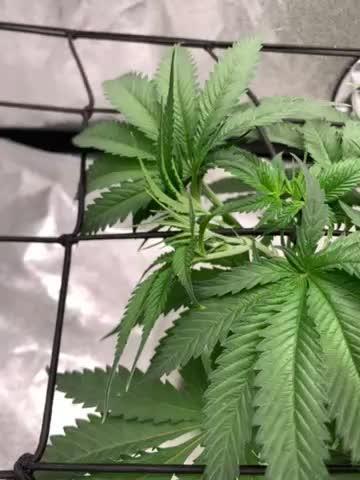
21/5/26.started week 6.day 36 from germination.
so,at this time what we have:strain have skunky aroma,different from earlier two.
The plant's growth and branching are proceeding as planned and respond well to all LOW STRESS TRAINING.
Watering is required once every 3 days.
the lowest branch was cut off for the clone
last photo-after defoliation(27/5)

Likes
3
Share


@Lilze
Follow
It’s finally getting a nice green colour
This week I changed the scrog net , it’s about 7” above the top of the pots .
upped the nutes to 1.8-2 ec.
Sprayed with canna cure
Watering every morning to about 10% run off
Lollipoped an defoliated ,Waiting to fill the net a bit more but will be switching to 12/12 very soon.
Likes
8
Share


@ThePiney_grower
Follow
2 week of flower
Not very satisfied for the sensi seed plant
Dutch passion and medical seeds are Amazing



Likes
18
Share


@Ultraviolet
Follow
Chemical reactions in which, a single substance splits up into two or more simpler substances are called decomposition reactions. These reactions are carried out by energy, supplied by different sources. The required energy can be supplied by heat (thermolysis), electricity (electrolysis), or light (photolysis).
Let’s talk about photolysis reactions (not photosynthesis): Photolysis (also called photodissociation and photodecomposition) is a chemical reaction, in which a chemical (an inorganic or an organic) is broken down by photons and is the interaction of one or more photons with one target molecule. The photolysis reaction is not limited to the effects of visible light, but any photon with sufficient energy (higher than the dissociation energy of the targeted bond) can cause the chemical transformation of the said (inorganic or organic) bond(s) of a chemical. Since the energy of a photon is inversely proportional to the wavelength, electromagnetic waves with the energy of visible light or higher, such as ultraviolet light, X-rays, and γ -rays, can also initiate photolysis reactions.
Like all other peroxides, hydrogen peroxide (H2O2) also consists of a relatively weaker O−O bond, which is susceptible to light or heat.
The net equation for the reaction is:
2H2O2⟶2H2O+O2
The step-wise reaction mechanism is suggested as follows (Ref.1):
H2O2+hν⟶2HO∙
HO∙+H2O2⟶HO−O∙+H2O
HO−O∙+H2O2⟶2HO∙+H2O+O2
Using isotope studies it was confirmed that the O2 formed is cleanly derived from H2O2 (Ref.2).
Notes: The rate increases rapidly in the presence of catalysts such as MnO2 and KI (Ref.2). The rate of decomposition is slow at room temperature, but it increases with temperature. It is believed to be due to thermal decomposition of H2O2, which seemingly accelerates the photolysis (Ref.3).
References:
1.J. P. Hunt, H. Taube, “The Photochemical Decomposition of Hydrogen Peroxide. Quantum Yields, Tracer and Fractionation Effects,” J. Am. Chem. Soc. 1952, 74(23), 5999–6002 (https://doi.org/10.1021/ja01143a052).
2.A. E. Cahill, H. Taube, “The Use of Heavy Oxygen in the Study of Reactions of Hydrogen Peroxide,” J. Am. Chem. Soc. 1952, 74(9), 2312–2318 (https://doi.org/10.1021/ja01129a042).
3.F. O. Rice, M. L. Kilpatrick, “The Photochemical Decomposition of Hydrogen Peroxide Solutions,” J. Phys. Chem. 1927, 31(10), 1507–1510 (https://doi.org/10.1021/j150280a004).
Interestingly, as early as 1934 Haber and Weiss (Ref. 1) proposed that HO2∙ is formed in the decomposition of hydrogen peroxide.
The subsequent reaction of the transient superoxide radical anion with hydrogen peroxide has been determined to also form the hydroxyl radical (Ref. 2). The higher pH version of the last reaction is, therefore, best represented as:
O2∙−+H2O2⟶2HO∙+OH−+O2
And as H++OH−=H2O, the net product formation is not altered. However, alkaline H2O2 is well known to be less stable than acidic hydrogen peroxide (Ref.3) even in absence of light exposure, which accelerates its decomposition (which can involve radical pathways) liberating oxygen!
References:
1.Haber Fritz and Weiss Joseph, 1934, The catalytic decomposition of hydrogen peroxide by iron salts. Proc. R. Soc. Lond. A 147: 332–351 http://doi.org/10.1098/rspa.1934.0221
2.TOSHIHIKO OZAWA, AKIRA HANAKI, Reactions of Superoxide with Water and with Hydrogen Peroxide, Chemical and Pharmaceutical Bulletin, 1981, Volume 29, Issue 4, Pages 926-928. https://doi.org/10.1248/cpb.29.926
3.https://www.researchgate.net/figure/Effect-of-pH-on-the-decomposition-of-hydrogen-peroxide-H-2-O-2-0-800-mg-l_fig1_234110563, from Yazıcı, Ersin & Deveci, Haci. (2010). Factors Affecting Decomposition of Hydrogen Peroxide. https://doi.org/10.13140/RG.2.1.1530.0648.

Likes
24
Share

@TrickzCutz
Follow
Servus Moin!
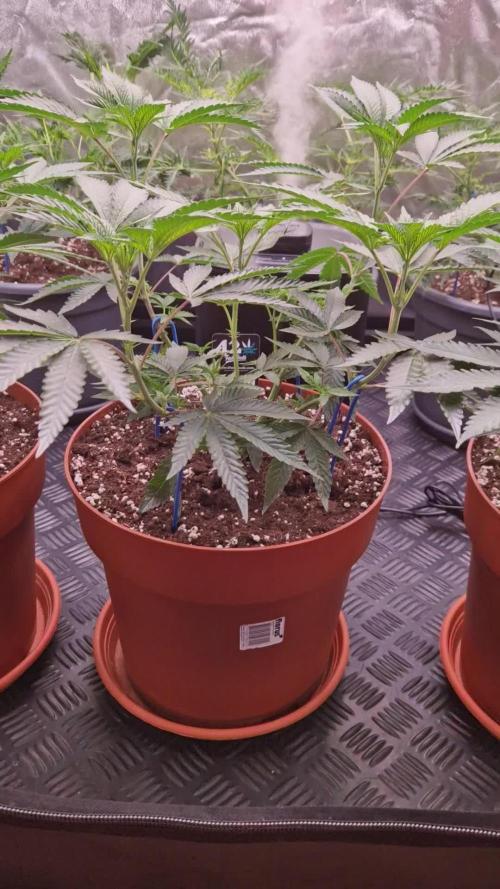
Die Black Orchard hat nicht mehr so starkes Taccorolling. Sie sieht wieder sehr gut aus.
Leider habe ich bei den vorderen 3 Ladys irgendwelche Schädlinge entdeckt, die stark wie Thripse aussehen. Deswegen habe ich direkt Raubmilben bestellt. Diese will ich einsetzen bevor es in die Blüte geht.

Likes
9
Share


@Wicked_Stix
Follow
The voodoo juice x platinum hermed this week so moved it to it's own tent. We have 6 plants remaining in the room. I cut out the maxigro this week. They are getting .5 tsp per gallon of maxibloom now. Seems to be keeping everyone happy. Not much to report other than that. Buds seem to be progressing pretty nice.
Likes
23
Share


@PapasGrow
Follow
Girl Scout Cookies XTRM 🍪❄️
From AMS - Amsterdam Marijuana Seeds 🌱
Lights by MarsHydro FC3000 🚀🚀
Tent - 100x100x180 Mars Hydro 🏕️
From Www.Mars-hydro.com
2xScrog used on GSC XTRM. She is extreme indeed. 🍪✨
Green house feedings are keeping it simple!🏆
+ Tested out Hesi Boost. ⚡
Flowering week 8 ✅
For final weeks moved out of tent to max out her potential in the flowering room.

Likes
15
Share


@Theia
Follow
A really explosive week of growth. I pushed PPFD up to 310umols. Dimmers are at 60% which is drawing 224w plus 18w of DRRB. I have alos started Emerson effect ... Another The Emerson effect is triggered by the simultaneous exposure of plants to light in the deep red and far-red spectra Deep Red 660 nm /Far-Red 700 nm .
A bit of boring science that explains why you need both far red and deep red in order to trigger Emerson.
The effect occurs because photosynthesis is driven by two distinct pigment systems working in series:Photosystem II (PSII): Absorbs energy most efficiently at shorter wavelengths (higher frequencies), like 680 nm (441 THz).
Photosystem I (PSI): Absorbs energy most efficiently at longer wavelengths (lower frequencies), specifically 700 nm (428 THz).
When you provide only the higher frequency (deep red), PSI becomes a bottleneck. When you provide only the lower frequency (far-red), PSII is not sufficiently excited to provide electrons. Providing both frequencies simultaneously allows both systems to work at peak efficiency, resulting in a rate of photosynthesis that is greater than the sum of the two lights used individually.
To understand the Emerson Effect, think of photosynthesis not as a single engine, but as a two-stage assembly line.
What is the Emerson Effect?
Discovered by Robert Emerson in 1957, this phenomenon shows that plants perform photosynthesis much more efficiently when they are hit by two specific types of light at the same time: Deep Red (660 nm) and Far-Red (700+ nm).
If you give a plant only Far-Red light, photosynthesis is very slow. If you give it only Deep Red, it's better but still limited. However, when you give it both at once, the total rate of photosynthesis is significantly higher than if you just added the two results together (1+1=3).
What is Happening? (The "Assembly Line")
Inside the plant's chloroplasts, there are two "workstations" called Photosystem II (PSII) and Photosystem I (PSI). They work in series, meaning the first one must pass "parts" to the second one.
PSII (The First Station): This station is tuned to catch Deep Red light (660 nm). It harvests electrons from water.
PSI (The Second Station): This station is tuned to catch Far-Red light (700 nm). It takes the electrons from the first station and uses them to create energy (ATP and NADPH).
The Problem: If you only provide Deep Red light, the first station works fast, but the second station can't keep up because it isn't being "powered" efficiently by that specific frequency. This creates a traffic jam of electrons. The Solution: By adding Far-Red light, you power up the second station. It now "pulls" the electrons from the first station much faster, clearing the traffic jam and making the whole assembly line run at full speed.
The Benefits for The Grow..
Because i am using the Biotabs water-only method, my plants already have a steady supply of organic nutrients. Implementing the Emerson Effect offers several distinct advantages:
Increased Biomass: Because the "engine" is running faster, the plant produces more sugars and carbohydrates, leading to heavier fruits or flowers.
Faster Finishing: Plants often reach maturity sooner because they have more surplus energy to complete their life cycle.
Better Light Penetration: Far-Red light is very good at passing through the upper leaves. This "wakes up" the lower parts of the plant that would otherwise be shaded, allowing the whole plant to contribute to growth.
Enhanced Secondary Metabolites: In many crops, this synergistic light can stimulate the production of terpenes and antioxidants, improving the "quality" (smell, taste, and potency) of the final harvest.
The "Sunrise/Sunset" Trick
I am using 4x Invisible sun Far red/Deep red bars,they use high-quality Samsung LH351H (660nm Deep Red) and specific Far-Red (730nm) diodes for 10–15 minutes at the start or end of the light cycle. This mimics the natural shift in light at sunrise and sunset, "waking up" the photosystems or signaling the plant to go into "sleep mode" faster, which can further optimize the flowering cycle.
Enviromentally i am chasing a VPD of about 1,1kpa. My room seem to sit nicely at lights on at 24c with no real drama and a little help from a 220W greenhouse bar radiator. Its using abot 4kw/h a day atm because my room is attached to the side of my house and its been -5c.. I have had to add some humidity as its also very dry atm. Im aiming for RH of 65% with my 24c but it is more around the 62s.. VPD is crucial and is the focus for this grow for me. The autopots and Biotabs make it so easy ican really just focus on perfect enviroment. A VPD of 1.0–1.2 kPa provides enough "atmospheric pull" to move calcium and magnesium up from the roots, which is critical for the rapid cell division happening now..
Plants will be flipped on Saturday which is their week 5 as im a bit behind..
As this happens i will push PPFD upto 4-500umols. by week 2 of flower. Thats the plan anyway..
Likes
11
Share


@Mr_Haze
Follow
Plants are looking healthy, OS fel over and started growing sideways. Just keeping it straight with soft tie.
Not much to report🌱
Tent is running in the night and in off in the hottest time of the day.

Likes
23
Share


@adam_pawloski87
Follow
Today is day 71 for these ladies and they are doing just amazing! Stacking up densely with a Very sweet smell , I still get hints of vanilla ! Not to much longer to go these girls few more weeks an they should be done! Stay tuned for next week ! ✌️
Likes
6
Share

@bkickstand
Follow
Grow Diary: Week 8 – Training and Sunlight Transitions
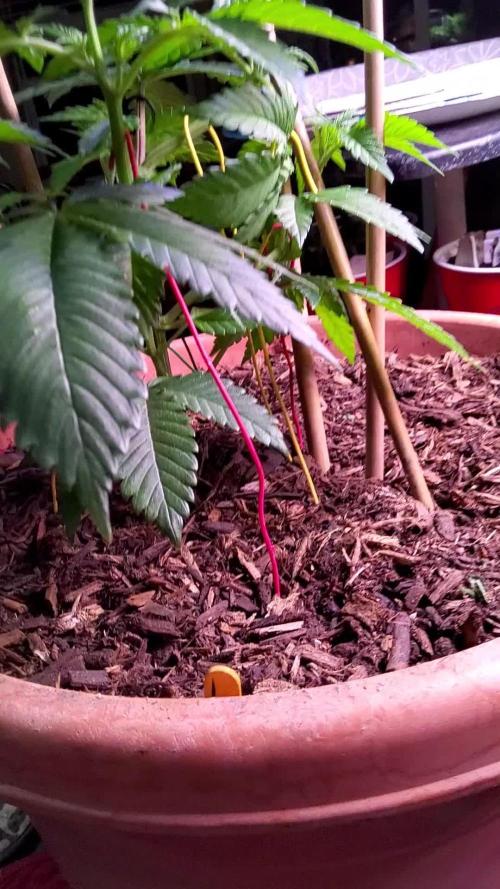
The Durban Poison quartet is hitting its stride this week. Looking at the latest photos and video, it’s clear that the training regimen is paying off. The focus of Week 8 has been "Low Stress, High Reward" as the plants prepare for their final move.
Plant Progress: Structural Integrity
The visual profile of DP1, DP4, DP5, and DP6 is looking fantastic. The foliage is a thick, vibrant green, and the node spacing is tight, indicating they are getting optimal light levels.
Training Technique: The colored LST stakes (red, yellow, and green) are doing a great job of pulling the main stems and secondary branches down. This is creating a level canopy, ensuring that no single "top" is hogging all the sun.
Leaf Profile:You can really see those classic Sativa fan leaves coming in—long, slender fingers that are starting to overlap.
Root Health:** The main stalks are thickening up nicely, showing good woody strength that will be necessary once they are in the larger 25-gallon bags.
The "Defensive Perimeter" Status**
The video and photos show the African Marigolds are making great progress in their Solo cups.
Current State: They are showing multiple sets of true leaves and look ready for their supporting role.
Placement: Having them staged right next to the DP plants on the deck ensures they are already familiarizing themselves with the local environment before the big transplant.
The Indoor/Outdoor Rotation
The photos highlight the flexibility of the current setup.
Sun Chasing: The plants were captured both under the supplemental indoor lighting and out on the deck. This "hardening off" process is crucial for preventing leaf scorch when they eventually move outside full-time.
Mobility: The use of the various pots and the proximity to the garden furniture shows how easy it is to shuffle these girls around to catch the best rays or find shelter from the wind.
Observations & Nutrition
The soil looks well-aerated with a healthy amount of wood-based organic matter. The plants aren't showing any signs of "clawing" or nutrient burn, which means the current organic feeding schedule is hitting the "sweet spot."
Next Steps:
1. The Big Move: All eyes are on the upcoming transplant. The plants are definitely reaching the limit of their current containers.
2. Monitoring: Keep an eye on the LST stakes; as the stems thicken, we’ll want to ensure the wire isn't cutting into the "skin" of the stalks.
3. Hydration: With the plants getting larger and the Colorado air staying dry, we'll be watching the soil moisture closely to ensure the microbes stay happy.
-Keep growing and stay mindful ✌️


