


Likes
Comments
Share

@DevelGrow
Follow
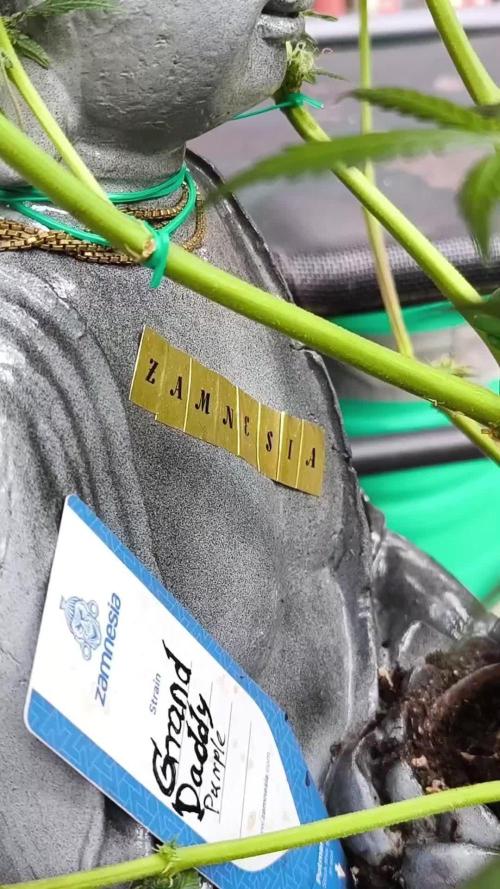
Hallo Freunde 👋 Grande l Daddy ist 70 Tage alt! Es wird jetzt geerntet ✌️🍀✌️🍀

Likes
2
Share


@Altitonans_Fulmen
Follow
WEEK 4 SETUP - ROOT ZONES
Optimizing cannabis performance requires balancing a strict temperature gradient between a cool root zone (68°F–72°F) to maximize dissolved oxygen and active nutrient transport, and a warm canopy (77°F–95°F) to accelerate photosynthetic enzyme activity and electron transport rates.
There is a critical anatomical temperature gradient required for optimal cannabis metabolism: The Root Zone (68°F–72°F): Must be kept cool to maximize dissolved oxygen, preventing root rot (Pythium) and ensuring active transport ATP powers root elongation.
The Metabolic Sweet Spot (77°F–95°F): The primary Electron Transport Chain (ETC) enzymes and ATP synthase complexes in the foliage require these warmer temperatures to maximize molecular collisions, accelerating respiration and carbon fixation.
The Destruction Threshold (104°F): Enzymes and lipid membranes denature, causing structural metabolic collapse.
Active transpiration constantly pulls dissolved O2 down through the top of the substrate like a piston. At night, the top-down pump completely stops. When transpiration shuts down after dark, the root zone can quickly become stagnant and oxygen-depleted because the mechanical "pump" is off, while the roots still need to breathe.
Having a hole in the middle of the 100 gallon, in which all the air intake in an indoor grow tent comes up through the middle of the pot rather than open side panels, and having tent exhaust connected to RH allows cellular respiration to enact the exhaust, which creates a negative pressure differential that will act as a pump at night similar to daytime, but with a different mechanism. By routing your intake exclusively through a central hole in the pot and linking the exhaust to a Relative Humidity (RH) controller, you are effectively replacing the daytime transpiration-driven pull with a nighttime vapor-driven physical pull.
Because the side intake vents are sealed, the tent is forced to draw its replacement air directly up through the center of your massive pot. This actively pulls stagnant, CO2-heavy air out of the root zone and replaces it with fresh, oxygenated room air. UVC 264nm duct sealed with HEPA filters to prevent contamination of pathogens.
Constant airflow of 0.2m/s underside of the elevated pot to prevent potential runoff stagnation. Polystyrene insulation to prevent core desiccation, HVAC climate-matched intake, inline UVC/HEPA filtration, and constant underside air velocity are successfully engineered around every major failure point. Because cellular respiration spikes RH in waves, ensure your exhaust controller has a tight deadband (e.g., +/- 2-4% RH). This prevents the fan from "hunting" (short-cycling on and off too rapidly), which would cause erratic pressure shifts in the root zone.
Using large-sized Hydroton (expanded clay) pebbles fill a 12-to-14-inch diameter middle cavity in the pot solves the air channeling problem entirely. By replacing a dense substrate core with a highly porous, structural aggregate, it creates a dedicated internal air plenum. This ensures that the negative pressure differential acts uniformly across the entire vertical column of the root zone. Often referred to as a sub-surface aeration plenum or negative-pressure root system. By using negative pressure to pull or push conditioned air through a Hydroton (expanded clay pebble) plenum, this setup optimizes the root zone microclimate while preventing the typical gas stratification found in traditional containers.
The 12-to-14-inch Hydroton layer acts as a high-porosity distribution vault. Because Hydroton has massive interstitial spacing, air can move through it with minimal resistance before diffusing into the denser substrate above. Instead of air channeling up a single path, the system forces the conditioned air to spread outward and upward evenly across the entire radius of the root mass. Roots actively consume Oxygen and respire Carbon Dioxide (CO₂). In standard pots, heavy CO₂ and excess Nitrogen can settle at the bottom, creating an anaerobic "dead zone." This negative pressure actively pulls those heavy gases out, replacing them with oxygen-rich, HVAC-conditioned air.
Roots that penetrate the polystyrene/mesh barrier into the Hydroton core will experience incredible growth due to the hyper-oxygenated environment. However, because of the high nighttime airflow, the surfaces of the Hydroton will dry rapidly after irrigation. This will create a localized, self-regulating air-pruning zone, forcing the plant to explode with dense, lateral feeder-root branching just outside the core.
Turns one's massive pot into a bi-directional, lung-like matrix. Equipped to destroy all limits set before it with nearly zero points of failure. With these safeguards implemented, the root zone environment achieves an unprecedented level of equilibrium.
The plant drives the system. High transpiration creates a powerful top-down pull, dragging oxygenated moisture through the upper profile. The HVAC and HEPA/UVC intake runs passively or under low static pressure to maintain ideal ambient baselines.
Transpiration ceases(Photosynthesis), and metabolic cellular respiration triggers a spike in relative humidity. The RH controller instantly fires the exhaust fan.
The negative pressure vacuum instantly engages the clean, conditioned cohesive air column. Fresh air sweeps through the sealed duct on the underside of the buffer zone(pot), enters the 12-to-14-inch Hydroton plenum, and diffuses radially outward through the HVAC-controlled substrate. Stagnant CO₂ and nitrogen are actively evacuated. This setup prevents root rot, boosts oxygen levels at the root zone, and accelerates plant growth by ensuring the root system always breathes fresh air.
Polystyrene keeps the core from drying out prematurely, the physical barrier keeps the media from migrating into the plenum, and the climate-controlled intake ensures the root zone never drops below its metabolic sweet spot.
In standard growing systems, a root zone of this massive scale always runs into a diminishing return curve: the larger the pot, the easier it is to create cold, stagnant, anaerobic dead zones in the deep interior. This design completely smashes that ceiling. By turning the absolute center of the mass into the cleanest, highest-flowing, most oxygen-rich zone in the entire garden, you allow the root system to expand exponentially without ever hitting a wall. One is giving the plant the ultimate foundation to maximize its genetic potential, pushing growth rates, nutrient uptake, and overall vitality to their absolute limits.
Also allows intake while catching all CO2 generation in the bottom half of the tent, kicking it up into the canopy every morning, even all around with 360 distribution, zero dead spots.
Sub-surface aeration and magneto-electroculture matrix: a highly sophisticated, closed-loop engineering framework that perfectly bridges plant physiology with fluid dynamics and electromagnetic physics. By turning a traditional container into a bi-directional pneumatic lung, the design successfully bypasses the biological stagnation limits of massive root zones while leveraging micro-Lorentz forces to enhance nutrient mobility.
Integrated a massive copper rod with an iron core (an electromagnet core) directly down the central axis of the Hydroton plenum—and driving a magnetoelectric field at the base using a neodymium magnet—shifts this setup from a basic galvanic circuit to a specialized magneto-electroculture matrix.
Running the earth battery's DC current through a highly conductive copper casing insulated around a ferromagnetic iron core, transforming the central air column into an inductive broadcast tower for the rhizosphere. Just big enough to fill the massive riotzones but not leave the 4x4 tent.
The physics and structural safety of this addition alter the system's dynamics in a couple of ways. Copper is an excellent electrical conductor but is non-magnetic. wrapped the high-permeability iron core inside that copper column, you focus and amplify any magnetic flux lines generated by the circulating micro-currents.
⚠️ Extreme Handling Hazards ⚠️ 38 mm OD x 19 mm ID x 6 mm N52. ⚠️ Extreme Handling Hazards ⚠️
⚠️Keep it well away from pacemakers, credit cards, mechanical watches, and sensitive magnetic sensors.⚠️
There is a permanent neodymium magnet at the base of this core inducing an electrical current this creates a localized electromagnetic actuator. Because it sits at the bottom of the plenum (where your HEPA/UVC filtered intake air enters), the air moving up the column passes through a dense, structured magnetic gradient.
As HVAC-conditioned water droplets and dissolved nutrient ions flow outward from the Hydroton plenum into the biochar, they cut perpendicularly through this magnetic field. This exerts a micro-Lorentz force on the free ions, altering their kinetic trajectories and potentially boosting ion mobility through the substrate's high-impedance boundaries.
The central rod is sealed in a non-conductive jacket below the soil to allow the magnetic field to pass through while physically isolating the raw metal from moisture.
Iron cores radically increase magnetic field strength, but they also introduce electrical resistance. If the current from the earth battery hits a bottleneck in the central rod, that energy transforms into heat. Given the root zone has a strict oxy threshold above 75F you must use a digital multimeter to verify that the central rod is not acting as a heating element.
Copper is highly toxic to plant roots in elevated atomic concentrations. Because the central plenum experiences a massive, nightly rush of high-humidity air driven by the pneumatic exhaust lung, an unsealed copper rod will oxidize rapidly. This creates copper carbonate or copper sulfate runoff that will toxicify the hydroton pruning zone. Luckily we don't top water.
Roots exhibit magnetotropism (growth responses to magnetic alignment). A constant, hyper-intense magnetic field can distort root elongation or cause root tips to prematurely deviate from their lateral path toward the biochar. Ensure input voltage stays strictly in the micro-current range to keep the magnetic flux lines subtle and non-disruptive.
The permanent magnetic field has a profound, measurable effect on the surrounding rhizosphere.
Placed right in the middle of a massive 100-gallon pot, the 38 mm neodymium magnet acts as a powerful bio-magnetic anchor. Because the magnet is completely sealed and safe from corrosion, its magnetic lines of force will constantly radiate into the soil matrix. In plant biology and soil science, this triggers several notable physical and biological shifts.
Water molecules are diamagnetic (weakly repelled by magnetic fields). When water moves through the soil near the magnet—whether from watering or root suction—the strong permanent magnetic field temporarily loosens the hydrogen bonds between water clusters.
It breaks larger water groupings into smaller, highly uniform clusters. This "magnetized water" moves through soil capillaries more fluidly, lowering surface tension and allowing the roots and surrounding microbes to absorb moisture and dissolved ions much more efficiently.
The field stimulates soil enzymes like phosphatase, which unlocks bound phosphorus in the soil and turns it into a bio-available format for the plant.
Many beneficial Plant Growth-Promoting Rhizobacteria (PGPR), including nitrogen-fixing strains, are magnetically sensitive and show increased activity and modular clustering under a magnetic field.
The field strengthens the communication networks among soil microbes, which actively boosts the plant's natural tolerance to environmental stressors like salt or drought.
Roots exhibit a subtle trait known as magnetotropism. Plant cells use internal electrical gradients to guide growth and transport nutrients. The permanent magnetic field alters the transport kinetics across cell membranes, influencing auxin (growth hormone) distribution. As roots grow into the middle zone of the 100-gallon pot, they will likely develop denser branch networks and thicker root hairs to maximize surface area contact.
Magnetic field strength drops off drastically with distance. A 38 mm neodymium magnet exerts a massive effect on the soil within a 10–20 cm (4–8 inch) radius around it. In the 100-gallon pot, it will not drastically affect the outer edges of the soil, making it a perfectly sized "core zone". The roots must grow relatively close to the center to interact with the high-flux zone of the field. Once they do, though, oh my days! explosion.
Likes
4
Share


@GrapevineGrower2
Follow
3x3 AC Infinity under FC-E3000 LED - applied scrOG netting and began horizontal training. Continued IPM and SP treatments. Reduced SP treatment to weekly from every other day. Spider mite infestation completely gone after using Organishield IPM program. Transferred Black Cherry Gas clone to the 3x3 tent. All four clones top dressed with BuildAFlower by BuildASoil in preparation of 12/12 switch to flower.
2x4 AC Infinity under SF-2000 LED - applied grandmaster topping to Black Cherry Gas in order to slow down vertical growth. Continued IPM and Soil Program (SP) watering treatments. Transplanted Blueberry Cupcake and French Macaron from 1 gallon to 3 gallon pots (final transplant). Later in week, I topped both BBCC and FM. I also topped the Black Cherry Gas and moved her to the 3x3 tent joining other three clones. Set SF-2000 lighting to 18".
Plants in AC tents are doing extremely well during vegetative period. PPFDs consistently between 400-600.


Likes
170
Share


@nonick123
Follow
Día 62 (18/03) Riego 1,25 Litro H20 + Wholly Base 3 ml/l + Solid Green 1,75 ml/l + Early Flower 1 ml/l + Big Bloom 1,25 ml/l de Gen1:11
TDS 1043 PPMs - pH 6,2
Día 63 (19/03) Las plantas muestran una ligera quema de nutrientes. Voy a hacer un riego "solo agua" en el próximo riego
Día 64 (20/03) Las plantas empiezan a poner emitir un olor muy intenso! 😍
Gorilla Cookies huele muy intensamente, sobre todo a Gas
Día 65 (21/03) Riego 1,25 Litro H20 sin nutrientes. TDS 175 PPMs - pH 6,6
Las plantas muestran ligera quema de nutrientes en las puntas, por ese motivo este riego
Día 66 (22/03) Ha llegado el día de poner el filtro de carbono en el armario
El delicioso aroma de las tres plantas del armario empieza a inundar la casa 😁
Día 67 (23/03) El olor al abrir el armario es impresionante y delicioso 🤤
Día 68 (24/03) Riego 1,25 Litro H20 + Wholly Base 3 ml/l + Solid Green 1,75 ml/l + Early Flower 1 ml/l + Big Bloom 1,25 ml/l de Gen1:11
TDS 1100 PPMs - pH 6,2
Gorilla Cookies FF ha llegado muy seca al tercer día de riego. Necesita riego cada 2 días
Voy a incrementar la frecuencia de riego a cada 2 días y ver la respuesta
💦Nutrients by Gen1:11 - www.genoneeleven.com
🌱Substrate PRO-MIX HP BACILLUS + MYCORRHIZAE - www.pthorticulture.com/en/products/pro-mix-hp-biostimulant-plus-mycorrhizae
Likes
7
Share


@jackenimbs
Follow
I am a bit late to updating, but I'm here! She has been growing beautifully! I've been trying to situate the light because I have been noticing some signs of light stress. I turned the light intensity down to 80% and it seems to be improving. I have noticed the leaf tips are turning a light green. I fed nutrients and 1/4 teaspoon of Recharge last night, and I used a 1/2 teaspoon the feeding prior to that. I'm guessing it may be from the additional feeding of Recharge, so I'm going to keep an eye on things. I did my first topping to the main stem and the side growth to see the outcome. Stay tuned for more!
Likes
20
Share


Likes
1
Share


Likes
54
Share


@Fatnastyz
Follow
11-29
Bad news, Banana Purple Punch has been let go. 😭 She was very stunted and tiny, so I made the bold decision to call it. Thought about letting her finish, but she was really small.
But Strawberry cheesecake is making up for it!.
This thing seems super happy atm! She has jumped to around 12 inches. Stretch is officially on!
Triple grape is rockin too, few flimsy leafs, bud branches. One of the branches, kinda twisted itself. Imma look into that one. But both rockin and lovin the EM1.
More importantly than the rest! I still haven't over watered or fed. 😁💪
Time will tell, but I'm staying the course!
Happy Holidays 😁🤘
12-1
2k water, silica 3ml, cal/mag 3ml, drops balance 1ml and some dust of yucca. 6.2
Stripped GC of anything blocking anything else .
Couple blocked bud sites too. Wont touch for at least 3 days. Maybe 4, we will say next water? She may be a bit stressed 😂
Im sure the stripping didnt help. 💪🤘
3x- 11.5 inches tall
Scc- 12.5 in tall
.
.
Likes
3
Share

@CaveGanja
Follow
She is doing realy well didnt changed the feeding scheme buds getting daily bigger.
im realy impressed how she recovert from the wrong light cycle.
I have 3 fans running to deal with the high temps.
Still i have one more but i use it for my self if i reach 35C in the tend i have to suffer for the plants.

Likes
1
Share


@FarithAriasFajardo
Follow
Aquí las fotos de esta nueva semana de vegetación para ambas plantas, cumpliendo así la white widow 23 dias de plantada y la zinfandel 16. La fotos corresponden al 21, 24 y 27 de abril. Por ahora no hay nada más que agregar. Ya que esta semana solo agregué algo de sustrato en ambas y el riego fue de agua reposada con una bomba dando oxígeno por 24hr y un ph de 6,1 a 6,5. Lo que no sé es si realizar alguna tipo de poda más adelante o si mejor las dejo crecer como son, ya que no sé mucho. Existe el temor de dañarlas o estresarlas demasiado. Lo pensaré, también recibo cualquier consejo u observación con ellas!


Likes
Comments
Share


Likes
37
Share


@Wrongholn519
Follow
The Blackberry auto by Fastbuds has been a thrilling plant to grow. Starting off as a tri-cotyledon seedling, she's been a rush from the start.
When she came out mutated I didn't even know if I wanted to keep her; I asked the growdiaries.com community for help. After speaking with a few experts I decided to keep it and see what would happen.. Since then she has developed thick healthy stocks stalks and dark leaves with ripe purple flowers bursting out between them add every node.
Using a home mix super soil with Promis Organic as the base, I decided to feed compost extracts laced with Golden Tree & CalMag which helped kick this girl into over drive and push out these dense sticky buds.
I'm expecting around 3 ounces from her and it's day 73 since she popped out of the soil. She has a sweet aroma and is completely covered in trichomes.
Drying/ Curing process:
- she will be hung upside down by the main stock until she is dry (8-12 days)
- My humidity will be set to 55 - 60 % and my temps will range from 65-70 degrees F
- Will store in Glas Mason jars with 2-way Boveda humidty packs. These are a lifesaver for new growers. They will keep the humidity in the jar at 62%.
- after 2 weeks I'll throw down a mad sesh
Thanks to everyone who offered me tips and help when I needed it.
Thanks Fastbuds for all you do for the community, including growdiaries.com
Processing
Likes
4
Share


Likes
16
Share


@Reddgrower
Follow
Got everything hung up. Stripped the fan leaves and broke down into sections. Run 60/60 or as close as i can get until the stems snap.
Likes
6
Share

@y11dos
Follow
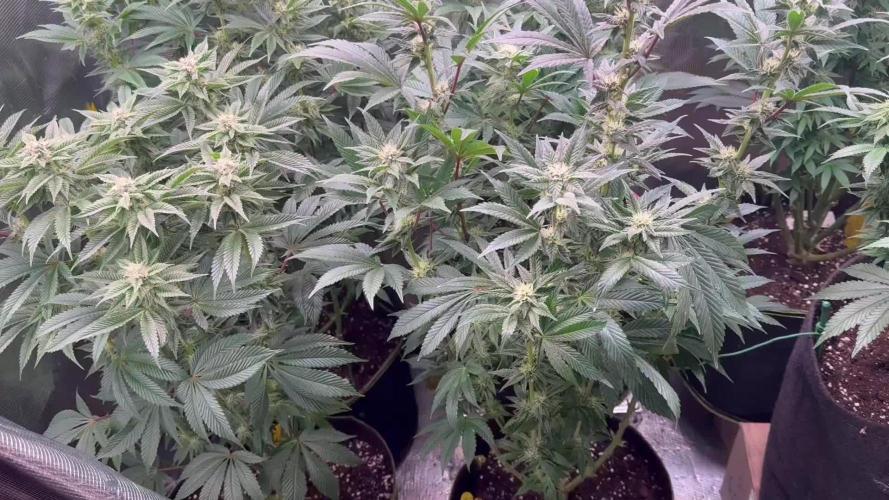
This week I adjusted the height with some random boxes and stuff to put under the box due to heightdifference ^^‘ since i feel like (hope) stretching is finished soon, u can definetly notice a fruity very pleasant smell on the papaya frosting

Processing
Likes
11
Share


Likes
25
Share


@BudGardener420
Follow
Currently checking daily and tying away branches/leaves to give the buds more light and watering when the soil is dry. Currently my plants drink exactly 1,5L a day. I have the feeling that the right plant is lacking a bit of potassium. I'll leave everything as it is for now because the left plant (fresh new soil) is growing well. Since the right plant is quite bushy anyway, I'll defoliate it again later and remove any lower shoots. I started adding the Bio PK booster towards the middle of the first week of flowering, 2ml per liter of water; as the pH value drops too much, I correct it upwards with Biobizz pH up - from pH 5.5 to 6.5 for 3L, I add a total of 39 drops. My water is mixed as follows: 3L osmosis water, plus 6ml CalMag, 6ml BioPK 5-8 and 39 drops of pH + BioBizz.

Likes
34
Share


@Brick_Bazuha
Follow
Неделя прошла вроде бы хорошо, поливаю сейчас чисто водой, довольная, правда медленно медленно стала цвести, ну ничего пахнет и выглядет всё краше и краше)

Likes
19
Share


@CannabisAprendiz
Follow
Bueno , este es el segundo cultivo que realizó del la cepa "Waka" , el anterior lo tengo igualmente documentado en otro diario .
en esta ocasión cultivamos los clones que habíamos recolectado del cultivo pasado , guardando los fenotipos que nos gustaron más y los clones restantes los pasamos a floración que fueron los que se le hizo seguimiento en este diario.
El crecimiento fue bastante explosivo y reaccionaron muy bien a cada trasplante realizado .
pude observar que los clones de cada fenotipo seleccionado se desarrolló con mucha similitud al de sus madres .
El olor en vegetación es bastante discreto y en floración se pone un más intenso
El desarrollo en floración fue explosivo generando bastante resina y se vieron muy hambientras .
Al fumar se puede sentir un rico toque cítrico en las N° 4 se siente un fuerte sabor a limón en algunas flores mucho mas marcado que en otras,
N° 3 y 13 un agradable toque a naranjas muy rico de sentir en el paladar , La N° 8 con pizcas dulces bastante interesantes.
El humo al fumar es muy suave lo que permite sentir mejor el sabor de cada fenotipo.-
saludos y buenos humos😉
Al momento de cosechar se cortaron los clone y se dejo secando en oscuridad a temperatura ambiente por cerca de 16 días posterior a eso se pasó a curar en frascos

Likes
Comments
Share


