


Likes
Comments
Share

@GermanGrow182
Follow
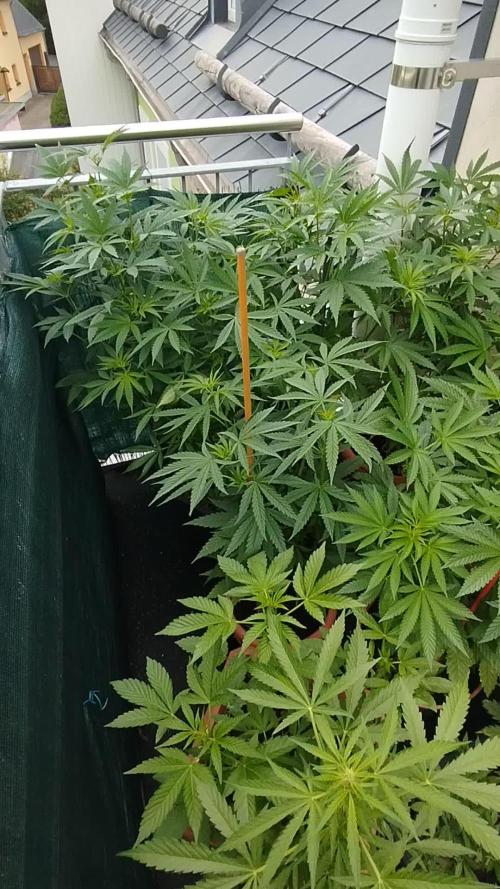
Durchwachsene Woche. Öfters Regen und prompt die erste SchimmelStelle diese Saison. Eine dicht gewachsene tropicana Cookies purple Auto war das erste Opfer. Auch noch der mainbud... 😐 Da auch eine fat Banana Auto und drei Apple fritter Auto reif sind, hab ich zwei komplette fritter und die mainbuds von einer Fritter und einer banana geerntet. Spatz in der Hand ist besser, als die Taube auf dem Dach... Sicher ist sicher. Die Photos kommen herrlich und haben knapp 90cm mit je 8 Haupttrieben. Das wird gut. Denn die wachsen noch mindestens 4 Wochen 😁👌 bis nächste Woche. Dann wird die erste Ernte beziffert ✌️

Likes
Comments
Share

@Kardo
Follow
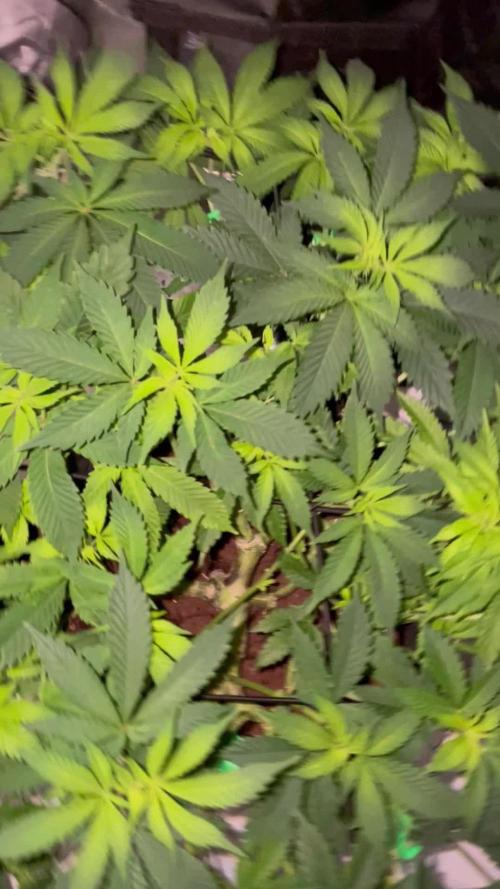
Sie hat sich den Platz genommen den sie braucht jetzt ist Zeit für die Blüte mal schauen wie sie in 5 Wochen aussieht.
Bis jetzt bin ich super zufrieden sie ist buschig und hat eine schöne Farbe ich bin gespannt wie die buds aussehen werden 😁
Likes
18
Share


@eldruida_lamota
Follow
Que grande es esta variedad, muy contento con El Progreso vegetativo de estos ejemplares.
Iremos viendo estas semanas cómo florecen ya que cambiamos el fotoperiodo, la cosa os Aseguro que pinta muy bien.

Likes
2
Share


@Yuriboyka99
Follow
la resa è ottima, la resistenza di questa genetica altrettanto. Ho avuto problemi con le mosche bianche e nonostante ciò non hanno accusato molto lo stress.
Likes
29
Share


@Ultraviolet
Follow
👋Top is a clean cut, no confusion for the plant, road ahead is clear, by completely removing the main growth tip, the auxin source is eliminated. The plant permanently halts vertical growth from that main stem and immediately sends its energy and hormones to the two new, evenly spaced branches just below the cut.
Fimming slightly different because a small tuft of the top growth is left behind, the auxin disruption is temporary and less severe. The plant recovers more quickly and sends its energy to multiple surrounding growth points, often creating four or more new shoots from the same spot. It will eventually regain some vertical dominance after a few weeks if left to its own devices, but with a little more LST, bending the apex to the same height as the rest of the internodes, this shatters dominance, hopefully creating around 8-9 main shoots growing at equal height once recovered and grown out.
Reduced environmental intensity for now and let her focus on dealing with this new stress for a week or two.
When H+ ions are added to soil, the first nutrient displaced from exchange sites is typically aluminum (Al3+), if it's present, followed by calcium (Ca2+), magnesium (Mg2+), and potassium (K+), because aluminum and these base cations have different binding strengths. The order of displacement depends on the lyotropic series, where ions with a higher positive charge and those with weaker binding strengths are displaced first.
The specific order of nutrient displacement is determined by the lyotropic series, which ranks the strength with which cations are adsorbed by soil particles:
Al3+: Most strongly adsorbed, so if present, it will be displaced by H+ ions, leading to increased solubility of aluminum and potential plant toxicity.
Ca2+: Displaced next, as it is more strongly bound than Mg2+ or K+ but less than Al3+.
Mg2+ and K+: Displaced after Ca2+.
The displaced nutrients can be lost from the root zone through leaching, becoming unavailable to plants.
As H+ ions increase, the proportion of acid cations (H+ and Al3+) on the exchange sites increases, while base cations (Ca2+, Mg2+, K+) decrease, resulting in a lower soil pH.
The amount of photosynthesis (water splitting) directly determines the availability of H+ ions (protons) in a plant.
90% of water is for cooling of photosynthetic apparatus the other 10% is split for its H+ among others things.
Carbon sugars, like glucose, do oxidize in soil through a process primarily driven by microorganisms, which break down these sugars for energy. This oxidation converts the sugars into carbon dioxide (CO2) through cellular respiration, a key part of the soil carbon cycle, though some carbon may also be incorporated into soil organic matter. The rate and extent of sugar oxidation depend on factors like oxygen availability, the presence of Fe oxides, and soil redox conditions, which can all influence the process.
My understanding of why we flush.
Just plain water, what does it do?
Strips the medium of salts and nutrients making it empty.
What does that do?
Triggers nutrient recycling within the plant.
What's nutrient recycling?
It is a natural part of plant senescence, which can be triggered once you know the switches. A 24:1 carbon-to-nitrogen ratio will also trigger.
Why won't it trigger autophagy for me?
Nitrogen needs to be gone, gone, gone almost. Ammoniacal (organic) nitrogen takes 4-5 times more water to separate it from soil particles than nitrates so what happens is most people jist flush the nitrates, leave all the ammoniacal in there and this prevents autophagy initiating.
Nitrogen decays differently depending on its form during the dry.
Ammoniacal nitrogen will oxidize in the air, leaving no trace. But nitrates do no decay and turn volatile and smelly and remain trapped until smoked, no matter how long you cure it does not oxidize. This is why you need to trigger it and begin the denitrfication process prior to harvest to get rid of all the nitrates. Otherwise, you will smoke it.
Flush till autophagy begins, just make sure you add no nitrogen afterwards. Micronutrients for trichomes. Don't leave the medium empty for 2 weeks, that does nothing but reduce yield 10%ish. Trichomes are another thing. Trichomes themselves are not directly affected by flushing; rather, flushing affects the plant's nutrient uptake, which influences the development and final state of the trichomes. Trichomes are filled with antioxidants in the last weeks, which is what makes them cloudy. A lot of the processing of antioxidants requires energy and nutrients (mostly micronutrients ), so you don't want that soil empty for 2 weeks, you just want the carbon nitrogen ratio 24:1and no higher. She still wants what she needs to ripen.
Processing antioxidants is energy-intensive; heat and light accelerate the rate at which THC converts to CBN. This is why you lower DLI, lower temps. By doing so, you reduce the oxidative workload caused by photosynthesis, which opens up the oxidative capacity for the production of antioxidants. THC is mostly processed at night when the plant's oxidative capacity is generally moreso "free and available" for work
Likes
11
Share


@Mo_Powers
Follow
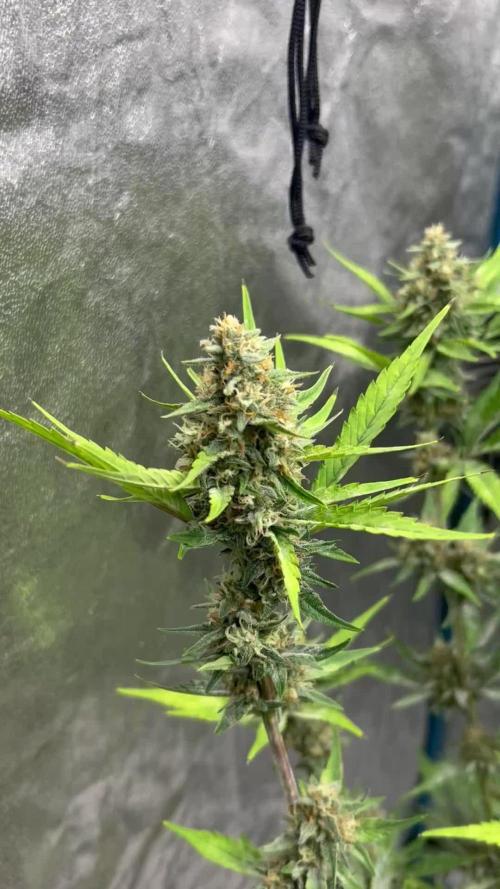
and here we go. another week has passed and she is still doing very well. the stem is nice and thick and the buds are also getting thicker. there is not really much to report. we are at about 12 hours of daylight. some leaves have got an autumnal colouring
Likes
3
Share

@Budking420
Follow
She’s doing amazing this week she’s really starting to ripen. I think 1 more week… granted I also like to really reduce the lights the last week to increase the chances of increasing yield. I’ve discovered that giving a 12/12 light schedule for the last couple of weeks really allows the plant to fill in its density, as well as allowing the roots a final stretch to access micro and macro nutrients. Check back next week to see just how fast she grows & remember it’s 4:20 somewhere

Likes
65
Share

@BudVision
Follow
Hi Growers,
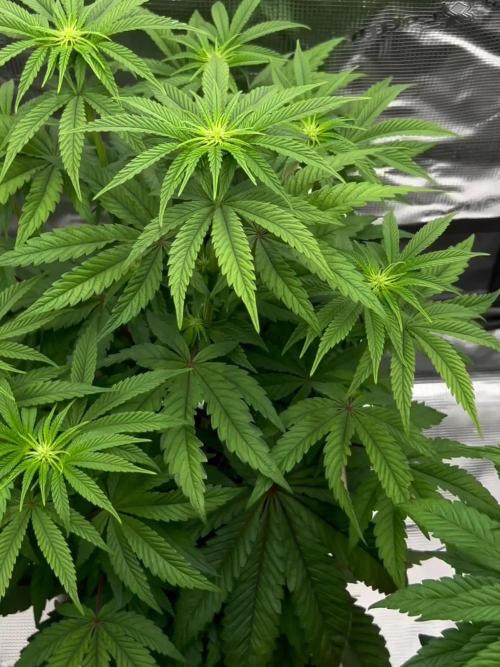
Week 2 of flower is here and the plants are clearly in full stretch mode. Every day they grow taller and fill the space nicely. Both ladies look healthy, strong and full of vigor. The male has already opened his first pollen flower, so pollen production has begun. I’ll start collecting some pollen soon and pollinate the two females.
———————————————————————————
Druhý týden květu je tady a rostliny jsou jasně ve fázi stretche. Každý den rostou a krásně zaplňují prostor. Obě samice vypadají velmi zdravě, silně a vitálně. Samec už otevřel první pylový květ, takže produkce pylu začala. Brzy začnu sbírat pyl a opylím obě samice.
Peace and happy growing ✌️


Processing
Likes
2
Share


@BigHorn
Follow
Week has gone well no support needed stock has been strengthened. New stocks coming in to replace the original 2 leaves. Looking very healthy. Trying to keep temp up a lil higher but I'm having difficulty do that currently. Just going to run the heat in my house a lil higher to help out.

Likes
20
Share


@SkunkyDog420
Follow
Hallo zusammen 🤙.
So das war es für sie wir sehen uns in 2 Wochen.
Sie erhalten 25 Prozent Rabatt in unserem Shop
Mindestbestellwert beträgt 75 Euro
https://greenbuzzliquids.com/en/shop/
Code: GD42025

Likes
13
Share


@KAPT_SAVE_Da_HOE
Follow
Chopped early due to an upcoming surgery. She's frosty with 5% ambers and sweet sweet candy smells. She does smell like runtz candy. I wish I could have let her go longer and happy I have more seeds depending on the smoke report.
Likes
13
Share


@Irish_Emeralds
Follow
Running smoothly so far... Still
only watering lighting, approx 200ml every 3 days or so.
Using the BioBizz nutes..
The fish mix stinks!
Likes
42
Share


@AutoCrazy
Follow
This plant is great! There is tons of trichome development and she smells super sweet.
There is some yellowing going on but she’s a big plant for a 20 gallon pot so it’s hard to find the right balance of top dressing to keep her happy. But all in all she is looking good and stacking up nicely.
😎🍿🍻🌱

Likes
4
Share


@AZMamaBear
Follow
What a difference mainlining makes. I broke a branch with the first mainline, but decided to continue the grow. She's a full 30" shorter than the Durban Poison that I started on the same day. I decided to do LST and she is respectable - and will have several massive cola's. We'll see how she turns out in the end.
Monsoon finally hits! Temps have dropped below the 110 mark low 100's! This grow will likely last > 30 weeks. Since GD only supports 30 weeks of diaries, this "week" will actually last two weeks.
Daytime high 95 106
Nighttime Lows 83 87
7/30/2022 - Day 183
7/31/2022 - Day 184
8/1/2022 - Day 185
8/2/2022 - Day 186
8/3/2022 - Day 187
8/4/2022 - Day 188
8/5/2022 - Day 189
8/6/2022 - Day 190
8/7/2022 - Day 191
8/8/2022 - Day 192
8/9/2022 - Day 193
8/10/2022 - Day 194
8/11/2022 - Day 195
8/12/2022 - Day 196

Likes
12
Share

@J4kpvp
Follow
Hello again:)
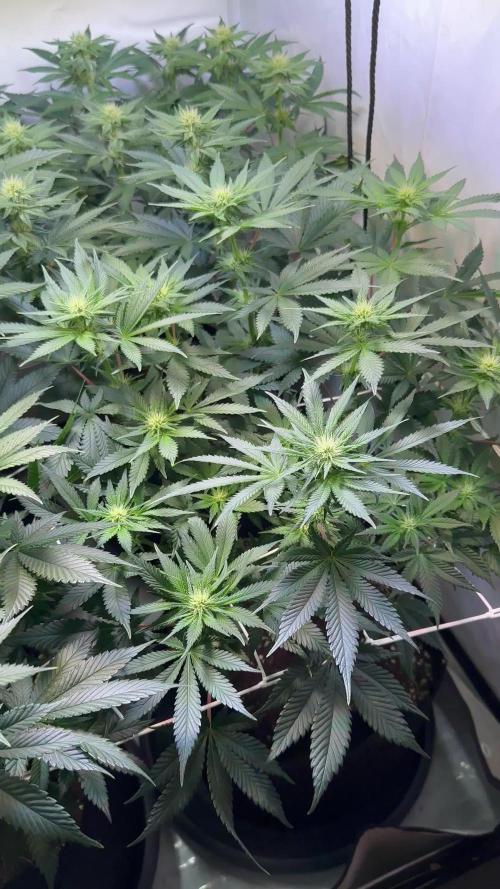
This week was as nice and easy as the weeks before. I have some humidity issues but I think I have a solution, let‘s see in the next days. Also there is still no need for fertiliser yet in my opinion, the leaves still look really nice, even a bit too dark on the tropical cookies (back right)
I also did the second dose of nematodes this week and I‘m also upping the water quite a lot, I‘m already at 3l per pot every few days and they take it without any problem :)
They also grew very evenly this time except for the watermelon weddingcake in front left, which stayed a little smaller compared to the massive chocolate sherbet in the back left
Looking forward to seeing the buds build up now:)

Likes
10
Share


@Kirsten
Follow
We are in flower for this 💚 ORION F1 AUTOFLOWER GROW 💖
The Organic Dry Amendments plant has really grown tall, I should have trained the plant earlier, aside from topping, which I did early on.
I LST'D the plant yesterday on the 11.7.25, I tied down the branches with soft garden twine to the grommets I added to the pots.
As the plants have been left for too long, they have grown tall, and now it is more difficult to train them.
💖 ORION LIQUID NUTRIENTS PLANT 💖
I LST'D on the 11.7.25 as above. This one is starting to stretch from flowering and had gotten taller as with the other plant.
Let's see how the training goes. They are looking a bit straggly. So hopefully, they will fill out with some more leaves and flowers.
You can check out the other diary to see how I cared for each plant, and the comparison if you're interested 🙂
💖 ORION F1 LIQUID NUTRIENTS 💖
Here is what I did this week.
8.7.25:
I watered with 2ltrs of dechlorinated water PH'd to 5.9 and containing the following nutrients;
💜 1/2 TSP Cal-Mag
💜 1/2 TSP Mega Crop Part A
PH: 5.9
PPM: 1500.
12.7.25:
I watered again today with 2ltrs of dechlorinated water PH'd to 6.0 and containing the following nutrients;
💜 1/2 TSP Mega Crop Part A
💜 1/2 TSP Cal-Mag
PH: 6.0
PPM: 1440
Thanks for checking in this week and hanging out in the comments 😊💚✌️🌱🙏🍃
Processing
Likes
3
Share


@Badger161291
Follow
Lady’s are looking good drinking more water and more nutrients any body any tips on wat they look like for first time grower
Likes
3
Share

@Nofeckingclue79
Follow
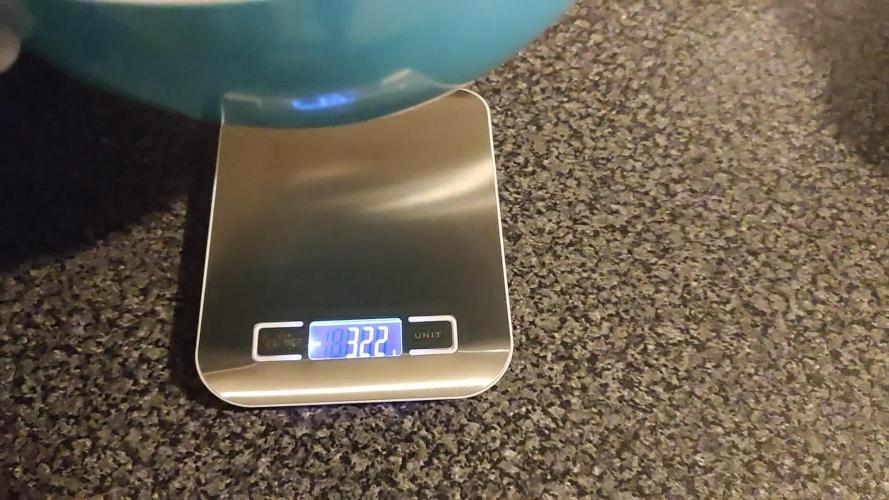
Even with the heat she has given me quite a big yield and that's with lack of watering and also training badly so I could have got a better yield if I have had paid more attention to her so until next time ✌️ out my fellow Growmies

Likes
5
Share


@AustinRon
Follow
TH 1Q2025 - Week 6 - Bolt 3
(ON Haze X Original Haze) X Northern Lights #2
“Todd’s Haze”
Objective
- 8 Female Plants, Topped ONCE @ Flip, 12” when topped
- Modified Sea of Green
Week’s Objectives
- Auto-Fertigation Installed and operational
- Twice/Day, 440 ml/ Day (Initial Rate) - 220 ml/Event
Weeks Observations
- We have a smattering of pistils showing - looks like pre-flowers with Haze morphology
- Confirms (for me) the known property of Haze - that 7+ weeks of veg (from seed) is required BEFORE the plants can initiate flowering. (Noting that CUTS will be ready to flower @ Flip.
Seeds Wet: 1139PM, 28.2.2025
Germinated: 2.3.2025
Flip: 21.3.2025
Harvest: 77 Days, DATE: 6.6.2025
_________________________________________
__
Fri Apr 11, 2025
TH 1Q25 22:F:3:1
EC: 1.8
LightDistance: [ 20.5, in] # We’re in STRETCH, ~1.5”/day!
LightIntensity: [ 640, µMol/m2/s]
- [x] TM-7: [ 0.125, g] # Prep
- [x] Fertigation: [8.5:8.5:3.4:3.4:3.4:0:3.4] # [Primer A:Primer B:CalMag Fuel:Silica Skin:Lush Green:Root Anchor:Peak Bloom]
- [x] Photosynthesis Plus: [ 6, ml]
- [x] Quillaja 60 Powder: [scant]
- [x] PCAL 1660: [ 0.5, gm] # Once or Twice/Week
- [x] TM-7 (µNutrients): [ 0.125, g]
__
Sat Apr 12, 2025
TH 1Q25 23:F:3:2
LightDistance: [ 18, in] # We’re in STRETCH, ~1.5”/day!
LightIntensity: [ 703, µMol/m2/s]
LightDimmer: [ 85, %]
We’re bringing up Intensity SLOWLY, as the plants adapt. Allowing the plants to grow INTO the LightField and naturally raise PPFD as it does.
- [x] TM-7: [ 0.125, g] # Prep
- [x] Fertigation: [7.8:7.8:3.1:3.1:3.1:0:3.1:0.0] # [Primer A:Primer B:CalMag Fuel:Silica Skin:Lush Green:Root Anchor:Peak Bloom:Resin Bloom]
- [x] Photosynthesis Plus: [ 6, ml]
- [x] Quillaja 60 Powder: [scant]
- [x] PCAL 1660: [ 0.5, gm] # Once or Twice/Week
- [x] TM-7 (µNutrients): [ 0.125, g]
__
Sun Apr 13, 2025
TH 1Q25 24:F:3:3
LightDistance: [ tbd, in] # We’re in STRETCH, ~1.5”/day!
LightIntensity: [ tbd, µMol/m2/s]
LightDimmer: [ 85, %]
- [x] TM-7: [ 0.125, g] # Prep dilution in 250 ml plain water
- [x] Fertigation: [7.8:7.8:3.1:3.1:3.1:0.0:3.1:0.0] # [Primer A:Primer B:CalMag Fuel:Silica Skin:Lush Green:Root Anchor:Peak Bloom:Resin Bloom]
- [x] TM-7: [ 0.125, g] # Delivered
- [x] Photosynthesis Plus: [ 6, ml]
- [x] Quillaja 60 Powder: [scant]
__
Mon Apr 14, 2025
TH 1Q25 25:F:3:4
LightDistance: [ tbd, in] # We’re in STRETCH, ~1.5”/day!
EC: [ 1.9, mS/cm]
- [x] TM-7: [ 0.125, g] # Prep dilution in 250 ml plain water
- [x] Fertigation: [7.8:7.8:3.1:3.1:3.1:0.0:3.1:0.0] # [Primer A:Primer B:CalMag Fuel:Silica Skin:Lush Green:Root Anchor:Peak Bloom:Resin Bloom]
- [x] Photosynthesis Plus: [ 6, ml]
- [x] Quillaja 60 Powder: [scant]
- [x] PCAL 1660: [ 1, tsp] # Once or Twice/Week
__
Tue Apr 15, 2025
TH 1Q25 26:F:3:5
EC: [ 1.8, mS/cm]
# [Primer A:Primer B:CalMag Fuel:Silica Skin:Lush Green:Root Anchor:Peak Bloom:Resin Bloom]
- [x] Fertigation: [8.7:8.7:3.5:3.5:3.5:0.0:3.5:0.0]
- [x] Photosynthesis Plus: [ 6, ml]
- [x] Quillaja 60 Powder: [scant]
- [x] Terps Plus: [ 2, ml]
- [x] PCAL 1660: [ 1, tsp] # Once or Twice/Week
__
Wed Apr 16, 2025
TH 1Q25 27:F:3:6
Stretched another 1.5”
Main Canopy @ 740 (PPFD)
Fertigation 1L/Plant/Day - 2 x 500 ml, 6 hour freq
LightDistance: [ 17, “]
LightIntensity: [ 740, µMol/m2/s]
EC: [ 1.8, mS/cm]
Fertigation Amount: [ 2.0, gal] # We’re a little low at a gallon/day …
Light Intensity: [ 750, µMol/m2/s] # Adjust Light Height to Achieve.
Light Dimmer: [ 100, %] # Photone is ok, but I think reads low . . .
# [Primer A:Primer B:CalMag Fuel:Silica Skin:Lush Green:Root Anchor:Peak Bloom:Resin Bloom]
- [x] Fertigation: [17.5:17.5:7.0:7.0:7.0:0.0:7.0:0.0] # [ 10, 4, 4]
- [x] Photosynthesis Plus: [ 12, ml]
- [x] Terps Plus: [ 2, ml]
- [x] Quillaja 60 Powder: [scant]
- [x] PCAL 1660: [ 2, tsp] # Once or Twice/Week’
__
Thu Apr 17, 2025
TH 1Q25 28:F:3:7
LAST HAND WATERING: FRIDAY We Start Auto-Fertigation
Light Distance: [ 13.5, in] # 2“ Today
EC: [ 1.8, mS/cm]
# [Primer A:Primer B:CalMag Fuel:Silica Skin:Lush Green:Root Anchor:Peak Bloom:Resin Bloom]
- [x] Fertigation: [16.9:16.9:8.5:8.5:6.8:0.0:6.8:0.0] # [ 10, 5, 4]
- [x] Photosynthesis Plus: [ 12, ml]
- [x] Terps Plus: [ 2, ml]
- [x] Quillaja 60 Powder: [scant]
