Likes
28
Share
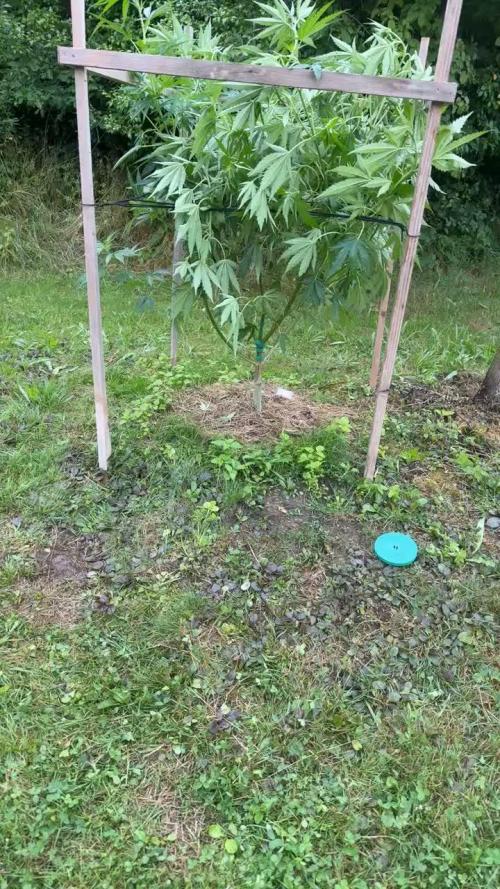
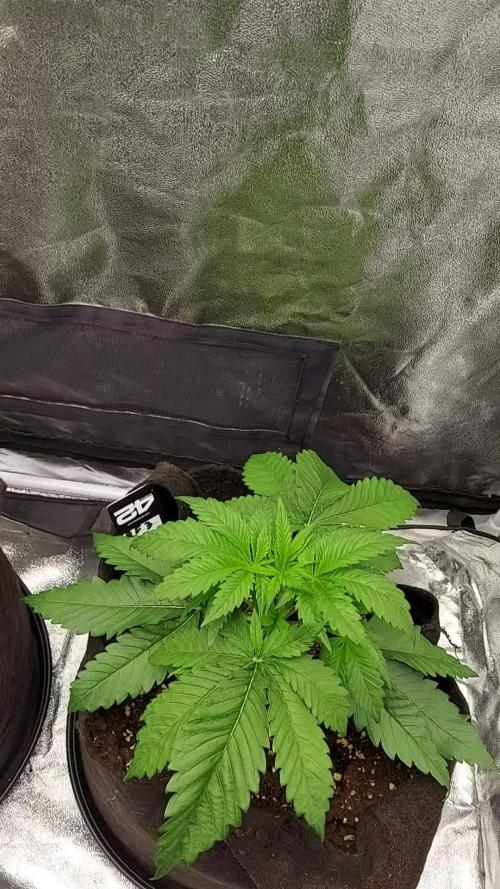
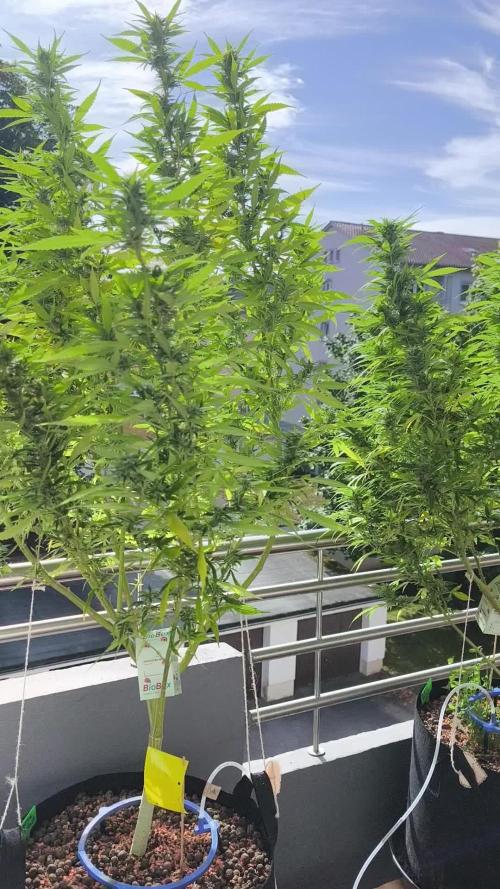
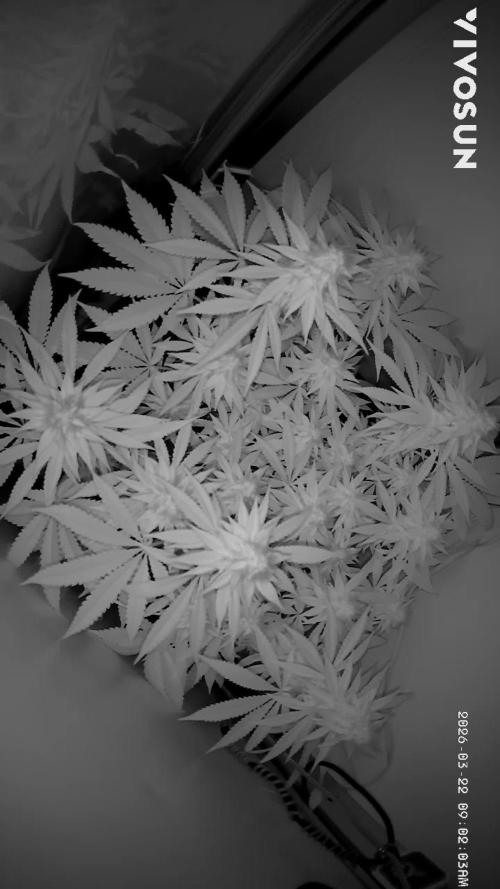
September 16, 2021 - Everything is chugging along nicely. Both girls are growing at a nice pace. I noticed a couple of fungus gnats earlier this week (I suspect they came in with the cheap soil I'm using with the herb garden). I've been letting the soil dry out and also put out new yellow sticky tape. I'm also spraying the plants with a rotating regimen of Neem Oil, Dr. Zymes and diluted Peppermint essential oils. I rotate spraying with a different solution every 3 days. I'll keep this up until flowering starts. I'll also be dropping new seeds next weekend. I'm going for a perpetual harvest with 2 plants starting every 4 weeks. 👍 Cya next week!!!
Likes
14
Share
6ª Settimana di Fioritura 💐💐💐💐💐💐 Guardate che bei colori che sta buttando la MIMOSA SHOT 🌼🎇 di HERBIES SEEDS 💚😍 verde chiaro, scuro... viola/nera e peli giallo fuo 🤩🔝 Che bellaragazza💚✅😘 E buon 420 a noi growers🚜💐💓
Likes
67
Share
Day 40: They got recoverd from overwatering. Leafs got darker because I gave them more nutrients, but gained early signs of slightly overfeeding ( Burnt tips on leafs). I had to boost them to fix it because there isn't much time with autoflowers. Now i only have to adjust my nutrient feeding with just 10 to 15% and its all good. They did stretch again, some growers love it but i think it is ugly and you will gain weak stems. Also the fans will not reach the plants properly, which is not good. This time it is my fault, i didnt want to let my friend take care of them while i was busy. What happend is that i could had raise my lamps again. When your lamps are to close to the plants( its not a big deal with LED but it is with HPS) your plants will get alot of heat and they will stretch. So the secret of smaller plants is to keep your lamps high, but not to high otherwise they don't grow proper. But never do this alot when they are in late flowering, because your buds will foxtail, unless you love to have foxtailed buds. I have to do something about the heat soon, because i want my buds compact and not fluffy. This will happen due lots of heat. Also due alot of stretching and other problems, I gained a messy cantopy resulting in many problems. For noobies the room looks awesome but pro's will see that because of this, the stems and branches are weak and everything beneeth it has no use anymore because it gets no light. The spaces between internodes are to far away, so there will not be huge buds. I also have to start give them cal/mag, i saw first stages of deficiency. Not a problem when you are early with spotting it. I didn't forsee that i had to work like 60hours a week suddenly while having autoflowers on cocos in 3 liter pots and you only can water them once per 2 days and can take care of them once per 3-4 days. That is not really ideal 😅 Positive thing is that the buds are starting to develope 😍 Thats all for now Day 42: I have been defoliating alot to get the air between the plants. There are still some leafs and branches i want to get rid off, but i don't want them to stress out to much. Also i have killed of 23 smaller plants to make more space for the others. This is always painfull but stupid if you don't do this. If the plants didn't stretch that far due heat and low placed lights, this would not have been the case. I would still have alot of small nice plants. See you guys next week!
Likes
14
Share
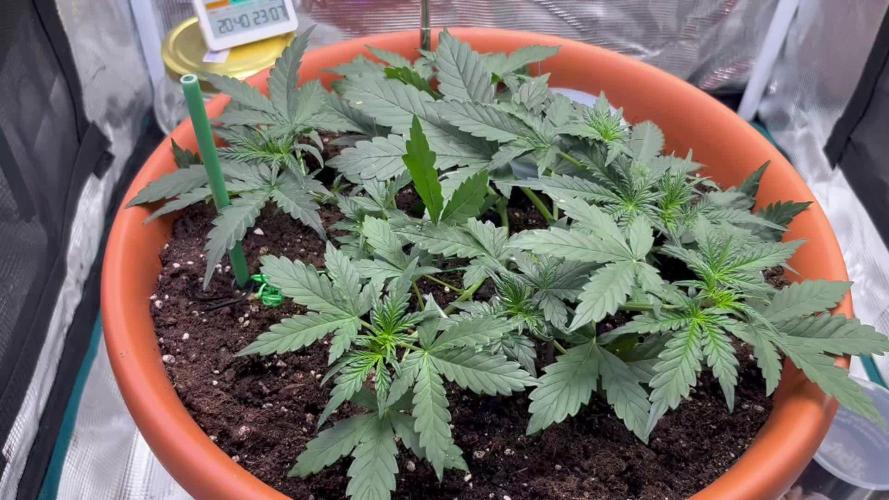
It's the 4th week! Stilling doing the mainlining, for some reason I found myself training the branches to form a bull horn shape, maybe I'll mount it on the wall after this first grow, lmao. I added more CalMag this week, as now I'm thinking the rust/brown spots and tips are from a Calcium deficiency since I am using distilled water. Time to watch these leaves, and if it continues to rust it might be the VPD. Nov 28th - pH 6.0, PPM 860, 1.7 EC, Temp 70f, Humidity 50% Nov 29th - pH 6.3 -> 5.8, PPM 860, 1.7 EC, Temp 80f, Humidity 55% Nov 30th - pH 5.8, PPM 860, 1.7 EC, Temp 80f, Humidity 60% Dec 1st - pH 5.9, PPM 860, 1.7 EC, Temp 80f, Humidity 70% Dec 2nd - pH 5.5 -> 5.9, PPM 840, 1.7 EC, Temp 80f, Humidity 60% Dec 3rd - pH 5.9, PPM 810, 1.6 EC, Temp 80f, Humidity 70% Dec 4th - pH 5.7, PPM 790, 1.6 EC, Temp 80f, Humidity 70%
Likes
3
Share
Been a good week no signs of shock at all. I have only been watering them with Mills Vitilize silica supplement , i think ive been doing 1 mls per gallon, slowly increasing the dosage. topped 2 plants in here , now am i wishing i did it for some of the others . Day 1 for all of these was the 03-08-24
Likes
17
Share
Day 5 of Starting my biggest grow yet. All seed are from fast buds and are prizes from nov 22 newbie of the month. Iam starting this grow now as I have worked my way to getting a setup I am happy with. Will try to keep a detailed run at this dairy. Iam Biobizz light mix substrate in 12L root nurse fabric pots under two mars hydro ts1000s running at 25%. Average temp 20c and humidity 80% this week. Got three healthy seedling my Cherry cola don’t look to good I will germinate a seed along side her this week and see how we go. Let’s get this work 💪🏽💪🏽💪🏽
Likes
333
Share
@Terp1
Follow
04.01.2024 Tag 65 - Woche 10 / Tag 2 Licht: 40cm – 90% Lichtzyklus: 12/12 Luftfeuchte: 65% Temperatur: 27°C VPD: 1,3 kPa Höhe: Apple Fritter - 45cm Purple Punch - 65cm Gelato - 75cm Bemerkungen: Die Apple Fritter sieht perfekt aus. Die Purple Punch sieht aus, als hätte sie einen leichten Brand UND einen leichten Mangel. Allerdings werden die oberen Zuckerblätter auch schon langsam lila... muss ich beobachten. Die Gelato hat auf jeden Fall was. Ich sehe einen leichten Kaliummangel und einen Calcium-Überschuss. Zusätzlich verdrehte Blätter, was auf PH-Schwankungen deutet - aber bei Living Soil eigentlich nicht von Bedeutung sein sollte. Ich lasse das CalMag erst einmal weg. Und pegel den PH die nächsten Gießvorgänge ein. Mal sehen, wie sie darauf reagiert. Ich denke insgesamt ist der VPD zu hoch. Ich wollte die Pflanzen ein wenig pushen aber das ist zu viel. Ich gehe wieder runter auf 1.2 kPa Terp 💪😎 ############################################################################################################################################################## www.zamnesia.com Gelato - abgefahrene Qualität hat noch nie so köstlich geschmeckt. Zamnesia Seeds präsentiert Gelato, eine stattliche indicadominierte Sorte, die im Grow Room eine tolle Figur macht und ein episches High hervorruft, das perfekt ausgeglichen ist. Im Unterschied zu anderen Gelato-Varianten auf dem Markt, wurde die ultra-potente Wedding Cake in unsere Version eingekreut, die Gelato das gewisse Etwas verleiht. Apple Fritter - wird Deine Laune heben, Deinen Körper entspannen und Deinen Geist aktivieren. Oh, und haben wir erwähnt, dass sie wie warmer, selbst gebackener Apfelkuchen duftet? Falls Du nach einer potenten, ertragreichen Sorte mit solider US-Genetik suchst, solltest Du in Deinem Grow Room Platz für Apple Fritter schaffen. Purple Punch - von Zamnesia Seeds ist eine traumhafte Indica, die mit einem exquisiten Geschmack und einem unglaublich entspannenden Effekt glänzt. Trotz ihrer kompakten Größe steht diese pure Indica für einen einfachen Anbau und großartigen Ertrag.
Likes
6
Share
- Day 63 The flowers look beautiful right now, very frosty, very phat, branches can't properly support them anymore and the smell is amazing. Day 66 Noticed today that the pot was still pretty heavy after 24 hours, seems like she is drinking a lot less now. Hard to tell since when she started drinking less because I can't move her at this point, too risky with all the branches bending so far because the buds are so heavy and the stems can't stay up on their own. Day 67 Pot is still very heavy today so I'm gonna skip watering today. Day 68 Gave 3 liter light feed today, but noticed no run off now, while I was getting 1 liter run off when I was watering everyday, so might have to keep up the daily watering.
Likes
153
Share
Didn’t gave her that much love for the love she gave me back, super easy to grow and maintain. No idea what she is but i wold grow her again 💚💚💚
Likes
18
Share
07/07/2025, beginning of week 8, a few issues have reared their head, done as many checks as I can on conditions and soil conditions and have come to the conclusion that I need to carry on sensibly feeding as these issues were probably present weeks ago but just not showing until now. Bud development seems ok and they are lengthening/stacking ok, she's becoming more and more frosty and starting to smell a bit, I think she will carry on lengthening this week before starting to flatten up from next week and will feed accordingly. Fingers crossed it doesn't fall apart haha.
Likes
13
Share
@Chucky324
Follow
Hello. This is the end of week 9 and the beginning of week 10 of flowering. It's sunflower season... ain't they pretty. I see plant #1 is looking ripe and could probably be harvested. But I'll grow it another week, because that was the plan to start with. Got 2 good flushes in so far and I want to get 2 more before harvest. Have seen dead aphid shells on some of plant #1 interiour leaves. Something must have eaten or sucked the insides out of them. Wow... Will post some pics/video next week just before harvest. OK. Have fun. Chuck.
Likes
1
Share
Remember that, however you are played, or by whom, your soul is in your keeping alone. Even though those who presume to play you be kings or men of power, when you stand before God, you cannot say, 'But I was told by others to do thus,' or that virtue was not convenient at the time. This will not suffice. Remember that. Day:18 84°F and 65% RH (VPD) for the vegetative stage. Approximately 1.15kPa(assuming leaf temperature is about 2°F cooler than the air), which falls right into the ideal vegetative sweet spot (0.8kPa to 1.2kPa). At 1.15kPa, plants can draw water and nutrients efficiently without risking stress or wilting. It keeps the leaf pores (stomata) open, allowing for ideal carbon dioxide intake and maximizing vegetative growth. VPD is determined by the leaf's temperature, not just the ambient air. Because leaves usually run 1° to 3°F cooler than room air under bright grow lights, my actual VPD will be slightly lower, closer to the 1.0kPa mark. As she transitions from vegetative growth to flowering, one can gradually lower the humidity (to around 45–60%) and drop temperatures slightly to prevent disease from settling inside dense buds when they appear. Night:6 At 70°F and 60% relative humidity, Vapor Pressure Deficit (VPD) is 0.86 kPa. This is right on the cusp of whats optimal for the vegetative stage. During the nighttime, plants generally close their stomata and undergo cellular respiration rather than photosynthesis. Transpiration slows to a near stop, making VPD less critical at night than during the day. However, maintaining a nighttime VPD between 0.8 and 1.0 kPa is highly beneficial in that it ensures the air is dry enough to prevent powdery mildew or bud rot, but moist enough to keep the plant from undergoing unnecessary stress. This range keeps the environment comfortable for cellular processes and prevents large atmospheric swings. Keeping it all flowing. (Not pushing them yet, these are photoperiods) The optimal soil (root zone) temperature for cellular root respiration and nutrient uptake in cannabis is between 68F & 72F This narrow range balances biological energy production (cellular respiration) with the dissolved oxygen levels in the soil, maximizing plant growth and health. Warmer soils hold significantly less dissolved oxygen. When soil temperature exceeds 74F oxygen depletion occurs, inhibiting cellular respiration almost entirely, At 68-72F root cells generate optimal adenosine triphosphate (ATP) via respiration to power root-tip elongation and the active transport of water and nutrients. Too Hot (Above 78F) Root respiration increases, demanding more oxygen, while the water's oxygen-carrying capacity drops. This creates a prime environment for anaerobic pathogens and Pythium (root rot). Too Cold (Below 60F) Root metabolism and cellular respiration slow to a crawl. This severely impairs nutrient and water absorption, leading to yellowing, wilting, and phosphorus deficiencies. A lot depends on whether it's automatic or photoperiod; with photoperiod, there is not as much of a need to push "hard" as the real countdown only begins once the flower is initiated. Automatics, on the other hand, the chronological "clock" begins ticking the moment the seed germinates. It is of critical importance that the seedling growth gets off to the races, understanding that early growth is like compound interest, which will pay off come harvest. This reality is why getting autoflowers "off to the races" early on yields such exponential benefits. The "compound interest" is directly related to the surface area of the leaves. Larger, faster-growing seedlings process more light and build bigger root networks early on, which translates into an explosion of vertical and lateral growth during their short vegetative window. The margins for error are so thin with autoflowers; this early-stage momentum depends on several critical practices. Seedlings exposed to increased atmospheric CO2 levels early in life will develop at an increased rate. To effectively "extend" or optimize the capacity of Photosystem II (PSII) for increased photosynthetic efficiency. In standard oxygenic photosynthesis, Photosystem II (PSII) is naturally limited to the red-light spectrum, peaking at 680nm. Extending its light-harvesting capacity past 700nm into the far-red region requires bypassing the natural limits of standard chlorophyll a. Adding 730 nm (far-red) LEDs alongside standard red/blue lights has been shown to increase canopy photosynthesis by 20–30% in several crops by acting synergistically with shorter wavelengths. However, the limitation is that excessive, pure IR/Far-red light (without accompanying red light) can trigger the "shade avoidance response," causing plants to grow tall, weak, and spindly rather than robust. Utilizing infrared light (specifically the 700-750 nm far-red range) is a viable method to boost photosynthetic efficiency. It acts as a bridge to allow PSII to utilize a broader spectrum of light, breaking the traditional 700 nm barrier. UVR8-mediated signaling (often in conjunction with CRY proteins) triggers protective mechanisms that maintain the stability of the photosynthetic apparatus (including LHCII and reaction center proteins), thus ensuring that the efficiency of Photosystem II remains higher in UV-B-exposed plants compared to plants lacking this receptor. ΦPSII indictates the rate of electron transfer from water to plastoquinone, which drives the production of ATP and NADPH. There is a close link between ΦPSII and the true rate of CO2 fixation (Φ*co2). ETR stands for Electron Transport Rate. It measures the speed at which electrons are moved through the thylakoid membranes in a plant's chloroplasts during the light-dependent reactions of photosynthesis. Infrared light (particularly Near-Infrared or NIR) improves cellular energy by interacting directly with the electron transport chain (ETC) in mitochondria. This process boosts adenosine triphosphate production, which acts as a metabolic coefficient multiplier by accelerating enzyme activity dramatically. Extend then multiply. Far-Red photons interact with plant photoreceptors to accelerate the plant’s biological "clock" or trigger a shade-avoidance response. Autoflowers don't use the plant's biological clock, although the IR will initiate a shade avoidance and make them stretchy. You can just add equal measures of 660nm-680nm to negate the shade avoidance effect. Replacing nights' "darkness" with a combination of IR+ and 660nm. Because autoflowers don't require a dark period to flower, many growers just blast them with light. 18/6 24/0. However, this ignores the plant's metabolic rhythms, where daytime photosynthesis (light reactions) must be perfectly balanced with nighttime carbon fixation and assimilation (Calvin cycle) to avoid bottlenecking plant development. Cellular respiration is a 24/7 process, but it can only function while the plant has the free oxidative capacity to do so. A 100% photosynthetically active leaf cannot perform cellular respiration. The viral trend of defoliation of every leaf that isn't "getting enough light" is of great detriment overall, putting 100% of the cellular respiratory "workload" and responsibility on the 0/4/6 hours of darkness in sub-optimal conditions for enzymatic activity. Photosynthesis captures nearly 100% of the initial energy as carbon, while cellular respiration is the process that unlocks 90% of that captured energy into usable ATP so the plant can use it. Respiration is considered roughly 30% to 40% efficient. It captures enough of the potential energy in glucose to synthesize around 30 to 38 ATP molecules per glucose molecule. The remaining 60% to 70% of the energy in the sugar is not captured in ATP; instead, it naturally escapes into the environment as heat, which helps regulate plant temperature. In plants, the primary enzymes of the Electron Transport Chain (ETC) and the ATP synthase complexes are typically adapted to function optimally in warmer temperatures (roughly 25°C to 35°C depending on the specific plant strain). As temperatures rise within this physiological range, molecular collisions increase, speeding up respiration and ATP production. The cannabis plant has a branched respiratory pathway. During heat or cold stress, plants activate Alternative Oxidase (AOX). AOX burns sugars to dissipate energy as heat rather than coupling it to ATP production. This pathway actually functions optimally at elevated temperatures to help protect the cell from the damaging build-up of Reactive Oxygen Species (ROS) during heat stress. Enzyme activity generally scales with heat; there is a strict biological limit. If canopy temperatures in a grow room exceed 40°C, the enzymes and their supporting lipid membranes lose stability. Not saying you need to go crazy, just optimize nights the same as we optimize days. Phosphorus is the driving force behind early seedling development. It acts as the "energy hub" of the plant, directly driving cell division, robust root growth, and the creation of DNA. Without an adequate, easily accessible supply early on, the plant's overall growth potential and final yield can suffer permanently. E=MC2 looks like a simple multiplication problem; it describes a fundamental physical truth: mass and energy are the same thing. The equation doesn't just calculate a value; it reveals that mass is effectively "congealed" energy. Energy is just numbers. Energy isn't a physical "substance" you can hold or touch. It is essentially an abstract, calculated number that we assign to a system to predict how it will change, interact, or move. A numerical label we attach to matter to track how it behaves. Because the universe runs on laws of symmetry (specifically, that the laws of physics don't change over time), a single global number must be conserved. We call that number "energy". We don't grow; we facilitate energy conversion. How well a seedling grows is essentially down to how much knowledge one can acquire to increase the level of conversion to occur. Applying knowledge effectively requires intuition, which comes from hands-on experience. A seasoned stoner learns to read subtle signs—like a slight change in leaf turgor (stiffness), subtle color shifts, or the specific texture of the soil—before a textbook diagnosis can be made. Ultimately, growing is the application of botanical science blended with active observation. Knowledge dictates your potential, but adaptability and attentiveness to the plant's immediate environment determine your results. 1.618 nature mathematically optimizes quantum energy transfer and light absorption efficiency within the photosynthetic machinery, as it naturally dictates energy scaling hierarchies and resonance dynamics. External vibration or electromagnetic wave that perfectly matches a plant's natural frequency directly influences plant growth. Low-frequency sound waves and targeted electromagnetic fields stimulate cellular processes and boost photosynthetic efficiency Does it produce better yields? How long is a piece of string? As long as you cut it. But isssss the juice worth the squeeze? The quantum framework of the IVM seems to think so. Good enough for the quantum firmware, good enough for the DNA software. Genetics are not dictated; they are expressed; the rate of that expression is dictated by the environment in which growth occurs. Quantum Coherence in Photosynthesis occurs When a photon of sunlight strikes a leaf, the energy it carries must travel to a reaction center to be converted into chemical energy. This process operates at nearly 100% efficiency. If the energy moved in a traditional "bunching" or random hopping manner, a large portion of it would be lost as heat. Instead, plants utilize quantum superposition. The energy particle (exciton) doesn't just take one path; it exists in a wave state and explores multiple pathways simultaneously. It essentially "chooses" the most efficient route to the reaction center simultaneously. Research shows that molecular vibrations and the specific network arrangements of chlorophyll molecules (like the naturally evolved Chlorophyll A & B ratios) actively protect against energy overflow, optimizing light capture across different light intensities. Enzymes are the biological catalysts that speed up chemical reactions within a plant's cells, allowing them to grow, metabolize, and repair. Rather than relying solely on the classical kinetic energy of molecules colliding, plants use quantum tunneling. Subatomic particles like electrons and protons (hydrogen ions) can literally "teleport" through energy barriers that they normally wouldn’t have the energy to climb over. This makes vital metabolic reactions happen far faster than classical physics could ever explain. Chloryphyll b has peak absorption at 460nm (Blue) and at 647nm(Red). If we take the blue peak wavelength 460nm and a UV-B, UVR8 peak absorption wavelength 285nm, Tryptophan-285 (W285) Sensing protein. 460/285=1.618 Φ If we take chlorypyhll b's Red absorption peak 647nm and a UV-A of 400nm, we get 647/400=1.618 Φ. "Structure of light". The cryptochrome photoreceptor (CRY) is a UV-A/blue light receptor that shares this dual sensitivity with several other biological structures and functions, including significant sequence similarity and a common evolutionary ancestor with DNA photolyase enzymes. These are light-activated enzymes that use blue/UV-A light to repair DNA damage caused by UV-B radiation in plants. Synergistic. But Shhh, it's a secret. Effective quantum efficiency of photosystem II, often denoted as ΦPSII, represents the proportion of light absorbed by Photosystem II (ΦPSII) that is actually used in photosynthetic electron transport. It is a key indicator of how efficiently a plant is using light for photosynthesis, as opposed to losing it as heat or fluorescence. ΦPSII (effective quantum yield of photosystem II) functions primarily as a "multiplier" (a coefficient of efficiency) rather than an additive factor when estimating the overall photosynthetic electron transport rate (ETR). Multipliers are considered far more beneficial than additions because they generate exponential growth, leverage existing resources to their full potential, and create sustainable, self-multiplying capacity, rather than just incremental, linear increases. This fascinating observation is rooted in the intersection of subatomic geometry, fractal scaling, and quantum dynamics. In specific molecular arrangements—such as in conjugated polymer networks or biomolecular architectures—the Golden Ratio (PHI) naturally dictates energy scaling hierarchies and resonance dynamics. Mathematically tied to the fine-structure constant, which defines the strength of the electromagnetic interaction. The Golden Ratio can be mapped geometrically as the Golden Angle (137.5 degrees) in atomic structures, linking the charge of the electron to fundamental quantum constants like Planck's constant. Electromagnetic. The Golden Angle (137.5): This angle is derived from the Golden Ratio (1.618). It is the smaller of two angles created when a circle is divided such that the ratio of the arcs equals the Golden Ratio.
Likes
93
Share
Hi guys, What's up? Welcome back to Queen Peaky's Flower Gardens We have decided to further extend this beautiful woman's stay in our tent to continue developing the fantastic buds she has developed
Likes
102
Share
Hello everyone! well friends !, so she took her final forms! from today it switches to flowering mode 12/12 .. in the diary I will add a week of flowering when it starts blooming and not when the light mode has changed .. I don’t like it when they do it .. it gets confused .. 2 weeks is needed for flowering to begin active after switching to 12 hour mode .. and those growers who add weeks of flowering when switching to 12 hour mode, damn you!)))
Likes
6
Share
Overall it was a great first time grow. The outcome was smaller than expected. This was caused by the heavy under watering, that stunted the growth of the plant. However the 26g of weed that I got from this harvest is amazing! Smoking is very smooth and the sativa effects are great.
Processing
Likes
6
Share
@Weedzoks
Follow
La plante a fortement jauni cette semaine et des taches sont apparues Flo 23: Arrosage eau Flo 24: Pulvérisation de 3ml de Vita Race
Likes
22
Share
1/25/2024 Vegetation Week 3 Day 1- took 2 Tops today and cleaned up a few lower leaves that were hanging down. The FiM seems to have worked well and looks like I have three branches coming in where it was FiMed. 1/26/2024 Vegetation Week 3 Day 2- took 2 Tops from the sides and took a little of the foliage that was touching the lid. She seems to be doing very well.. Water change day tomorrow.. YAY!! will get a good picture of the roots and see how she is doing. 1/27/2024 Vegetation Week 3 Day 3- Water Change Day! I noticed a slight red coming in on the STEMS which I added a pinch of EPSOM salt to help correct. I added 36 Gallons of Water I added the following Nutes: Silica = .5Mil/Gal= 18Mil CalMag= .75Mil/Gal= 27Mil FloraMicro = 4.2Mil/Gal= 187Mil FloraGro= 3.8Mil/Gal= 137Mil FLoraBloom= 3.0Mil/Gal= 108Mil ORCA = .5Mil/Gal= 18Mil EPSOM- 1 big pinch 1/28/2024 Vegetation Week 3 Day 4- I cleaned her up just a little bit on stuff hanging down. I also made sure the PH is balanced so she could soak up the New Nutes. 1/29/2024 Vegetation Week 3 Day 5- I Got sick, Possibly food poisoned.. Luckily for me the system was able to do what it do and hold it down until I was feeling better. 1/30/2024 Vegetation Week 3 Day 6- I was still to sick to go to my grow room... Possibly food poisoned.. Luckily for me the system was able to do what it do and hold it down until I was feeling better. 1/31/2024 Vegetation Week 3 Day 7- First day back.. Her PH was down to 5.72 so I raised the PH back up closer to 6.0, I took a few pictures and got her height.. Feeling better through prayer so was able to get some pics today.