Likes
Comments
Share
The Sensi Seeds Research breeding project has created eleven cannabis seed varieties. How? By combining new cannabis cultivars with a selection of strains from their long-established cannabis gene bank. For the first time in thirty-six years, they are opening the doors of the Sensi Seeds Research and Development Department. Week #5 Plants are doing well, there’s not much to do except to let them grow. Roots are filling the pots, I might transplant them in their final pots (18l) during next week. The Mars-Hydro SP250 has done a very good job during these 5 weeks. The plants need more space to grow, I will have to switch on the HID next week to give some more light coverage. Giving them a light feed during the week using Cellmax BIO 8-2-2 (not listed) and not Organic Grow ☝️ In my quest for plants science I have found something interesting about the Dr Cleve Backster 😊 but apparently controlled experiments that have attempted to replicate Backster's findings have failed... weird isn’t it ? 😳 (I’m looking for a job in the Cannabis industry as Master Grower, Mineralogist, Quality Control)
Likes
9
Share
Had a lot going on this week so the plants didnt get any care or maintenance at all other than just checking on the water level a couple times. They need some major defoliation which I wanted to do this week but procrastination is the vibes currently. Will probably get some done next week.... the plants are looking good and most of them are bushing out pretty nice. They dont seem to be stretching as much as they normally do by this time, but they are transitioning to flower. Will probably do a flush and water change soon since they haven't had one in over a month. I'm just anxious to see some frosty buds at this point.
Likes
8
Share
@Elixire
Follow
• Just get the seeds already soaked them up on water waiting them to crack open 😝. • 48h after 2 of them pop out the fast honey cream and also the critical. • They finally all pop out and looking nice and healthy after a complete 72h 18/05/2020 • I lower the light yesterday the 🌱 did not react . They didn’t stretch at all they look green and healthy Day 2. • everything seems ok hot days on my place fighting the heat 30c inside the tent today • after 6 days little bit of red stem due to light level, i raise up the light until the stem turn back to green. No deficiency for know they look healthy and 😃
Likes
6
Share
Trimmed two fan leaves to encourage horizontal growth, watered today with fert. Gently bending leaves downward with hands. Everything seems ship shape.
Likes
41
Share
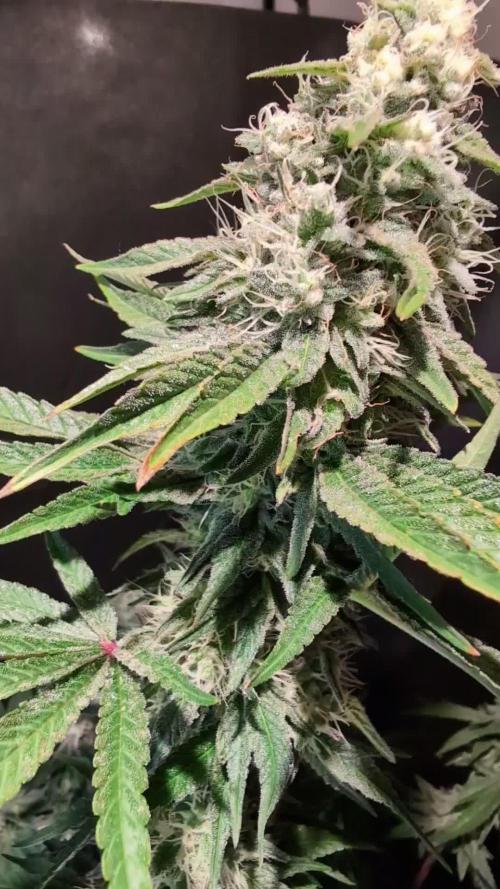
Already showing some flower buds. It's developing well. Did some hard defoliation. smells good
Likes
10
Share
I watered my girl in day 10 with merely 250 ppm and 5.8 pH. Hope it wont cause any nutrient burn ! Update: watering every 1-2 day with 300ppm and 5.8pH.
Likes
6
Share
@Pepeu420
Follow
Experiência muito boa, já estou com um clone da mesma florindo novamente Não percam a oportunidade planta incrível!
Processing
Likes
14
Share
Week just starting off and the one baby has still not broken thru so I take matters into my own hands and attempt emergency surgery!!! I sanitized a Raw loader stick and gently pulled the sprout up. It laid over after and I'm going to give it a few hours before I try to put something to hold it up if it doesn't manage to orient properly. Any advice would be appreciated, This week just started so will edit it throughout the week.. 11/18 Transplanted into 1ga pots and gave first n00tz FF 3tsp/GA Big Bloom. 11/19 Ok so my humidy has been plumiting to 33-36% so I tried putting a rag over a fan, putting a rag in a bowl over the inlet and nothing helped so I went to amazon and bought this! https://www.amazon.com/gp/product/B08GQZDS9J It has a gallon or so tank and a humidity sensor so it cycles to maintain humidity. 11/20 Anyways humidifier shows up today and I kicked it up to 80% and its about 70% after 4 hours.. I'll drop it down once the babies get to growing a bit more. I'm actually worried I transplanted too soon. Shout out to my boy Jeff! And a smaller shout out to James! 11/22 So no real changes the last few days, the plants still aren't thirsty so holding off on that. I did rearrange grow tent to allow me to set up a camera to capture time lapse of the process and I had to get some power to it so it doesn't cut off when the lights go out hehe. I mean all is well I guess, I'm still concerned bout my little plants and the one with the crooked stem. Although I'm thinking the more I keep hands off right now the better chance they'll have! Wish me (and my babies) luck! 11/24 So everything looks smooth, today I uploaded a time lapse of the last couple days which if you speed thru it can see movement of the plants which is cool, but I'm stressing that my 3 way meter isn't correct. Its reading like 6-7 on moisture scale after about 7 days of being on the same water/feeding. I am anxious to water again but don't want to overwater...I mean I do feel some moistness if I press down on the soil. I'm quickly learning this is a great means to work on your patience!!! Oh and I'm rapidly losing hope for the bent girl, so sad.
Likes
11
Share
By the looks of her on week 9 I can say I Am impressed...she was fed some black strap molasses which I Know she loves...I expect some more heavy rains from tomorrow as the tropical storm passes through let’s see how she holds up after…airflow on this mountain 150M above sea level is really good so she dry out in no time….fingers crossed!
Likes
114
Share
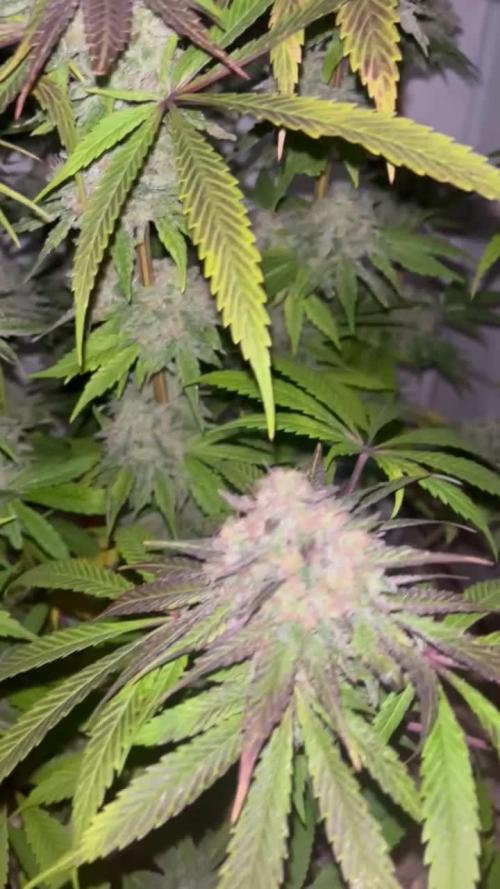
Week 7 Flower Let the Flush commence! 💦 Both girls started flush on Day 41. Twin2 is definitely finishing sooner than Twin1, but as they've both been tested the same, they'll both be taken down on the same day after a 14+ day flush. We're having a rise in heat in my area so it's interesting to see how each pheno reacts. Twin2 seems to be showing slightly more heat stress, by shooting a few fox tails, but at this size it's only a good thing 😉 I've also only just found a new trait being expressed on both twins, but much more consistently on Twin1, and that's the double serrated leaves you can see in the photo's. It doesn't mean or affect anything, it just a cool trait 🍁 I run approx 30+ltr water through each pot each time they're flushed. Before doing so I check the ppm and pH value of the run off from each pot and take records. To do this, I gently pour a few litres in the centre of the pot until a sufficient amount has drained into the tray below. This can then be tested with your TDS/EC pen and pH pen. I still use Activated EM1 (EMA) throughout flush at 1ml/ltr because microbes are always a benefit. Once stretched/activated it goes a very long way so if I don't use it throughout flush, then it may go over it's 6-8week shelf life. They're both looking great and still filling up. Both twins are coated in trichomes and have their own distinctive smells. They both smell very floral; Twin2 smells a lot sweeter, but Twin1 has a more earthy, almost gassy kind of smell to her that's just as nice. These girls are definitely not making my choice any easier yet! Looking forward to seeing them fade. Thanks for following and happy growing! 🐺
Likes
13
Share
Recette du tco pour 20 litres. (Grammes : gr) 50gr biochar 250gr zéolite 3gr granulé Micro-Organisme IT45 10gr pollen d’abeilles 10gr levure de bière 3gr endomychorize 10gr consoude 20gr vers de farine 10gr cendre coque de ricin 12gr ortie microniser 15gr Kelp 10gr spiruline 10gr de cbd living soil 20ml de miel liquide 30ml de mélasse 20ml d’acide humiques et fluvic Mettre tous les ingrédients (sauf la mélasse ,l’acide h/f et le miel) dans un filtre 400micron, le placer dans un seau avec de l’eau (10litres). Rajoutez le miel et 10ml de mélasse Y mettre un micro bulleur alimenter sur une pompe à air et faire oxygéné le mélange pendant 24h. Rajout de 10ml de mélasse après 12h le début de la mise en route de la pompe. A la fin des 24h rajoutez le restant de mélasse et d’acide h/f, mettez y en plus 10litres d’eau au mélange. Reste plus qu’à arroser! j’y ai incorporé 7litre de mélange La veille j’ai préparé le pot à l’arrosage avec 500ml d’eau et 2gr de Bacillus IT35 Amyloliquefaciens X5 Bacillus Amyloliquefaciens : rhyzosphère, probiotiques. Aspersion et arrosage. Utilisable pour toutes cultures. La bactérie Bacillus Amyloliquefaciens se fixe dans la rhizosphère en se nourrissant des exsudats racinaires. En contrepartie, elle stimule la croissance racinaire en sécrétant des métabolites de croissance et solubilise le phosphore en sécrétant des phytases (enzymes). Effet probiotique consistant en l’utilisation de micro-organismes bénéfiques pour la nutrition et la santé des plantes. La spiruline, le plus riche et le plus complet des amendements organiques La Spiruline est une algue aquatique connue comme complément alimentaire, la Spiruline est aussi un amendement organique et écologique très complet. D'une grande qualité nutritive, elle apporte à vos plantes une quantité de nutriments, dont l'azote, phosphore, potassium, minéraux, acides aminés, vitamines, chlorophylle et protéine. Le charbon végétal actif est capable d’absorber jusqu’à cinq fois son poids propre en eau ainsi que les éléments nutritifs qui s’y trouvent. Il joue ainsi le rôle de catalyseur et d'amplificateur pour les fertilisants traditionnels, qu'ils soient d'origine organique ou minérale. Ce pourquoi il est idéal pour activer un sol et pour les thés de compost oxygénés. Le charbon végétal améliore la diffusion et la disponibilité des éléments nutritifs dans le sol et offre des conditions propices au développement des micro-organismes. Le Biochar peut être introduit dans une grande variété de sols. Il est particulièrement efficace dans les sols pauvres, difficiles et acides. Pour faire agir rapidement et efficacement sa capacité d’amendement, le charbon végétal est enrichi et biologiquement activé avec des micro-organismes. Le Biochar se comporte ainsi comme un structurateur et un activateur dans le but de valoriser les sols. Composition : • Charbon végétal actif 31%
• Matière organique 33%
• Matière sèche 75%
• C/N : 17
• PH : 7,2
• Azote (N) : 2,1 % dont 1,2 % azote organique
• Phosphore (P205) : 0,74%
• Potassium (K20) : 1,18%
• Calcium (Ca) : 6,8%
• Magnésium (MgO) : 0,65% Le pollen est l'ingrédient de base de la fabrication du miel par les abeilles. Riche en vitamines et minéraux, il est qualifié « d'aliment parfait », y compris pour les plantes ! Les zéolithes sont des roches cristallines, présentant des capacités d'adsorption particulièrement importantes vis à vis des polluants que l'on rencontre dans l'eau et dans certains liquides, ainsi que dans l'air et les gaz. Elles sont extrêmement poreuses comme les charbons activés et elles peuvent être chargées électriquement pour opérer comme des échangeurs d'ions. La zéolithe est un produit naturel qui respecte notre environnement. Utilisé dans le milieu industriel depuis de longues années déjà, ce minerai aux propriétés filtrantes particulières commence à se vulgariser dans le domaine de la piscine privée, de l'aquariophilie, des bassins d'agrément, de la récupération des eaux de pluie, ou encore de la culture des bonsaïs et autres plantations diverses par exemple... 4 points techniques majeurs : - Grâce à leur propriété hydrophile, les zéolithes peuvent adsorber l'eau jusqu'à 30% de leur poids total et sans aucune variation de volume : pas de gonflement en présence d'eau ni de craquement en cas de déshydratation comme certaines argiles. Les zéolithes sont d'ailleurs de puissants agents anti-mottant (anti-agglomérant). Cette propriété est très appréciée dans le cas des terrains de golf et autres aires de jeux. - Les zéolithes ne captent pas l'eau de façon irréversible, elles se comportent comme une réserve au voisinage des racines. Celles-ci peuvent capter l'eau en fonction de leur besoin. Les zéolithes permettent ainsi de réduire les besoins d'arrosage jusqu'à 35 %. - Une zéolithe se comporte comme une "Zone de Stockage" qui retient l'azote et les éléments minéraux nutritifs au voisinage des racines et les relâche lentement en fonction des besoins de la plante. Cela se traduit par une croissance harmonieuse mais rapide du végétal. - La capacité d'adsorption et l'énorme rapport surface/volume des zéolithes, vont permettre à la fois la rétention de la solution du sol et une bonne oxygénation au voisinage du système racinaire. Les zéolithes favorisent donc l'organisation biologique des sols en contribuant au développement de la micropopulation. L'apport en nutriments (N, P, K) est réduit de 20 à 25 %. Ces derniers, adsorbés par la zéolithe, sont beaucoup moins sensibles au lessivage et à l'évaporation. Composition minéralogique : * Chabasite 70 % * Phillipsite 2 % * Feldspath 5 % * Augite 3 % * Illite - Mica 2% Analyse atomique: * Sio2 52 % * AL2o3 17 % * CaO 5,7 % * K2O 6,1 % * MgO 2 %, * Na2O 0,6 % * Fe2O3 3,6 % Amendement calcaire, dolomie et gypse avec préparation microbienne à base de Bacillus Amyloliquefaciens IT45 et Saccharomyces cerevisiae LYCC6420 Formulation : micro granulés (1 – 1,6 mm) à base de rhizobactéries favorisant la croissance des plantes qui se multiplient et colonisent rapidement la zone des racines, et de levures Saccharomyces cerevisiae souche LYCC ayant un effet probiotique. Les PGPR produisent des enzymes qui solubilisent le phosphore à partir de complexes inorganiques et organiques dans le sol et stimulent la croissance des racines efficaces augmentant ainsi la zone d'interception des éléments nutritifs. Les levures LYCC permettent une occupation de la rhizosphère par une flore bénéfique. Composition :
• Matière sèche : 96,8%
• Matière organique : 91,5%
• N total : 6,6% dont N soluble dans l'eau 0,17%
• P total : 2%
• K total : 1,7% Micro-granulés : 
• Oxyde de calcium (CaO) total : 30%
• Oxyde de magnesium (MgO) total : 7%
• Anhydride sulfurique (SO3) : 13% La levure de bière est une matière vivante qui permet un meilleur fermentation pour les thés de compost oxygénés notamment conseillé pour accompagner les croissances ou apporter un gros coup de pousse pendant la floraisons. La levure stimule la vie des sols également à l'arrosage direct en apportant tout aussi bien que dans le TCO sa population l'espèce micro-bactérienne positive pour votre sols ainsi que des oligo-éléments et diverse vitamines. Composition : • 2,8% (N) total dont 1% (Norg), • 2,3% (P205) • 1,6% (K20) • 35% de MO • C/N : 8. PH : 8,4. Sous forme de poudre mouillable. Il contient des spores du champignon mycorhizien Rhizophagus Irregularis MUCL57891 avec des levures inactivées spécifiques. 2000 spores/gramme d’endomycorhize Rhizophagus Irregularis MUCL57891 et Saccharomyces Cerevisiae LYC6420 inactivée. Se connecte efficacement au système racinaire et forme un vaste réseau souterrain de filaments, qui agissent comme des extensions pour atteindre les nutriments et l’eau au-delà de la rhizosphère Composition : • Poudre contenant 2000 spores/g. d’endomycorhizes Rhizophagus irregularis La Consoude (Symphytum Officinale) est une plante présentant de nombreuses propriétés. Particulièrement riche en Potassium (K) organique, la consoude est une alliée idéale pour les périodes de floraison. La consoude a tout pour plaire : riche en vitamine B12, elle agira également comme stimulateur racinaire, mais aussi comme biostimulant cellulaire, grâce aux alcaloïdes, aux allantoïnes et jusqu'à 30% de protéine ! 100% déjection de vers de ténébrions.
Très riche en microorganismes, le guano de vers de farine est une matière directement composté par les vers. En effet, c'est bien la digestion de matières végétales par des larves, insectes ou autres arthropodes qui valident le processus de compostage, que ce soit en zone de production de cultures d'insectes, pour le compost maison ou la dégradation de litière forestière. Les bactéries et autres champignons obtenus grâce au système digestif de nos vers, permettent la dégradation accélérée des éléments nutritifs dans vos supersoils, et les symbioses permettant l'assimilation des éléments nutritifs. Cette bio-activation intense mettra dans vos sols, à la disposition de vos plantes, un panel tellement varié de nutriments frais qu'il nous est aujourd'hui technologiquement impossible de pouvoir tous les nommer et de les compter. Le guano de vers de farine fournit une grande polyvalence. Très équilibré, il s'utilise en entretien ou en apport ciblé seul ou en complément de d'autres amendements ou fertilisants organiques. Il agit comme un puissant activateur de sol et/ou de substrat. Cendre coque de ricin NPK 0,1-18,6-16,5. 0,1% (N-Azote), 18,6% (P205-Phosphore), 16,5% (K2O-Potasse), 11,7%(Ca0), 9,1 (Mg0) - Origine : Inde ACTION SOL • rend rapidement accessible au sol Phosphore, Potasse, Magnésium et Calcium. ACTION PLANTE • Apport aux stades agronomiques propices. • Produit riche en éléments fertilisants : combinaison NPK 35%. • Régularité de l’apport, milieu et fin de floraison. . Favorise la sénescence. Analyse chimique : • NPK 0,1-18,6-16,5 • N-Azote 0.1% • P205-Phosphore 18,6% • K2O-Potasse 16,5% • CaO-Calcium 11,7% • MgO-Magnésium 9,1% Ortie bio micronisée Stimule la vie du sol et la végétation. Composition : • 2,8% (N) total dont 1% (Norg), • 2,3% (P205) • 1,6% (K20) • 35% de MO • C/N : 8. PH : 8,4 KELP poudre
ascophyllum nodosum
- amendement sol Croissance et floraison - Meilleure germination - Meilleur développement racinaire Meilleure assimilation - Résistance aux stress osmotiques - Augmente la production de chlorophylle = plantes plus vertes = lumière mieux captée - Lutte contre le stress osmotique - Développement des Micro-Organismes dans le sol – Riche en vitamines, fer, iode, oligo-éléments, hormones de croissance auxines et cytokinines - Idéal en épandage et pour les thés de compost oxygénés. Important : notre Kelp est un goémon noir mais il n'est pas le varech bien moins fertile de la même famille qui est l'algue qui pullule et pollue la Bretagne, notre algue pousse uniquement à plus de 50 mètres de fond dans les grands courants froids au large de la Norvège.
Likes
10
Share
@Fader1
Follow
In this week, i switch from MH lamp to HPS lamp. from day 38 to now, day 41, the plants seem wilted, I thought it was drought but when I gave them drink nothing changed.
Likes
19
Share
@Wenz004
Follow
Bissl fetter geworden, sieht man nur im Zeitraffer etwas. Ansonsten nix passiert. Und...durch einen Düngerfehler die Spitzen etwas verbrannt👍
Processing
Likes
26
Share
@rhodes68
Follow
8/31 Week 7 and the damned tent is full .... such problems err? 25 sq ft of green, did not expect this really was hoping the extra space would allow more plants but this is full on 5 Plants doing well just trying to make em all fit Nuets remain as is Defoliation to try and get they to fit in the tent a bit easier, removed fan leaves. 9/1 Upped PK to 2ml/g the cotton balls have begun 9/2 Stretching nicely at 28" 9/4 Major defoliation cleaned bottoms middle tops get the buds in light and help them fit in the tent better. Still hitting about 1 inch-ish a day nut seem to be slowing
Likes
18
Share
@wolfvb
Follow
📅 Week 1: The Micro-Mission Begins! 🥦 Strain: Sticky Broccoli Auto 🥦 Stage: germination Light Schedule: 18/6 📝 The General Vibe Welcome to my micro-grow experiment! I'm using an extra Sticky Broccoli Automatic seed from my main grow to see what I can achieve in a small space. She's popped and is looking healthy! This is going to be a fun little side project. So original I popped one 6.01 but she did not Survive, I guess I have over water her the new one have survived so far. It will be nice experiment and challenge! 🌡️ Environmental Data: 💡 Light: @ 70% intensity 🌡️ Temp (Day/Night): 27°C / 24°C 💧 Humidity (RH): 65% 🚿 Watering: Mist the soil surface daily to keep it moist ⚗️ pH : 5.5 🍽️ The Menu (Nutrients) Powered by Plagron Biobizz root juice 3ml
Likes
8
Share
It’s almost time! This week both plants are getting flushed to prepare them for harvest. 🌱 After that, they’ll be cut down and hung up to dry. #2 has developed an absolutely massive main bud — honestly the biggest I've ever had so far! Meanwhile, #1 stands proud as the tallest plant in the tent, still giving off that amazing sweet, tropical aroma.🍍🍬 Both plants have shown a very fast flowering time, finishing up quicker than expected! Upon checking the trichomes, about 65% are milky, 30% amber, and 5% still clear — exactly where I want them for the effects I'm aiming for. Super excited to see the final results after the dry and cure💚
Processing
Likes
6
Share
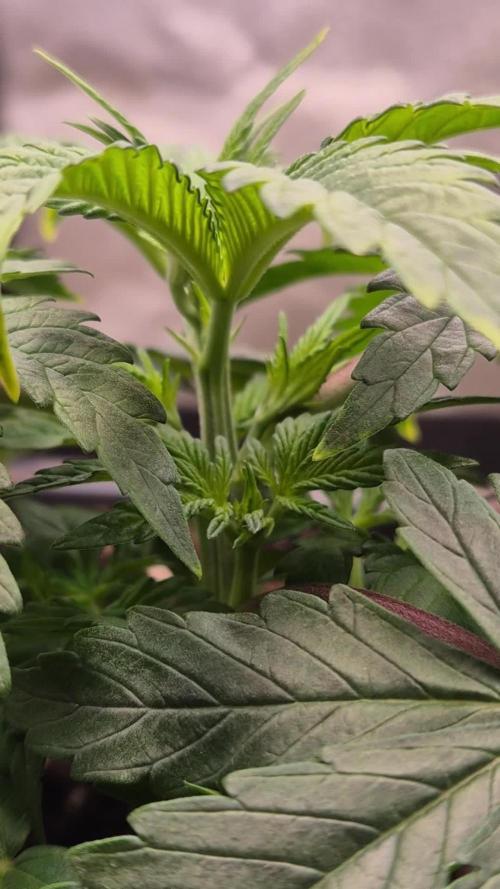
This girl is turning out to be quite the Bush, but is now starting to strech in height. Cant wait to see the progress by next week