


Likes
Comments
Share

@goatpharms
Follow
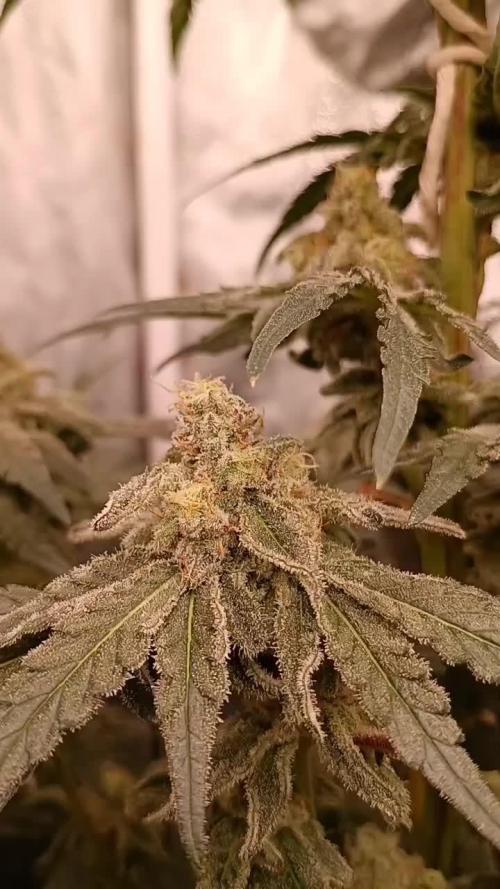
Filing for divorce this week… Mrs Mac is looking way too fine to ignore 😍😅
Despite last week’s 30°C heatwave, the girls didn’t flinch. Temps have eased off now, and there’s zero sign of stress — just happy fattening buds.
PK 13/14 and booster are in the mix (as always, I start as soon as I see bud sites and keep it running till flush). Buds are stacking up beautifully with a solid coat of frost starting to come through.
New Oscillating Cloudray S6 installed
If you’re like me and have gone through multiple crappy fans, the Cloudray S6 Gen 2 is a solid choice — well-built, quiet, powerful, and it can be hooked up to a controller 🌱💚

Likes
9
Share

@BLAZED
Follow
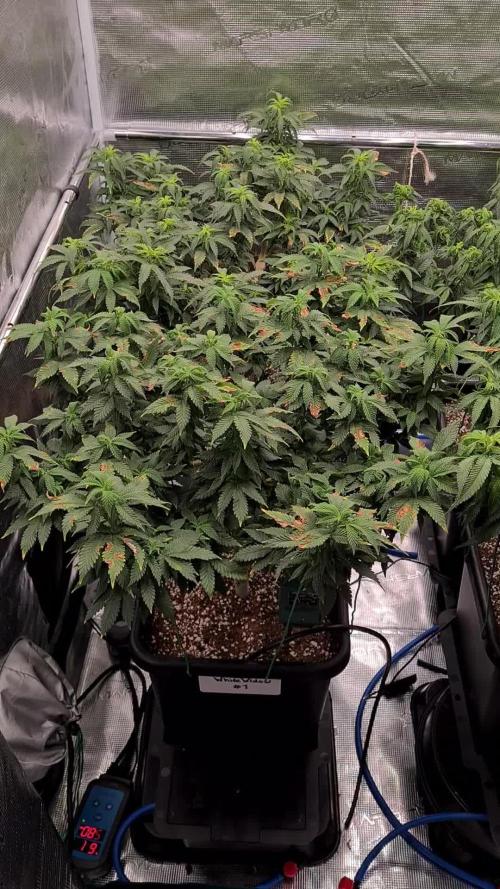
Week 13 (9-9 to 15-9)
9-9
Temps: 18.8 to 27.6 degrees
Humidity: 48% to 67%
Watering: Both 600 ml.
Decreased the light intensity from 50% to 40%
10-9
Temps: 19 to 24.2 degrees
Humidity: 51% to 58%
Watering: Both 500 ml.
Dry Weight #1 3.2 kg. #2 2.8 kg.
11-9
Temps: 16.5 to 22.5 degrees
Humidity: 50% to 62%
Watering #1: 1000 ml. #2: 1400 ml.
Dry Weight #1 3.5 kg. #2 3.0 kg.
12-9
Temps: 18.5 to 23.6 degrees
Humidity: 50% to 55%
Watering: Both 500 ml.
Dry Weight #1 3.8 kg. #2 3.4 kg.
13-9
Temps: 19.9 to 23.1 degrees
Humidity: 49% to 59%
Watering #1: 500 ml. #2: 1000 ml.
Raised the light to 65 cm distance of the top canopy.
Dry Weight #1 3.8 kg. #2 3.4 kg.
14-9
Temps: 19.5 to 23.4 degrees
Humidity: 50% to 60%
Watering: Both 500 ml.
Dry Weight #1 4.2 kg. #2 3.8 kg.
15-9
Temps: 20.5 to 24.7 degrees
Humidity: 54% to 61%





Likes
18
Share


@DjDaveAtHome
Follow
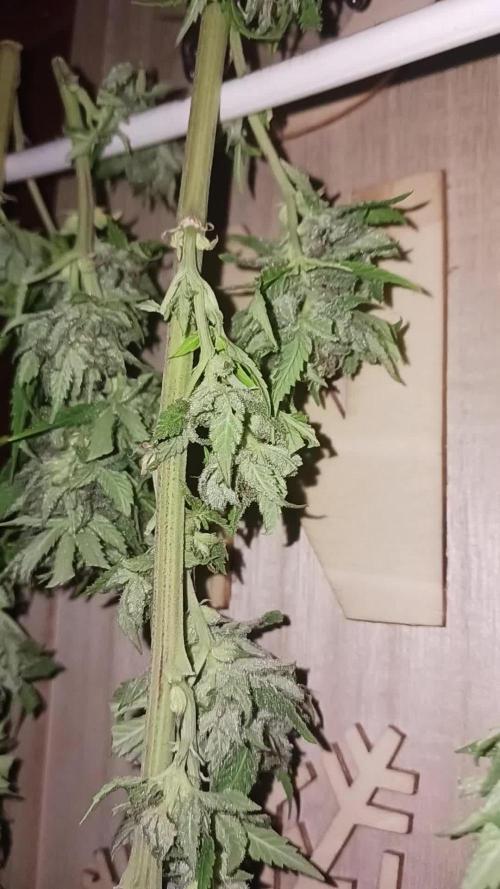
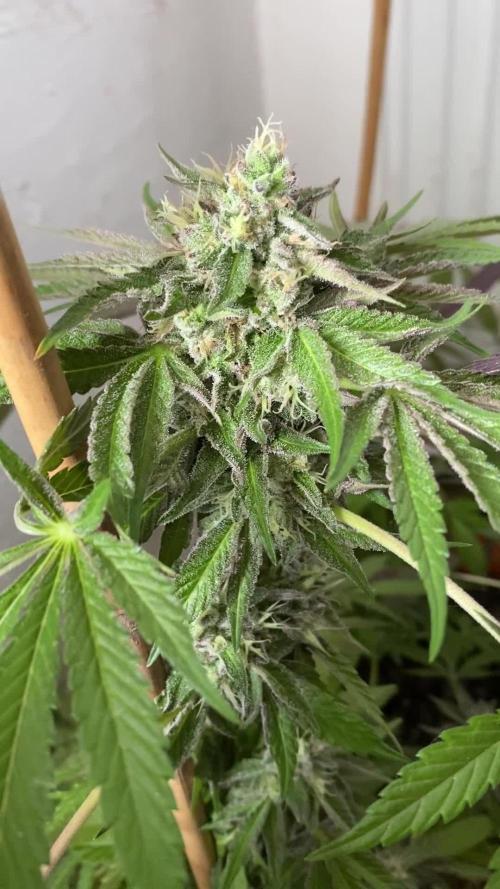
This was the easiest to grow. Shook off light stress and hard water to produce more yield than any of the others. Will be growing again. Dense, golf ball size nuggets.


Likes
3
Share


@RunicKevin58675
Follow
Good evening to all growers !! It starts to make a certain smell that is now clearly perceived even outside the growroom... So from next week we will attach the filter you have activated carbon ;D

Likes
18
Share


@Ageddd
Follow
---------------------------------------
Seedsman Afghan Kush Harvest
---------------------------------------
Harvest day 6th of December, 6/12/2019
Germination: 6/8/2019
Weight on the scales : 219g, weighted after 10 days of drying, but there are stems and some leaves, not a lot, but only bud would be a little less weight.
Flowering weeks: 10 weeks
Veg weeks: 7 weeks
Fluxh weeks: 2 weeks
----------------------------------------
Harvest was a little aerlier than expected ( flowers development), because i spotted some mold points on some buds, like 5 in total, lost few flowers but a cleaning trim was done after. I was checking every day, cut the plant inmediatly, also beacuse RH was rising, and also some rain was coming after a couple of sunny days.
Production could have been better, yes, but, started to flower really late too, so that allowed the plant to grow a little more also, so that added some branches and space for buds, the thing that i notice is that they could have grow more in summer, but its simply a blessing that, this plant, made it until December hahaha :D
Loved to eat a lot, high doses always. Noticed extra vigorousity when adding rich micro nutrients.
Trully special plant, the range of purple/dark purple/blue purple colours showed will make me remember this plant.
The flowers pack an extraordinary aroma, after 3 weeks in jars, the flavour is: hash/fruity/cream and it smells like: mangoes/fresh fruits and hash/resin.
I hope you like the diary Growmmies, thanks to all the people arounde here, for the views, advices, comments and likes, it will be always a pleasure :)
Take care guys.....Good Vibez !!! and wish you Happy Hollydays !!!!
Dont forget to roll one if you can ^^.
Music is from Alfa Mist : Mulago.


Likes
4
Share


@Uk420time
Follow
Coming along nicely .. introduced pk slowly and seems to be doing a really nice kob along with the boost .. how long left you recon guys ?? 3 or 4 weeks ? ... Happy growing grhomies 🤟❤️
Likes
8
Share


@4F1M6
Follow
This ladys packing on to 4 fatty colas and stacking them to the tits. She has other branches obviously lol but the 4 colas are all sharing dominance and really getting fat. Bud structre is really coming in now. Very round and dense. Lots of flowers already piled on at every bud site. Trichomes are piling on thick already. This is gunna get mighty frosty!
I reduced the nitrogen dose again. I also stopped giving her vigorous. Its a pure bloom mix now as this lady is booming with flowers. Until next update. Happy growing and stay lit fam.
Likes
6
Share


@Floryx
Follow
-getting really tight now
-will install scrog-web to use the space fully
-some leafs still have yellow and brown spots
-think i will fetilize twice a week from now on
-getting a lil cold in the night but therefore humidity is now almost perfect
Thankful for any comment :)
Processing
Likes
13
Share


@BedroomGrower
Follow
July 19: Hi guys and girls, that past has been an interesting week. I have already collected a Cream Cookies and a Zkittlez from the 420 FastBuds and can report the first report in the C.C.C.
The other plants grow strong and others are almost ready to be harvested. For example, the Zkittlez that has completed its flowering under the LED lamp is already receiving only water like a second cream Cookies. I must say that comparing the plants grown and flowered under the HPS lamp and the LED lamp I don't find many differences, both plants have produced very dense and resinous buds. As you can also read in my journal C.C.C. both the Cream Cookies and the Zkittlez become part of my favorite varieties 😉
In the pictures you can see how the LSD-25 is a real purple variety. At his side is the Purple Glam Kush from BulkSeeds, which has nothing in purple except the name, but which is producing a considerable amount of buds with the latter plant. Back on the LSD-25 I have to admit that it is really beautiful and the photos don't do it justice. In the future I will make better ones. The Lemon AK and the Six Shooter have grown considerably in height and for this reason I have practiced the FIM with other smaller plants.
July 24: This week I tried for the first time to make a resin extract using the BHO system, although instead of Butane I used Dimetyl Ether, a gas made for this kind of extractions made by Daxso. For many years I have used waste to make good hashish using the ice-olator method (water ice and sieves) and recently I also bought a bubbler machine because I am lazy 😆 In recent months, however, I have seen many videos on Youtube of people who made high quality resins with the BHO system and I decided to try. I purchased and used a 50 cm extractor, but I've already bought another one smaller than 30 cm that I want to fill with just buds. I made my first excerpt and could follow the steps in the video I uploaded. Unfortunately to smoke I will have to wait until next week when my new Focus V Card V2 arrives, but as soon as I get there I will keep you updated 😋
Likes
Comments
Share


Likes
Comments
Share


@CentralCoastGenetic
Follow
Fast forward two weeks and they are showing ! Out of six plants only two wore males . Switch up to bloom nutrients let’s see how that goes 🤙🏽
Likes
2
Share

@SugarandTerps
Follow
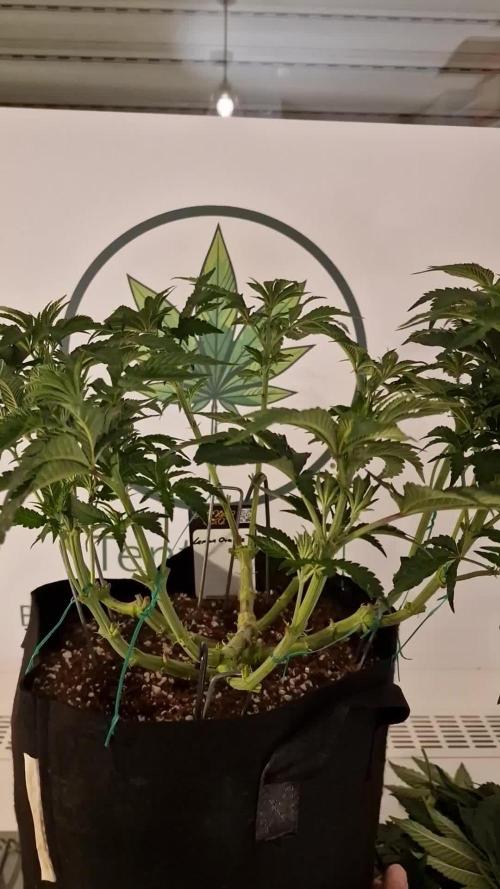
Vegi W6
12.2.2026 Gießwasser 2L, Ph-Wert 5,8, EC 3,0
14.2.2026 Gießwasser 2L, Ph-Wert 5,8, EC 3,0
17.2.2026 Entblätterung und unter Triebe entfernt. Vorbereitung für die Umstellung in die Blüte. Neues Reservoir angemischt.
Processing
Likes
17
Share


@TheGanjaGrower
Follow
I don't think I'm going to grow autoflowers for a while. I think I have much more control over photos and they are much more potent.
Likes
5
Share


@Subbe
Follow
Start of week 9 flower
Feeding once a week. Added calmag to the whitewidows feed her leaves have Brown spot . Double checked pH on every watering . 6,5. The Big plants have alittle higher pH 7.
Otter than the Widow none of the other plants are displaying any issues.
Havnet have time for my usual photobombing . Will come later this week.
Likes
60
Share


@BOMbolenath
Follow
The plant is developing well despite the high temperature.
During the week the weather got better, the plant is growing well.

Likes
11
Share


@blasterw32
Follow
Hello gardeners!
I'm starting my third grow after two good attempts where I learned a lot. In my first trial I was able to pull 40 + 20 + 20 = 80 g under not optimal conditions (limited time mostly), and in my second I improved to roughly 40 + 40 + 60 = 140 g with one additional week in veg and an additional led panel during flower.
Now, my goal is to harvest 3 x 60 = 180 g with pretty much the same set up.
The differences from my previous grow will be:
1) 1 more week in veg (total 6 weeks): I felt that my girls were not mature enough when I flipped them to 12/12 in the last grows. I wanna see them stronger and more robust this time
2) Use a larger pot size during flower (5 gal): for the same reason as above, I want to give them the opportunity to be strong and robust plants
3) Reduced number of colas (16 per plant): last time I was a bit conservative doing lollipop and removing the little side branches, and ended up with ~23 colas/ plant, which did not allow proper spacing between colas. Although ventilation was never a problem, there was a lot of shade that could not be avoided.
4) Improved feeding regime: (see images) one of my goals with my growing is to establish a good feeding regime that works reasonably well for average strains with my growing medium (PRO MIX herbs and vegetables). Since the medium is a hybrid between soil and soiless, the plants don't need extra nuts in the first weeks, but as the plants grown, the organic compost present in the medium becomes not sufficient. My feeding strategy is basically the GH Flora Series - Drain to Waste chart with reduced amounts in the first 4 weeks and slightly less nitrogen during flowering.
5) Height Control: since the girls will have an extra week to grow, I'll need to be extra cautious and control their height from the very beginning. I'll be doing 1 top in the CBD and GG, and probably 2 on the Moby Dick. I also may try something similar to manifolding on the Moby Dick if she starts to grow really faster than the others. In addition, I'll be scroging everything as low as I can.
6) LED panel distance: last time plants finished flowering about 16 in away from the lamp. I feel that I can lower it to 13~14 without problems, so I'll try this too
SET UP --------------------------------------------------------------------------------------------------------------------------------------------------------------------------------------
Grow tent 2 x 3 x 6" hidden on a closet (0.54 sq meters)
Light: 2x LED Panel VIPARSPECTRA 450w (200w real)
Air filtration VivoSun 4" exhausting outside the closet
Air circulation: 2x 120mm 5v desk fan
Container: Red Solo cups / 1 GAL / 3 GAL / 5 GAL
Medium: 75% PRO MIX Herbs and Vegetables (sphagnum peat moss, Peat humus, compost, perlite, gypsum, limestone, organic fertilizer, Mycorrhizae - NPK: 0.30 - 0.05 - 0.10) + 25% Perlite
Nuts: GH Flora Series
Ph: 6.0
