


Likes
Comments
Share


@Roberts
Follow
White widow is still hanging in there. I am still battle some issue. I did a solution change today. Hopefully that helps straighten her out. Thank you Seedsman, Medic Grow, and Athena nutrition. 🤜🏻🤛🏻🌱🌱🌱
Thank you grow diaries community for the 👇likes👇, follows, comments, and subscriptions on my YouTube channel👇.
❄️🌱🍻 Happy Growing 🌱🌱🌱
https://youtube.com/channel/UCAhN7yRzWLpcaRHhMIQ7X4g.

Processing
Likes
6
Share


@iMeus
Follow
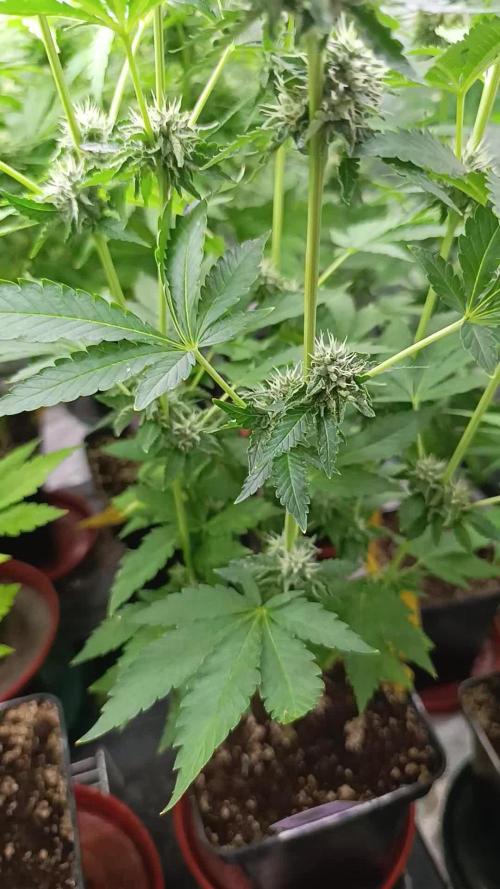
This was a good week, just starting to see bud sites pop up and now flower has officially begun.
I noticed that the Primal Punch still looked a tad under fed so I blasted everyone with 1 scoop of Grow and 2 scoops of bloom (age old nutrients)
I never used dry nutes before so here's hoping that I can stay on top of this grow and produce some sweet buds! Depending on when I harvest there may be another 9-12 weeks of flower.
I'll pop in some more details after I get some shut eye, much love, Meus <3
Likes
13
Share

@420DeepGrow
Follow
📆 Semana 6
La fase de engorde entra en pleno rendimiento y los cogollos aumentan de volumen de forma notable. Los cálices comienzan a apilarse, formando flores muy compactas, densas y completamente cubiertas de resina. El aroma se intensifica rápidamente, mostrando cada vez más el carácter dulce y afrutado de la genética.
La estructura permanece firme y equilibrada, permitiendo que la luz alcance toda la canopia y favoreciendo una maduración uniforme. El consumo de agua y nutrientes continúa en uno de sus puntos más altos, por lo que mantener un riego constante y una nutrición estable resulta fundamental para sostener el ritmo de desarrollo.
⚡ EC: 1.9
💧 pH: 6.2–6.5
🌡️ Agua: 20–22°C
🌫️ Humedad: 40–45%
💡 PPFD: 1050–1100 µmol/m²/s
🌡️ Temperatura: 24–27°C
🔥 Nota: En esta etapa la prioridad es mantener la máxima estabilidad, clima controlado y una nutrición equilibrada.
Seguimos creciendo fuerte 💪!

Processing
Likes
24
Share


@ROM101
Follow
Missed updating and taking photos of this girl yesterday so heres the latest. She's doing great and stacking hard and fast. Added a video of all the FFT I've got going as I've never done this before and though it would be a nice addition 👍👍👍


Likes
46
Share


@GanjaReaper
Follow
Day 21:
So we are currently in day 21, I finished all my work for my growroom.
They where pushed into flowering 5 days ago. They always need to settle first before even turning into that stage.
So my gues that in the end of the next week we will start to see the first indicators.
I still gave them veg nutrients this week since they are still in growing stage.
I did notice that many plants have weak stems and where sloppy underneeth. Didn't liked that, so in order to have thicker stems and branches I decided to top all the plants ( not showing in these picutues, i did that after making the pictures)
Topping your plants will create stronger thick stems and branches!
Also removed the first 1-2 internodes on each branch. I kept 5 or 7 branches each plant. I can't remember the ''science'' behind it but I have been told that many years ago by fellow OG Dutch growers and Family members.
Anyway It is importend to have uneven branches. So 5, 7 or even 9 but never 6 or 8.
Normaly I would have loved a huge main cola and it is known by many amnesia growers to not top the plants because they make beautifull thick main colas.
On the other hand, when having this much plants on each m2, it will create weak stems and branches.
I rather have strong plants with thick stems and branches to transport all nutrients properly and not breaking when having buds on them or having to mayor support them.
The leafs, stems and branches look fine to me. No stress or deficiencies. 1/3 of them like to drink thought which is a good thing but it really enjoying.
Now I have to weigh by lifting the pots which one needs more or less feedings lol. Instead of giving them all like 5 seconds of water.
Might show you guys my feeding ''barrel'' next week. It is a 250L one.
Untill next week.

Likes
12
Share


@CaliforniaOGkush
Follow
it's extremely hot 106 this week out here California any tips to keep theese growing bigger??
Likes
2
Share


@GERGrowDesigns
Follow
Welcome to Veg Week 1 of Sensi Seeds Karate Kid
I'm excited to share my grow journey with you from my
Sensi Seeds Project . It's going to be an incredible ride, full of learning, growing, and connecting with fellow growers from all around the world!
For this Project , I’ve chosen the Feminized Photo Strain Karate Kid :
Here’s what I’m working with:
• 🌱 Tent: 120x60x80
• 🧑🌾 Breeder Company: Sensi Seeds
• 💧Strain Info : 25-33%
• ⏳ Flowering Time: 8-10weeks
Likes
15
Share


@DopeLeaves
Follow
I love this new diary app! Getting to document each and every grow, makes it easier to improve the next time. If this website continues to gain more and more growers, I think Grow Diaries might be the goto site for uniting together growers from all over the world.

Likes
57
Share


@TheBudWhisperer
Follow
Week 8 of flower is in the books and this show is quickly coming to an end. I said last week we had about 7-10 days and I was spot on at the 10 day mark. I was only wrong about the order. The cheese is ready to chop before the rest and the gorilla cookies, cherry Bomb and lemon haze will follow in due course. The cheese is a beast and it’ll take a little time to get it all run through the bowl trimmer. At least the big one goes first. Her tallest colas have foxtailed like mar, despite the late supercrop. You can tell where the sweet spot for the light is at about 10” distance from the canopy. Any closer than that and the tails begin to show prominently. It’s a good example of just how close you can get to these fixtures with a little bit of prior experience. It’s been noted for the next run😎👍😎. The res. is on an h2o2 only flush for the remainder until the rest are ready to come down. Not a moment too soon either - the pollen chucking project has stalled out waiting for these girls to finish and now that we’ll have a little extra room, we can start running our cuts in the aerocloner🤟. Not long at all now folks. Thanks for tagging along through all this. Learned a bunch about this system and we’re back to hardware mode to make some serious improvements for the next run🤙😎. I love hardware mode😉.
Background/Repetitive Nonsense
The strain line up on this grow is look’n quite saucy 😈. We’ve got 2 FB strains this time around - Gorilla Cookies (seems we always have some GSC cross in the works). Mainly because the colours look stellar and remind me of a sugar breathe we did last year that was 🔥. The other FB is their original Cheese strain... because we already smoked all our cheese... and we really like our cheese...😉. Emerald triangle was kind enough to include a freebie of Lemon Haze. Wasn’t really big on the list but we haven’t done a haze strain to write home about yet so worth a go👍. The last is a Cherry auto from Bomb seeds that we’ve been trying to get to for months. Let’s just hope that she’s not a dud like the last bean.
The new digs for this run are courtesy MarsHydro👊. Their 2x4 single grow tent, paired with a shiny new 240w QB courtesy ViparSpectra.
These folks were kind enough to discuss a collaboration and as a result, here we are to test out the gear with an inaugural run of autos. Each week, we’ll try to expand on some of the benefits of each, as well as any limiting factors or considerations that need attention when pondering purchase.
Already I can say that both are high quality products in terms of overall craftsmanship.
MarsHydro 2x4 Grow Tent:
Excellent construction in terms of durability. Reinforced stitching on the zippers and corners ensures zero tearing. Conveniently placed screen vents and intake/exhaust ports. The ceiling exhaust port only exists on the right side. Perfect for me but not great if you’re running exhaust from the top on the left side (left side wall port makes up for this however). The aluminum frame is rigid enough to support the weight of the lights and accessories. Once you have some weight in the tent, she’s go’n nowhere and you can assemble and break it down in record time if moving or stashing the grow op.
Only limiting factors I’ve noticed is that temp. Control will be an issue for a tent. It just doesn’t have the same insulating ability as a wood cabinet or other permanent enclosed space. No worries, this is offset by a small desktop heater and keeps the environment exactly where desired. The other issue was a production problem - the ceiling vent was accidentally stitched into the corner seams on the assembly line. Again, no real issue - just pulled it out with no damage or fraying to the tent or port👍.
Website link here:
https://www.mars-hydro.com/grow-tent/buy-mars-hydro-grow-tent-24x48x70-2-x-4-cabinet-closet-grow-box-upgraded-diamond-1680d-mylar-for-sale
ViparSpectra 240w Quantum Board:
This thing is sleek and slick in terms of design. Closest comparable to it that I’ve seen would be spiderfarmers line of qbs. They feature the same top-o-the-line components and roughly similar spectrums. Where VS takes the advantage is in the convenience of the dimmer nob which is easily accessible and works great at 50% with no strobing👍. The heat sink is also larger which contributes to lower temps. That’s not a good thing in my case but beneficial for most folks.
I can already say that this will be a great fixture through all stages of growth. Where I know this light will excel will be in the veg. Stage for sure. Dimming function gives seedlings a much better chance of success with the ability to use lower lighting levels early on and the coverage area on a 240w is great. The average grower will find this panel suitable and fitting to their needs in a 2x4 grow space although I’d suggest 2 units if going any larger than that. The total output in this space equates to about 30w/sq.ft. Which is a decent amount of coverage based on power vs. Growprint. Ideal for veg. Certainly but, in flower - I tend to run closer to 50-60w/sq.ft to achieve higher yields. Again, similar fixtures have performed admirably in the past and while this wouldn’t be considered an “entry-level” fixture, I’d recommend that any grower new to the game not skimp on lighting and start with one of these. The price points are a great value for quality LED tech. These days, so there’s little reason to even consider a lesser fixture👍.
I have no detail on limiting factors for this light as yet but have heard that stock branded fixtures don’t necessarily incorporate enough red diodes. I’ve seen no issue myself but confess - I’m no lighting guru.
Website link:
https://www.viparspectra.com/collections/xs-series/products/xs-series-xs2000
***8% discount when using code: “ItBudWhisper”***
Happy to have you along for the ride if you made it this far through my opening rant!!😎🤟😎🤟😎


Likes
21
Share


@TripLife
Follow
The bigger plant is doing amazing, I supercropped the top branch and it instantly accepted it and the buds were reaching within the hour! The little guy I’m still not so sure about yet.
Likes
2
Share


@Scrubz767
Follow
They started flowering gave them Chicken Manure a few days earlier when I noticed it, in the 3rd week if flower i'm going to give them rabbit manure and make a flowering tea for them 😁we will see how it goes also might get a PK Booster 🤔


Likes
5
Share


@Kickdrum
Follow
The Mars Hydro FC-E1500, the Inkbird dehumidifier, and the auto-draining pot stands have all arrived this week. I will set up the pest control, nutrients, and the Exhale CO2 bag when I return from Italy. I will be leaving for 9 days next week, and I must admit, it makes me quite nervous to leave the house for a trip. However, I have tested the automation system, and it should take care of the light cycle and feeding/watering remotely.
It is surprising to see that the "normal" leaves are already twice the size of the round cotyledons (or "seed leaves") after just 4 days. This indicates that my autoflowering plants have already entered the vegetative growth stage. It's a positive sign that the autoflowering genetics are taking effect and the plants are progressing rapidly, even at this early stage. The DLI (Daily Light Integral) of 18.6, which I have set, is ideal for supporting this quick transition. Providing sufficient light intensity and duration during the vegetative stage is crucial for autoflowering strains as it fuels their accelerated growth and development.
I have been watching the size and appearance of the leaves to track the plants' progress. Maintaining the optimal environmental conditions I have been going for including an 18/6 photoperiod, a temperature range of 24-28°C, and a relative humidity (RH) of 55-70%, which should theoretcially enable my autoflowers to continue thriving in the vegetative stage.
The fact that my plants have reached this milestone within the first 3 days is a promising indication of a fast and productive growth cycle.

Likes
24
Share


@Daweed83
Follow
Last 2 weeks. Gave them nutrients for half of the week and started to flush then. Want to have a nice flush this time to see the effect on the buds. Getting closer and very excited!! 😍

Processing
Likes
4
Share


@CanadianFillmore
Follow
Start of week 7! Week 6 went really well for the Glueberry OG. She has also show some nute deficiency signs, a few rust spots, but otherwise is healthy and the buds are packing on weight. This lady is on an 8 week schedule, removed big bud and added overdrive to the nute lineup.

Likes
106
Share


@Fibro_Witch
Follow
Stellar week for the Critical Girls. The others are still lagging behind a bit, I wish they'd get their act together. Some are showing a little nitrogen deficiency, so I'll give them a foliar spray tomorrow. I also flushed them with some sledgehammer back on Thursday because one of the Critical Cures and the Blue Shark was showing a little Boron lockout.


Likes
2
Share


@Homestickycannabis
Follow
Sorry all its been busy on my end,getting my first outdoor grow in over 20 years going, and it's a whopper of a harvest if all goes well. Now back to the Dos si Dos, she's getting so frosty and really fattening up nicely. These two clones are the last of my monster cropper's I have. It's hard to imagine that these two lovely specimens were clones taken at week 5 of flower and reverted back to veg. I do know now that if I would've waited another couple weeks before flowering these two monster clones I would have ended up with substantially more bud sites. I have heard that monster cropping produces plants that are far more bushier and are perfect candidate's for the S.C.R.O.G technique of plant training.
I do have to say that this genetic from Barney's Farm has earned a spot in my lineup indefinitely do to it stability and he's a growing, super fast flowering I'm just an exquisite taste.
Likes
7
Share

@CanadianFillmore
Follow
Week 2 begins, not much to report other than the pro-mix HP hasn't dried out enough to warrant another feeding.
Likes
38
Share


@MrSpooky882
Follow
Heute erste mal gedüngt es sieht alles sehr gut aus bisher, bin gespannt wie der stretch aussieht, ich habe 1 vegi Woche verplant hochzuladen 😅🤔
Seit dem 17. Sind sie in der Blüte.
Wünsche euch ne schöne Woche!
Fertilized for the first time today, everything looks very good so far, I'm curious how the stretch looks, I've planned to upload 1 vegi week 😅🤔
Since the 17th they are in bloom.
Have a nice week!
Likes
3
Share


@ChitownCannaChica
Follow
Had to do this for the contest so I didn’t screw up my other diaries!