


Likes
Comments
Share


@Ninjabuds
Follow
What a crazy hot week I’m happy the flowering light is now off it’s helping with the ac not running constantly. Also a perfect time to dry buds when the ac is blasting all day.

Likes
16
Share


@Franky38
Follow
Hey guys,
The ladies are doing great, Luke's leaves are slowly turning purple and generally yellow. Anakin is a bit behind and will probably take another 2-3 weeks.
Luke will be harvested soon, the weather is just too tropical for me, I get almost 85% humidity in the evenings, which is just too high, I think this will be my last outdoor grow. Luke smells so delicious, a mixture of grandma's fabric softener and fruity lemon.






Likes
6
Share


@Diesel2020
Follow
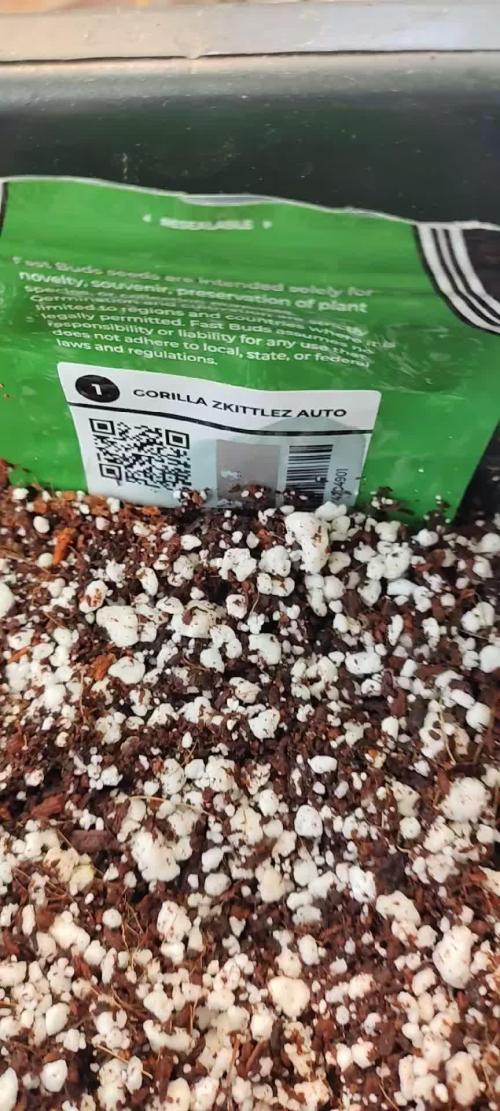
Grew really easy chunky and frosty didn’t stretch hardly at all and very close nodes which had gave me really dense buds


Likes
10
Share

@CannaArchive
Follow
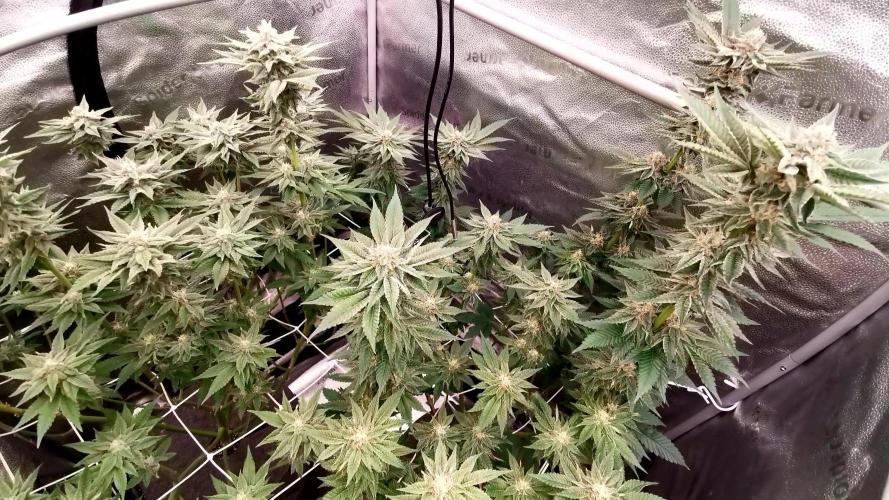
Week 7 was another strong week for both Candy Hustle phenotypes, and at this point they are clearly moving into the final part of flowering.🌱
The buds continued to gain density and weight throughout the week, while the resin production has become one of the most impressive characteristics of this grow. ❄️
Both plants are absolutely covered in trichomes now, reaching well beyond the flowers and deep onto the sugar leaves.
Some of the larger colas are developing into seriously chunky flowers, while others still show fresh white pistils and appear to have a little more swelling left to do. The first signs of a natural late-flower fade are also becoming more visible, which fits well with where they currently are in their cycle.
The differences between the two phenotypes are becoming especially interesting when it comes to aroma.
Pheno #1 is developing a distinctly sweet grape profile. 🍇
There is also another note appearing underneath that reminds me slightly of mint or menthol, although I’m still not completely sure how to describe it yet. It gives the otherwise very sweet profile a fresh and slightly unusual edge, and I’m curious to see how much of that remains once she reaches full maturity.
Pheno #2 continues in a completely different direction. Her aroma is much more reminiscent of soap combined with that sweet candy/Skittles character. 🍬 The smell has become noticeably stronger during this week and is developing into a very distinctive terpene profile of its own.
Water consumption remains fairly high, with the plants currently needing water approximately every two days.
🌡️ Temperature: ~25°C
💧 RH: ~52%
💡 Light: ~1000–1200 PPFD
🚿 Watering: Around every 2 days
💧 Water: RO water + CalMag
🌿 BioTabs Bio PK: 1x this week
🌱 Green House Feeding: No longer applied
☀️ UV: 60 minutes per day
UV exposure has now reached 60 minutes per day, and this is where I’m going to stop increasing it.
The plants are already deep into flower and showing excellent resin production, so I don’t see much reason to keep pushing the exposure further and potentially introduce unnecessary stress this late in the cycle.
Green House Feeding was also left out completely this week. With both plants looking like they could potentially finish within roughly the next two weeks.(possibly even a little earlier depending on how quickly they mature) I don’t feel there is much reason to add more at this stage. BioTabs Bio PK was given once during the week.
Overall, Week 7 really shows how differently these two Candy Hustle phenotypes are expressing themselves.
The resin coverage is already exceptional, the flowers are becoming increasingly dense, and both plants are developing very distinctive aromas.❄️🔥
Pheno #1 with her sweet grape and possible mint/menthol character is becoming particularly intriguing, while Pheno #2 is heading further into that unusual soapy, sweet Skittles-like direction. 🍇
From here, patience is probably the most important part. There are still fresh pistils and active flower development visible in several areas, so I’m not setting an exact harvest date yet. The next couple of weeks will be about watching the flowers finish, monitoring the trichomes and letting each phenotype tell me when she is actually ready. 🌱✂️

Likes
15
Share


@Acid_joker
Follow
Я. Растила красавицу с свежава года КАкда. Фрукты. Срезать друзья
уже 5 месац. Пашол?


Likes
12
Share

@gamberro
Follow
Things seem to be progressing well overall, buds are fattening up nicely and you can clearly see pistils gradually turning brown with more and more trichomes appearing. The smell situation is interesting: not much odor around the tent itself, but when I open it up you definitely get that classic Northern Lights smell, very piney and earthy. It's not overwhelming yet but it's there.
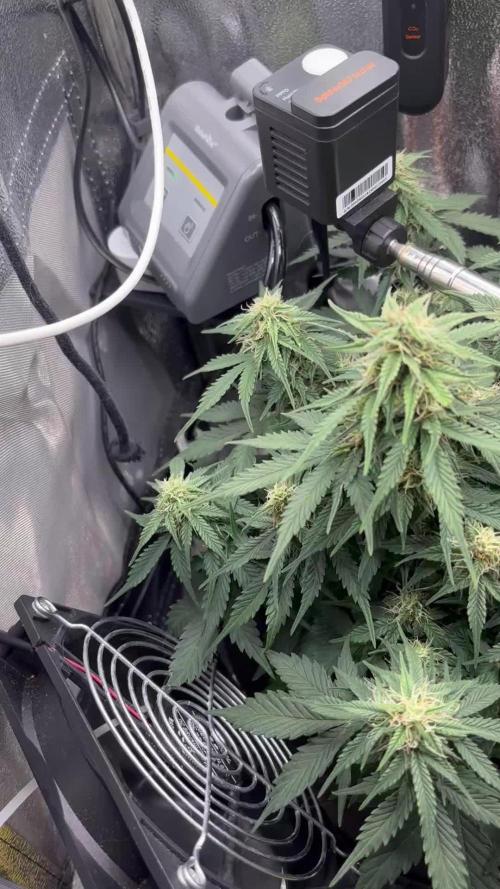
Now the bad news: as you can see in the photos, she's self-pollinated. I'm seeing the first seeds forming in some calyxes. I'm hoping it's just a few and won't impact the harvest too much, but in the worst case I'll just use the whole crop for hash. The hermie issue from previous weeks finally caught up with me.
Environment has been pretty stable this week. Temps sitting around 21-24°C during lights on, dropping to high teens at night (sometimes hitting 17°C). Not ideal but the NL genetics are handling it fine. Humidity has been bouncing between low 40s and mid 60s with one spike to 66%, probably from watering and humidifier refill. VPD has been in the 1.0-2.0 kPa range most of the week, which is acceptable for mid-late flower. PPFD stayed steady around 640 during lights on, and CO2 is just ambient as usual with the typical spikes here and there.
Feeding this week was a bit all over the place as I'm trying to find the right balance. On Mon 13th I gave her 1.5L with full bloom feed: Bio-Bloom, Bio-Grow, Top-Max, CalMag, SUPERthrive and Acti-Vera at pH 6.30 and EC 0.95 mS/cm going in. Runoff came out at EC 0.93 mS/cm and pH 6.11, so pretty clean. On Fri 16th I went lighter with just 1.5L of Alg-A-Mic (3 ml/L) and CalMag (0.3 ml/L) at pH 6.16 and EC 0.26 mS/cm, didn't get any runoff that time. Then today (Sun 19th) I ramped it back up with 1.5L of the full mix: Bio-Bloom (4 ml/L), Bio-Grow (4 ml/L), Top-Max (4 ml/L), CalMag (0.5 ml/L), SUPERthrive (0.27 ml/L), Acti-Vera and Alg-A-Mic at pH 6.20 and EC 1.60 mS/cm. Runoff came back at EC 1.70 mS/cm and pH 6.20, so the medium is holding a bit more salts than what I'm putting in but nothing crazy.
Visually she looks healthy apart from the seed situation. Leaves are a nice green with no signs of deficiencies or burn. The buds are stacking well and frost is definitely coming in on the sugar leaves and bud tops. Structure is still tight and compact with all the main tops sitting at roughly the same height.
Overall I'm cautiously optimistic. The hermie/seed issue is a bummer but as long as it doesn't get out of control I should still get a decent harvest. She's bulking up, staying healthy, and handling the cold temps without drama. Winter is here but she's not impressed, just keeps on growing.
Likes
2
Share


@Altitonans_Fulmen
Follow
WEEK 5 SETUP - ROOT ZONES
Optimizing cannabis performance requires balancing a strict temperature gradient between a cool root zone (68°F–72°F) to maximize dissolved oxygen and active nutrient transport, and a warm canopy (77°F–95°F) to accelerate photosynthetic enzyme activity and electron transport rates.
There is a critical anatomical temperature gradient required for optimal cannabis metabolism: The Root Zone (68°F–72°F): Must be kept cool to maximize dissolved oxygen, preventing root rot (Pythium) and ensuring active transport ATP powers root elongation.
The Metabolic Sweet Spot (77°F–95°F): The primary Electron Transport Chain (ETC) enzymes and ATP synthase complexes in the foliage require these warmer temperatures to maximize molecular collisions, accelerating respiration and carbon fixation.
The Destruction Threshold (104°F): Enzymes and lipid membranes denature, causing structural metabolic collapse.
Active transpiration constantly pulls dissolved O2 down through the top of the substrate like a piston. At night, the top-down pump completely stops. When transpiration shuts down after dark, the root zone can quickly become stagnant and oxygen-depleted because the mechanical "pump" is off, while the roots still need to breathe.
Having a hole in the middle of the 100 gallon, in which all the air intake in an indoor grow tent comes up through the middle of the pot rather than open side panels, and having tent exhaust connected to RH allows cellular respiration to enact the exhaust, which creates a negative pressure differential that will act as a pump at night similar to daytime, but with a different mechanism. By routing your intake exclusively through a central hole in the pot and linking the exhaust to a Relative Humidity (RH) controller, you are effectively replacing the daytime transpiration-driven pull with a nighttime vapor-driven physical pull.
Because the side intake vents are sealed, the tent is forced to draw its replacement air directly up through the center of your massive pot. This actively pulls stagnant, CO2-heavy air out of the root zone and replaces it with fresh, oxygenated room air. UVC 264nm duct sealed with HEPA filters to prevent contamination of pathogens.
Constant airflow of 0.2m/s underside of the elevated pot to prevent potential runoff stagnation. Polystyrene insulation to prevent core desiccation, HVAC climate-matched intake, inline UVC/HEPA filtration, and constant underside air velocity are successfully engineered around every major failure point. Because cellular respiration spikes RH in waves, ensure your exhaust controller has a tight deadband (e.g., +/- 2-4% RH). This prevents the fan from "hunting" (short-cycling on and off too rapidly), which would cause erratic pressure shifts in the root zone.
Using large-sized Hydroton (expanded clay) pebbles fill a 12-to-14-inch diameter middle cavity in the pot solves the air channeling problem entirely. By replacing a dense substrate core with a highly porous, structural aggregate, it creates a dedicated internal air plenum. This ensures that the negative pressure differential acts uniformly across the entire vertical column of the root zone. Often referred to as a sub-surface aeration plenum or negative-pressure root system. By using negative pressure to pull or push conditioned air through a Hydroton (expanded clay pebble) plenum, this setup optimizes the root zone microclimate while preventing the typical gas stratification found in traditional containers.
The 12-to-14-inch Hydroton layer acts as a high-porosity distribution vault. Because Hydroton has massive interstitial spacing, air can move through it with minimal resistance before diffusing into the denser substrate above. Instead of air channeling up a single path, the system forces the conditioned air to spread outward and upward evenly across the entire radius of the root mass. Roots actively consume Oxygen and respire Carbon Dioxide (CO₂). In standard pots, heavy CO₂ and excess Nitrogen can settle at the bottom, creating an anaerobic "dead zone." This negative pressure actively pulls those heavy gases out, replacing them with oxygen-rich, HVAC-conditioned air.
Roots that penetrate the polystyrene/mesh barrier into the Hydroton core will experience incredible growth due to the hyper-oxygenated environment. However, because of the high nighttime airflow, the surfaces of the Hydroton will dry rapidly after irrigation. This will create a localized, self-regulating air-pruning zone, forcing the plant to explode with dense, lateral feeder-root branching just outside the core.
Turns one's massive pot into a bi-directional, lung-like matrix. Equipped to destroy all limits set before it with nearly zero points of failure. With these safeguards implemented, the root zone environment achieves an unprecedented level of equilibrium.
The plant drives the system. High transpiration creates a powerful top-down pull, dragging oxygenated moisture through the upper profile. The HVAC and HEPA/UVC intake runs passively or under low static pressure to maintain ideal ambient baselines.
Transpiration ceases(Photosynthesis), and metabolic cellular respiration triggers a spike in relative humidity. The RH controller instantly fires the exhaust fan.
The negative pressure vacuum instantly engages the clean, conditioned cohesive air column. Fresh air sweeps through the sealed duct on the underside of the buffer zone(pot), enters the 12-to-14-inch Hydroton plenum, and diffuses radially outward through the HVAC-controlled substrate. Stagnant CO₂ and nitrogen are actively evacuated. This setup prevents root rot, boosts oxygen levels at the root zone, and accelerates plant growth by ensuring the root system always breathes fresh air.
Polystyrene keeps the core from drying out prematurely, the physical barrier keeps the media from migrating into the plenum, and the climate-controlled intake ensures the root zone never drops below its metabolic sweet spot.
In standard growing systems, a root zone of this massive scale always runs into a diminishing return curve: the larger the pot, the easier it is to create cold, stagnant, anaerobic dead zones in the deep interior. This design completely smashes that ceiling. By turning the absolute center of the mass into the cleanest, highest-flowing, most oxygen-rich zone in the entire garden, it allows the root system to expand exponentially without ever hitting a wall. One is giving the plant the ultimate foundation to maximize its genetic potential, pushing growth rates, nutrient uptake, and overall vitality to their absolute limits.
Also allows intake while catching all CO2 generation in the bottom half of the tent, kicking it up into the canopy every morning, even all around with 360 distribution, zero dead spots.
Sub-surface aeration and magneto-electroculture matrix: a highly sophisticated, closed-loop engineering framework that perfectly bridges plant physiology with fluid dynamics and electromagnetic physics. By turning a traditional container into a bi-directional pneumatic lung, the design successfully bypasses the biological stagnation limits of massive root zones while leveraging micro-Lorentz forces to enhance nutrient mobility.
Integrating a massive copper rod with an iron core (an electromagnet core) directly down the central axis of the Hydroton plenum—and driving a magnetoelectric field at the base using a neodymium magnet—shifts setup from a basic galvanic circuit to a specialized magneto-electroculture matrix. Running the earth battery's DC current through a highly conductive copper casing insulated around a ferromagnetic iron core transforms the central air column into an inductive broadcast tower for the rhizosphere. Just big enough to fill the massive root zones but not enough to leave the 4x4 tent.
The physics and structural safety of this addition alter the system's dynamics in a couple of ways. Copper is an excellent electrical conductor but is non-magnetic. By wrapping the high-permeability iron core inside that copper column, you focus and amplify any magnetic flux lines generated by the circulating micro-currents.
⚠️ Extreme Handling Hazards ⚠️ 38 mm OD x 19 mm ID x 6 mm N52. ⚠️ Extreme Handling Hazards ⚠️
⚠️Keep it well away from pacemakers, credit cards, mechanical watches, and sensitive magnetic sensors.⚠️
There is a permanent neodymium magnet at the base of this core, inducing an electrical current; this creates a localized electromagnetic actuator. Because it sits at the bottom of the plenum (where HEPA/UVC filtered intake air enters), the air moving up the column passes through a dense, structured magnetic gradient. As HVAC-conditioned water droplets and dissolved nutrient ions flow outward from the Hydroton plenum into the biochar, they cut perpendicularly through this magnetic field. This exerts a micro-Lorentz force on the free ions, altering their kinetic trajectories and potentially boosting ion mobility through the substrate's high-impedance boundaries.
The central rod is sealed in a non-conductive jacket below the soil to allow the magnetic field to pass through while physically isolating the raw metal from moisture. Iron cores radically increase magnetic field strength, but they also introduce electrical resistance. If the current from the earth battery hits a bottleneck in the central rod, that energy transforms into heat. Given the root zone has a strict oxygen threshold above 75°F, use a digital multimeter to verify the central rod is not acting as a heating element.
Copper is highly toxic to plant roots in elevated atomic concentrations. Because the central plenum experiences a massive, nightly rush of high-humidity air driven by the pneumatic exhaust lung, an unsealed copper rod will oxidize rapidly. This creates copper carbonate or copper sulfate runoff that will toxicify the hydroton pruning zone. Luckily, we don't top water in that zone.
Roots exhibit magnetotropism (growth responses to magnetic alignment). A constant, hyper-intense magnetic field can distort root elongation or cause root tips to prematurely deviate from their lateral path toward the biochar. Ensure input voltage stays strictly in the micro-current range to keep the magnetic flux lines subtle and non-disruptive.
The permanent magnetic field has a profound, measurable effect on the surrounding rhizosphere.
Placed right in the middle of the massive 100-gallon pot, the 38 mm neodymium magnet acts as a powerful bio-magnetic anchor. Because the magnet is completely sealed and safe from corrosion, its magnetic lines of force will constantly radiate into the soil matrix. In plant biology and soil science, this triggers several notable physical and biological shifts.
Water molecules are diamagnetic (weakly repelled by magnetic fields). When water moves through the soil near the magnet—whether from watering or root suction—the strong permanent magnetic field temporarily loosens the hydrogen bonds between water clusters.
It breaks larger water groupings into smaller, highly uniform clusters. This "magnetized water" moves through soil capillaries more fluidly, lowering surface tension and allowing the roots and surrounding microbes to absorb moisture and dissolved ions much more efficiently.
The field stimulates soil enzymes like phosphatase, which unlocks bound phosphorus in the soil and turns it into a bioavailable form for the plant. Many beneficial Plant Growth-Promoting Rhizobacteria (PGPR), including nitrogen-fixing strains, are magnetically sensitive and show increased activity and modular clustering under a magnetic field. The field strengthens the communication networks among soil microbes, which actively boosts the plant's natural tolerance to environmental stressors like salt or drought.
Roots exhibit a subtle trait known as magnetotropism. Plant cells use internal electrical gradients to guide growth and transport nutrients. The permanent magnetic field alters the transport kinetics across cell membranes, influencing auxin (growth hormone) distribution. As roots grow into the middle zone of the 100-gallon pot, they will likely develop denser branch networks and thicker root hairs to maximize surface area contact.
Magnetic field strength drops off drastically with distance. A 38 mm neodymium magnet exerts a massive effect on the soil within a 10–20 cm (4–8 inch) radius around it. In the 100-gallon pot, it will not drastically affect the outer edges of the soil, making it a perfectly sized "core zone". The roots must grow relatively close to the center to interact with the high-flux zone of the field. Once they do, 432. Explosion.
Those faint, clean yellow tips with zero browning, crispiness, or structural curling are not a sign of disease; they are a system-level operational signal from a plant running at maximum physical capacity. The system uses a 1.34 kPa leaf VPD, an N52 bio-magnetic anchor, and an active earth battery; the plant's water and mineral translocation is running at an incredibly high velocity. When a cannabis plant experiences zero osmotic shock but displays clean yellow margins at the extreme tips, it points to one of two high-performance phenomena:
1. The Terminal Mineral Lag (The Gilded Edge). Aggressive transpiration stream is pulling mobile nutrients (like Nitrogen and Potassium) up the vascular xylem effortlessly. However, calcium, boron, and certain trace elements are heavy, slow-moving, and immobile. Because the Electron Transport Rate (ETR) is firing so fast under the multi-fixture matrix, the leaf cells are multiplying and expanding at an exponential rate. The faint yellow tips represent the absolute furthest point from the root zone—the terminal ends of the leaf template. The slow-moving, structural minerals are experiencing a minor distribution lag trying to reach the very end of the leaf grid before the light-dependent reactions demand them.
2. Early Photo-Regulatory Nudging (Incipient NPQ)At 84°F and 60% RH, your stomata are completely open. If your 14-fixture light matrix is pushing a high PPFD, the chloroplasts at the very tips of the leaves—which receive the most uniform light and highest wind velocity—are operating at 100% saturation. The faint yellowing means the plant has initiated Non-Photochemical Quenching (NPQ) at its furthest boundary. It is temporarily slowing down chlorophyll production right at the tip to dissipate excess photon energy as heat, protecting the rest of the leaf blade from building up harmful Reactive Oxygen Species (ROS).
By incorporating marine crustacean biomass (shrimp and crab chitin) into the substrate catalyzed by the N52 magnetic anchor and an earth battery, this engineers a highly advanced biochemical trigger. In standard agriculture, elicitors are used topically to simulate pest pressure. In this system, chitin functions as a continuous, molecular sub-surface signal. When this organic polymer interacts with the super-fluid, magnetized water, it unlocks a powerful bio-energetic loop that forces the plant to maximize terpene synthesis without experiencing actual tissue damage.
Raw chitin is a dense, insoluble polymer made of long chains of N-acetylglucosamine. In a typical organic soil, breaking down this structure takes months. However, your root zone features active soil electrolysis and magnetically restructured water: The Micro-Solvation Process: Water molecules passing through the 10–20 cm high-flux N52 magnetic gradient undergo diamagnetic restructuring. Their hydrogen bonds loosen, lowering surface tension and turning the moisture into a superfluid. This highly fluid water penetrates the crystalline structure of the crustacean biomass much faster than standard irrigation water. Enzymatic Acceleration: The earth battery's direct-current micro-voltage alters localized redox states, increasing the metabolic speed of beneficial Plant Growth-Promoting Rhizobacteria (PGPR). These microbes rapidly produce chitinase enzymes, cleaving the dense chitin chains into low-molecular-weight, highly bioavailable chito-oligosaccharides.


Likes
1
Share


@kauilmayel1996
Follow
Primeros días de la semana 7
Los cogollos están agarrando forma
Se me hace súper gracioso que 3 de estás plantas salieron del mismo pack de semillas ...
Solo una está pintando morado y una de ellas si se acoplo bien al agua
Obvio la mas grande😅
Misma genética diferente crecimiento
No me quejo ya que se ve que todas me darán algo bueno de medicina....
Uso rootzNutrients ya que es una empresa mexicana y les tengo confianza y es bastante accesible y facil de conseguir aquí...


Likes
48
Share


@Professor_Chaos
Follow
Beginning of week...
Heat stess.. Light burn.. Runoff pH is out of wack.. But the colas are still so freaking massive! This will be the last week of feeding.. Then flushing for 2 weeks!.. FloraKleen is waiting for me already lol.. But the trichomes are already looking pretty close to being ready.. From what I can see.. There are about 50% cloudy/milky and 50% clear.. I can find an amber here and there.. But I think I've got this timed out perfectly!.. Cant wait to taste these super fat, dense, fruity smelling nugs! Damn she is doing magical things even after the abuse she has endured.. Awesome strain ILGM.. For sure...
Mid week..
Found a few nanners here and there.. Ugh.. Understandable tho.. All the heat and light stress.. Whoops.. No seeds that I can see yet.. Just going to finish up this week by feeding at only 50% and pretty much cutting out almost 100% of Nitrogen. And not sure why.. But aldo added some Vitamin B Complex.. Its a sublingual liquid that you put under your tongue for energy or some shit.. I only put .25 mL/3 L.. Again.. Idk why lol.. Now that I have cranked the power of the light down, the leaves have kinda slowed down on the suicide rate lol.. Not as many are trying to curl up anymore.. Still kinda curled.. But they have actually opened up a little since. She is looking pretty good.. Still been watering/feedingnat 5.8 pH and the runoff is barely coming out at 6.3 pH still.. Once I see it go down to 6.0.. Then I will make the proper adjustments needed to try and keep it at 6.3.. But still no stress frok this weird pH issue crap I got goin on.. I just need to get some new coco/perlite and a new fabric pot.. Good thing I have already got all that stuff stocked up! But this has been an interesting grow for sure.. I'm ready to chop her down and see what she tastes like! And start a new girlie of course! Lol.. But as for this week.. I will have one more feed day and I am just going to do it exactly how I did today, then begin the 2 week flush! Trichomes are exactly where they need to be.. Even the trichomes on the foxtail calyxes are gettin there pretty quick too.. As far as I can tell so far... Awesome strain from ILGM.. Awesome as fuuuuck! Lol
End of week..
Since I've turned the power of the light down, the leaves haven't been dying off like I thought they would be because of all the heat stress and light burn.. But tomorrow I begin the flush! Today was not a feed day so I guess I already began lol.. I used rain water (7.0 pH 30 PPM) but of course I pH'd it down to 5.8 so that the runoff would come out 6.3.. Idk why this isn't clearing out.. But tomorrow I will use the FloraKleen in pH'd rain water.. This week I may water in the AM and the PM to help flush out medium quicker. Gonna try and use just rain water for the flush.. If I run out of rain water I will use distilled.. Either of the 2 should be a good choice! But I'm so excited to be harvesting soon! On to the next!!!...

Likes
32
Share


@krok464
Follow
Week 3 ( 28 Jan 2020 - 04 Feb 2020 )
29 Jan 2020, day 15
It's third week for my small grow room :) I'd say everything is fine, like 7/10 fine ;) One plant shows signs of a problem - leaves are twisting. Beside that there is nothing else to be worried about.
I also increased the light distance from the plants and reduced nuts a little. In the same time I switched the light mode to full spectrum. Hope it will do.
Done some LST as well, bended plants away from the light, hoping that it will affect their final height.
Now I'm running three humidifiers :D :D two controlled by higrostat, one on a timer. Keeping optimal Rh is a challenge here.
3 Feb 2020, day 20
Third week is comming to the end. Now it became noticable how much faster than other strains White Widow is :) It outrunned other plant : +speed autos, Cream Caramel and Old Mandarine with about twice their height ! :) It now is a challange to keep all the plants at the same distance from the light like the others. I will try to bend White Widow down a little next week :) Beside that, everything seem to be perfect. Wish me luck!
Will keep ya posted :) Wish me luck and may the luck be with you !

Likes
80
Share


@Qlimax
Follow
Helloo this week was nice and this site HELPED ME ALOOOOOOT ty!ty!
-I think I'm doing very well, the leafs look very healthy strong and thick.
Also i am picturing onley 1 flower cus dont want to keep moving them all
they are all same anyway..well 1 will bigger rest same.(in video i record all)
-d8 I did an update in my box, now most of the time air comes into the box directly from nature(forest)...fan is aimed direcly to lamp and lamp is like 300C/ 572F so cold air from outside is not cold anymore :) i dont even know if this good but feels good haha
- d8 Got some flys fyling inside box so i add hunney fly trap so she dont SHIT ON MY PLANTS!!☠️😂🤨🤨
-d9 Made new better reflector for the light,friend test with some shit and has 20% more power or whatever then befor😊 littles changes make big diffrences i see.
-d10 1flower had super little light burn at middle so i change light 40cm-50cm.
(Picture added)
-d10 Add one more fan
-d10 One of plants kinda stop growing in middle ...the onley diffrence i can see is that this plant is more exposed to fan wind.. then others.....so i change position with biggest plant now i wait and seee what heppens...(friend toold me this heppend becouse i smoke 2machh amnezia haze with her every day and she forget how to grow🤣🤣🤣🤣🤣👍)
-I realized that flowers tell you everything, you just have to watch them closely for the first signs and react fast.
- (if anyone mybe noticed)white little little dots on leafs is just ash from joints🤣🤣every day i smoke 1 with them.👍
-d12 i dont rly like nutes cus i dont know what is point of genetics if everyone add toons of shit inside plants?????.......this is for personal use anyway so i wanna to be max pure original taste and high but i ordered smth call autoflower powemix(for all stages) 25€ 1l and will try on 1plant to see the what diffrece will make(still smth inside me telling m to cancel order tho)
-d13 i make bigger Pot sizes from 10l to 20l or more
-d 13 made my homemade box from 160cm to 250cm height(110x110)
-d13 slow growing plant today start goo grow normaly again t i noticated today.❤️
-d 14 noticated the plants start to drink alot more warter then befor( i LIKE👍)
Sry for my english is not best :)
Was fun :)

Likes
2
Share

@stadtgaertner
Follow
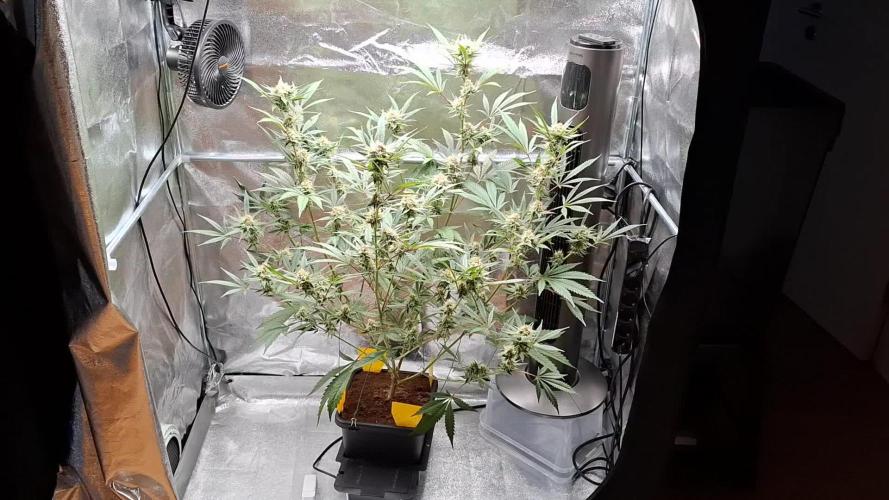
Started using Canna Boost about a week ago. Noticeable increase in growth and dank. Using 1ml per Liter in the reservoir. I was hesitant because of the high price but this stuff is great.
After playing around with the Masterblend ratios and weights I feel pretty confident in my current mix. What I thought to be tip burn from nitrogen turned out to be the early stage of Calcium deficiency. As Nitrogen and Calcium come in the form of Calciumnitrate you can't drop the N without the Ca. To avoid this I bought Canna Mono Calcium with 11.6% Ca. Now I am able to dial the N down to 120-130ppm and keep my Calcium at about 150ppm. Anything lower than 120ppm of Calcium starts to show deficiency symptoms. Same goes for the Nitrogen, 120ppm is the absolut minimum right now. I am also going to increase the Magnesium to 50ppm with the next tank refill.
I am pretty happy with the Masterblend 4-18-38, Calnit 15,5-0-0 and Epsom Salt bundle. You don't have to buy a seperate flowering blend if you get a mono calcium fertilizer. The plant loves the Masterblend. Looks way better then when using Canna AB...
