




Likes
5
Share


@pzwags420
Follow
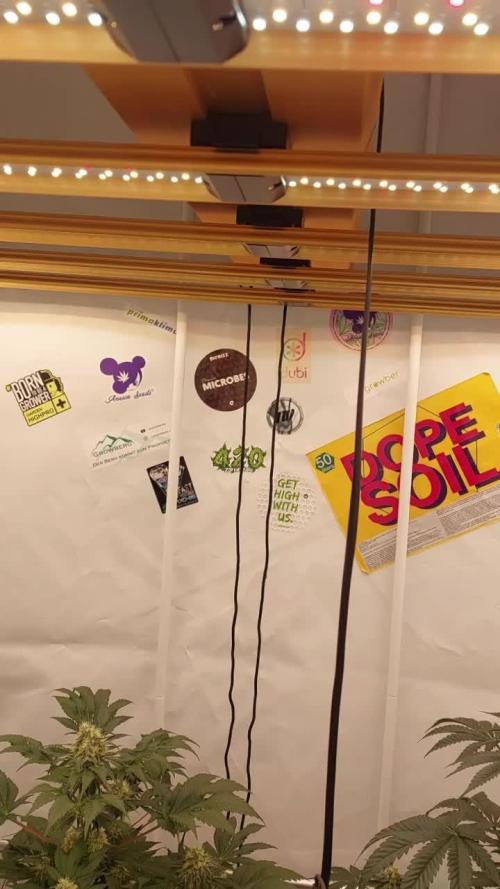
The start of week 5 is going well. Blueberry is smelling nice and my seedlings should be showing preflowers soon.


Likes
31
Share

@Hempface86
Follow
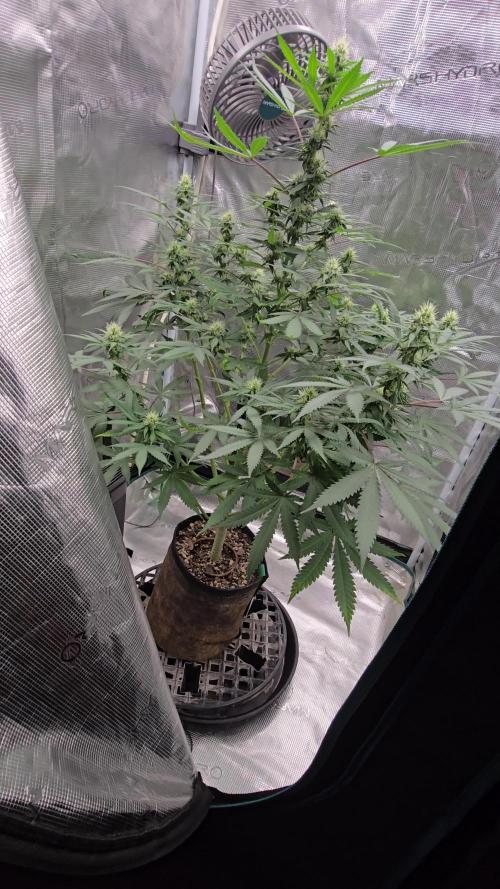
As you can see, she is flowering. At a very good pace, which makes me think this is not a haze at all =( .. it's definitely not an auto flower and does not show sativa characteristics.. So we officially have on our hands, a mystery strain... I've reached out to the breeder, about it and have gotten no response with typically means they have no idea lol .. all good.Hope everyone is well.God bless and happy growing 🙏
Likes
18
Share


@DevilsBud
Follow
Boom!!!!
New week and Damm there looking fire great smell coming from them all day long couple weeks to go 💪🏻
Likes
16
Share


@Mrg7667
Follow
About day 38 i am just realizing that i am stupid and been feeding the biogrow for cocoa coir 🤦♂️ way iver nuting with soil it says never to go over 1ml/L
So i will be flushing for at least 1 or two waterings. Looking for the tip burn to stop spreading and the tips to not look like there clawing

Likes
50
Share


@UKauto
Follow
grow space is listed as what I had her in up until the last 4 weeks when moved and switching lights.
Likes
3
Share


@LeosLivingSoil
Follow
Eine ein Fuß Bud an einer auto ist schon Wild, dadurch das Sie die Anfangszeit aber draußen war hat sie Blattläuse mit reingeschleppt, das war arsch. Semi Outdoor kann ich also nicht 100% weiterempfehlen :D


Likes
45
Share


@Ultraviolet
Follow
2nd net is up. Early bud formations are promising. holding up to the extremes pretty well, some leaves taking minor damage, but overall, she is holding up, gave her 1 night at 50F see how she would react, stressful. Not advised as it messes with her metabolism, but I want to see if it triggers any anthocyanin response. Love to see her purp up but no signs yet.
My homework.
Rubisco regeneration is intrinsically linked to nitrogen supply because Rubisco is a major sink for nitrogen in plants, typically accounting for 15% to over 25% of total leaf nitrogen. The regeneration phase itself consumes nitrogen through the synthesis of the Rubisco enzyme and associated proteins (like Rubisco activase), and overall nitrogen status heavily influences the efficiency of RuBP regeneration.Structural Component: Nitrogen is an essential building block for all proteins, and the sheer abundance of the Rubisco protein makes it the single largest storage of nitrogen in the leaf.
Synthesis and Activity: Adequate nitrogen supply is crucial for the synthesis and maintenance of sufficient Rubisco enzyme and Rubisco activase (Rca), the regulatory protein responsible for maintaining Rubisco's active state. Nitrogen deficiency leads to a decrease in the content and activity of both Rubisco and Rca, which in turn limits the maximum carboxylation rate, Vmax, and the rate of RuBP regeneration Jmax, thus reducing overall photosynthetic capacity.
Nitrogen Storage and Remobilization: Rubisco can act as a temporary nitrogen storage protein, which is degraded to remobilize nitrogen to other growing parts of the plant, especially under conditions of nitrogen deficiency or senescence.
Nitrogen Use Efficiency (NUE): The allocation of nitrogen to Rubisco is a key determinant of a plant's photosynthetic nitrogen use efficiency (PNUE). In high-nitrogen conditions, plants may accumulate a surplus of Rubisco, which may not be fully activated, leading to a lower PNUE. Optimizing the amount and activity of Rubisco relative to nitrogen availability is a target for improving crop NUE.
Photorespiration and Nitrogen Metabolism: Nitrogen metabolism is also linked to the photorespiration pathway (which competes with carboxylation at the Rubisco active site), particularly in the reassimilation of ammonia released during the process.
To increase RuBisCO regeneration, which refers to the process of forming the CO2 acceptor molecule Ribulose-1,5-bisphosphate (RuBP) during photosynthesis, the primary methods involve optimizing the levels and activity of Rubisco activase (Rca) and enhancing the performance of other Calvin-Benson-Bassham (CBB) cycle enzymes.
Biochemical and Environmental Approaches:
Optimize Rubisco Activase (Rca) activity: Rca is a crucial chaperone protein that removes inhibitory sugar phosphates, such as CA1P (2-carboxy-D-arabinitol 1-phosphate), from the Rubisco active site, thus maintaining its catalytic competence.
•Ensure optimal light conditions: Rca is light-activated via the chloroplast's redox status. Adequate light intensity ensures Rca can effectively maintain Rubisco in its active, carbamylated state.
•Maintain optimal temperature: Rca is highly temperature-sensitive and can become unstable at moderately high temperatures (e.g., above 35°C/95F° in many C3 plants), which decreases its ability to activate Rubisco. Maintaining temperatures within the optimal range for a specific plant species is important.
•Optimize Mg2+ concentration: Mg2+ is a key cofactor for both Rubisco carbamylation and Rca activity. In the light, Mg2+ concentration in the chloroplast stroma increases, promoting activation.
•Manage ATP/ADP ratio: Rca activity depends on ATP hydrolysis and is inhibited by ADP. Conditions that maintain a high ATP/ADP ratio in the chloroplast stroma favor Rca activity.
Enhance Calvin-Benson-Bassham (CBB) cycle enzyme activity: The overall rate of RuBP regeneration can be limited by other enzymes in the cycle.
•Increase SBPase activity: Sedoheptulose-1,7-bisphosphatase (SBPase) is a key regulatory enzyme in the regeneration pathway, and increasing its activity can enhance RuBP regeneration and overall photosynthesis.
•Optimize other enzymes: Overexpression of other CBB cycle enzymes such as fructose-1,6-bisphosphate aldolase (FBA) and triose phosphate isomerase (TPI) can also help to balance the metabolic flux and improve RuBP regeneration capacity.
Magnesium ions, Mg2+, are specifically required for Rubisco activation because the cation plays a critical structural and chemical role in forming the active site: A specific lysine residue in the active site must be carbamylated by a CO2 molecule to activate the enzyme. The resulting negatively charged carbamyl group then facilitates the binding of the positively charged Mg2+ion. While other divalent metal ions like Mn2+ can bind to Rubisco, they alter the enzyme's substrate specificity and lead to dramatically lower activity or a higher rate of the non-productive oxygenation reaction compared to Mg2+, making them biologically unfavorable in the context of efficient carbon fixation. The concentration of Mg2+ in the chloroplast stroma naturally increases in the light due to ion potential balancing during ATP synthesis, providing a physiological mechanism to ensure the enzyme is activated when photosynthesis is possible. At the center of the porphyrin ring, nestled within its nitrogen atoms, is a Magnesium ion (Mg2+). This magnesium ion is crucial for the function of chlorophyll, and without it, the pigment cannot effectively capture and transfer light energy.
Mg acts as a cofactor: Mg2+ binds to Rubisco after an activator CO2 molecule, forming a catalytically competent complex (Enzyme-CO2-Mg2+). High light + CO2) increases demand: Under high light (60 DLI is a very high intensity, potentially saturating) and high CO2, the plant's capacity for photosynthesis is high, and thus the demand for activated Rubisco and the necessary Mg2+ cofactor increases. Mg deficiency becomes limiting: If Mg2+ is deficient under these conditions, the higher levels of Rubisco and Rubisco activase produced cannot be fully activated, leading to lower photosynthetic rates and potential photo-oxidative damage.
Optimal range: Studies show that adequate Mg2+ application can enhance Rubisco activation and stabilize net photosynthetic rates under stress conditions, but the required concentration is specific to the experimental setup.
Monitoring is key: The most effective approach in a controlled environment is to monitor the plant's physiological responses e.g., leaf Mg2+ concentration, photosynthetic rate, Rubisco activation state, and adjust the nutrient solution/fertilizer to maintain adequate levels, rather than supplementing a fixed "extra" amount.
In practice, this means ensuring that Mg2+ is not a limiting factor in the plant's standard nutrient solution when pushing the limits with high light and CO2.
Applying Mg2+ through foliar spray is beneficial to Rubisco regeneration, particularly in alleviating the negative effects of magnesium (Mg) deficiency and high-temperature stress (HTS). While Mg can be leached from soil, within the plant it is considered a mobile nutrient, particularly in the phloem. Foliar-applied Mg is quickly absorbed by the leaves and can be translocate to other plant parts, including new growth and sink organs.
Foliar application of: NATURES VERY OWN MgSO4 @ 15.0g L-1 in a spray bottle.
Foliar sprays are often recommended as a rapid rescue measure for existing deficiencies or as a supplement during critical growth stages, when demand for Mg is high. Application in the early morning or late evening can improve absorption and prevent leaf burn.
The starting point [of creativity] is curiosity: pondering why the default exists in the first place. We’re driven to question defaults when we experience vuja de, the opposite of déjà vu. Déjà vu occurs when we encounter something new, but it feels as if we’ve seen it before. Vuja de is the reverse—we face something familiar, but we see it with a fresh perspective that enables us to gain new insights into old problems. Come walk in the enchanted forest.
Likes
1
Share


@greengenetics420
Follow
11.05.24
Es scheint, dass die Thripsbehandlung mit BAC Vital erfolgreich war - es wurden keine Schädlinge mehr beobachtet. Durch mehrmaliges Besprühen konnte ich die Luftfeuchtigkeit etwas erhöhen. Heute wurden die Pflanzen in 2-Liter-Töpfe umgetopft, in denen sie nun weiter wachsen können, bis sie schließlich in die 30-Liter-Töpfe kommen. Ich habe ihnen einen kräftigen Schluck Wasser mit Terra Aquatica Root Booster, Terra Aquatica Seaweed und Glückspilze Mykorrhiza Soluble gegeben.
12.05.24
Die Pflanzen haben das Umpflanzen gut überstanden und zeigen keine Stressreaktionen. Die Blätter stehen prall gegen die Sonne.
13.05.24
Die Kleinen zeigen bereits wieder starkes Wachstum, daher habe ich sie heute mit der Pinzette getoppt. Ich denke, sie werden in den nächsten 3 Tagen den Stress abbauen und dann beginnen, die unteren Triebe nach oben zu entwickeln. Da wir eine Fläche von 120x120 mit geschlossenem Kronendach erreichen wollen, ist es wichtig, dass die Pflanzen frühzeitig in die Breite wachsen.
16.05.24
Die Pflanzen zeigen generell ein gutes Allgemeinwachstum, obwohl die Umgebungsbedingungen nicht ideal sind. Temperatur und Luftfeuchte sind zu hoch, woran ich arbeite, aber die aktuellen Außentemperaturen erschweren das.

Likes
1
Share

@StoneyApple
Follow
Day 28
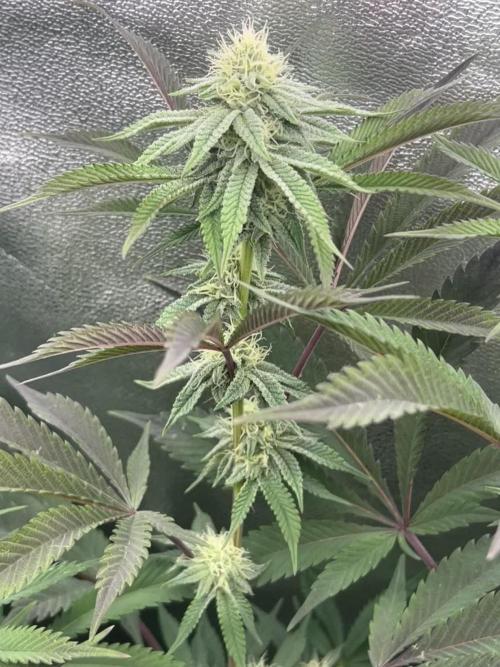
The plant is looking strong and healthy.
Gave it a dose of compost tea earlier this week, and it responded well.
I will rise the temps again this week as the SBC drying is done.

Likes
16
Share


@AestheticGenetics
Follow
4/9/25
This plant is beyond frosty. Stacking up super nicely. Seems like she will yeild quite a bit.
My only gripe is that she has like no smell at all.
Using the foil as a soil cover is working quite nicely. the top soil is getting filled with roots quite well.
Top dressed 1tsp of Bloom
1tsp microbe charge
1tsp bloom

Likes
2
Share


@Grandillustrator
Follow
This week the plant finally gets the tent to itself and I began training for a wider canopy , poor girl looks tortured lol in this week I notice a mutation on one of the branches fasciation which I show in the video I’m unsure as what to do because in the week because I want to switch the plant very soon to flower and don’t want to waste a branch but I kinda wanted to see what the buds would look like if I left i ultimately decided to chop it

Likes
4
Share


@knnabisgrower
Follow
En la 6ta semana de vegetación hicimos una poda de bajos y desfoliación en general para potenciar el crecimiento de los brotes superiores, mejorando la iluminación y ventilación en el cultivo. También hicimos unos cuantos amarres (lst).

Likes
4
Share


@Kush_T_Big_Nugz
Follow
Week 7 and time to flip these bitches into flower, given them a defol which last time I think I took much more off but I think I’ve taken enough off and il strip them again at day 21 of flower.... got light leak here and there in my old rickety shed lol so gonna get the caulk gun out seal anything I can see, set the timer to 12/12 and we’re off 👍🏼


Likes
10
Share


@GrowingInPeru
Follow
Buena variedad y pega fuerte se siente como si te derritieses es una sensación muy buena 😎pero me gusto mucho cultivarla este cultivo esta a base de pura agua con nada de PK ni NPK. OG Kush Auto excelente trabajo


Likes
5
Share


@Unnamed
Follow
I raised the EC to ~2000, lowered ORP to ~100 and didn't see any tip burn yet, will observe the plant and might increase it even more, haven't grown this strain yet.
No smell yet.
Roots are looking good, maybe a little stained due to Universol Yellow which has a strong yellow color.
Did more LST and defoliation, with the stretch I might reach the frame for Scrog next week?
So I noticed a mutation that has been there for a while but I only noticed it this week, this plant is giving me a little headache with the slow growths on top and mutations but mid week it started to grow more, maybe it is coming back right now since the roots are doing good from start and the plant laid a good foundation before it takes off now? I had worse starts with great results.
Since stretch definitely started mid week and flowering is starting I will count it as flower mid week but will mark is as flower on GD starting next week.
Also added predator mite pouches as precaution, better safe than sorry.
Values are average of the day.
DATE - °C - RH% (Tent Temp/RH)
20241028 24.4 59.9
20241029 24.1 62.7
20241030 24.3 62.4
20241031 24.0 58.5
20241101 22.9 60.6
20241102 23.2 60.3
20241103 23.4 58.4
DATE - PH
20241028 5.84
20241029 5.94
20241030 5.96
20241031 5.98
20241101 6.17
20241102 6.07
20241103 6.01
DATE - ORP (mV)
20241028 197
20241029 175
20241030 165
20241031 159
20241101 185
20241102 114
20241103 93
DATE - EC(us/cm)
20241028 1576
20241029 1536
20241030 1561
20241031 1583
20241101 1685
20241102 1914
20241103 1962
DATE - CF
20241028 15.76
20241029 15.36
20241030 15.61
20241031 15.83
20241101 16.85
20241102 19.14
20241103 19.62
DATE - °C (Reservoir)
20241028 22.3
20241029 21.9
20241030 22.5
20241031 22.5
20241101 21.3
20241102 21.1
20241103 22.1