






Likes
42
Share


@Ultraviolet
Follow
Thank you. Gave her a cocktail to help with stress. Added 1st net for lateral support, not so much now, but for later. Blue light is absorbed by photoreceptor proteins called phototropins, which trigger a hormonal response that causes cells on the shaded side to elongate, making the plant bend toward the light. Try and fill this side a little. She is quite big already, just needs to find her stride again after the undue torture.
The mind is constantly working and producing, just like a factory. It's not just a passive recipient of information but an active producer of ideas, attitudes, and beliefs. The "ingredients" in this factory are the information you consume, such as books, conversations, and the media you engage with. The "products" are your thoughts, beliefs, and actions. The quality of the ingredients directly influences the quality of the output. To guard the door of your mind means to be selective about what you allow in. It involves actively choosing to consume positive and constructive information while filtering out negativity and harmful influences. If you don't guard your mind, others can "dump" whatever they want into it, leading to undesirable results in your life. You must take responsibility for the inputs to ensure you produce the outcomes you desire.
5 apex stems with 20-30 mini cola, let them develop a little, with the apical dominance shattered, all those 20-30 will all compete with each other as soon as that stretch is initiated. Key to a good stretch is making sure the plant is cycling efficiently, with large ATP conversions occurring lights out.
For now, I'm keeping light intensity high. A plant will slow its vertical growth in very high light intensities, leading to a more compact form with thicker stems and leaves. This response is a protective mechanism against light stress, which can damage the photosynthetic apparatus and lead to symptoms like leaf scorching, yellowing, and brittleness. Instead of growing taller, the plant invests its energy into creating a more robust, stress-tolerant structure.
Providing plants with necessary antioxidants helps protect the photosynthetic apparatus by scavenging reactive oxygen species (ROS) that cause damage from excess light.
UV light exposure can impact the xanthophyll cycle by either enhancing its photoprotective role or causing damage, depending on the intensity and type of UV radiation. UV exposure can trigger the synthesis of more xanthophyll cycle pigments to increase the plant's capacity to dissipate excess energy, but it can also cause direct damage, particularly to Photosystem II, and may lead to a decrease in the de-epoxidation state (DEPS ratio) which indicates a reduced capacity to dissipate excess energy.
Plants can respond to UV stress by increasing the synthesis of xanthophyll cycle pigments, such as violaxanthin and zeaxanthin, to improve their photoprotective capacity. UV-induced changes in xanthophyll cycle pigments can be linked to a plant's overall tolerance to high radiation stress. The xanthophyll cycle helps protect against photoinhibition, which is especially important when the plant is exposed to high levels of both UV and visible light. High doses of UV radiation can directly damage photosynthetic components, including the proteins, lipids, and pigments in the thylakoid membranes. Exposure to UV radiation can have a mixed effect on the de-epoxidation state (DEPS ratio) of the xanthophyll cycle pigments. In some cases, UV can inhibit the conversion of violaxanthin to zeaxanthin, resulting in a lower DEPS ratio and a reduced capacity for energy dissipation. However, the total pool of xanthophyll cycle pigments may increase, and this enhanced pool size could provide a greater potential for photoprotection despite a lower DEPS ratio.
The xanthophyll cycle works alongside other mechanisms, such as the accumulation of flavonoids (UV screens), to protect the plant from UV-induced damage.
Blue light repairs 100% UV-induced damage in plants through a process called photoreactivation, which uses a light-dependent enzyme called photolyase. This enzyme uses energy from blue and UV-A light to directly reverse the damaging pyrimidine dimers in the DNA caused by UV-B radiation, a key mechanism for maintaining the plant's genetic integrity.
After carbon, light, water, temperature, and nutrients, the limiting factor of a plant's growth is often its own internal factors or the amount of a key ingredient. Chlorophyll concentration is one such factor, as the amount of this pigment limits how much light can be captured for photosynthesis. Other factors include chloroplast number, respiration rate, and the concentration of carbon dioxide in the atmosphere, as plants are often in a CO2-deficient condition.
60x60x18=64800seconds x 700 = 45,360,000moles. 45DLI
Exposure to 165 µW/cm² of ultraviolet-B (UV-B) light for 3600 seconds = 1 hour, a extremely high, acute dose triggering stress responses and protective mechanisms.
.
The plant's photoreceptor protein, UVR8, senses the UV-B radiation. This triggers a signaling cascade that activates specific genes to protect the plant from damage. In response to the UV-B signal, the plant ramps up the biosynthesis of protective compounds like flavonoids, phenolic acids, and anthocyanins. These compounds absorb UV radiation and accumulate in the epidermal layers of leaves to shield inner photosynthetic tissues. The plant may increase leaf thickness or deposit more cuticular wax, creating a physical barrier to the radiation. The plant will produce more enzymatic and non-enzymatic antioxidants to neutralize the reactive oxygen species (ROS) produced by the UV-B radiation. The plant activates enzymes, including photolyases, to repair DNA damage caused by the UV-B. These repair mechanisms are critical for preventing permanent genetic mutations.
While protective measures are activated, a high dose delivered over a short period can cause stress that overwhelms the plant's defenses.
Photosynthesis is highly sensitive to UV-B. A high dose can inactivate Photosystem II (PSII), damage thylakoid membranes within the chloroplasts, and reduce chlorophyll content, which lowers the plant's overall photosynthetic capacity. Despite repair mechanisms, high UV-B doses can inflict persistent damage on the plant's DNA. The overproduction of reactive oxygen species can cause oxidative stress, leading to the oxidation of lipids and proteins and disrupting cellular function.
I am playing in the enchanted forest.
Likes
22
Share


@GrowinHome
Follow
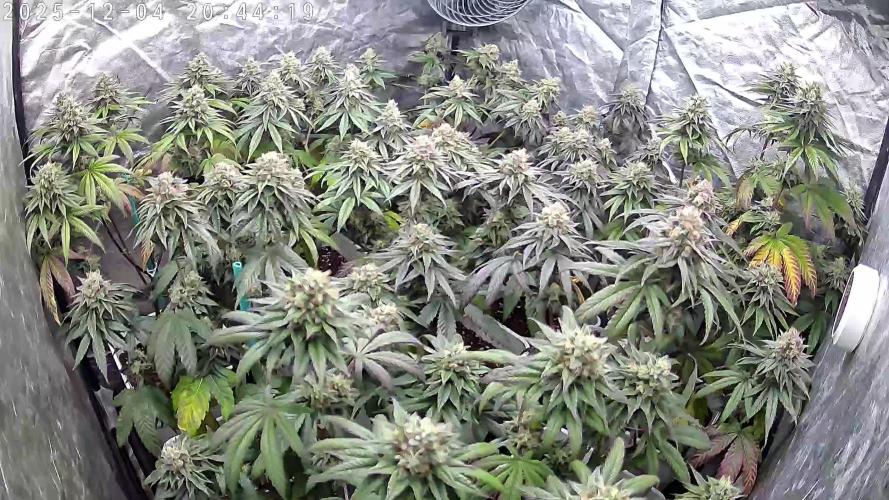
Here we are entering week 5 of flower.
Steady growth, the buds are starting to gain some good weight.
The leaves looking nice and green with some nice frost



Likes
6
Share


@4twentysupplyco
Follow
Germination was pretty good, we lost one of each strain. We soaked for 24hr then wet paper towel for 24hr then in a tray and dome for 2 days under a sun blaster 50 watt light for the first week or so

Likes
15
Share


@AustinRon
Follow
LJ4Q23 Flower 10
HARVEST WEEK
_______________________________
Environment Targets (Flower 10 - Harvest)
- Scotoperiod: [ 13, h] # Contiguous dark hours daily
- TemperatureMax: [ 78, °F]
- RH: [57, %]
- VPD: [ 1.2, mS]
- LightIntensityMax: [ 750, µMol/m2/s]
- LightDistance: [ 16.5, “]
Fertigation Plan:
- RLA Hydro Chart, EC 1.3 - 0.8
- Primer A: [ 6, ml, gal]
- Primer B: [ 6, ml, gal]
- Silica Skin: [ 2, ml, gal]
- Resin Bloom: [ 2, ml, gal]
Penultimate 3 Days (before Harvest)
- RLA Resin Bloom, EC: 0.8
__
Wed Jan 31, 2024
LJ4Q 64:F:9:1
EC: 1.3
- [x] Runoff Amount: [ 550, ml]
- [x] Runoff EC: [ 3.3, mS]
__
Thu Feb 1, 2024
LJ4Q 65:F:9:2
- [x] Runoff Amount: [ 650, ml]
- [x] Runoff EC: [ 3.2 , mS]
__
Fri Feb 2, 2024
LJ4Q 66:F:9:3
Refresh/Dilute Reservoir, EC: [ 1.1, mS] - IF Refresh - Resin Bloom Only @ [ 8, ml, gal]
- [x] EC Reservoir, Dark: EC: [ 1.3, mS]
- [x] Add 1 Gal, w/ Resin Bloom [ 8, ml, gal], Reservoir EC: [ 1.1, mS]
- [x] Runoff Amount: [ 800, ml]
- [x] Runoff EC: [ 3.2, mS]
__
Sat Feb 3, 2024
LJ4Q 67:F:9:4
- [x] Reduce Feed Duration from 4 Minutes to 3 Minutes (775 ml Runoff is a tad high, yes?)
- [x] Trichome Check - Are we Ready to Harvest Tuesday?
- [x] Runoff Amount: [ 775, ml]
- [x] Runoff EC: [ 2.9, mS] # First Day with Runoff EC Coming Down . . .
__
Sun Feb 4, 2024
LJ4Q 68:F:9:5
- [x] Runoff Amount: [ 550 , ml]
- [x] Runoff EC: [2.9 , mS]
- [x] Dilute Reservoir to EC: [ 0.8, mS] # Resin Bloom: [ 8, ml, gal], EC: 1.0
__
Mon Feb 5, 2024
LJ4Q 69:F:9:6
Add another gallon w/ 8 ml Resin Bloom Only . . .
EC Solution: [ ?, mS]
EC Reservoir: [ 0.9, mS]
- [x] Runoff Amount: [ 75 , ml]
- [x] Runoff EC: [ 4.5, mS]
__
Tue Feb 6, 2024 # HARVEST DAY 70 !!!!
LJ4Q 70:F:9:7

Likes
8
Share


@Rko41
Follow
Jolie buisson les têtes s’agrandissent vite c’est une fast version vivement le changement de couleur


Likes
Comments
Share


@RatmanJR
Follow
June 21st update. 28 days since flip.
Plant is growing phenomenal. Was able to crank the lights up to 80% for the first time in this grow without her throwing a fit.
All of the banana peels I’ve fed her the last few weeks have disappeared and have been feeding my soil mites and my worms. I have not had any bad pests since I started using these predator mites I love it.
I can’t even begin to describe the smell of this thing. It’s like a raspberry tart mixed with just a little hint of gas. I’m so excited to give this a try when the time comes
Noticing Trichomes going all the way down some of the fan leaves so that is always cool to see.
Also I noticed this is common with living soil but I’m done bothering trying to defoliate. I will do one more in two weeks at day 42. But anything I remove at this point is just going to come right back.
As always nothing but water. Will give her some tea tmmr like every Sunday with some big 6, worm castings, molasses, and some cow cal 24.
Likes
14
Share


@Weedbadk
Follow
Día 1 y todas geminaron vamos a usar lst a todas y algunas lst y poda apical
Día 5 desde puesta en sustrato
Solo pulverizó
Likes
7
Share


@greenvibez
Follow
Unos cogollos brutales ! Tienen muchísima resina … los olores son de frutas y con el toque Cali que la destaca ! En general chicos es una cepa que si tuviera que repetir no lo dudaría ni un segundo por su fácil cultivo y sus grandes cogollos 17g en seco en maceta d 3l

Likes
18
Share


@VI_Cannabis
Follow
First day went as expected. I put the paper towel in a small see-thru plastic container and put it on the table. With a bit of water and the seeds in side, the germination has now started!
Day 2 no progression, moved the tray into my furnace room (pitch black and warm)
Day 3 major progression. I got them out and started to prep the jiffy pellets. Shortly after I transferred the roughly half inch tarp roots with seeds into the jiffy pellets, root down, seed up, slightly covered with dirt. I soaked them in water (like a beginner i overwatered heavily knowing what I know now). I placed them back in the tray and put them at a window for light.
(Note) the plan was to do outdoor so no light or tent was ordered at this point.
Day 4-7 not much progression seeing as the clouds and rain showed up...
Likes
26
Share


@MiniBoxGrower
Follow
Like most beginners I am very impatient.
Therefore the following question can I be satisfied with growth so far ?
I haven't used any fertiliser so far because I put pre-fertilised soil in the pot when I repotted it.
It hasn't received much water yet either, I drowned a plant before, so I have become cautious.
I'm starting to think about training her, because I'm very limited in height.
5.5. 80ml
7.5. 100ml
11.5. 240m
Likes
7
Share


@Giovi
Follow
last week of vegetative growth and we are ready for flowering !! The plants look healthy and I gave them some more nitrogen to prepare them for the 12/12 change! I'm excited I can't wait! I prepared some clones hoping to be able to root and gorilla plants again !! I also did a little defoliation! What do you guys think? Grazie mille 😘😘

Likes
22
Share


@BB_UK
Follow
Tricky situation with these as one Hermed so isolated them and let them finish! Still got an amazing result! Can’t actually wait to try these 2! One had fruity and spicy aromas and the other was dank like a deep kushy smell too it!
Likes
17
Share

@eldruida_lamota
Follow
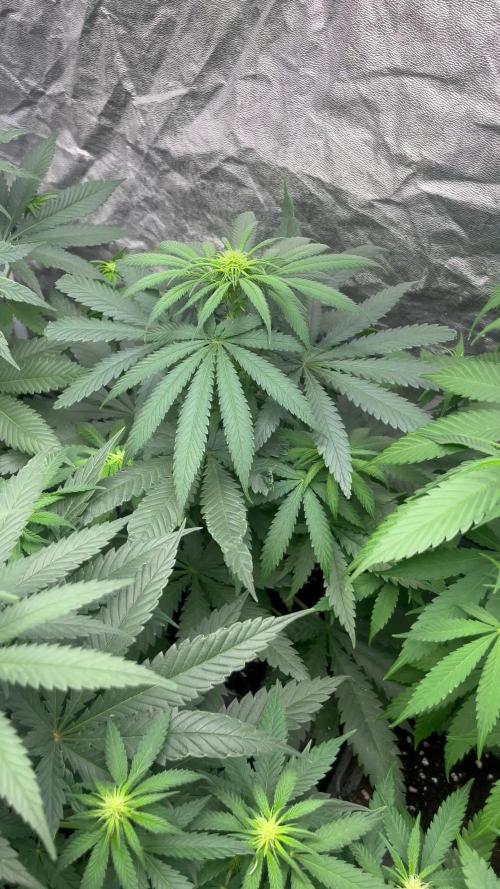
Actualizamos familia, con la segunda semana de floración de estas Sherbet Jedi Joint de HighBreed.
Gracias al LST arrancaron a crecer bien los satélites y va pareciéndose a un arbusto, tienen un color bien verde sin carencias por el momento y se ve que están sanas, las plantas están en macetas de 7 Litros definitivamente, con tierra top crop, con una altura similar a 50/55cms.
Como los anteriores cultivos tuve visitantes(trips) estoy rociando aceite de neem y jabón potásico 1 vez a la semana, añadí también tiras de color azul / amarillo para prevenir y controlar mejor el tema plagas.
El riego que aplicamos son 700ml de agua cada 48 horas y el ph se controla en 6.5, la temperatura la tenemos entre 22/25 grados y la humedad ronda el 55% gracias al humidificador.
El mismo día que escribo esto el foco está al 80% de potencia. Me gusta subirlo muy progresivamente, las manías.
- os dejo por aquí un CÓDIGO: Eldruida
Descuento para la tienda de MARS HYDRO.
https://www.mars-hydro.com
- los nutrientes directamente desde https://agrobeta.com/agrobetatiendaonline/36-abonos-canamo
Hasta aquí todo, Buenos humos 💨💨💨
Likes
7
Share


@gablmo
Follow
Another busy week with the vege. I gave it microbes, a HID lamp at 400 watts, sprayed for bugs and also covered the media with plastic wrap to get rid of 3 or 4 gnarts and of course a had another flood with the GoGro water system and I took one plant out of the garden because she is frozen in time. I still don't know why. The trellis is doing good. Lots of work.


