Likes
Comments
Share
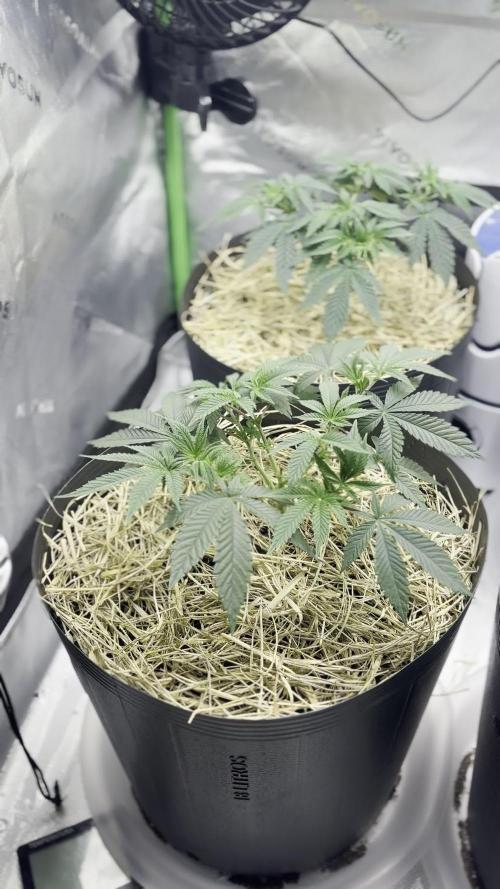
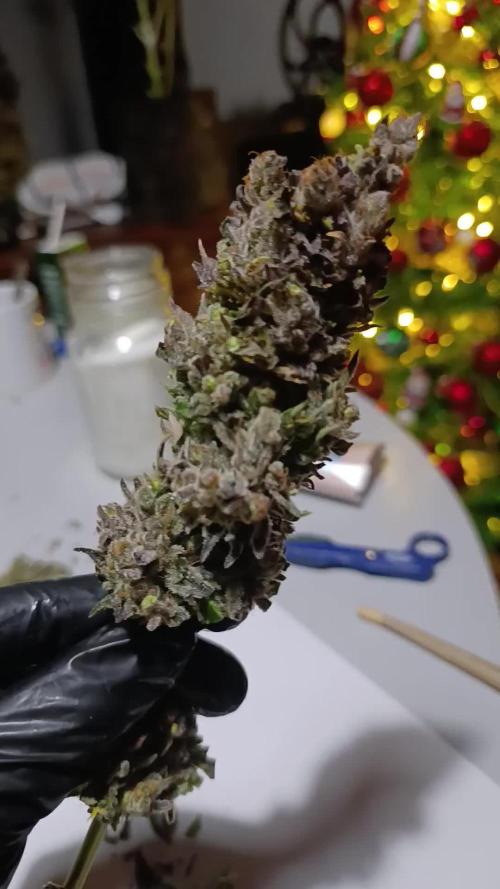
🌱 Growtagebuch – Woche 11 🌱 "Woche 11 und die Ernte der Apple Strudel Auto stehen an. 🏁 Aufgrund von 5-Liter-Töpfen und Fimming-Experimenten in einem 60x60x140 cm Zelt fiel der Ertrag mit knapp 24 Gramm eher gering aus. 📉 Die Ernte hätte bereits in Woche 9 oder 10 stattfinden können, wurde jedoch bewusst hinausgezögert, um eine bernsteinfarbene Trichomentwicklung zu erreichen. ⏳ Dafür überzeugt die Qualität der Buds auf ganzer Linie. ✨ Sie duften intensiv nach Apfel und die Wirkung ist relativ ausgewogen. leicht Indica-dominant. 🍎😴 Qualitativ ein sehr gutes, quantitativ jedoch eher bescheidenes Ergebnis. ⚖️" Ähnlich der anderen bieden Pflanzen...
Likes
41
Share
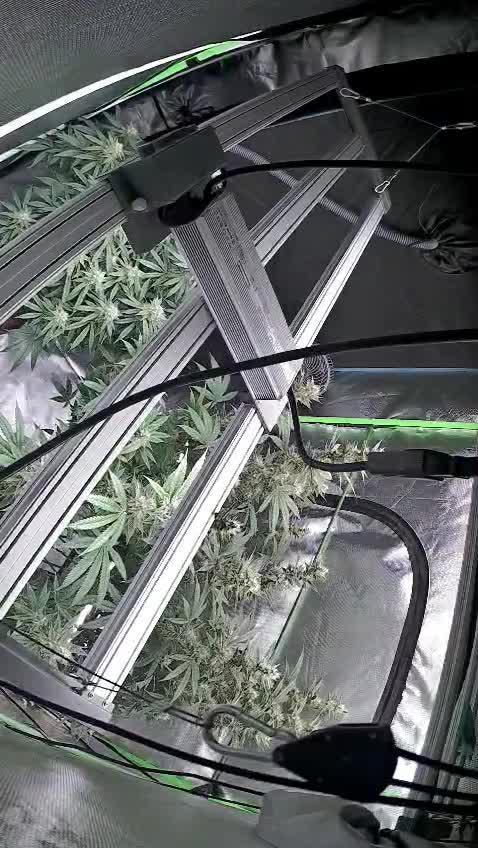
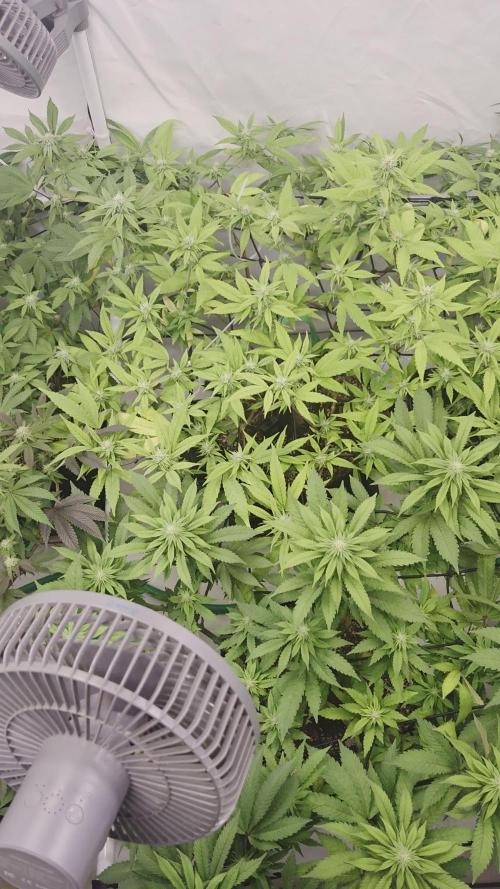
So we have reached the end of Week 6 from and I am flipping the the ladies to flower. I have uploaded a video along with pictures..... Hope it plays. Stay Safe guys and Happy Growing, any questions just ask away 👍🏾💚
Likes
12
Share
Checkout my Instagram @smallbudz to see the Small budget grow setup for indoor use, low watt, low heat, low noise, step by step. 17/11/2019 - Pot feels light and the is bottom dry to the touch time to water, gave her 1,5l of water PH 6.2 with 0.5ml Grow, 1ml, Bloom and 0.5ml Max Biobizz reduced the dosage from last time, watered util some runoff appeared. 18/11/2019 - Mixed another batch of Alg-a-Mic 2ml per liter to spray on lights off PH 6.2
Likes
21
Share
@DogterB
Follow
Week 14 Day 92 (10/16) Checked her trichomes and she's just starting to show some amber. She may need watered tonight, probably will add in some Mammoth P and molasses too. Day 93 (10/17) I've been slacking on updates and pics, but there's just not too much to say or document. She's still doing her thing, really looking more frosty than the first partial harvest. Thinking I should have waited a bit longer for the first cut, but oh well, it still gets the job done. I have held off on watering as her pot is still pretty heavy. It was lighter this morning so maybe this afternoon I will water her. I'm keeping an eye on her trichomes as I want there to be more amber for the final harvest. Day 94 (10/18) Everything from the partial harvest has been dried and I finally weighed it all. Came out to around 48.5g (including the 4-5g we've been smoking on). There's still plenty more on her. Everything has been jarred up for a few days and I've got Boveda packs in the jars too. Day 98 (10/22) Checked the trichomes this morning and I think I might put her in the dark for 48 hours starting tomorrow night. She's turning into a fuggin 100 day auto. Day 99 (10/23) Well, I made the executive decision to prep her for harvest. When her lights went off last night, I unplugged it from the timer so she'll have her 48 hours of dark. I also added some ice cubes around her base. I've read about the dark helping and the ice simulating a frost, but I've never done this so we'll see. Shouldn't hurt right? So I'll be harvesting her Saturday night or Sunday. And hopefully popping another over the weekend 😃 Day 100 (10/24) Well she's been in the dark almost her 48 hours. I have family in town tonight, so she may have to wait until tomorrow to get cut. Or I might just stay up half the night and get her down tonight lol. We'll see. Day 101 (10/25) Technically week 15, but who's counting. Cut her down today. Got her cleaned up and into paper bags to dry. Will get a weight and post the harvest once she's dry. Getting another one ready to go 😉
Likes
5
Share
@Dunk_Junk
Follow
Her first week!! Soil mix in her little 1L airpot is 2:1 Soil:Perlite
Likes
11
Share
@DimJesus
Follow
Hola a todos! Creciendo felices la segunda semana, comencé a fertilizar. No puedo estimar la altura porque le adiciono substrato poco a poco pues bajó unos centímetros después de humedecido. Pensando en utilizar LST para aprovechar mejor el espacio, estufa pequeña. Me parece que se está desenvolviendo bien. Acepto recomendaciones 🙌
Likes
7
Share
Oggi ho tagliato la pianta e lo messa a seccare in box a seccare purtroppo ho dovuto toglierla un po prima per motivi di vicinato ma non male Da umida ha fatto 21 grammi mi aspetto 7g come conclusione
Likes
6
Share
@QuantumB
Follow
Mad stretch this week! A little bit of nute burn where I overfed but other than that, things are looking good. Once the stretch has slowed down I will do some heavy defoliation to get things under control a tad but at the moment I'm just letting them do their thing. Peace! QB
Likes
42
Share
🍀42fastbuds🍀 Guava auto x3: 57/63 days flow Papaya sherbet x3: 70 days flow Gorilla melon x2: 70 days flow
Likes
6
Share
@BigGGrows
Follow
This week i harvested her on day 88 from seed week 13. This girl had some issues. She none the less survived long enough to finish up. Around the 2 week of flower she began burning up underneath the led's ( which don't get that hot). It's really weird, because out of 3 plants that were under the led's i run, this candy kush was the only one to react this way. I narrowed it down to this being the issue after flushing and verifying run off ph, defoliation, and nutrient decreases.She was also transplanted during preflower from a 1 gallon to a 5 gallon pot, which she took to well and really grew alot bigger from. I pulled off soooo many damaged leaves from the issues that occurred from the burning. It was so bad, i eventually built a greenhouse for her to finish up in. Although i think she could have been grown better and produced more, i cannot complain. I did oven bake some bottom branch larf buds and rolled up a sample. Of course the terpines were garbage and she tasted like shit haha, but the high was pretty good and intense! After she is done drying i will supply dry picks and weights, then she will be going into them curing jars. Oh and she was flushed for one week using only tps signal and molasses. She will indeed get another run in the future.
Likes
16
Share
@nonick123
Follow
Día 15 (27/01) Ha reaccionado bien al trasplante. A ver como se desarrolla en los siguientes días! Día 16 (28/01) Muestra un buen desarrollo con las primeras ramas formándose Día 17 (29/01) Subo a DLI 40 Muestra un color verde estupendo 😍 Día 18 (30/01) Tras subir el DLI la temperatura en el indoor ha subido a de 22ºC a 26 ºC, de modo que va a acelerar las necesidades hídricas Se sigue desarrollando estupendamente 😁 Día 19 (31/01) Seguimos a buen ritmo Creo que debería haber regado este día... (Visto como estaba de seca al día siguiente...) Día 20 (01/02) Elimino las ramas más inferiores (1er nudo) que siempre suelen quedar débiles en el stretch Riego con 350 ml H2O RO Día 21 (02/02) Empieza a estirarse! 😍 Está sedienta! Riego con 350 ml H2O En una semana a floración! FastBuds 15% DISCOUNT code "NONICK" 2fast4buds.com @fast_buds_official_ @fastbuds.official 💦 BioTabs 15% DISCOUNT code "GDBT420" biotabs.nl/en/shop/ @biotabs_official 🌱Substrate PRO-MIX HP BACILLUS + MYCORRHIZAE @promixmitch @promixgrowers_unfiltered 💡2 x Mars Hydro FC1500 EVO Led Grow Light (2024 NEW FC 1500-EVO Samsung LM301H 150W LED) - https://marshydro.eu/products/fc1500-evo-led-grow-lights/ - https://www.amazon.de/dp/B0CSSGN5D8?ref=myi_title_dp
Likes
7
Share
@vicisdope
Follow
Ms Mia Wallace went to town and blew the f up. Lots of leaf growth but no sign of bud spots- I know it’s early days tho. Watered with half serving of bloom nutes. Not the ideal nute mix I think, but served me well last grow. Also, as I turned up the light to max power, I noticed heat stress so i turned it down and successfully installed the worlds most eco friendly trellis - one minute- hockey net - next minute - weed trellis. It’s called upcycling boys and girls. I know it’s shit, I’m gonna reinstall it one more 1/4 ass so it’s a full half-ass scrog. Point is, the canopy is flat, pushed that puppy down so there’s more distance. Light back to 100%. Humidity was a little higher under the canopy, even with the dehumidifier, so I put my inline fan back in (was just a booster in-line fan before) and the temp and humidity is dropping. Saw a little bug. Hit the top & bottom canopy layer with light neem oil spray then incecticidle soap. I saw a small critter so I put Diatomaceous Earth on a upside down Tupperware lid. Don’t know if that works. Last time I did a top coat of the stuff on top of the soil - something happened and bad nute burn. Anyone know anything about this? Finally, also tied down a bunch of branches to let the light hit the lower areas. Tune in next time, where I’ll show you how to make a trellis from a pair of spandex Leggings , Peanut butter and a single streamer from the handlebars of a kids bicycle. Keep your buds green, and your grow room clean.
Likes
2
Share
67 days since April 16th, 2026 We become aware at such times of man's wonderful ability to bring seemingly unrelated elements into harmonic balance, and receive a glimpse into a world where everything exists in conscious sympathetic attunement to everything else. When we listen to a piece of music that seems to strike a beautiful chord somewhere inside us, or view a painting that simply glows with harmonic awareness well executed, we probably do not spare much time to contemplate the wonderfully intricate combination of vibrations that our sensors make it possible for us to perceive. We tend to appreciate the relationship between the parts of something by an awareness of the harmony or dissonance of the whole. This ability enables us to say "what a beautiful house!" instead of "analysis has proven that this collection of building materials exhibits certain elements of harmonic proportion." While this ability to instinctively appreciate the beauty of true harmony has an important role to play in evolution, a more analytical understanding of the laws involved can be most useful. This is especially so if we wish to create works of art where each part exists in true harmony, not only with the other part of that particular whole, but with the universe within which the creator and the created exist. Everything vibrates. From the most dense matter to the most subtle cosmic rays, everything which our senses allow our thoughts to become aware of, can be specified in terms of wavelength or frequency of vibration. These two terms define the same thing, but from different points of view. The following are the approximate wavelengths of various energy carriers: Cosmic rays 0.000,000,001 mm Gamma rays 0.000,000,1 mm X rays 0.000,500 mm Ultraviolet rays 0.003 mm Visible light 0.006 mm Infrared 0.01 mm Sound waves 1 meter Radio waves 300 meters Violet light 400 nm to 450 nm Blue light 450 nm to 500 nm Green light 500 nm to 570 nm Yellow light 570 nm to 590 nm Orange light 590 nm to 610 nm Red light 610 to 700 nm 1 nanometer (nm) = 0.000,000,1 cm = 1/10,000,000 cm If a guitar string is plucked and we hear a sound, it is not too difficult for the human mind to associate this sound with the vibration of the guitar string. With color it is quite different. It is difficult for us to conceive that the color of a substance is not an inherent property of the substance itself, but an indication picked up by our senses of that substance's ability to absorb or reflect the light which happens to be shining on it at that moment. Neither the matter nor the light is colored. What happens is that the brain learns to differentiate between the frequencies reflected or transmitted by the substance the eyes are focused on. The same thing happens with sound. When we say "Oh! Listen, they're playing my favorite song," what we really mean is: "My brain has stored within it a particular pattern of frequencies. I have compared the new information being received with this stored pattern and have deduced the answer that the two patterns are similar within certain specified tolerances." The 'pleasure' involved could have something to do with our running the pre-recorded pattern at the same time, in 'sympathy' with the new pattern as it is received. The word sympathy describes very well our ability to appreciate color and sound. It also describes the reason behind certain elements of harmony. For instance, if a substance vibrating at 100 cycles per second (tone 1) is in the proximity of another substance vibrating at 200 cycles per second (tone 2), we could perceive, if we had the right equipment, a certain sympathetic relationship between the two. We will see from this that there is a uniform doubling of the first tone seen in the second. At various points along the waves, the two are the same in amplitude. At other points, they are at opposite poles to each other. This doubled frequency has more points of similarity to the original than any other frequency except the original itself. If the equipment we had available for measuring these two frequencies was a soundboard amplifier and a pair of ears, then we would hear what would sound to us like one tone. If we had the opportunity to hear one at a time, we would hear that although they sound the same, one is higher in pitch than the other. This characteristic of 'the same but different in pitch', musicians have called the octave. Any two tones produced where one has exactly doubled the frequency of the other is called an octave. Speaking in ratios, an octave would appear then as the ratio 2:1 or 1:2, depending on whether we are talking of an octave up or down. A single note produced by almost any instrument will contain more than one wavelength or frequency. It will have a dominant frequency, the wavelength of which we would call the note's 'fundamental' or 1st harmonic. It will also have a varying number of upper harmonics, gradually fading in intensity into infinity or silence. Natural harmonics always have the same pattern of intervals between them. The interval between the 1st and 2nd harmonic is a perfect octave; between the 2nd and 3rd a perfect fifth; between the 3rd and 4th a perfect 4th; and so on, the intervals becoming smaller and smaller until they lose any relationship with the western 12 tone scale as it exists at the moment. Just as an octave has certain elements of sympathy with its fundamental, so some intervals have been noted to be more perfectly in sympathy with the fundamental than others. The ratio of the 'perfect 5th' or interval of 7 semitones, as it occurs in the harmonic series, is 3:2 or 2:3, while that of the 'perfect fourth" is 4:3 or 3:4. All the tones in the western 12 tone scale can be expressed in terms of the ratio between the upper tone and its fundamental. This would seem to be an ideal way of generating a scale from any given fundamental and several attempts have been made to do this, the Pythagorean system being probably the most well known. Although when working with a single tone instrument playing on its own, the Pythagorean formula works wonderfully well, if we had several instruments tuned this way together and asked them to play almost any western music, we would find that at times they sounded quite out of tune to each other. The lack of flexibility of the various scale systems based on the harmonic series has led to what is known as the 'tempered' scale. This uses as its primary unit of interval the ratio of the octave or 2:1. It then proceeds to divide the interval between any fundamental and its upper octave into 12 smaller intervals by applying the ratio: two to the one-twelfth power, to one (21/12:1). This equals 1.059463094, so by multiplying any frequency by this number, we will obtain the tempered semitone next up from our fundamental. We will also find that any tone twelve semitones up from any other tone, in a scale generated in this way, will have exactly double the frequency. If we took the note middle C on a piano and halved the wavelength, we would have the note C one octave above. If we halved this, we would have the C above, and so on. However, within about 6 octaves, we would find that although a 'sound' was being produced, no human ear could perceive it. If we kept on going, halving and producing upper octaves of our fundamental C, we would proceed through the infrared band, into the visible light spectrum. If we happened to be outside during the day, we would, for one octave only, see the note C with our eyes. The next octave above would already be in the ultraviolet band, and outside the eye's sensitivity range. If we can think of color as being an indication of a substance's vibratory rate or wavelength, we may begin to see a relationship that could exist between the color and sound spectrums. The logical extension of what has so far been said is that there exists a scale in the color spectrum that corresponds exactly to the scale in the sound spectrum, each color tone being an octave of the equivalent note in the sound range. This is not the end of the story but only the beginning. If we can for the moment accept that any wavelength in one band has upper and lower octave stretching out to infinity, then the next question is 'fine, but what shall we use as our fundamental? A particular color? A particular sound frequency?' The musicians among us will probably say 'A 440'. This means that the note A should vibrate at 440 Hertz, or 440 times per second. They would tell us that this is standard pitch has been adopted by most orchestras around the world; pianos are tuned to it, instruments are constructed to formulas based on it, and so to them it would probably seem the most appropriate place to begin. Some of these musicians may know of the battle that is still raging with regards to this being the standard, but few would know why A = 440 Hz was chosen except that it worked when it was set to be a suitable compromise between the many different pitches in use at the time. 432 Hz is said to be mathematically consistent with the patterns of the universe. Studies reveal that 432 Hz tuning vibrates with the universe’s golden mean PHI and unifies the properties of light, time, space, matter, gravity, and magnetism with biology, the DNA code, and consciousness. When our atoms and DNA start to resonate in harmony with the spiraling pattern of nature, our sense of connection to nature is said to be magnified. Another interesting factor to consider is that the A=432 Hz tuning correlates with the color spectrum, while the A=440 Hz is off. Audiophiles have also stated that A = 432 Hz music seems to be non-local and can fill an entire room, whereas A=440 Hz can be perceived as directional or linear in sound propagation. Once you adopt the idea that sound (or vibration in general) can have an equalizing and harmonizing effect (as well as a disturbing effect), the science of harmony can be applied to bring greater harmony into one's life or tune to specific energies. There is a form of absolute and relative harmony. Absolute harmony can, for example, be determined by the tuning of an instrument. The ancients tuned their instruments at an A of 432 Hz instead of 440 Hz - and for a good reason. There are plenty of music examples on the internet that you can listen to in order to establish the difference for yourself. Attuning the instrument to 432 Hz results in a more relaxing sound, while 440 Hz slightly tenses up the body. This is because 440 Hz is out of tune with both macro and micro cosmos. On the contrary, 432 Hz is in tune. To give an example of how this is manifested microcosmically: our breath (0,3 Hz) and our pulse (1,2 Hz) relate to the frequency of the lower octave of an A of 432 Hz (108 Hz) as 1:360 and 1:90. It is interesting to note that 432 Hz was the standard pitch of many old instruments and that it was only recently (19th and 20th century) the standard pitch was increased. This was done in order to be able to play for bigger audiences. Bigger audiences (more bodies) absorb more of the lower frequencies, so the higher pitch was more likely to “cut through”. One of the oldest instruments of the world is the bell ensemble of Yi Zeng (dated 423 BC), tuned to a standard F4 of 345 Hz, which gives an A= 432 Hz. The frequency of 345 Hz is that of the platonic year! Similarly, many old organs are tuned in A=432 as well; for example, St. Peter’s Capella Gregoriana, St. Peter’s Capella Giulia, S. Maria Maggiore in Rome. Maria Renold’s book “Intervals Scales Tones and the Concert Pitch C=128 Hz” claims conclusive evidence that 440 Hz and raising concert pitch above scientific “C” Prime=128 Hz (Concert A=432 Hz) disassociates the connection of consciousness to the body and creates anti-social conditions in humanity. The difference between concert pitch A=440 Hz and Concert A=432 Hz is only 8 cycles per second, but it is a perceptible difference of awareness in the human consciousness experience of the dream we share called existence.
Likes
26
Share
@darb35
Follow
Day 22 - 660 ml water (ph 6.5)(22 cm) Day 23 - 660 ml water with Acti+Heaven+Grow+Calmag (ph 6.6)(24 cm) Day 24 - no water(26 cm) Day 25 - 660 ml water (ph 6.6)(28 cm) Day 26 - 660 ml water with Acti+Heaven+Grow, also trimmed a bit of fan leafs, it's getting crowded inside (ph 6.5)(30 cm) Day 27 - 660 ml water (ph 6.6)(33 cm) Day 28 - 1L water (ph 6.5)(35 cm)
Likes
5
Share
Hallo zusammen 🤙. Habe sie heute geerntet. Wir hören uns in 3 Wochen mit dem Erntebericht.
Likes
Comments
Share
@Aleks555
Follow
🌿 Week 3 – SEEDSTOCKERS Amaretto Tarmac Auto We’re now in week 3, and our beauty has reached around 15 cm in height! We’ve started LST (low stress training) and gently bent our plant to promote better light exposure and bushier growth. 🌞🌱 Also began feeding with Xpert Nutrients veg-phase fertilizers — time to boost that green energy! 💧 Everything is looking great so far — stay tuned!
Likes
1
Share
The last two weeks have mainly been about survival and recovery. The clones were still dealing with the consequences of the heatwave, and some of them had a much harder time than others. While some plants slowly started to recover, others were fighting just to stay alive. The progress was far from uniform. Some clones developed a stronger root system relatively quickly, while others remained much more fragile and took considerably longer to establish themselves. This is where the unplanned asymmetry of this grow really began. The original plan was to create a relatively uniform canopy from genetically identical clones. Instead, the plants were already developing at very different speeds before the main grow had even properly started. At this point, the clones ranged from approximately 10 cm to 36 cm in height. Some were stronger. Some were weaker. Some were still fighting for their place. But all of them are still here. 🌱 INTO THE FINAL POTS 16 plants were selected for the main setup, while the extra clone remains on the bench as our substitute player. 🏀🌱 The clones were transplanted into four 15 L pots, with each pot divided into four sections. This gives each plant approximately 3.75 L of growing medium. The four pots were placed into two AutoPot Easy2Grow trays and connected to the system. 🌱 PREPARING THE GROWING MEDIUM For this grow, I am using the BioTabs Just Add Water strategy. The growing medium was prepared with the BioTabs components needed to create the nutritional and biological foundation for the plants. ⚡ SILICIUM FLASH Silicium Flash was added as an organic fertiliser and soil improver, providing silicon and essential nutrients to the growing medium. 🌿 STARTREX Startrex was added to help create a biologically active growing medium and support the soil life around the roots. BACTREX Bactrex was used to introduce beneficial microorganisms into the growing medium. 🍄 MYCOTREX Mycotrex was added to provide beneficial mycorrhizal fungi and support the development of the root zone. 💥 BOOM BOOM SPRAY After transplanting the clones into their final pots, they received another treatment with BioTabs Boom Boom Spray. I decided to use it as an additional boost while the plants were adjusting to their new growing environment and continuing to develop their root systems. The goal of the Just Add Water strategy is to prepare the growing medium with the necessary nutrients and beneficial biology from the beginning. From here, the plan is to keep things simple. RO water. After a few weeks, the AutoPot system takes over. And let the biology in the growing medium do its work. 💧🌱 The 16 clones are now finally in their permanent positions. The tent is already beginning to fill up, but the plants are still very small and have a long way to go. The next challenge will be to see how these survivors develop now that they have more space and a prepared growing medium. Let's see what happens next. 🌱💚
Likes
2
Share
Not as big as last time