Likes
Comments
Share
Likes
4
Share
@SamDo
Follow
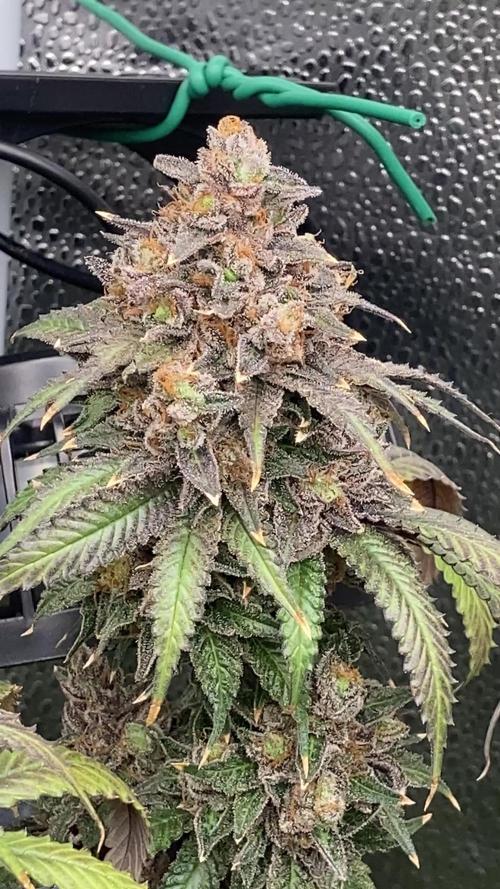
Hello growers, This week marks an important step in the development of the Pineapple Upside Down from Humboldt. The plant has now been moved into the flowering tent. The main reason for this change is simply to give the plant more space and to benefit from better environmental control. The larger tent allows improved airflow and more stable climate management, which should help the plant maintain a healthier rhythm moving forward. Even though the light fixture changed, the spectrum remains the same. The plant is still running under a 3500K spectrum, so there should be no real shock from a lighting perspective. Light intensity has been kept around 600 PPFD, which means the plant continues growing under conditions that are very similar to what it was used to previously. Some environmental adjustments were also made this week. The VPD has been increased slightly to around 0.8–0.9 in order to encourage stronger transpiration and improve nutrient uptake. Last week the plant showed a small slowdown in growth and overall vigor. The leaves were slightly droopy and the plant looked a bit less energetic than usual. After reviewing the parameters, the most likely explanation was a pH drift upward toward 6.2–6.3. While this range is not catastrophic, it can reduce the plant’s ability to absorb certain nutrients, especially nitrogen, which could explain the temporary slowdown that was observed. The pH has now been corrected and brought back down to around 5.8, allowing it to naturally fluctuate between 5.5 and 5.9. Since this adjustment is very recent, the plant will need a few days to fully respond to the correction. Earlier in the week, the EC had been increased to 2.0 to test the possibility of a nutrient deficiency. Toward the end of the nutrient solution cycle, the mixture was slightly diluted with osmosis water in order to rebalance the EC and avoid pushing the plant too hard. This week was also used to work heavily on the plant’s structure. A topping combined with a strong defoliation was performed. The canopy was opened up significantly, removing a large amount of leaf mass to improve airflow, light penetration, and overall structure. It was not a light cleanup — the plant was trimmed quite aggressively in order to reset the canopy properly. The plant originally had four main apexes, and each of those was topped again. This now creates approximately sixteen main growth points. With sixteen apexes, the plant structure is now approaching the intended final architecture. From this point forward, the main objective is simply to allow the plant to recover from this fairly heavy pruning session, regain strength, and stabilize before any further training. Over the coming days and weeks, the focus will be on observing how the plant responds to the pH correction, the environmental adjustments, and the recent structural work. For now, everything appears to be back under control. We’ll see how she responds over the next week. Alright growers, take care and see you next week.
Likes
36
Share
@Roberts
Follow
Just waiting to fulfill my Spider Farmer contract. They won't let me restart without fine. Next week I am cutting them down to throw away. Then clean well, and start over. This hplvd did not come from AMS, it was in my previous photoperiod grow. It got transferred at some point. Thank you Spider Farmer and Amsterdam Marijuana Seeds. 🤜🏻🤛🏻🌱🌱🌱 Www.amsterdammarijuanaseeds.com Thank you grow diaries community for the 👇likes👇, follows, comments, and subscriptions on my YouTube channel👇. ❄️🌱🍻 Happy Growing 🌱🌱🌱 https://youtube.com/channel/UCAhN7yRzWLpcaRHhMIQ7X4g Spider Farmer G300w: https://amzn.to/3S2zvsd Spider Farmer 10X20 Heat Mat Kit - https://amz.fun/lsa0J Spider Farmer Amazon Store: https://www.amazon.com/spiderfarmer Spider Farmer Official Site: https://spider-farmer.com Discount code: saveurcash
Likes
210
Share
@nonick123
Follow
Bienvenidos a la semana #3 El crecimiento ha sido espectacular  Esta planta me está devolviendo el gusto de cultivar fotodependientes como cuando era joven, da gusto ver como crecen de forma exponencial día tras día Ha pasado un par de días de la semana en interior debido a la inestabilidad meteorológica.  Se ha mantenido en la maceta de 3 litros hasta el día #21 Día #22 (09/06). Hacemos el transplante a maceta de 15 litros La composición del substrato es: Base tipo Light mix + perlita (hasta 25 por ciento) + hummus de lombriz + micorrizas + guano de murcielago La idea era pasarla a una maceta de 7 litros y después de 20 días aprox a la maceta de 15 litros, pero estaba el cepellon lleno de raíces, y he decidido pasarla directamente a la maceta final, porque me parecía que había poco más espacio al pasar de 3 litros a 7 litros A ver cómo reacciona!    Este día #22 también ha vuelto al exterior hasta nuevo aviso meteorológico  Se planea hacer topping cuando alcance el quinto - sexto nudo para que no se vuelva de un tamaño incontrolable (que por otro lado estaría bien   ) Gracias por leerme y seguir mi diario!
Likes
41
Share
Bonjour les Growmies, encore une fois je vous remercie de venir visiter mon journal. J ai passé ces Unicorn Sherbert 🦄🌈 @CultclassicSeeds en flo apres juste 3 semaines de croissance.Je n'ai pas trop l habitude d avoir une si petite croissance mais comme dans la tente j ai 3 pieds qui ont beaucoup plus de croissance que d habitude je me dis qu il y aura une bonne moyenne dans la tente. Les plantes en elle même sont magnifique avec de très grande feuilles d un vert profond .Elles sont toutes les deux bien marqué comme hybride Indica le stretch ça bientôt commencer.Mais je croise les doigts demain j ai ma tente XxL qui arrive Avec ma nouvelle lampe temps attendu FC E6500,💯🔥🔥🔥🔥🔥🔥grâce à cette lumière 💡☀️je compte que mes Unicorn s ressemble a Pegasus et s Envolent en galopant 😁😁😁😁 🌈🦄24/09 Les unicorns ont galopé vers de nouvelle contrée .Et elles se sont installées dans une tente beaucoup plus grand et avec une meilleure lumière un véritable bonheur.🦄🌈. A côté des autres génétiques leur tige principale est énorme grosse comme mon pouce .C est impressionnant pour le peu de croissance qu elles ont eût 25/09 Encore une journée de passer apr s le passage en 12/12 J ai deux phénos différents les différences commencent à se marquer .Une beaucoup plus touffue que l autre donc je vais les appeler #1 et #2.La plus touffue est #2. Sinon elles ont des feuilles énormes avec un vert éclatant.
Processing
Likes
6
Share
Y hasta aquí, el corte última semana ya de todo el proyecto, solo queda tijera en mano y esperar para catarlo. Os muestro mi zona de trabajo en un video 🤷‍♂️ Para mi consumo justo
Likes
62
Share
Hello and Welcome back 🌱 It‘s now 7 days ago since I put them in Water to Germinate and now it‘s their 5th day of growing. Yesterday, they got their first 4 hours of darkness and now i‘m slowly going down to 18/6 light schedule. I admit, the environment was sometimes very off due to experiments with VPD and leaf temperatur but I think I can dile it in correctly for this growing stage and beyond (hopefully). I was trying to see what happens if I stress them a little and hoped they would grow faster but they 100% didn‘t like it. They heat up pretty fast when the Air is too hot and dry because the roots are not developed and the plant is not established enough. An established plant can stay outside in the heat of the sun and still have cool leaves. So my environment for this stage is as above (27°C,70%RH). Light at 15000 Lux (≈370 ppfd) a little high but I‘ve noticed some stretching and I asumed they wanted more light and I really don’t want any more stretching. My media comes without nutriens so i feed little amounts of it every time they dry out enough. This is a Indica dominant strain so I asume they will stay fairly smal. Btw. If anybody wonders if CO2 bags work, check out the Video I uploaded. They are still seedlings (not really in Veg yet) and so i‘m treating them as such for the rest of the week. Root developement is now the top priority wich, if you didn‘t know, is better in a smal pot first because they are more likely to develope secondary roots but we’ll see. I heard It‘s like topping just underneath the plant. When they are ready to be transplanted I most likely will take the first three. Update: I did all the preperations for Transplant bc I was worried about root bound. I took Nr. 4 out and washed it as carefully as I could to expose the roots. Some of them got stuck on harder peaces of dirt and got ripped off. But it looks like alot of secondary roots developed instead of just one long taproot, wich is nice. I assume i can transplant them in the next few days. I rearanged the plants according to the Lux reading, wich is highest in the middle so the bigger plants (Nr.1 and Nr. 3) went to the sides. Maybe Nr.1 got the „smal“ genetics and it’s not anything environmental. thanks for following along this far and happy growing! Update: hey guys so yesterday I noticed, that the roots are coming out of the bottom. They were trying to get to the bottom of the three pots 😭 i had to do an emergency Transplant wich went very bad because they were stuck in the little pots. I don‘t think i‘m going to use these kind of pots anymore because they were not easy to get out. I even dropped Nr. 3 but luckily nothing bad happened. After the transplant both Nr. 1 and 2 were already ready to get more light. But Nr.3 was turning away from the light and the leaves were hanging down. So to lower the stress and encourage root groth I redusced the amount of light to a minimum and lowered the Temperature and highten the RH. This seemed to work well because the leaves were purking up again. The next day after 6-7 hours of darkness they are doing fine again but i‘m going to give them a little longer to establish themselves in the new pot. I changed the light schedule to 18/6 since I had to give them more darkness yesterday. I hope everything goes smothly from now on.
Likes
9
Share
No problems thus far. Plants looking healthy and buds are really starting to fatten up now. One of the Dirty Kush Breath's is starting to purple up and they have a sweet berry smell. Sugar cane has a similar sweet smell but more of a citrus smell. Only half way thru flower.....can't wait to see how big these buds get!
Likes
25
Share
Processing
Likes
25
Share
@GACiNATI
Follow
Super cropped and defoliated , realoy looking amazing i did have a nutrient build up start to happen and i flushed it on nov 10 and nov 11 , still has slight symptoms of too much nitrogen , temps been sitting at 73 at night and 77 with lights on gave just water today will see how it looks after its dry and i may flush twice again
Likes
52
Share
Once again she passes my expectations, late to the show with trichome production. I'm surprised there is purple on the bud, maybe Purpinator does work. I thought I could see hints under the grow lights and thought my eyes were deceiving me, I was just being hopeful. But nah 2 of the 3(under the UV) have developed a beautiful tone of purple. I was never going to bother with a deep freeze but maybe the whole bud will change given conditions, that would be something, fingers crossed. 🤔 was a little skeptical that reducing temps humidity would change density, but it does, buds are solid something I've not been able to achieve before. Rule of thumb is never to surpass 60% RH in the flowering phase and try to progressively reduce it down to 40% in the last 2–3 weeks before harvest. The plant will react as it seeks to protect its flowers, responding by producing denser buds and a higher concentration of resin. Cannabis plants are sensitive to sudden temperature changes, especially in the flowering stage. Extreme heat or cold can impact bud density and overall yields. In nature as a defense mechanism from cold, the plant sensing sudden dips in temperature will attempt to remove the pockets of air within the bud, it achieves this by compacting itself in doing so to better protect itself from cold snaps which are normally indicators in nature that worse weather is on the way. Terpene levels are the highest just before the sun comes out. Ideally, you want as many terpenes present in your plants as possible when you harvest. Cannabis plants soak up the sun during the day and produce resin and other goodies at night. The plant is at its emptiest from "harvest undesirables" so to speak right before the lights on. Boiling cannabis roots during harvesting slows down the drying process. When you boil cannabis roots, it shocks the plant, closing the stomata on the leaves. This prevents massive moisture loss through the leaves, leaving only the floral clusters actively losing moisture at a reduced pace. I've always run a strict 60/60 and it took almost twice as long to dry to a snap than previous grows where I didn't boil for what it's worth. Chlorophyll is good for the plant but not for you. When you harvest the buds, even after you flush them, if you flush them, they’re still filled with chlorophyll. Freshly cut buds are greener than dried buds because they still contain loads of chlorophyll. However, when rushed through the drying process, the buds dry but retain some chlorophyll, and when you smoke it, you will taste it. Chlorophyll-filled buds are smokable, but they aren’t clean. Slow drying gives the buds enough time and favorable conditions to lose the chlorophyll and sugars, giving you a smoother smoke. How the plant disposes of the chlorophyll and sugars by a process of chemically breaking them down and attaching the decomposed matter once small enough to water molecules which then evaporate back into the ether. Time must be given to the process to break down the chlorophyll and sugars. Think of it like optimizing the environment for decay. All the nutrients it could ever need are in abundance, it eats nutrients based on its demand for growth, which is dictated primarily by available light. Plant growth and geographic distribution (where the plant can grow) are greatly affected by the environment. If any environmental factor is less than ideal, it limits a plant's growth and/or distribution. For example, only plants adapted to limited amounts of water can live in deserts. Either directly or indirectly, most plant problems are caused by environmental stress. In some cases, poor environmental conditions (e.g., too little water) damage a plant directly. In other cases, environmental stress weakens a plant and makes it more susceptible to disease or insect attack. Environmental factors that affect plant growth include light, temperature, water, humidity, and nutrition. It's important to understand how these factors affect plant growth and development. With a basic understanding of these factors, you may be able to manipulate plants to meet your needs, whether for increased leaf, flower, or fruit production. By recognizing the roles of these factors, you'll also be better able to diagnose plant problems caused by environmental stress. Water and humidity *Most growing plants contain about 90 percent water. Water plays many roles in plants. It is:* A primary component in photosynthesis and respiration Responsible for turgor pressure in cells (Like the air in an inflated balloon, water is responsible for the fullness and firmness of plant tissue. Turgor is needed to maintain cell shape and ensure cell growth.) A solvent for minerals and carbohydrates moving through the plant Responsible for cooling leaves as it evaporates from leaf tissue during transpiration A regulator of stomatal opening and closing, thus controlling transpiration and, to some degree, photosynthesis The source of pressure to move roots through the soil The medium in which most biochemical reactions take place Relative humidity is the ratio of water vapor in the air to the amount of water the air could hold at the current temperature and pressure. Warm air can hold more water vapor than cold air. Relative humidity (RH) is expressed by the following equation: RH = water in air ÷ water air could hold (at constant temperature and pressure) The relative humidity is given as a percent. For example, if a pound of air at 75°F could hold 4 grams of water vapor, and there are only 3 grams of water in the air, then the relative humidity (RH) is: 3 ÷ 4 = 0.75 = 75% Water vapor moves from an area of high relative humidity to one of low relative humidity. The greater the difference in humidity, the faster water moves. This factor is important because the rate of water movement directly affects a plant's transpiration rate. The relative humidity in the air spaces between leaf cells approaches 100 percent. When a stoma opens, water vapor inside the leaf rushes out into the surrounding air (Figure 2), and a bubble of high humidity forms around the stoma. By saturating this small area of air, the bubble reduces the difference in relative humidity between the air spaces within the leaf and the air adjacent to the leaf. As a result, transpiration slows down. If the wind blows the humidity bubble away, however, transpiration increases. Thus, transpiration usually is at its peak on hot, dry, windy days. On the other hand, transpiration generally is quite slow when temperatures are cool, humidity is high, and there is no wind. Hot, dry conditions generally occur during the summer, which partially explains why plants wilt quickly in the summer. If a constant supply of water is not available to be absorbed by the roots and moved to the leaves, turgor pressure is lost and leaves go limp. Plant Nutrition Plant nutrition often is confused with fertilization. Plant nutrition refers to a plant's need for and use of basic chemical elements. Fertilization is the term used when these materials are added to the environment around a plant. A lot must happen before a chemical element in a fertilizer can be used by a plant. Plants need 17 elements for normal growth. Three of them--carbon, hydrogen, and oxygen--are found in air and water. The rest are found in the soil. Six soil elements are called macronutrients because they are used in relatively large amounts by plants. They are nitrogen, potassium, magnesium, calcium, phosphorus, and sulfur. Eight other soil elements are used in much smaller amounts and are called micronutrients or trace elements. They are iron, zinc, molybdenum, manganese, boron, copper, cobalt, and chlorine. They make up less than 1% of total but are none the less vital. Most of the nutrients a plant needs are dissolved in water and then absorbed by its roots. In fact, 98 percent are absorbed from the soil-water solution, and only about 2 percent are actually extracted from soil particles. Fertilizers Fertilizers are materials containing plant nutrients that are added to the environment around a plant. Generally, they are added to the water or soil, but some can be sprayed on leaves. This method is called foliar fertilization. It should be done carefully with a dilute solution because a high fertilizer concentration can injure leaf cells. The nutrient, however, does need to pass through the thin layer of wax (cutin) on the leaf surface. It is to be noted applying a immobile nutrient via foliar application it will remain immobile within the leaf it was absorbed through. Fertilizers are not plant food! Plants produce their own food from water, carbon dioxide, and solar energy through photosynthesis. This food (sugars and carbohydrates) is combined with plant nutrients to produce proteins, enzymes, vitamins, and other elements essential to growth. Nutrient absorption Anything that reduces or stops sugar production in leaves can lower nutrient absorption. Thus, if a plant is under stress because of low light or extreme temperatures, nutrient deficiency may develop. A plant's developmental stage or rate of growth also may affect the amount of nutrients absorbed. Many plants have a rest (dormant) period during part of the year. During this time, few nutrients are absorbed. Plants also may absorb different nutrients as flower buds begin to develop than they do during periods of rapid vegetative growth. 432 Hz is said to be mathematically consistent with the patterns of the universe. Studies reveal that 432 Hz tuning vibrates with the universe’s golden mean PHI and unifies the properties of light, time, space, matter, gravity and magnetism with biology, the DNA code and consciousness. When our atoms and DNA start to resonate in harmony with the spiraling pattern of nature, our sense of connection to nature is said to be magnified. Another interesting factor to consider is that the A=432 Hz tuning correlates with the color spectrum while the A=440 Hz is off. Audiophiles have also stated that A = 432 Hz music seems to be non-local and can fill an entire room, whereas A=440 Hz can be perceived as directional or linear in sound propagation. Once you adopt the idea that sound (or vibration in general) can have an equalizing and harmonizing effect (as well as a disturbing effect), the science of harmony can be applied to bring greater harmony into ones life or a tune to specific energies. There is a form of absolute and of relative harmony. Absolute harmony can for example be determined by the tuning of an instrument. The ancients tuned their instruments at an A of 432 Hz instead of 440 Hz - and for a good reason. There are plenty of music examples on the internet that you can listen to in order to establish the difference for yourself. Attuning the instrument to 432 Hz results in a more relaxing sound, while 440 Hz slightly tenses up to body. This is because 440 Hz is out of tune with both macro and micro cosmos. On the contrary, 432 Hz is in tune. To give an example of how this is manifested micro cosmically: our breath (0,3 Hz) and our pulse (1,2 Hz) relate to the frequency of the lower octave of an A of 432 Hz (108 Hz) as 1:360 and 1:90. It is interesting to note that 432 Hz was the standard pitch of many old instruments, and that it was only recently (19th and 20th century) the standard pitch was increased. This was done in order to be able to play for bigger audiences. Bigger audiences (more bodies) absorb more of the lower frequencies, so the higher pitch was more likely to “cut through”. One of the oldest instruments of the world is the bell ensemble of Yi Zeng (dated 423 BC), tuned to a standard F4 of 345 Hz which gives an A= 432 Hz. The frequency of 345 Hz is that of the platonic year! Similarly many old organs are tuned in an A=432 as well; for example: St. Peter’s Capella Gregoriana, St. Peter’s Capella Giulia, S. Maria Maggiore in Rome. Maria Renold’s book “Intervals Scales Tones and the Concert Pitch C=128 Hz” claims conclusive evidence that 440 Hz and raising concert pitch above scientific “C” Prime=128 Hz (Concert A=432 Hz) disassociates the connection of consciousness to the body and creates anti-social conditions in humanity. The difference between concert pitch A=440 Hz and Concert A=432 Hz is only 8 cycles per second, but it is a perceptible difference of awareness in the human consciousness experience of the dream we share called existence.
Likes
20
Share
@TPBzh
Follow
So fast and so strong, really impressive! Everything is going alright here
Likes
5
Share
@Helmi1704
Follow
The past few days have been a bit of a rollercoaster. First we got hit with some insane storms that cranked the humidity way up 🌧️💨. Just when things started to calm down, a brutal heatwave rolled in, hitting 91°F (33°C) 🔥. The plant definitely had to dig deep to get through that combo. But hey, she took it like a champ 💪 and powered through this unholy trinity of stress: repotting, extreme humidity, and blazing heat. Growth is still nice and compact 🌿 with tight internodal spacing. No signs of deficiencies on the leaves either. Everything’s looking green and happy ✅. This week I fed her using 75% of the BioBizz feeding schedule . Since my tap water has a pretty wild imbalance between calcium and magnesium, I added about 10% distilled water and gave her a tiny boost with some MagMono. Watered about one-third of the pot’s volume, roughly 1 liter, with a bit of runoff 💧. pH was dialed in to 6.4. Depending on how she develops, a second repot might be on the table next week
Likes
4
Share
@Pokan187
Follow
Have some deficiencies or ph imbalance still troubleshooting. The pH was off but now everything is back on track. I have some amber on the watermelon, the northern light is milky from top to bottom but no amber yet The smell is pretty strong I do not feed the plants at all besides watering them with water from fish tanks. Made some live soil and added horse manure, homemade bone meal from fish bones, compost from vegetable scraps and black soldier fly frass. I do not use chemicals on any of my grows.
Likes
4
Share
Starting to mature and swell. Colors coming through and smells pickin up
Likes
26
Share
1️⃣02.10.23- День 94 от семечки и 34 день 12/12. Проведено мероприятие по разведению веток lst для проникновение света и лучшей циркуляции воздуха . В планах убирать по несколько листов за сеанс . В остальном растение счастливо , хоть она и не высокая) 2️⃣05.10.23- Проведена масштабная дефолиации около 30% листвы . Дабы избежать плесени и дать огромному количеству соцветий свет .
Likes
12
Share
day22 video. now adding more pk booster than earlier weeks, should be done week 7-8 we will see day23 I start adding more pk, still will 4x more pk now. Some nice pics today, videos of each, frost on fan leafs, no issues other than pros: bridal frost on fan leafs+sugar, cons 6ft tall. I think I should have pumped more pk earlier into flower/pre Its cool. Adding 2tbsp soluble pk into 5gal vs quarter tbsp in beginning 22 days ago. I am feeding soluble pk, +3 pk soil conditioners and carbs every day. There is no water day. day 25 stacking up. been spraying old cs I made 3ish years ago to test, works on unrooted so I may potential cross. Bridal starting to smell like a mix between fresh watermelon, and lemon+lime or a citrus aroma.
Likes
1
Share
Algunas de 4 semanas otras de dos semanas y medias , todas contentas y bien alimentadas , pulverizado con delta 9 antes de pasar a floración , y primeras dosis de top bloom
Likes
2
Share
Video pretty much says it all. Plants are doing great. *Grow Notes: limit defo. In most stages. Little tip burn overall so prob. At the high end of the Berkana. Good internodal spacing - look’n at a quality stack. Lowers were still too low on launch, would’ve benefited from a little more veg. Time. *minor light burning in localized areas has begun to show up elsewhere. There is a chance it’s early and very slight nute burn after the tent was flooded out last week. Running 20L of water through em over the next two days to dilute the current Rez mix and flush out any lingering solids and minerals that be throwing em off. That shouldn’t cause any issues and will isolate the problem if it’s localized light burning. Moved up the lights a touch regardless as well. *update - there was definitely a little light burn in one hot spot but the leaf issues are now prevalent on plants 2,6&7. It’s repp’n like P&K deficiency which would track with previous runs and further support how nute hungry some of them have been in the past. We’re changing out from the Berkana to Maxi-Bloom anyway due to need and the GH nutes are generally somewhat stronger in content than Druid so that should solve the problem🤞. Either way - on this basis alone, plants 1,3&4 are starting to look like our prime candidates for seed from the clone cabinet. Only time will tell on this issue but prefer we breed it out as best as possible when we start the back cross against the F1 pollen.
Likes
1
Share
@GrowFunMD
Follow
Grape Walker Kush is massive. Very pleased with these plants. Super Orange Haze is also doing great, just more normal size, not as massive as GWK. SOH is also slightly behind GWK in bud stage.
Likes
10
Share
@ViTeM
Follow
Mein 1.er grow mit meinem neuen Upgrade 🤩 Kannst kaum erwarten bis alles aufgebaut ist. Nach monatelanger Recherche habe ich mich nun für eine neue Box mit neuem Licht entschieden und einiges mehr. Meine "babies" warten auch schon auf ihr neues Zuhause 🌞🌅🌻