





Likes
35
Share


@SantaStone
Follow
Hello friends! 👋
Thank you to everyone who stops by and shows interest in this beautiful Biscotti Mintz!😎
🌿So week 4 of flowering has come to an end. The second stage of the big, long-awaited defoliation.
-80% of leaves and extra branches were removed.
-We remove Bud Factor X from the diet for one week, because it artificially causes stress in the plant to produce oils. We'll add it again in a week.
-A humidifier has been installed. It is necessary to achieve humidity +- 85% for about 5 days, while recovering from defoliation.
-No problems or deficiencies were found in the plant.
See you later! 👋🤙
Перевести страницу

Likes
1
Share


@Oims_Finest
Follow
Hi all,
Nothing much to say. Have a look. She started to stretch quite nicely and keeps thriving. All good, no complaints..
See you next week..
Likes
16
Share

@ArucambaAutoflowers297
Follow
Day 30
Growth:
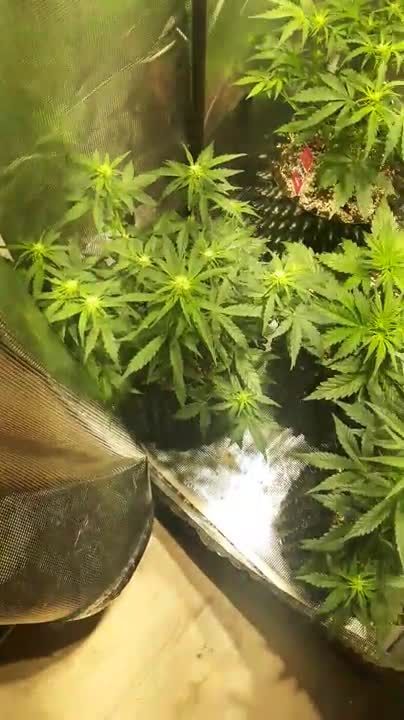
So the ladies have been developing bud sights all over. As expected they didnt get big allowing 5 plants in the tent.
Training:
So the girls got tied down before stretch and all branches caught up like i wanted. They also had a mild defoliation yesterday to increase light penetration


Processing
Likes
6
Share


@Greenwizhun
Follow
First grow in My own soil(less) mix. Peat+vermiculite+lime+gypsum

Likes
244
Share


@DogDoctorOfficial
Follow
So here is my week report on the fabulous Supafreak by HiElevation Genetics. Buckle up, because this girl is a wild ride!
Oh my, let me tell you about this Supafreak. She's like no other girl I've ever grown before. From the moment she sprouted, I knew she was something special. Her unique characteristics and unruly growth had me hooked from day one.
Now, we're approaching her final days, and it's time to make some crucial decisions. I've decided to stop all feedings and switch to just watering with Aptus Holland Fluvic Blast. Why, you ask? Well, let me break it down for you.
First, let's talk about this Fluvic Blast. It's like a secret weapon for plant health. Fluvics are organic compounds that enhance nutrient uptake and stimulate plant growth. It's like giving my Supafreak a supercharge of awesomeness. And let me tell you, she's responding to it like a champ.
One of the reasons I've chosen to go this route is because I believe in reutilizing my soil for future grows. It's like giving back to Mother Nature and keeping the soil alive and kicking. Fluvic Blast helps to replenish essential nutrients and promotes soil health, ensuring that my future plants will have a solid foundation to grow upon.
Now, let's talk about her close-up shots. Oh boy, the trichome production is out of this world! It's like she's showing off her bling, sparkling with potency and beauty. I can't wait to see how she develops in these final days.
And the smell, oh my goodness! It's unique and peculiar in the most delightful way. It's like a symphony of aromas that tickle the senses. I can't even put it into words, but trust me when I say, it's a scent that will linger in my memory forever.
So, my friends, there you have it—my joyous, knowledgeable, and fun report on the magnificent Supafreak. She's one for the record books, and I'm grateful to have experienced this journey with her. Stay tuned for the grand finale, where we'll uncover the full extent of her freakiness. Until then, keep growing and keep smiling!
As always thank you all for stopping by , for the love and for it all, i fell blessed to have you all with me for one more love journey, and a different one form the rest i did so far <3 <3 <3 Thank you Thank you Thank you , you guys are great and have been amazing , thank you for everything <3<3<3
#aptus #aptusplanttech #aptusgang #aptusfamily #aptustrueplantscience #inbalancewithnature #trueplantscience #dogdoctorofficial #growerslove
With true love comes happiness , Always believe in your self and always do things expecting nothing and with an open heart , be a giver and the universe will give back to you in ways you could not even imagine so <3 <3 <3
<3 <3 <3 Growers love to you all <3 <3 <3
Here are the words from this peace of art from nature creator Shapeshifter's @ HI-ELEVATION GENETICS <3 <3 <3
"FREQUENTLY ASKED QUESTIONS
Q. How did you create/breed Freakshow?
A. Methodical selection, line breeding, and culling is the short answer. Read our About page for more details.
Q. Is it an indoor or outdoor type?
A. Everything I've ever worked has been outdoors, including of course Freakshow. It has been our experience that outdoor (or sun grown, as it's recently being referred to) cultivars seem to perform extremely well under artificial conditions. This is true of seed starts or clones made from seed starts. The opposite is not always true; indoor clones often give an outdoor grower headaches because they don't always make the transition smoothly. This is due to light spectrum, temperature, and/or photoperiod changes. Yes, Freakshow will do exceedingly well indoors, and will thrive and mature just fine in a wide variety of natural environments as well, so it's definitely both and I think might even prove to be more resilient to those sorts of transitions.
Q. What are the potency and terpenoid levels?
A. Average 18-20% THCa, THC; negligible CBD, CBN with terps variable, averaging 2.5-3.5, primarily limonene and pinene, but this is variable, there was a lot of diversity in terp combinations and compositions in all the prior generations, it's just something that was left "as is" for now. The different parallel lines that we are developing can be directed in a few different pathways flavorwise.
Q. Why are the seeds white?
A. Why is the sky blue? No, the mature seeds are shrouded by a rice paper thin membrane which has coloring and mottling on it, but it's so fragile that it disintegrates in the process of shucking. Stripped of the outer layer the seeds are very pale, nearly white. It came as no surprise that this plant would have abnormal seeds.
Q. Is it a GMO?
A. Wow...? Well, it's seriously "modified" and the modifications are definitely genetic, and it is an organism. (Genuinely Modified Organically!) Uh, no. No radiation, no recombinant DNA, no gene splicing or editing, no TALEN or CRISPR! These biotechnologies don't belong in the food and medicine plant industries. Sadly, in the near future it will become commonplace and widespread in cannabis and other medicinal plants as it is already is with food crops and ornamentals. I'll avoid discussion on this topic for now, but we hope some people enjoy consuming Frankenbud!
Q. What's the floral period length?
A. 8-9 wks, finishes early Oct. at most latitudes and elevations.
Q. Is it a big producer?
A. Freakshow will produce nice, fat, dense colas (see gallery) with remarkable trichome coverage, and you can expect yields according to your veg. time, root space, and general knowledge and expertise as a gardener. The same set of variables apply to expected outcomes regarding cannabinoid levels and terpene profiles.
Q.What is the lineage?
A. (Bigbud x Skunk#1) x (Big Sur Holy Weed x Banana Kush). NLD("Sativa") dominant, but the afghanica influence is apparent. I'm pretty sure that Freakshow contains some Trainwreck and some Maui Wowie based on some research I did on the origins of the Pineapple Express. Interestingly Big Sur Holyweed, OG Kush, Banana, Trainwreck, and Maui Wowie are all of unclear origins. We have to remember that these are all just names and that they don't really mean much. The exact heritage of any cultivar today is impossible to determine accurately. Also, considering the amount of continuous shameless hybridization that has occurred in the last 40 yrs., any modern kind could easily contain over 40 kinds. In the case of Freakshow, it's much more limited because the ancestry is largely older "Sativas" that didn't go through as much outcrossing. In the 70s in Santa Cruz, Haze was a favorite among surfers for the pure energy and I still have (greatly improved) stock of it around, simply because even when I made hybrids with it I always kept the original in pure form for obvious reasons.
Q. What is the psychoactive effect like?
A. Like the flavors, many people have commented that the "buzz" is somewhat different than other mainstream types out there. It's not entirely out of the scope of imagination that given that this strain has new alleles in so many other respects, that it could also contain new, unique cannabinoids, as well as new and unique terpenoids, some of which may not even be among the standard 16 or so that the average lab is testing for. Aside from the up, cerebral, energetic boost, some report a mild time/space warp effect. Creativity and idea induction should be mentioned, for sure. Freakshow has the pure energy effect and greatly alters perception to the positive side, so definitely destroys depression. Appetite suppression is a side effect, but the enjoyment of food is enhanced. I personally will attest to all of the above. We all have different receptor profiles, so these are just generalizations. Couch unlock.
Q. Is it pest and mildew resistant?
A. Indeed it is. On many occasions in the last few years, it has been observed that when pest and mildew issues were affecting other plants adjacent to in the vicinity of Freakshow plants, for unknown reasons the freaks remained entirely unaffected. This includes 0botritis, PM, various mites and insects, soil fungus, etc. We haven't heard any complaints along those lines so far, so if anyone has any problems, especially with a rigorous IPM regimen in place, we would like to hear about it. And if anyone can attest to the extreme level of resistance it seems to have we'd love to hear about that as well.
Q. Does it contain web-leaf genetics?
A. I thought I better clarify this because there are a few people thinking that because of an article "Growing Marijuana that Doesn't look like Marijuana" that mentions that I had worked web-leaf types years ago and had eventually turned that into Freakshow. This is incorrect and I'm needing to get ahold of the writer to have him change it. When I read the piece and saw the mistake I figured it didn't matter that much, that the actual method of breeding could just remain a "trade secret". Recently, I noticed online that a posting, "Freakshow only exists because of duckfoot" by Curious Cannabis Connoisseur, where he explains how I developed Freakshow using Duckfoot. Let me explain, about 20 yrs. ago a friend gave me a jar of seeds labeled "BC Bigbud" and I sprouted flats of hundreds to look for oddities and had found one web-leaf pheno which we named Webster. It was a female so I bred it to a normal leaf male and began selecting and stabilizing a line of Webster. About 5 or 6 generations later I had nailed it to 100% webs and had also stabilized it for a deep purple color and a nice "gingerbread" terp profile. I was busy working other lines at that point so I put Webster in the library. Also, I was having a hell of a time getting a pheno of it that flowered to my satisfaction. (it seemed to finish with a limited number of calyxes). I knew I would have to outcross it to something with a big tasty bud and restabilize it for web-leaf, and I no longer had the original BC Bigbud. I still have the Webster seeds, and trust me the thought has crossed my mind to make the cross with Freakshow, but why? Why mess around crossing things just to create something even weirder? I have heard that the "Duckfoot" also doesn't bud up well so maybe there's a correlation there. Anyway, people can do what they want to and I will too, but crossing Freakshow with some low-THC crap like ABC is in my opinion idiotic. I worked extremely hard stabilizing and perfecting a beautiful new subspecies and I believe it should be kept pure. I won't go on a rant here about the rampant crossing and the lack of line-breeding in the cannabis world in the last several decades, or where this will eventually lead us, but I will say that it's not in a good direction. Bottom line....Freakshow has no web-leaf genes, it was made using top-grade tropical narrow-leaf drug (NLD) cultivars.
Q.Why is Freakshow patented?
A. Although I and most others (including all the folks at HSC) believe in and subscribe to the concept of "open sourcing" because sharing in cannabis genetics was always the cultural norm, it was decided that Freakshow should be protected (1) because it is a novel and unique, not a preexisting strain (or even subspecies), (2) To keep the greedy corporate big boys from exploiting it, (3) To maintain control of the genetic refinement of it in all future generations. We really can't wait to share it with the entire collective world of cannabis enthusiasts and invite experimental breeding for personal use and curiosity."
source https://freakshowcannabis.com


Likes
27
Share


@Calibarsjay
Follow
These plants smell to pungent can’t wait to cut them, overall everything has gone well big dense buds, the getiva 1700e was a upgrade i put in on the last day for my next run it was not grown using a getiva i used 600hps. Terps are looking good and ready

Likes
14
Share


@Insta_SmokeyGrow
Follow
She’s getting updated more often on Instagram the tags @smokeygrow_ …..This week iv let her do her own thing she’s loving the Phlizon pl1000 hopefully get her under the 2020 240w pro soon the colours on this girl are unreal really showing her full potential I seriously think this is one of the nicest colours iv seen in the actual nugget it’s self 🍓🥤 what do you think 💭

Likes
54
Share


@Rasta_Faraev
Follow
20.01.21. 45 дней Халкберри. Халкберри действительноно побил мой рекорд по скорости зацветание. Переход длился всего одну неделю. Видимо я рано сделал 12/12 не дав ей восстановиться после стрессовых тренировок.пришлось подставить 10 см платформу под горшок, чтобы не опускать сетку. Но, тем не менее она очень толстая и пышная дама. Кушает отлично, толстеет, лбрастая стимами, а они у неё очень крупные. Породистость чувствуется. Следим дальше. Всем спасибо за ваше внимания, друзья)) .
Likes
54
Share


Processing
Likes
25
Share


@Xanthur
Follow
This week stretching is done. One of them had a late growth spurt, and is now only 16 inches below the light. It doesn't feel too hot. Leaf temps are 78 right under the light. I'll leave it unless it starts to show signs of stress. You can clearly see her in the pics and video.
I have a problem with controlling smell. My house has an entryway that is open to the basement but separated from the main floor, so the entryway smells like the basement. I know what you are thinking... But it is not flower smell. It smells too clean! The massive fan and filter are running at high power to control humidity, and that makes the whole basement smell not normal.
Other than that, the tent is on autopilot for now. Not much work needed other than adding 5-10 gallons of plain water every day.
Likes
15
Share


@Lazuli
Follow
Final 2 weeks, the buds are hard full of frost i switched the feeding to finalpart now


Likes
18
Share


@thenotillwizard
Follow
Harvested at day 76, after 72h of darkness.
Very good yield!
3.3 pounds of dry buds + 1 pound of trim
The 2 keepers yielded 366 and 342g of premium quality smoke.
Very uplifting and energizing high :) Love it!
Likes
30
Share


@Canadian
Follow
This plant have a very strong smell and there are very high THC with a good balance that allows you to still be productive on my day . All popcorn and small buds were chopped into pieces and put in a pot for edibles.
The buds that grow from the plant that did very well are very dense and heavy the main cola waited 15.56 grams dry

Likes
111
Share


@Cyrusdavirus
Follow
Kannabia Seed , Columbian Jack
High everyone 👋 another week in the books and the ladies are looking pretty good 👍 I'm not sure on training for them yet but it's almost time to start 😀 I'll have to decide what I'm doing very soon.
I received and installed the new UR45 from Mars Hydro they are UV-IR supplement light bars designed to fit the Fc6500 and Fc8000 I'm excited about having them in my growroom. Check out my Instagram if you want to see closer pictures of them installed.
Mars-Hydro.com discount code " Cyrus "
Thank you Mars Hydro and Kannabia Seed Company

Likes
29
Share


@nonick123
Follow
Día 41 (03/06) Riego 750 ml sólo H2O pH 6.2
Empieza a engordar sus cogollos 😍
Día 42 (04/06) Riego con 750 ml H2O + Regulator 0,15 ml/l + P-Boost 0,5 ml/l + K-Boost 0,5 ml/l + CaMg-Boost 0,25 ml/I +TopBooster 0,2 ml/l - pH 6.2
Está apilando y engordando sus cogollos, y empieza a mostrar senescencia en la hojas inferiores. La veo capaz de acabar en 8-9 semanas! El tiempo lo dirá
Día 43 (05/06) Riego 750 ml sólo H2O pH 6.2
Día 44 (06/06) Riego con 750 ml H2O + Regulator 0,15 ml/l + P-Boost 0,5 ml/l + K-Boost 0,5 ml/l +TopBooster 0,2 ml/l - pH 6.2
Día 45 (07/06) Riego 750 ml sólo H2O pH 6.2
Está empezando a mostrar tonos morados en los cogollos! 😍
Día 46 (08/06) Riego con 750 ml H2O + Regulator 0,15 ml/l + P-Boost 0,5 ml/l + K-Boost 0,5 ml/l + CaMg-Boost 0,25 ml/I +TopBooster 0,2 ml/l - pH 6.2
El tamaño del cogollo central es impresionante 💥😁
Día 47 (09/06) Riego con 1 Litro H2O + Regulator 0,15 ml/l + P-Boost 0,5 ml/l + K-Boost 0,5 ml/l + CaMg-Boost 0,25 ml/I +TopBooster 0,2 ml/l - pH 6.2
💦Nutrients by Aptus Holland - www.aptus-holland.com
🌱Substrate PRO-MIX HP BACILLUS + MYCORRHIZAE - www.pthorticulture.com/en/products/pro-mix-hp-biostimulant-plus-mycorrhizae
Likes
10
Share


@Gruschel_Muschel
Follow
Purple Punch am 26.12.2024
Tag 49 / 14.02.2025
Meine Purple Punch steht schon in der 7 Woche, ein großer Erfolg für mich.
Habe mit Bio Bloom und Bio Grow in der letzte Woche sie gedüngt, das Ergebnis kann sich sehen lassen.
Heute, wird Acti Vera, Alg A Mic und Bio Heaven in das Gießwasser hinzu gegeben.
Feedback:
Ich bin überaus voll zufrieden wie meine Pflanze sich entwickelt hat, ich denke die gute Erde und der Dünger von Biobizz hat ein großen Teil beigetragen. Ich werde mal schauen wie die Pflanze in der 8 Woche aussieht.
Ich nehme gerne Ratschläge von der Community an.

Likes
120
Share

@DogDoctorOfficial
Follow
The Harvest Prelude:
After a patient wait and 48 hours of darkness, the moment arrived. The Tropical Tangie Lego Ninja, standing proudly like a silent guardian, was ready for the grand harvest. The sound of each cut echoed through the grow space, reminiscent of felling a mighty tree. The compact structure of the buds was awe-inspiring, a testament to the ninja's disciplined growth.
The Lego Ninja, like a stoic warrior, was then hung upside down, beginning a two-week drying ritual. Maintaining an ambient temperature of around 21°C and a relative humidity of 60%, this slow-drying process allowed the buds to retain their essence, preserving the symphony of terpenes and cannabinoids.
The trimming phase unfolded like a fragrant masterpiece. Each bud, adorned with a glistening layer of resin, transformed the trimming process into a sensory delight. The zesty aroma of oranges enveloped the room, a tangible expression of the tropical lineage. The compact buds made every snip a careful dance, revealing an abundance of frosty trichomes.
The moment of reckoning arrived with the scale's unveiling. The Tropical Tangie Lego Ninja, from a single plant, bestowed upon me 309 grams of dried medicine. Each gram was a treasure trove of cannabinoids, a promise of euphoria and relief. The sheer compactness of the buds translated into a concentrated potency that left me in awe.
In parallel, the clones, nurtured with equal care, showcased a fascinating divergence. A twist in the tale unfolded as the intense oranges of the mother transitioned into vibrant tangerines. This unique expression, I believe, was a testament to the clones weathering a summer heatwave differently, bringing forth a distinct personality.
The clones, resilient and generous, gifted me a bountiful 549 grams of pure joy. This now my keeper of the garden, an embodiment of the Lego Ninja's legacy. The harvest dance, though familiar, carried the nuances of tangerine zest, a refreshing twist that left me eager to explore its intricacies.
Both harvests shared a common thread—their resinous abundance. The trim bin, akin to a treasure chest, gleamed with golden trichomes and fragrant joy. Sticky fingers became a badge of honor, a tangible connection to the resinous richness that filled the room.
Shout Outs:
No harvest report is complete without expressions of gratitude. A special nod to @DutchPassion_Official for crafting the genetic marvel that is the Tropical Tangie Lego Ninja. Their expertise paved the way for this epic journey, and I tip my hat in acknowledgment.
In conclusion:
As the dust settles on this epic harvest saga, my heart brims with happiness and excitement. The Tropical Tangie Lego Ninja has proven itself not just as a plant but as a living masterpiece. Stay tuned for the smoke report, where we delve into the true essence of this botanical ninja's legacy. Until then, fellow cultivators, may your gardens flourish, and your harvests be as bountiful as the joy they bring.
As always thank you all for stopping by, for the love and for it all , this journey of mine wold just not be the same without you guys, the love and support is very much appreciated and i fell honored and blessed with you all in my life<3 <3 <3
#aptus #aptusplanttech #aptusgang #aptusfamily #aptustrueplantscience #inbalancewithnature #trueplantscience
With true love comes happiness <3 <3 <3 Always believe in your self and always do things expecting nothing and with an open heart , be a giver and the universe will give back to you in ways you could not even imagine so <3 <3 <3
Friendly reminder all you see here is pure research and for educational purposes only
<3 <3 <3 Growers Love To you All <3 <3 <3
P.S- I must extend my sincerest apologies for the missing video reports. Regrettably, Grow Diaries is still facing some technical issues that are preventing me from uploading them. Rest assured, as soon as the situation is resolved, I'll share those videos to give you an even closer look at this fascinating journey. or in my case apparently GD dont let me do uploads over 100mb with is super small file if you working and editing videos , doing my best here to upload them all but GD is not making my life easy on this <3 <3 <3
