


Likes
Comments
Share


@BudeCo
Follow
Antecipado em 1 semana pois não tenho mais como esperar. Bom resultado para plantas que revegetaram...
Agora e paciência na secagem.


Likes
36
Share


@BrigadeDesTerps
Follow
Freaky se porte bien pour l’instant, elle n’a pas l’air d’attirer les limaces.
Je vais commencer à l’alimenter en thé de compost oxygéné pour la booster un petit peu


Likes
Comments
Share


@braxat420
Follow
My other grow was growing into the light, so I had to switch them. This light doesn't have the greatest coverage, but it had to be done. The humidifier is still down, and I'm going to have to move house with it on one of the coldest days of the year, so this grow does not have everything going for it. Smells strong, like candy apples and the buds are getting very dense.

Likes
4
Share


@Kayotic
Follow
Last defoliation
Moved to the 4×2, under the SF2000
Getting fat and frosty
Watering every other

Likes
77
Share


@ArucambaAutoflowers297
Follow
Today the girls are 17 days old and are looking great and growing fast.
I performed LST last week for the first time, i decided to get rid of the bend and let them grow upwards. Im currently bending the branches to encourage them to grow outwards. I also use the ponytailing technique. By tying the uppergrowth in a ponytail 5 hours a day you maximize the light penetration. I repeat this process 3 to 4 days in a row
The girls had their first feeding of Canna Terra Vega at 0.5ml p/L and are loving it so far.

Likes
32
Share


@GrowingTime
Follow
Guys shit happened at the end of week 9, my ph tester went off and i messed up.
my leaves looks soft as shit. now i am using the drop ph tester and brought in a decent level the ph, see if things will come back or will have to do something more
Likes
3
Share


@BudsBanditUK
Follow
Not much going on, the buds are getting fatter. There is now a faint smell. Some buds now getring some colour. Still taking feed probably at least 2 weeks left.

Likes
Comments
Share

@JamesRenato
Follow
Na primeira semana de floração a preocupação aqui no meu grow, é com relação ao espaço. Vou ter que providenciar algum suporte para distribuir melhor as flores dentro do foco de luz e sustentar o peso depois que os buds começarem a engordar. A nutrição segue com a mesma base porem com menos nitrogênio e mais fósforo, potássio, cálcio e magnésio.
Likes
42
Share


@Dunk_Junk
Follow
Trichomes are milky but the pistils have too many white ones still.
Flowers have slowed down in their growth.
Another week to go maybe.


Likes
21
Share


@NSABND
Follow
Start of Week 12 😉
Day 86 autumn comes too fast 😵😲😪
Day 88 time is running out 😲😯😧
Day 89 the weather turns to epic fail 💀💀💀
Day 90 the sun comes back again 😍👌 oh lord
Likes
21
Share


@Ultraviolet
Follow
Heyókȟa
I desire naught but the study of nature, to find my way back home.
12x12=144, A dodecahedron is a polyhedron with 12 faces, and in coordination chemistry, it refers to a geometry where ligands surround a central metal atom (in this case, Magnesium) in a specific, 8-coordinate arrangement. Dodecahedrane is a hydrocarbon, meaning it's composed solely of carbon and hydrogen atoms. The carbon atoms are arranged at the corners of a dodecahedron, a 3D shape with 12 pentagonal faces. The water molecules in the dodecahedron form hydrogen bonds that are individually slightly weaker than in either the dimer or the tetramer. However, because three-quarters of the O -H groups in the dodecahedron form hydrogen bonds, it has a more negative energy per molecule than has either the dimer or the tetramer. Magnesium (Mg2+) is the essential, central metal ion in the chlorophyll molecule, crucial for photosynthesis by enabling light absorption and energy transfer. It is chelated by four nitrogen atoms within the porphyrin (or chlorin) ring structure. Chlorophyll appears green because it reflects light in the green region of the visible spectrum, specifically between 490 and 570 nm. The main resonance electronic frequency of a neutral Magnesium (Mg) atom corresponds to the transition from the ground state to the first excited state. Resonance Line Wavelength of Mg2+: 285.1nm (UVB light). The central atom of the chlorophyll molecule is Magnesium (Mg2+), which is coordinated within a porphyrin ring. The electronic "resonance frequency" of this central atom—meaning the frequency at which its electrons absorb energy—is primarily driven by the electronic transitions (ETR) of the surrounding conjugated chlorin ring structure, rather than a discrete atomic transition of the Magnesium atom itself. The resonant electronic frequencies of the chlorophyll porphyrin (technically, a chlorin) ring are determined by the energy required to promote π-electrons within its conjugated system, primarily appearing in the blue and red regions of the visible spectrum.
In standard physics, Chloryphyll b has peak absorption at 460nm (Blue). If we take the peak wavelength 460nm and a UV-B, UVR8 peak absorption wavelength 285nm Tryptophan-285 (W285) Sensing protein. 460/285=1.618 Φ, "natural harmony" and the "structure of light". The cryptochrome photoreceptor (CRY) is a UV-A/blue light receptor that shares this dual sensitivity with several other biological structures and functions, including significant sequence similarity and a common evolutionary ancestor with DNA photolyase enzymes. These are light-activated enzymes that use blue/UV-A light to repair DNA damage caused by UV-B radiation in plants.
Dodecahedrane (C20H20) is a hydrocarbon with a cage-like structure where carbon atoms form 12 pentagonal faces (a regular dodecahedron). It is highly symmetric (icosahedral), contains no delocalized electrons (no aromaticity), and has minimal angle strain, but significant torsional strain. Water Dodecahedron (H2O) forms hydrogen-bonded cages. While individual hydrogen bonds in this structure are weaker than in the linear dimer or tetramer, it has a more negative total energy per molecule. This is because three-quarters (75%) of the groups are involved in hydrogen bonding, creating a very stable, closed-shell configuration. a 3D carbon hydrocarbon (C20H20) to stable water clusters in hydrate, while the Magnesium ion acts as the central activator within a conjugated ring in biological systems, with its electronic absorption dominated by the ring, not the atom itself.
Effective quantum efficiency of photosystem II, often denoted as ΦPSII
In horticultural lighting, adding 730 nm (far-red) LEDs alongside standard red/blue lights has been shown to increase canopy photosynthesis by 20–30% in several crops by acting synergistically with shorter wavelengths. However, the limitation is that excessive, pure IR/Far-red light (without accompanying red light) can trigger the "shade avoidance response," causing plants to grow tall, weak, and spindly rather than robust. Knowing is half the battle however, engineering or utilizing infrared light (specifically the 700-750 nm far-red range) is a viable method to boost photosynthetic efficiency. It acts as a bridge to allow PSII to utilize a broader spectrum of light, breaking the traditional 700 nm barrier.
Extend, then multiply.
UVR8-mediated signaling (often in conjunction with CRY proteins) triggers protective mechanisms that maintain the stability of the photosynthetic apparatus (including LHCII and reaction center proteins), thus ensuring that the efficiency of Photosystem II remains higher in UV-B-exposed plants compared to plants lacking this receptor. ΦPSII indictates the rate of electron transfer from water to plastoquinone, which drives the production of ATP and NADPH. There is a close link between ΦPSII and the true rate of CO2 fixation (Φ*co2), particularly in C4 plants.
Effective quantum efficiency of photosystem II, often denoted as ΦPSII, represents the proportion of light absorbed by Photosystem II (ΦPSII) that is actually used in photosynthetic electron transport. It is a key indicator of how efficiently a plant is using light for photosynthesis, as opposed to losing it as heat or fluorescence. ΦPSII (effective quantum yield of photosystem II) functions primarily as a "multiplier" (a coefficient of efficiency) rather than an additive factor when estimating the overall photosynthetic electron transport rate (ETR). Multipliers are considered far more beneficial than additions because they generate exponential growth, leverage existing resources to their full potential, and create sustainable, self-multiplying capacity, rather than just incremental, linear increases.
Humans, and most other mammals, rely on other mechanisms, such as nucleotide excision repair, to manage and repair UV-induced DNA damage. As such, humans do not have the direct, light-driven repair mechanism that photolyase offers in plants.

Likes
52
Share


@Any_Zenin
Follow
Tag 8 : Das umtopfen in 1l Töpfe hat den Pflanzen gut getan sie entwickeln sich weiterhin gut, auf Lichtintensität 50% umgestellt
Tag 9 : Lichtintensität auf 60% gestellt langsam erhöhen und beobachten, es bilden sich kleine Kugel Trichome auf den Blättern die sehr gut duften wenn man sie leicht reibt.
Gegen 16:00 Uhr das Wasser mit Biobizz CalMag 0.3ml/l versetzt und mit BioBizz Bio Down auf einen PH Wert von 6,4 gebracht, anschließend alle Töpfe befeuchtet und
mit kurzer Wartezeit 150ml Wasser pro Topf gegeben was 15% Topfvolumen der 1l Töpfe entspricht, es entsteht kein Drain.
Tag 10: Den Pflanzen gefallen die größeren Töpfe und anscheinend auch das PH angepasste Wasser sowie das zusätzliche BioBizz CalMag es wird stetig Blattmasse zugelegt.
Tag 11: Die Entwicklung schreitet gut voran, heute um 09:45 Uhr habe ich die Lichtintensität auf 70% erhöht und beobachte wie die Pflanzen reagieren, ich denke morgen wird wieder gegossen, das Gewicht der Töpfe kontrolliere ich mit einer Waage.
Tag 12: Heute morgen um 7:30 Uhr jeden Topf gewogen, anschließend befeuchtet und nach einigen Minuten warten Wasser mit einem PH Wert von 6,5 und 0,3ml BioBizz CalMag gegossen. Die Erhöhung der Lichtintensität von 70 % vertragen sie ganz gut aber ich kriege meinen VPD Wert nicht niedriger durch die hohen Temperaturen und geringe Luftfeuchtigkeit die durchs Fenster kommen evtl. muss ich nochmal einen Luftbefeuchter dazu stellen.
Tag 13: Alles sieht gut aus, mit dem Luftbefeuchter kann ich den VPD besser regulieren, morgen wird umgetopft und gegossen, beim wiegen der Töpfe waren die Wurzeln schon unten am Topf zu sehen, heute gibt es nichts weiter zu tun.
Tag 14: Die Töpfe sind sehr gut durchwurzelt ich denke der Shrooms Wurzelstimulator hat auch dazu beigetragen, eigentlich wollte ich heute in 5,7L Töpfe umtopfen schaffe dies leider nicht aus Zeitmangel. Deswegen ist der Plan die Pflanzen bis morgen weiter durchtrocknen zu lassen und sie ein bisschen mehr zu stressen. Morgen werden dann alle in 5,7L Töpfe gesetzt und ordentlich angegossen. Das ist das Ende der zweiten Woche.
Mein Fazit: Es lief bisher alles gut eine Pflanze zeigt an den unteren Blättern einen Nährstoffmangel vielleicht kommt das weil ich sie am Anfang evtl. überwässert habe, trotz der schlechten Temperatur und Luftfeuchtigkeitsverhältnissen die ich durch den Luftbefeuchter seit einigen Tagen besser im Griff habe, haben sich meiner Einschätzung nach alle Pflanzen ganz gut entwickelt.
Falls jemand diesen Bericht lesen sollte bin ich gerne froh Tipps und Hinweise zu hören da dies mein erster Grow ist.
Morgen nach dem umtopfen gibt es wieder ein Update ;)

Likes
10
Share


@Kinghaze
Follow
In week 3 of flowering, the ladies suffered from nutrient deficiency.
Due to vacations, they had SPA water only for a week.
I immediately added nutrients to the water tank, with an EC of 1.8
I will also add green sensation starting this week.
I also defoliated them, all the affected leaves are almost all gone.

Likes
5
Share


@Mo_Powers
Follow
i was on holiday for 14 days and left the plant to its own devices. (AUTOPOT takes care of that) and when i came home i was amazed. it has doubled in size. it has coped very well with the LST training and a very funny and whimsical growth has developed. i will continue to use this type of LST. it has become so thick on the main stem that it has bent the plastic clamps. i am once again impressed by the FAST BUDS genetics
😎💪
Likes
10
Share


@Beancultiv8r
Follow
So far these girls are beginning their push towards early stages of flowering! Each node is slowly developing pistils, new growth & reaching for the light! They've widened quite a bit seeing as both plants are slowly making their way outside the edge of their 6.6 gallon autopots. I'm noticing the increase in water consumption with no signs of new deficiencies at the 1.7EC 5.8ph. I will be increasing the the EC to 2.0 after flowering begins to progress.

Processing
Likes
6
Share


@ganjaman24
Follow
It smells of nothing but diesel n a very pungent Kush smell the berries nor mango scent hasn’t quite poked thru yet but it definitely smells of quality bud in the veg closet ha may need to upgrade my carbon filter. Gonna move these ladies at the end of the week. Thanks for tuning in!


Likes
2
Share

@L8bloomr1008
Follow
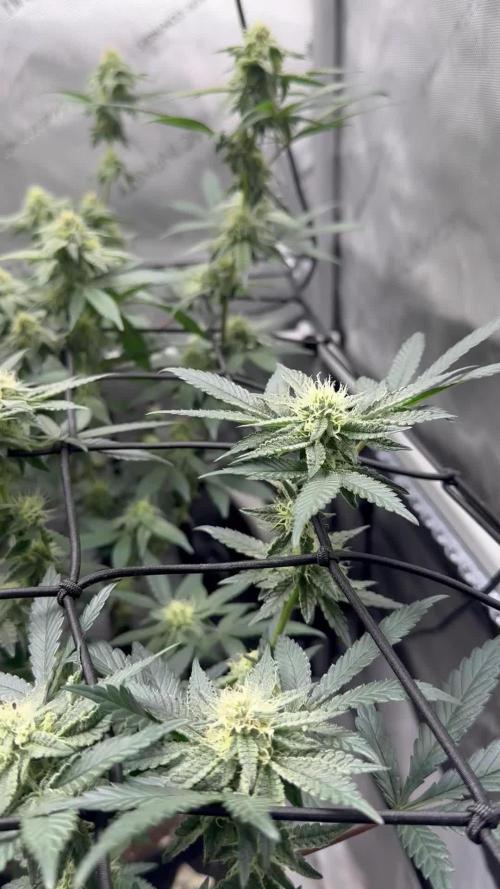
Did a bigger defol. Adjusted the trellis. May or may not have been watering with too high of ph (7.2) so hopefully microbes have been doing their job.

