


Likes
Comments
Share


Likes
30
Share


@HAPPY91
Follow
Mars Hydro TS 3000
Dimensions:
25.3" x 22.8" x 2.7"
Weight:
11.3lb
Coverage:
4x4 feet
Watts Consumed:
~450w
Light Intensity:
Up to 1150 uMol @ 18" height
Spectrum:
Full White + Infrared
LED Brand:
Unbranded LEDs
Voltage:
120; 240; 277
Warranty:
3 Years
Week 14 6/23/2021-6/29/2021:
Day 90 6/23:
Played Santana Radio. Drank 0.5 gallons plain water=22 ppm 6.2 ph 73 f. 69.6-79.0 46%-70%
Day 91 6/24:
Played Reggae Radio. Drank 0.5 gallons Fish Brew water=16 ppm 6.4 ph 74 f. 68.9-77.5 48%-65%
Day 92 6/25:
Played Slipknot Radio. Nothing today. 70.9-81.7 48%-74%
Day 93 6/26:
Played High Octane Radio. Drank 0.5 gallons plain water=16 ppm 6.5 ph 78 f. 74.7-83.3 46%-61%
Day 94 6/27:
Played My Likes Radio. Drank 0.5 gallons plain water=19 ppm 6.4 ph 81 f. 76.3-84.2 48%-63%
Day 95 6/28:
Played Reggae Radio. Drank 0.5 gallons plain water=21 ppm 6.0 ph 80 f. 75.9-84.4
Day 96 6/29:
Played Santana Radio. Today is the last day under the lights for her. When lights go out she is moved into dry tent keeping it dark and trying to keep cool. 71.6-80.6 45%-71%

Likes
24
Share

@Oldwied
Follow
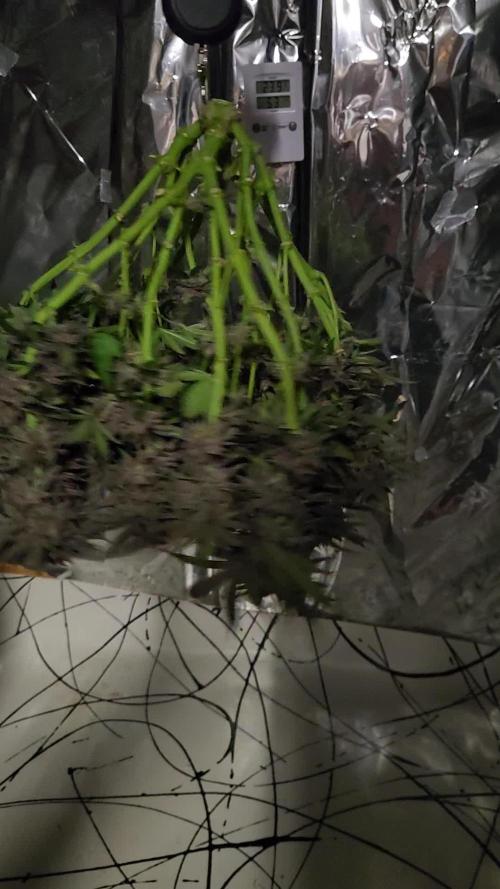
After 3 days of darkness the buds turned in a deep purple colour.
I divided the plant in three, it was hung up and dried at 19°C for 7 days. After that it was dry trimmed.
Strawberry Cola Sherbet F1 Fast Version:
= 109 g buds + 25 g trimm
= 134g

Likes
5
Share


@GarciasGarden
Follow
Day 19 from switch and look at them😍 been using the same nutrients/ same amount and they are loving it. Temps have been going great and buds are actually forming !

Likes
4
Share

@Ibgrowing
Follow
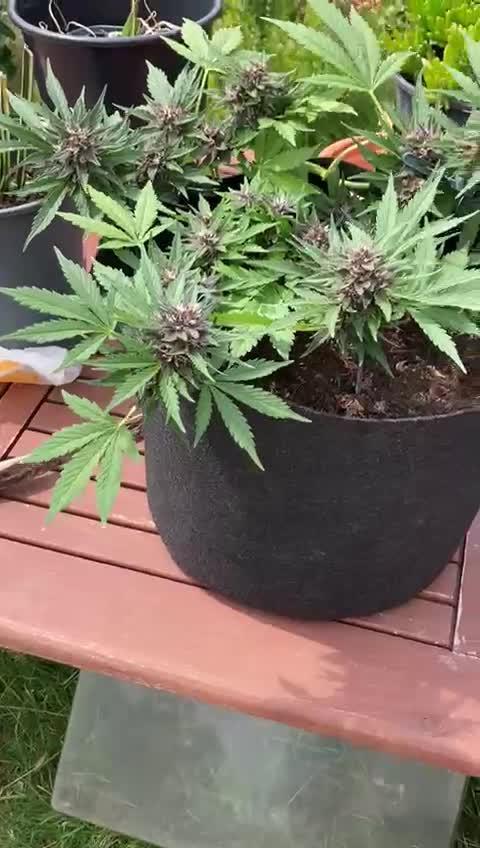
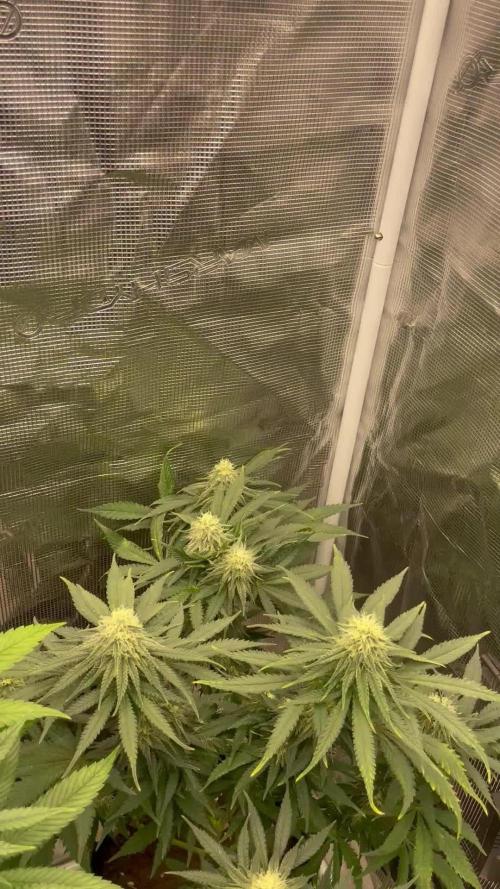
I am not home at the moment so I have someone taking care of my girls. The quality of the video is a bit grainy because of WhatsApp, sorry about that. She is still getting the same amount of nutes, but i will up the flowering nutes because of the yellowing of the lower leaves.


Likes
15
Share


Likes
29
Share


@SalocinSpecial
Follow
***Note that I started to count the days when I placed the seeds between paper towels. The seeds were planted 3 days later and sprouted from the ground 2 days after being planted.
D80 (13/05/2021): I'm looking at the trichomes every other days. Glue Gelato is starting to show amber on top buds. No amber for Banana Kush and Gelato. This time I will chop them all at the same time so the one I will rely on is the Glue Gelato. As soon as she is ready, I will harvest them all. Banana Kush and Gelato would probably need more, but in term of logistic, I need to harvest all my plants at the same time.
D83 (16/05/2021): Not ready yet. I'm checking trichomes closely! 😬
- Light: the lights are at 100% and at 12 inch form the plants.
- Temperature: during the day: 24-25C ; during the night: 20C.
- Humidity: the humidity is maintain around 46-48% all the time.
- Air circulation: There is an oscillating fan on the ground, one fixed fan pointing on top of the canopy and one fixed fan to help cool the lights.
- Water: I gave water every other day or when the ground feel dry or the pots feels light.
- ***IPM: I never mention it but I'm using nematodes pouch as an integrated pest management. I had trouble with pest in my first grow and I learned from it. That's the only thing I do for pest and of course watching closely and regularly at my plants 😊

Likes
2
Share


@ccsculture420
Follow
Esta semana ha sido un poco raras ya que tengo dos criaturas que no me está gustando su color y la forma de sus hojas que son la B y la C. La B ha ido tomando un mejor color pero la C pareciera cualquier planta menos de canabis y lo peor del caso es que el la criatura B encontré unos insectos. Son en realidad millones pero no maltratan a la criatura. Es la la única que los tiene. Gracias al que me pueda guiar.
Les dejo el vídeo de los dinosaurios insectos

Likes
Comments
Share


@Kannisho
Follow
Se me ocurrió hacer un scrog desde ceros, aunque es solamente un piloto ya que falta una defoliación y un arreglo en la estructura, pero eso nos da a entender que este ciclo de vegetativo le falta aun varias semana, realmente lo hago para divertirme 💚🤩


Likes
4
Share


@Dr_Green_Thumb87
Follow
12/28 feeded ph6 incl. Calmag and Greenhouse Short Flower
12/30 ICE ICE Baby
Likes
44
Share


@Cogollo_eu
Follow
**Encontrarás la traducción a español al final de la descripción**
From/Desde: 12/04/19 || To/Hasta: 18/04/19
From day/Desde día: 50 || To day/Hasta día: 56
You can find the Money Maker Diary here:
** Podéis encontrar el diario de las Money Maker aquí:**
https://growdiaries.com/diaries/25667-gorillamakingmoney-gorilla-vs-money-m
-----IMAGES & VIDEOS-----
I'm sorry for not having a tlapse video this week, i slaved the cam onto my 60x60 tent to record the first growing week of another plants, next week i will return with more tlapse videos.
-----WEEK SUMMARY-----
To have a visual size of the plants take into consideration that the SCROG net it's fixed 24 cm abobe the top part of the soil.
There's something i want to correct and remark this week. About the question i asked some weeks ago on growers help, about the plant with decoloring problems (Photos 7 & 13), where i've choose the defoliation answer as the correct one. Watching the plant today, I would say that it can be an excess of co2 in the roots caused by a co2 tablet that I used during the first days of growth. You can notice how the part of the plant in the back does not present de decoloration it have in the front.
Also remarking what i've told last week, i must say the SCROG is not a true SCROG, as some colas begin below others, and also colas are of different heights among all plants. Anyway i'm very happy on how everything is going. And insisting again, I have very very few experience growing cannabis, this is my 3rd grow, 2nd indoor, and first time with photo-period at indoors, and of course is the first time too i'm trying to apply growing technics on a serious way. I really don't know if i'm doing things right or wrong.
-----WATERING CALENDAR-----
13/04/19 - 1.250 ml with all week nutrients -(Sensizym, bloom stimulator, bloom nutrition & amino complex) @ PH6.4 & 1.3 E.C.
17/04/19 - 1.250 ml with Silica Power, Pro Active, Bloom Stimulator, Bloom Nutrition, Sensizym & 5 drops of Amino Complex @ PH6.5 & 1.3 E.C.
*****ESPAÑOL*****
-----IMÁGENES Y VÍDEOS-----
Siento no tener vídeos timelapse esta semana, he esclavizado la cámara en el armario de 60x60 para grabar la primera semana de crecimiento con otras plantas que tengo en el.
-----SUMARIO SEMANAL-----
Hay una cosa que quiero corregir y remarcar esta semana. En sobre la pregunta que realicé hace unas semanas sobre la planta que tenía una decoloración (Fotos 7 y 13), en la que escogí la respuesta de la variegación. Viendo la planta a día de hoy, yo diría que es un exceso de CO2 en las raíces causado por una pastilla de CO2 que usé durante los primeros días de crecimiento. Al fijarse bien se ve como la parte trasera de la planta no presenta las decoloraciones y sin embargo la frontal si.
Para tener una idea más o menos certera del tamaño de las partes de las plantas, tened en cuenta que la red está fija a 24 cm de la parte superior de la tierra de los tiestos.
También remarcando lo que dije durante la última semana, he de decir que el SCROG no es un SCROG real, ya que las colas no empiezan desde la misma altura ni son de la misma altura, ni las plantas son de la misma altura. Pero yo estoy muy contento con como va la cosa, vuelvo a insistir que es mi primera vez con foto-dependientes indoor, mi segundo armario indoor y el tercer cultivo de mi vida, y por supuesto la primera vez que aplico o intento aplicar las técnicas de cultivo. Lo estoy intentando realizar bien y de manera eficaz, pero realmente no se si lo estoy haciendo bien o mal, yo simplemente me lio y veo como responden las plantas.
-----CALENDARIO DE RIEGO-----
13/04/19 - 1.250 ml con todos los nutrientes semanales -(Sensizym, bloom stimulator, bloom nutrition & amino complex) @ PH6.4 & 1.3 E.C.
17/04/19 - 1.250 ml con Silica Power, Pro Active, Bloom Stimulator, Bloom Nutrition, Sensizym & 5 gotas de Amino Complex @ PH6.5 & 1.3 E.C.

Likes
2
Share


@Greenbean420
Follow
One of the plants grew massive! However the smoke wasn’t the best until a good 4 weeks cure. Very hairy buds too which was interesting 😂 Still a nice smoke
Processing
Likes
21
Share


@GreenISR
Follow
I have made some clean up down the plant ,I cant belive its a clone so big 🤗

Likes
5
Share


@Imccloskey
Follow
Increased the lights to 50% here. This made the temp in the tent higher. As you can see we have moved to a larger pot. This soil in the new pot is 33% our organic mix and 66% Happy Frog. Still no nutrients needed because of what is in the soil mix.

Likes
2
Share


@MN-Frozen420
Follow
Day 70
Looks like its doing well for being a photo period. this is my first one.
Likes
9
Share


@PajaritoUY
Follow
Nicole kush ya es conocida dentro de mi carpa y en todo el mundo. una planta muy vigorosa, su aroma dulce y cítrico deleita incluso a los que no entienden el cannabis. Su sabor denso y refrescante queda grabado en la mente del experimentador. Una hermosa y transformadora planta con flores. Tendré esta joya en mi jardín en otras ocasiones.

Likes
9
Share


@SSKNFbyHAZE
Follow
** COST **
TO RUN
- Used previous ⛺️ setup : 0.00USD
- Monthly electricity : 36.73USD <-- other ladies sharing ⛺️
- 3 Gallon Fabric pot : 0.15USD
- Bonsai wire : Apx. 0.03USD
- Reused soil from last run : 0.00USD
FOR NUTRIENTS
- Jadam Microbial Solution : 0.00USD
- Fermented Plant Juice : 0.00USD
APPLYING
- JMS : 30ml / 1 Litter
- FPJ : 30ml / 1 litter
TOTAL COST : 36.91USD
Throughout the week, I give compost tea, and fermented plant juice once each ^^
Its almost time!!
Trichrome are cloudy, but its hard to find amber Trichromes yet.
According to Fastbuds she will be ready in 4 days ^^;
Hope you guys have a wonderful day today ^^v
*** Please Like, comment & share ***
Highly appreciated -----/-----<@


Likes
64
Share


@Roberts
Follow
Baked Bomb autoflower is starting to preflower. I think she is a bit behind due to the issues I had early on in the grow. She has been growing great for many weeks now. She has been looking really good lately. Thank you Bomb Seeds. 🤜🏻🤛🏻🌱🌱🌱💣
Thank you grow diaries community for the 👇likes👇, follows, comments, and subscriptions on my YouTube channel👇. ❄️🌱🍻
Happy Growing 🌱🌱🌱
https://youtube.com/channel/UCAhN7yRzWLpcaRHhMIQ7X4g
