


Likes
Comments
Share


@QualitySeeker
Follow
Everything looks good and healthy. Lets wait couple weeks for flowring :)


Likes
7
Share


@Krissci
Follow
Ending 1st week of flowering
Mainlining for 1st time
8x Nodes, topped 3x
Tied down to create even canopy
Flavour & yield is my biggest aim
Day 3 - Tie down training and defoliation. Both strong growers..
WC2 is the biggest so far

Likes
7
Share


@Kneel_deGrasse_Highson
Follow
Hey folks
2 Nov
New week. Last week flew right?. Anyhow weve hada mix of weather this past week. Some really hot 31C temps to milder very rain and cloudy days. The plants are loving it however.
Iv decided for the time being to stop using chemical nutes and keep the grow organic, which is why I switched to a handful of bonemeal on the surface of each plant. Will see how they respond.
Plant 1 doing really great! Really impressed by this plant. Its also very pretty with pink purple buds and has not once showed any signs of sickness. It just keeps low and bushy and keeps shooting up those buds. They top buds are gradually fattening up nicely as the leaves of the plant become dark green.
Plant 2 confuses me a bit. Its in flower alright but the rate of bud produ tion is super slow, and pistil count at 1 time is also low??? Reveging maybe?? Looks very healyhy however
Plant 3 almost ready for harvest. Been flushing for a week now, waiting of the final pistils stzge and ambering of trichs before chopping
Iv also included some pictures of my growth patch with smaller plants surrounding. An Outdoor SOG???
Till next time growmies
Sho/ciao
Likes
22
Share


@SecretTreasures
Follow
Photos taken on day 56 of flowering (last day of week 8 of flowering)
We are entering the last week as planned. Today is day 57 of flowering, day 50 for the London Pound Cake X Zoap. Since last week, all the plants have gained a lot more trichomes. Nasha's Fat Freddy's Cat is becoming more and more purple, Mimosa X Orange Punch is becoming more and more peachy and London Pound Cake X Zoap is turning a light shade of pink. Meanwhile, the larger leaves around the tubers are already curling with resin and the smell in the tent is very intense. Only water is used. Some plants have an incredible resin production and some flowers are still swelling, which can be seen in the light green areas of the otherwise dark flowers. Some plants look more mature than others, but that's the way it is when you use seeds. Temperature is still around 25 degrees during the day and around 19 at night. One Fat Freddy's Cat plant has developed an 'albino tip', which according to my information it can be genetic, for example when plants are backcrossed for recessive traits and can be due to environmental factors such as growing too close to a powerful lamp, which is also the case here. However, only this one plant has this trait and it is only particularly pronounced on one tip and less pronounced on another.


Likes
5
Share


@SopChop
Follow
Keeps growing too close to light. Have now raised light as high as can get it. Doing HST to keep top of branchs at least 10" from light.
has now been stretching for about 5 long weeks. please make it stop.

Likes
16
Share


@btcywtsitw
Follow
These were quite an experience to grow. My second grow ever and they are great. I loved the way they flowered and how they responded to topping. They absolutely loved it. I would 10/10 grow again. Strong genetics and a very strong high.

Likes
30
Share


@VanTheMan
Follow
Start of week 4 - She is looking real good. She is getting rather bushy but is not growing much taller yet. still only at roughly 13cm.
Day 22 - 23/01-2024 - watered 1.3L (1ml of calmag-grow-bloom-top mixed with 1.5l water)
Day 26 - 27/01-2024 - watered 1.5L (1ml of calmag-grow-bloom-top mixed with 1.5l water) - She has started growing a bit taller and has reached 17cm today
Day 28 - 29/01-2024 - She has been growing a little taller and has now reached 20cm total. I really like how compact and bushy she seems, so many branches on so little stem. 😍
She does not seem to have started flowering yet so i'll start my next week as veg week aswell.
Likes
10
Share


@StickyFingah420
Follow
Planta hermosa, por problemas de respaldo no tengo sus fotos finales y es una pena :( pero puedo decirles que es una planta que rinde bien, entrega frutos de calidad y no es para nada exigente.
Likes
Comments
Share
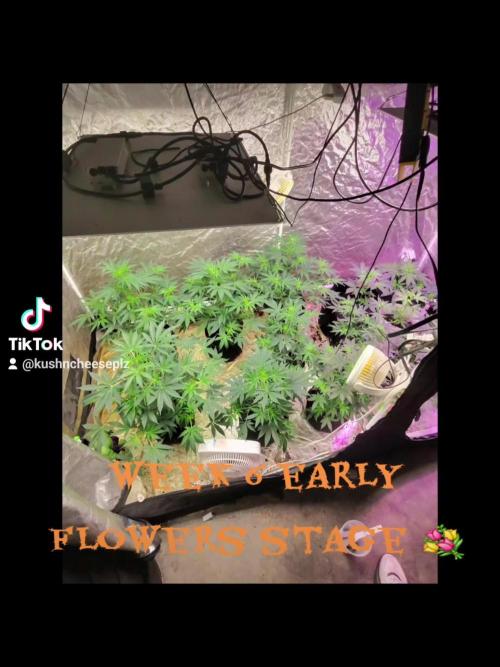

@Kushncheeseplz
Follow
Right now , the challenge is the humidity
To combat against it., open the other tent

Likes
7
Share


@Eaegifts
Follow
Topped her late in the week but mostly hand lst and then after adding the hydroton back to lst with a tie. Had to switch over to Botanicare from the Jacks 321 because I ran out but I may switch back for flower. Last week Veg yay!

Likes
30
Share


@Smokescreen420
Follow
Taken these pics and video today as im gonna start defoliation and lollipopping, such a shame visually as they look really healthy but its yime to start getting ready for those big nugs......hopefully
Processing
Likes
37
Share


@NewbieLearner
Follow
Flowering coming along very well. THE BIG STRETCH has begun haha. All the plants stretching and getting ready for flowering is what I mean haha. Smell is super nice from the gorilla glue and the mold is decreasing rapidly.
Used half milk and half ph solution along with many copper treatments to help cure the mold situation which came up from bringing an outdoor plant indoors, never so this!


Likes
6
Share


@shasam
Follow
This is my 3rd week of flower after months of struggles, I was about to cut them off and abort the grow ... My plants were hit with yellowing tops and leaves were being burnt for no apparent cause. I installed a chiller, reduced EC, distanced the light and still ... Only to find out that calcium toxicity was the culprit .... It caused a potassium lock out that literally burned the leaves and stunted growth completely ... They looked like seedlings despite well crossing the vegetative stage ... Flushed my tank ... removed the calcium completely and the magic started ... This week I’m attaching this beautiful time lapse video of my girls coming back from the dead and filling out my tent space completely! :)


Likes
12
Share


@Kakui
Follow
Por lejos este ha sido mi mejor cultivo hasta ahora, han sido los cogollos más grandes, densos y llenos de tricomas que he cultivado, comparado con el cultivo anterior en el que usé el mismo tipo de planta, está vez fue muy superior. Los motivos de la mejora pueden ser varios, incluidos más luz, ya que en el cultivo anterior solo tuve 480w, ahora fueron 720w, también usé tutores y palitos de madera para crear una estructura firme en algunas plantas, y fueron estás mismas las que tuvieron los cogollos más grandes, así que lo usaré en todas las plantas del siguiente cultivo. Además el tiempo de cultivo se redujo de 4 meses a 3 meses y medio, aprox. Ahora solo queda esperar unas 2 semanas para el secado y ver cuánto fue la cosecha total en gramos secos, la anterior fue de 635 gramos secos, está yo creo que por lo menos rondará los 700 gramos secos, incluso puede que me sorprenda y sea mucho más.

Likes
4
Share


@Jaschkoo0
Follow
On Day 127 i harvested a few buds from the right plant because she had perfekt condicioned trichomes and a lot from the left because i dont want to risk more mold.

Likes
74
Share


@Rasta_Faraev
Follow
Всем привет, дорогие друзья! Ещё одна неделя в копилку. 50 дней позади. Начинается активный рост перед цветением, одна из соседок-халкберри уже выпустила одуваны аж на 8 день в режиме 12/12. Банана активно пьёт компот, по 2-3л в день, лейкой орудовать становится сложно. Задумываюсь о капельном полив на след цикл. В целом все хорошо как мне кажется. А вам? Пишите в комментариях, всегда рад Вашему вниманию, коллеги и спасибо!
23.10.21. Заснял спящих красавиц. Оцените музыку😍 сделаю ещё видос как проснутся и фото


Likes
179
Share


@StarLorr
Follow
Welcome to my Øpium diary.
In this diary:
Seeds: sponsored by Ðivine Șeeds
Media: Promix HP
Nutrients: Advanced Nutrients, Diablo Nutrients.
Light and Weather: Şun☀️and Mother Earth.🌎
___________________________
Feeding:
Tue 23Jul: 4L nutrients pH'd 6.5 and 4L water not pH'd
Wed 24Jul: 10L water not pH'd
Thu 25Jul: 4L water not pH'd
Fri 26Jul: 8L water not pH'd
Sat 27Jul: 4L nutrients pH'd 6.5 and 2L water not pH'd
Sun 28Jul: 10L water not pH'd
Mon 29Jul: 8L water not pH'd
*please note that most water only feedings are 2L at the time throughout the day in bottom saucer*
___________________________
What a beautiful summer that we're having. Just one day last week it was cloudy and colder and got some rain, rest of the week sublime weather.
My Ðivine Ladies are pre flowering and hopefully will be blooming soon, next week update should be FLO fingers crossed😄
______________________________
Øpi was found with a spider mites nest..squished the squatter with my thumb and index... all 3 Ðivine Gals got the spa treatment, soap insecticide
spray 2 litres each soaked them real good, before flowering it was a smart move😉
______________________________
Thanks for stopping by, likes and comments are appreciated!👊🏻😎
Keep on growin!
Keep on tokin!!!
😙💨💨💨💨💨

Likes
8
Share


@TegridyCal
Follow
White Widow is swelling the peaks it was finally a little slow maybe but they are swelling very well. The trunk is beautiful thick and resistant, on the flowers the first trichomes are seen, the plant is finally coming.
