


Likes
2
Share


@Khalico20
Follow
Es 3stupenda ya genera resina,esta empezando la tercera semana, suerte que le controle la altura ,muy agradecida con pocos cuidados esta muy sana y esperando probar este aroma que es suave y intenso, buenos humos!
Likes
4
Share


@Ageddd
Follow
Bending ULH1, and give her a dose of 1l: (3ml/l TopVeg+1ml/l Green Explosion) , after the Nutrients dose it got a little more darker. The broken leaves are being replaced by the new branches leaves, so the storm was just a little pain ... Vigorous mode: ON
Watering ULH2: It is getting more colour :) . I think it is starting to root well and eat the nutes stored in the soil.


Likes
20
Share


@LaGrassaFarm
Follow
Buena semana de lluvia que hemos tenido por mi zona. ¿Qué tal están? A principios de semana le realizamos su último trasplante a maceta final de 7 litros.
También una defoliación, que le dejé solo hojas en los dos últimos nudos. Y nada, mantuvieron el sustrato húmedo, con el riego del propio trasplante. Así que estas pidiendo agua, y en cuanto se vuelva a encender el foco, le daremos su riego. Y bueno, ya pocos días restan para que empiece la fase de floración.
Muchas gracias por el apoyo recibido, y nos vemos otra semana más, un saludo y buenos humos🙌

Likes
5
Share


@NoProbation4Weed
Follow
Light hitting with around 850 PPFD
The stinkyness of this lady is insane! one of the loudest plants ever grown.
She takes her time but I am fine with that.
Overwatered 1 time this week but she took it like a champ.
Likes
1
Share


@Ninjabuds
Follow
Not a lot to update the seedlings have came up out the soil at this point they are still to small to tell any visible differences.
I started all the seeds from all 10 packs and and I put 26 of them in soil I now have about 20 of them left I still have atleast one left if every strain. I just kept the 20 plants that all started off at the same time it’s so much easier when there is not some plants behind from the rip. In a few days I will pick out the best one from each of the 10 strains and toss the rest so sad there is a plant count here.


Processing
Likes
9
Share


@High_Grade_Dadli
Follow
#1 start showing male parts so it got pulled....also seem like a have a mag. Prob hopeful it clear out during the week..... TP #3 to 7gal pot during 2week flowering....also TP another one that i wasnt keeping track of in veg into a bigger pot that only start growing after I topped it
Likes
13
Share


@Danieledec
Follow
Hi Guys
the triple is doing well
and i think next week orthe next after i will change the light schedule and start the flowering
what you think??is that a good choice??
sorry for the bad quality of the pics
thx everybody
Daniele & Claudia
Italians from Greece


Likes
Comments
Share


Likes
150
Share


@FrenchxFarmer63
Follow
Une semaine de plus et ces demoiselles ce portes très bien !
Je continue tous les trois jours à les palisser un peu plus , avec comme arrosage du purin d'ortie tous les deux arrosages.
Bien content des graines de chez @Sensi Seeds ! 🤝🙌

Likes
228
Share

@yan420
Follow
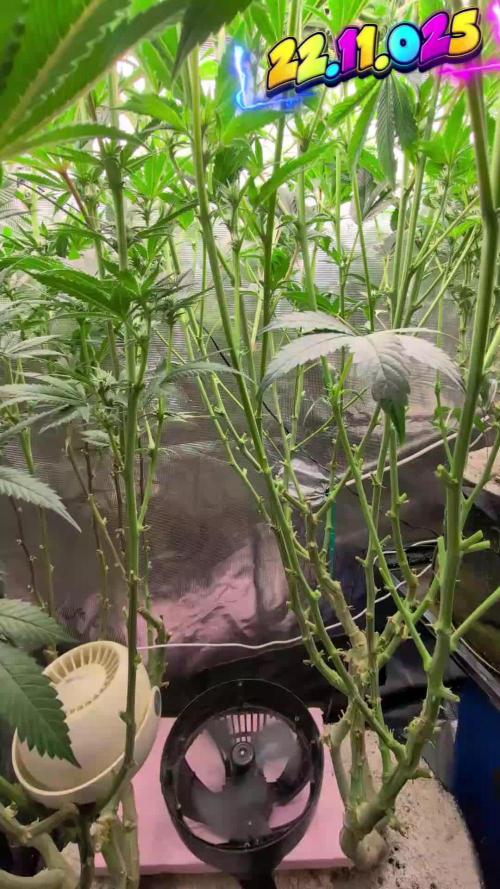
This two were part of another diary and got moved out due to space reasons at VW8 and moved back indoors at VW20
https://growdiaries.com/diaries/218151-auto-god-s-glue-grow-journal-by-yan402
13.09.25 VW21 Both are looking good and are developing tighter nodes than when they were outside, I'm going to have to keep cutting them back every once and a while I also applied nematodes against thrips and fungus gnats.
20.09.25 VW22 some spots and some yellow leafs, I think it's a root problem, probably root bound, but both seem healthy and are getting thicker so maybe just top up with Coco coir and give a slight different nutrient schedule less Tri Part Bloom could do the trick MAYBE lol.
27.09.25 VW23 Topped up the pots with extra coco coir and trimmed the side roots a bit, both plants were root bound 📹
03.10.25 VW23 did a HST/LST session 📹
12.10.25 VW25 Done a major HST session to try and keep them in line with the Sunset Sherbet GF I have going in the same tent, rest in the video 📹
17.10.25 VW25 ffj/fpj/fish 30 → 60 ml
19.10.25 VW26 it just became a one plant diary, keeping #5, #6 gets it's own diary for testing nutrients.
20.10.25 VW26(?) Feed tweak: added 3 g Calcium Nitrate/ 30 L (≈ 15 ppm N + 10 ppm Ca)
24.10.25 VW26 did a defoliation and trimming session 📹
25.10.25 VW26 I'll be repoting tomorrow, 26.10.25 VW27 rest in the video📹
27.10.25 VW27 Epsom Salt 0 → 2.5, Calcium Nitrate 3 → 9 g
01.11.25 VW28 CalMag 60 → 30ml, TriPartBloom 20 → 30ml, Magnesium 2.5 → 3.5g
04.11.25 VW28 no more yellowing between the veins and no new spots, the changes to the schedule worked, rest in the video 📸
09.11.25 VW29 Did what I'm hoping is a last cleanup 🎥
12.11.25 VW13 Did another cleanup in the tent 🎥, also switched to the FERMAKOR PK Micro schedule, (10.11.25) added Phosphoric acid as a pH down in preparation for flowering
14.11.25 FW1 FERMAKOR PK Micros 40 → 50 ml
22.11.25 FW2 Calcium Nitrate 40 g → 35 g
🌱💦🌱💦🌱💦🌱💦🌱💦🌱
Day to day tasks & actions 🌿
🌱💦🌱💦🌱💦🌱💦🌱💦🌱
22.11.25 FW1 – Fed 5l of #1 → 2l runoff
23.11.25 FW2 – Fed 5l of #1 → 2l runoff
(*RUNOFF reused for indoor house plants)
🍶💧🍶💧🍶💧🍶💧🍶
💧 Nutrients in 30 L #1 Veg — FERMAKOR
🍶💧🍶💧🍶💧🍶💧🍶
💧 Calcium Nitrate (Calcinit / Nitcal):
45 g → 40 g → 35 g
= 1.33 g/L → 207 ppm N + 253 ppm Ca
= 1.17 g/L → 183 ppm N + 224 ppm Ca (current)
💧 PK Concentrate (FERMAKOR Base):
30 ml → 40 ml → 50 ml
= 1.00 → 1.33 → 1.66 ml/L
→ balanced 1:1 P:K + light micros (from extract)
💧 Home-made FFJ/FPJ (Fish + Veg):
30 ml
= 1.00 ml/L
Epsom Salt (MgSO₄·7H₂O):
8 g
= 0.27 g/L → 26 ppm Mg + 35 ppm S
💧 Fetrilon Combi 1 (Micros):
0.5 g
= 0.017 g/L
→ Fe 0.7 ppm • Mn 0.7 ppm • Zn 0.3 ppm • Cu 0.3 ppm • B 0.1 ppm • Mo 0.02 ppm
Phosphoric Acid (pH down) + Citric Acid (chelation):
→ First set pH with phosphoric acid
→ Add a little citric only if extra chelation is needed
💧 Target pH: 5.8 – 6.0 (drop test yellow-green)
📦 TOTAL Inputs:
60 ml → 70 ml → 80 ml / 48.5 g per 30 L
= 2.00 → 2.33 → 2.66 ml/L + 1.62 g/L (current)
⚙️✂️⚙️✂️⚙️✂️⚙️✂️⚙️
✂️ Tools & equipment ✂️
⚙️✂️⚙️✂️⚙️✂️⚙️✂️⚙️
✂️ 2× MarsHydro SP3000
⚙️ MarsHydro 150mm ACF Ventilator
✂️ Trotec dehumidifier (big unit)
⚙️ Mini no-name dehumidifier
✂️ Kebab skewers (LST – stainless)
⚙️ Wire + roast skewers (LST assist)
✂️ Scissors (HST)
⚙️ Vacuum (for spills & cleanup)
✂️⚙️✂️⚙️✂️⚙️⚙️✂️⚙️✂️⚙️✂️⚙️
🍒🍭🍬🌈🍒🍭🍬🌈🍒🍭🍬🌈🍒
🦄Fantasy Feast ( Seeds)🦄
🌈🍒🍭🍬🌈🍒🍭🍬🌈🍒🍭🍬🌈🍒
Species: Hybrid (Regular)
Genetics: The mother is Unicorn Whip by Dirty Bird Genetics. The father is Charcuterie by Cannarado Genetics.
Effect: Unknown Mixed effect body and head high
Flavor: Some phenos are Skunky gassy fruity, some are fruity sour citrus with a chemical touch and a touch of skunk
Flowering: Estimated 8–10 weeks
Resistance: Strong — Testing phase done
YouTube Link: https://youtube.com/-m8h?si=A7x4Zlr2kj-_ga31
Likes
45
Share


@chapadux420r
Follow
Oh well, 6 weeks have passed since the 12/12 schedule and all is going really well (I think)
Skunk 47 gaining some colors and some weight, the green poison tops who were a little behind from their big brothers are catching up and the critical+ 2.0 are struggling to support the bud weight
Really happy with the results so far, let’s wait for the finals 3/4 weeks to see them really gaining the real weight and colors
Tell me what you think!!


Likes
40
Share


@Peeman
Follow
Wow last day of August, summer is flying by
All the girls have finally stepped into high gear and are flourishing although in years past at this time of season my girls have always been further along. I guess this means a later harvest this year? Wondering if other growers are experiencing the same pattern.
Sept.1 and average temps have started to drop during the day and the morning dew has reared its ugly head once again. This will probably be the case from here on in. Going to try my best to keep the girls from staying wet throughout the day.
Sept.3 noticed some powdery mildew on my Godfather OG #1 in front of the wall. Made up a concoction of 1 litre of milk to 3 litres of water and gave her a good spray after the sun went down.
Also sprayed the rest of my girls as a preventative. Hopefully this will help manage the problem.
Sept. 6 this week has been quite windy most days and my Godfather OG blew over landing on top of Trainwreck #1 and breaking 2 lower colas OUCH! 👺 My fault for having Godfather to close Trainwreck


Likes
9
Share

@therealgrowmie
Follow
Things are moving in the right direction again. After a rough patch, the plants have stabilised and are now showing only minor deficiencies.
I decided to prune the most dysfunctional growth to focus energy on healthier, actively growing tissue and improve overall photosynthesis. That seems to have helped, as new growth is coming in stronger and recovery is underway, though they’re not fully there yet.
We’re back on track for now and have also transplanted into 3L pots. The next days will be about monitoring and letting them settle in.
Growmie lesson:
Sometimes correcting a problem means acting decisively, but recovery still takes time. Removing damaged leaves can help, as long as it’s done carefully and not rushed.
Stats so far:
💧 Watering: Every third day
🌡️ Temp: 24–26°C
💦 Humidity: 65% RH
📈 VPD: ~1.18 kPa
💡 Light: ~400 PPFD
Processing
Likes
10
Share


@Barcelona_Farmers710
Follow
Entramos en semana 4 de flora con un calor extremo con el Lec... a la espera de renovar equipo a led pero tendremos que acabar con Lec está tirada farmers, a pesar de todo tiene bastante resina y huele bastante bien sobre todo la Sweet Skitllez!🍁
Likes
55
Share


@Ultraviolet
Follow
What's in the soil? What's not in the soil would be an easier question to answer. 16-18 DLI @ the minute. +++ as she grows.
Probably not recommended, but to get to where it needs to be, I need to start now.
Vegetative @1400ppm 0.8–1.2 kPa 80–86°F (26.7–30°C) 65–75%, LST Day 10, Fim'd Day 11
CEC (Cation Exchange Capacity):
This is a measure of a soil's ability to hold and exchange positively charged nutrients, like calcium, magnesium, and potassium. Soils with high CEC (more clay and organic matter) have more negative charges that attract and hold these essential nutrients, preventing them from leaching away.
Biochar is highly efficient at increasing cation exchange capacity (CEC) compared to many other amendments. Biochar's high CEC potential stems from its negatively charged functional groups, and studies show it can increase CEC by over 90%. Amendments like compost also increase CEC but are often more prone to rapid biodegradation, which can make biochar's effect more long-lasting. biochar acts as a long-lasting Cation Exchange Capacity (CEC) enhancer because its porous, carbon-rich structure provides sites for nutrients to bind to, effectively improving nutrient retention in soil without relying on the short-term benefits of fresh organic matter like compost or manure. Biochar's stability means these benefits last much longer than those from traditional organic amendments, making it a sustainable way to improve soil fertility, water retention, and structure over time. Needs to be charged first, similar to Coco, or it will immobilize cations, but at a much higher ratio.
a high cation exchange capacity (CEC) results in a high buffer protection, meaning the soil can better resist changes in pH and nutrient availability. This is because a high CEC soil has more negatively charged sites to hold onto essential positively charged nutrients, like calcium and magnesium, and to buffer against acid ions, such as hydrogen.
EC (Electrical Conductivity):
This measures the amount of soluble salts in the soil. High EC levels indicate a high concentration of dissolved salts and can be a sign of potential salinity issues that can harm plants.
The stored cations associated with a medium's cation exchange capacity (CEC) do not directly contribute to a real-time electrical conductivity (EC) reading. A real-time EC measurement reflects only the concentration of free, dissolved salt ions in the water solution within the medium.
98% of a plants nutrients comes directly from the water solution.
2% come directly from soil particles.
CEC is a mediums storage capacity for cations. These stored cations do not contribute to a mediums EC directly.
Electrical Conductivity (EC) does not measure salt ions adsorbed (stored) onto a Cation Exchange Capacity (CEC) site, as EC measures the conductivity of ions in solution within a soil or water sample, not those held on soil particles.
A medium releases stored cations to water by ion exchange, where a new, more desirable ion from the water solution temporarily displaces the stored cation from the medium's surface, a process also seen in plants absorbing nutrients via mass flow. For example, in water softeners, sodium ions are released from resin beads to bond with the medium's surface, displacing calcium and magnesium ions which then enter the water. This same principle applies when plants take up nutrients from the soil solution: the cations are released from the soil particles into the water in response to a concentration equilibrium, and then moved to the root surface via mass flow.
An example of ion exchange within the context of Cation Exchange Capacity (CEC) is a soil particle with a negative charge attracting and holding positively charged nutrient ions, like potassium (K+) or calcium (Ca2+), and then exchanging them for other positive ions present in the soil solution. For instance, a negatively charged clay particle in soil can hold a K+ ion and later release it to a plant's roots when a different cation, such as calcium (Ca2+), is abundant and replaces the potassium. This process of holding and swapping positively charged ions is fundamental to soil fertility, as it provides plants with essential nutrients.
Negative charges on soil particles: Soil particles, particularly clay and organic matter, have negatively charged surfaces due to their chemical structure.
Attraction of cations: These negative charges attract and hold positively charged ions, or cations, such as:
Potassium (K+)
Calcium (Ca2+)
Magnesium (Mg2+)
Sodium (Na+)
Ammonium (NH4+)
Plant roots excrete hydrogen ions (H+) through the action of proton pumps embedded in the root cell membranes, which use ATP (energy) to actively transport H+ ions from inside the root cell into the surrounding soil. This process lowers the pH of the soil, which helps to make certain mineral nutrients, such as iron, more available for uptake by the plant.
Mechanism of H+ Excretion
Proton Pumps: Root cells contain specialized proteins called proton pumps (H+-ATPases) in their cell membranes.
Active Transport: These proton pumps use energy from ATP to actively move H+ ions from the cytoplasm of the root cell into the soil, against their concentration gradient.
Role in pH Regulation: This active excretion of H+ is a major way plants regulate their internal cytoplasmic pH.
Nutrient Availability: The resulting decrease in soil pH makes certain essential mineral nutrients, like iron, more soluble and available for the root cells to absorb.
Ion Exchange: The H+ ions also displace positively charged mineral cations from the soil particles, making them available for uptake.
Iron Uptake: In response to iron deficiency stress, plants enhance H+ excretion and reductant release to lower the pH and convert Fe3+ to the more available form Fe2+. The altered pH can influence the activity and composition of beneficial microbes in the soil. The H+ gradient created by the proton pumps can also be used for other vital cell functions, such as ATP synthesis and the transport of other solutes. The hydrogen ions (H+) excreted during photosynthesis come from the splitting of water molecules. This splitting, called photolysis, occurs in Photosystem II to replace the electrons used in the light-dependent reactions. The released hydrogen ions are then pumped into the thylakoid lumen, creating a proton gradient that drives ATP synthesis.
Plants release hydrogen ions (H+) from their roots into the soil, a process that occurs in conjunction with nutrient uptake and photosynthesis. These H+ ions compete with mineral cations for the negatively charged sites on soil particles, a phenomenon known as cation exchange. By displacing beneficial mineral cations, the excreted H+ ions make these nutrients available for the plant to absorb, which can also lower the soil pH and indirectly affect its Cation Exchange Capacity (CEC) by altering the pool of exchangeable cations in the soil solution.
Plants use proton (H+) exudation, driven by the H+-ATPase enzyme, to release H+ ions into the soil, creating a more acidic rhizosphere, which enhances nutrient availability and influences nutrient cycling processes. This acidification mobilizes insoluble nutrients like iron (Fe) by breaking them down, while also facilitating the activity of beneficial microbes involved in the nutrient cycle. Therefore, H+ exudation is a critical plant strategy for nutrient acquisition and management, allowing plants to improve their access to essential elements from the soil.
A lack of water splitting during photosynthesis can affect iron uptake because the resulting energy imbalance disrupts the plant's ability to produce ATP and NADPH, which are crucial for overall photosynthetic energy conversion and can trigger a deficiency in iron homeostasis pathways. While photosynthesis uses hydrogen ions produced from water splitting for the Calvin cycle, not to create a hydrogen gas deficiency, the overall process is sensitive to nutrient availability, and iron is essential for chloroplast function.
In photosynthesis, water is split to provide electrons to replace those lost in Photosystem II, which is triggered by light absorption. These electrons then travel along a transport chain to generate ATP (energy currency) and NADPH (reducing power). Carbon Fixation: The generated ATP and NADPH are then used to convert carbon dioxide into carbohydrates in the Calvin cycle. Impaired water splitting (via water in or out) breaks the chain reaction of photosynthesis. This leads to an imbalance in ATP and NADPH levels, which disrupts the Calvin cycle and overall energy production in the plant. Plants require a sufficient supply of essential mineral elements like iron for photosynthesis. Iron is vital for chlorophyll formation and plays a crucial role in electron transport within the chloroplasts. The complex relationship between nutrient status and photosynthesis is evident when iron deficiency can be reverted by depleting other micronutrients like manganese. This highlights how nutrient homeostasis influences photosynthetic function. A lack of adequate energy and reducing power from photosynthesis, which is directly linked to water splitting, can trigger complex adaptive responses in the plant's iron uptake and distribution systems.
Plants possess receptors called transceptors that can directly detect specific nutrient concentrations in the soil or within the plant's tissues. These receptors trigger signaling pathways, sometimes involving calcium influx or changes in protein complex activity, that then influence nutrient uptake by the roots. Plants use this information to make long-term adjustments, such as Increasing root biomass to explore more soil for nutrients. Modifying metabolic pathways to make better use of available resources. Adjusting the rate of nutrient transport into the roots. That's why I keep a high EC. Abundance resonates Abundance.
Likes
9
Share


@alejandrogo_chile
Follow
Cada vez crecen más las Big Devil F1 y la "luz" que emite este LED de Mars-Hydro les encanta ❤️, gracias a Emmie de Marshydro por enviármelo.
Le hago amarres para disminuir la altura, ya que se han espigado por un viaje desde otra ciudad.
Aunque sigo sin saber cual es la distancia ideal, por ahora tengo al TS1000 a unas 18'' pulgadas de las plantitas 💡📏🌱.
Likes
3
Share


@LeRaar
Follow
Problemas de ph en el hidro debido a la inexperiencia.
Nutrientes segun tabla.


