





Likes
9
Share

@Cesilko
Follow
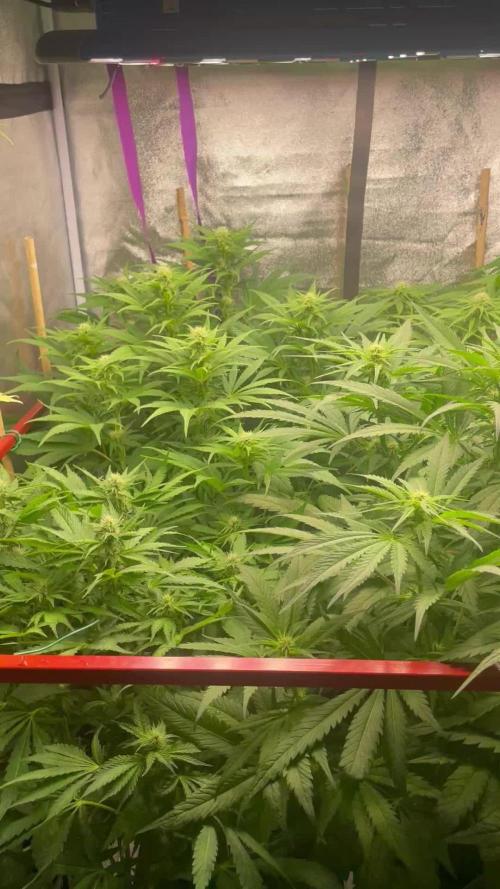
21 den květu proběhla defoliace. Dělal sem ji hned po rozsvícení. Někde sem se dočetl ze se ma dělat hned z rána. Aby mohly zaschnout rány přes den. No a teď už jen voda, fermentované čaje a kochání se jak rostou. Tak snad to nějak nedojebu. Growu zdar


Likes
11
Share


@Chubbs
Follow
420 Fastbuds
BlueDream Auto
Week 5
These girls have taken off. I swear they get prettier every week. It's been such an easy strain to grow just giving it well water and using good soil. I have been spraying 50ml per gallon of PureCrop1 on them as a preventive maintenance and pest control.
All in all Happy Growing

Likes
14
Share


@MrWigglyJiggly
Follow
Buds are densing up everyday and trichomes are coming along nicely. 3 more weeks to go. I feed her one last time after this there will be no nutrients given to her. Just water only.


Likes
3
Share


@UrbanBoer
Follow
Unknown Strain SA PLUG Edition, herself and Monday's Blue,are the oldest trees, and yet they have not finished flowering, the seasonal change is to blame.
It to boosts skinny stems, but I am more intrigued in how she's going to support her buds.
Processing
Likes
35
Share


@Ganjagrandaddy
Follow
Hi all. A good week of growth for the Amnesia haze lady despite the crazy temps in the UK the past few weeks. 31°c heatwaves daily have had some negatives on the recovering 2 girls . The amnesia is a huge plant now for my room dimensions and I would love to see the results from an outside grow of this amazing strain. I took a lot of lower growth tips out and wish i could have took clones as they were such good strong examples of her. I cannot sing her praises enough at this point and she jas took to her training with no issues at all. I am hoping to give them another 2 weeks max which will give the other plants time to recover and get some size back on.
The Red hot cookies has remained yellow except a few lower growth points , she had some very damaged roots from the root rot and temps but still managed to add some height and side growth. The tank changes and new res mix should hopefully support her to keep the new roots healthy and growing.
The Sweet Afghani Delicious has been trying really well to keep herself growing too. Her ability to overcome such a hit with root rot and keep going gives me a positive note on this strain. Her recovery is expected soon now so should give her a good chance to harvest well.
Overall I am happy with what is here following such a difficult attack by heat and pathogens. Watch those res tanks in the heat above 21°c guys , pathogens thrive at this temp !.

Likes
6
Share


@KivzBudz
Follow
Overall I’m very happy to end my first run like this. I think I made a pretty decent job and I can’t wait to try the finished product after curing.
Happy growing everyone! 🍀🌱
Likes
7
Share


@KannaKullektiv
Follow
Hiiigh friends 🙌
Welcome to week 5. 😍
The pretty ones have gained a lot of mass and have grown big and strong. This means they are continuing to train diligently.. 😊
See you next week. 👋
Arturo for KannaKullektiv
🙏
Likes
9
Share


@Thatgoodgas93
Follow
This week I’m glad I’ve spent time looking at my plants every time I cypher blunts w em because I wouldn’t have spotted seeds growing since their sacs are soo green it hides em pretty well. As you probably may have guessed I banished it from my tent & have cleaned my tent thoroughly to ensure there are no chances my females can get so much as get a whiff of it. Now as I said in my diary last week I was kinda bummed out that I couldn’t at least benefit from one plant giving me seeds but now I have been given a chance to reap something I had no idea I’d been sowing this whole time least of all the strain that wreaks of a very sticky & bubbalicious odor even with the most minimal contact. I must say it was a blessing in disguise cuz tbh them seeds ain’t cheap & as much as the wait may be worth it any & every grower novice (myself) to pro needs a stash on hand at all x to be able to grow or experiment with. It get cold up here in the winter so I be bored in the house on em snow days. As always there’s always something new each week & this week I’ll have to say the terpinator has not disappointed. I have been using far more little in terms of nutrient doses through out this grow as I realized the automatic spray bottle I have is nearly 3 liters & I've only been administering the minimal doses/liter as instructed in the grow diary nutrients chart into the near 3 gal bottle this whole time!! Not going to go crazy & double up but before I up the dosage I’ll perform a very thorough flush from rain in the forecast to reset its Ph. Can’t wait to see how both male & female turbo diesel strains differ in development in the 8 remaining weeks.


Likes
113
Share


@DeaneR
Follow
Wow! She grew this week 😜! The buds are stacking up nicely and the sugar leaves are starting to frost up with trichs. Surprisingly, not much odour yet😕. Her tent mate BlueCookie is real sticky and fragrant.
Added B-52 to the nutrient mix this week. Watered on Apr.21 FL 25 and Apr.24 FL 28, with 1/2 gallon (nutrients as listed above) poured slowly topside.
Lightly defoliating every other day or so. I'll likely try to reveg. this girl after harvest ( for clones), so I have left some larfy buds down low for that purpose.
That's about it for now. Not much to do other than feed and water her....and of course watch her bloom😍.
Thanks for stopping in!
Peace,
DeaneR😎

Likes
8
Share

@NoProbation4Weed
Follow
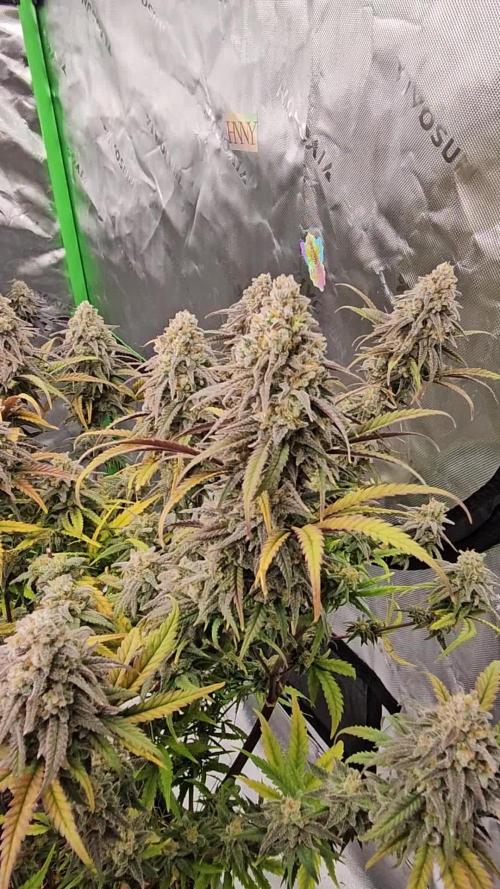
the last 2 weeks she did not get any fertilizer.
Good smell and heavy yielder. Seems to be the best yielder this run.
Terps are there and as expected leaning to the mimosa side of life.

Likes
9
Share


@Growing_Spartan
Follow
Today’s date is June 11th, it has been 6 days since my last update.
So far the Dolomite lime seemed to have helped with the yellowing of my fan leaves and the only “yellow” ones left look like they have a fade to them but I’m not sure if it’s due to proximity of the harvest or from the magnesium deficiency I had earlier. Either way I have to be more on top of my nutrients and my macros too.
They chunked up a decent size and the branches are even toppling over from their density! Trellis was definitely needed for this one.
Nothing special but watering when needed, temps have been as high as 84 and as low as 67, I’m really trying to master the environment but due to my location it’s getting harder to do so without hoping I don’t blow a fuse with all my equipment running, haha.
Overall I’m happy so far and hopefully next run I’ll dial in more perfectly, if you have any tips for me please share!



Likes
13
Share


@GrowGuy97
Follow
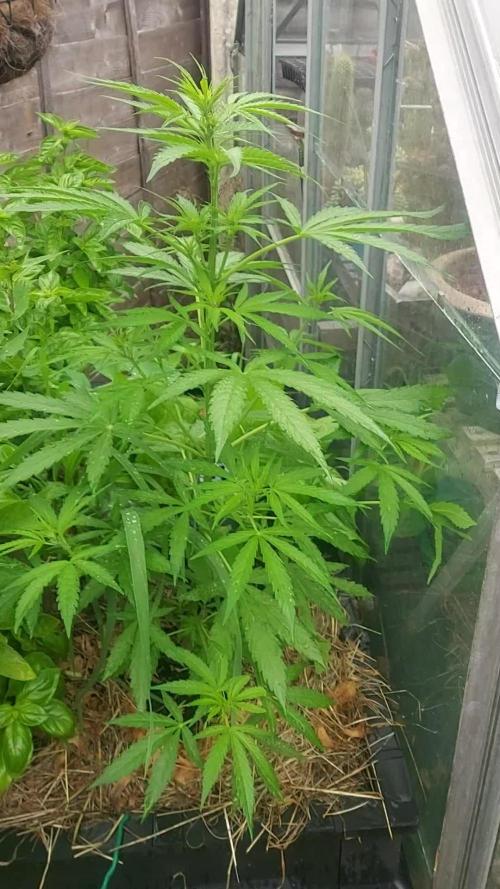
Flower day 5 for mainline - This lady is really stretching! Can’t wait to see what the buds look like on this!😍😍 thanks for following friends & happy growing!🌱✌️🏼
Likes
8
Share


@Ctrellis90
Follow
Wow!
That's what I find myself saying every time I look into this beautiful flower tent!
It's the end of week four bloom and dang am I happy lol. I'm absolutely in love with this plants strong indica structure. She looks so strong and sturdy, can't wait to see how she looks in full bloom, stacked up with flower... gorgeous plant.
We're running the insect Frass now, full strength and I also put down some hummus and compost as a top dressing just to be sure that these ladies have enough food. I'm sure that should be plenty until harvest.
Thanks for stopping by and be sure to check out Nupeddler and Growing Organic! Discount code CollinT

Likes
92
Share


@DogDoctorOfficial
Follow
🌱 Week 1: The Journey Begins! 🌟
Hey Grow Fam! 🙌 We’re off to an epic start with our TrolMaster adventure, and I’m already feeling the love for the setup, the seeds, and the growth happening in the room! So, let’s dive right in and get into the details of this exciting week!
🌿 Germination Update:
Our first Gorilla Melon seed from Fast Buds didn’t sprout, but no worries—round two was a success! 🦍🍈 The second seed has germinated and is looking full of potential. I’m throwing in a Sweet Seeds Papaya Zoap into the germination station too, so we’re keeping this exciting lineup going strong! Germination is such a key part of the journey, and having a healthy start is what it’s all about.
🔧 Room Build & TrolMaster Setup:
The build is coming along beautifully, and I gotta say, the TrolMaster system is blowing my mind! Everything’s under control like magic 🎩✨, and the TM+ app? Wow, just wow. I mean, I can literally be in the bathroom and still keep an eye on the plants—check all the metrics, adjust settings, and fine-tune what I need, all from my phone! 😂💧 This level of control is next level. I’m loving how smooth and seamless it makes managing the room. The gear is just unreal, and seeing it all come together is truly something special.
🌱 Nutrition Talk:
As for feeding, we’re starting light but smart! I’ve begun with 0.15ml of Regulator and 0.25ml of Startbooster per liter for now. I always believe in starting easy and ramping up as the plants develop. These early stages are crucial—balance is everything. For the time being, I feel this is more than enough to keep the babies happy and healthy. 🌿💧 The Regulator is working wonders in maintaining plant structure and health, while the Startbooster is fueling the early root and vegetative growth, laying down a solid foundation for the weeks to come. It’s about getting it right from the start—too much too early can be a killer. Keeping it steady with precision, that’s the goal!
Big Shout-Outs:
To the amazing team at @TrolMaster, @Fast_Buds, @Sweet_Seeds, @AptusHolland, and all the incredible sponsors—I’m beyond grateful for the support! 💚 And to my GrowDiaries fam and followers, you guys make this journey what it is—thank you for the love, and I’m so honored to have you along for this ride. 🙏
We’re just getting started, and I can’t wait to show you what’s next. Stay tuned for more updates, epic builds, gear reviews, and plenty of insight. Don’t forget to follow me on GrowDiaries, YouTube, and IG for exclusive content, and let’s make this grow the best one yet! 🌿🔥
Growers Love to All 💚💚💚
P.S.- A deep dive into the Full Spectrum Quantum Sensor (MBS-PAR):
The Full Spectrum Quantum Sensor (MBS-PAR) is an essential tool for any serious grower looking to optimize their light environment. This sensor measures photosynthetically active radiation (PAR), which refers to the spectrum of light that plants actually use for photosynthesis—typically between 400 and 700 nanometers and more depending .
What makes the MBS-PAR sensor special is its full spectrum capability, meaning it accurately detects not just visible light but also far-red and UV light—which are crucial for maximizing plant growth, development, and flowering. With this tool, I can monitor the exact intensity of light my plants are receiving, making sure they’re getting the optimal levels for every stage of growth.
By using this sensor in my grow room, I’ll be able to ensure that the light distribution is uniform across the canopy. Plus, it allows me to fine-tune the light output from my ThinkGrow LED setup, ensuring my plants are thriving under the best conditions. Whether it’s increasing light during the vegetative phase or fine-tuning it for flowering, the MBS-PAR sensor helps me keep everything on point. And the best part? I can monitor it all through the TrolMaster app, ensuring I can make adjustments whenever needed—even if I’m not in the grow room!
This level of precision means healthier plants, better yields, and maximum efficiency. It’s a game-changer for taking the guesswork out of lighting and getting closer to growing perfection! 🌱💡
Growers Love to All 💚💚💚


Likes
54
Share


@MadeInGermany
Follow
Hey guys :-)
First of all I have to say that all 5 strains I have in the tent from Amsterdam Genetic are beautiful genetics 👍 .
This week they were repotted into 8L fabric pots.
When repotting, 2 g of Green House Powder Feeding Bio line were added per liter of substrate :-) .
That's enough until the first flowers start 👍.
Watering was done twice this week with 0.8 l each.
Otherwise everything was cleaned and checked and fresh osmosis water was mixed.
Stay healthy 🙏🏻💚
👇🏼👇🏼👇🏼👇🏼👇🏼👇🏼👇🏼👇🏼👇🏼👇🏼👇🏼👇🏼
‘Powered by GreenHouse Feeding’
Copy the link for 10% off all Nutrients 👇🏼
https://shop.greenhousefeeding.com/affiliate/MadeInGermany_PassionGrower
👇🏼👇🏼👇🏼👇🏼👇🏼👇🏼👇🏼👇🏼👇🏼👇🏼👇🏼👇🏼
You can buy this strain at :
https://www.amsterdamgenetics.com/product/choco-cheesecake/
👇🏼👇🏼👇🏼
Use the coupon code: madeingermany
for 10% on all Amsterdam Genetics seeds
Water 💧 💧💧
Osmosis water mixed with Cal/Mag (24 hours stale that the chlorine evaporates) to 290 ppm and Ph with Ph- to 5.8 - 6.4
MadeInGermany

Processing
Likes
19
Share

