





@HIAZ_urbanbudfarmer
Volgen
Hello to all , Do-si-do's are going well #1 is 21 days old , the others around 15 days old. #2 was a bit mutated (leaves) but is coming back. Upgraded to a Mars Hydro Fce 4800, a very nice light ,good build quality, great coverage . Start Lst this week, increased nutes & feeding, every 2 hours for 15 minutes. Till next week Gromie's rock on🤙🤪🤘


@hooolian
Volgen
the plants have really grown this week and are on 250ml of filtered water every other day. nodes are looking nice and tight together and foliage is really taking shape. they seem to be growing at different speeds. Humidity can rise to 65% during the night may need to invest in a mini dehumidifier when flowering.
Possibly will switch to 12/12 light cycle and initiate budding at the end of next week which will be November 21st.


@LSchnabel
Volgen
This plant was amazing from start to finish.
I will update a final comment soon as well as final weigh and a review of the smoke once sent out to a group of testers.

shorts_status_processing


@ThePotFactory
Volgen
Just flushing the girls this week, waiting for most trichomes to go cloudy instead of clear. Ive now switched the lights off for 36/48 hours and will harvest in the next couple of days :))


@TheCannaProphet
Volgen
~ FastBuds PAPAYA SHERBET Photoperiod~
Well here we go on another journey together through 'Canna-land' and this one's kinda special... forget that, it's VERY special because this is FastBuds newest surprise for the community, a FEMINIZED PHOTOPERIOD STRAIN!🤯
I was fortunate enough to score these seeds, of which only 1000 were available and can't wait to see what this strain can do! This Papaya Sherbet, according to FastBuds, is a hybrid with a 9-10 weeks flowering period. For a more detailed and accurate description of this strain the following from FastBuds says it best:
"Combining the massive stature of Papaya (Oni Selection) with the strength and resilience of one of our best keeper cuts (Sunset Sherbet), this strain develops into a big, expansive bush adorned with numerous bud sites that later transform into a generous harvest of medium-sized buds. Papaya Sherbet flowers deliver a signature flavor of premium cannabis with subtle citrus undertones that emerge upon inhaling. During growth, her aroma makes for a sweet yet pleasantly bitter fragrance, giving you an idea of what the smoke will taste like. Notably stress-resistant, Papaya Sherbet is a great choice for growers working in challenging environments. She is very forgiving and rebounds quickly from any adversity, allowing growers the freedom to experiment with confidence that she will take everything like a champion she is. This strain embodies resilience, flavor, and abundant yields in every grow cycle."
Sounds like an epic strain and I personally cannot wait for this lady to strut her stuff!😍
________________________________________________________________________________________________________________________________________________________________________________________________________________________________________________________________________________________________________________________
The Setup:
This is going to be an outdoor grow, but I have started the Papaya Sherbet photoperiod indoors as our weather is still a bit too chilly to put a newly sprouted seedling outside (nighttime temp's dipping regularly into the 40's℉).
The plan is simple... let her grow inside under a 19/5 light schedule until the nighttime temperatures are in the mid 50's℉, which shouldn't be long. After which, she'll be moved outside and transplanted into the soil which I have already setup and inoculated with beneficial microbes from BioTabs and slow release dry amendments from Gaia Green. Once she's established herself outside she'll be given periodic top dressings of Gaia Green 4-4-4 and 2-8-4 along with worm castings and Compost Tea's. Her grow area is approx. 5'x5' and I have posts and a trellis net set up already for when she gets bigger to aid in training her. Let the fun begin!🤪💚
________________________________________________________________________________________________________________________________________________________________________________________________________________________________________________________________________________________________________________________
Weekly Updates:
8/11- Here we go into the FIRST WEEK of flower for the FastBuds Papaya Sherbet photoperiod! She finally finished her preflower stretch, ending up at a nosebleed height of 90" tall! It was such a great sight to look at her yesterday and see little flowers beginning to form. She's going to be a beautiful plant!
8/13- Our weather has cooled off after last weeks tropical system passed and it's nice to have a much needed break from the heat and humidity!
I am continuing to water daily with 5-8 gallons of well water from the garden hose. I also went ahead and removed two small branches that were at the very bottom of the Papaya Sherbet that would only take away nutrients from more beneficial areas of the plant.
8/15- Today, I top dressed the Papaya Sherbet with 3 cups of Gaia Green 2-8-4 Power Bloom which I watered in with well water from the hose. I then applied 1/2 gallon of a nutrient mix I made up in 2 1/2g of well water consisting of: 1/4 cup Neptune's Harvest Seaweed(kelp) plant food and 2 1/2 tsp. of Plantonics Amino Bliss.
8/17- There goes the first full week of flower for this incredibly stunning Papaya Sherbet photoperiod from FastBuds and I can not wait to see her transformation as this lady progresses through flowering!
Thank you for checking out my diary, your positive comments and support make it all worthwhile! 💚Growers Love!💚😎🙏




@Ultraviolet
Volgen
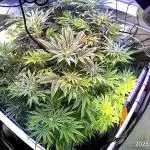
Gave her a cocktail to help with stress. Added 1st net for lateral support, not so much now, but for later. Blue light is absorbed by photoreceptor proteins called phototropins, which trigger a hormonal response that causes cells on the shaded side to elongate, making the plant bend toward the light. Try and fill this side a little. She is quite big already, just needs to find her stride again after the undue torture.
The mind is constantly working and producing, just like a factory. It's not just a passive recipient of information but an active producer of ideas, attitudes, and beliefs. The "ingredients" in this factory are the information you consume, such as books, conversations, and the media you engage with. The "products" are your thoughts, beliefs, and actions. The quality of the ingredients directly influences the quality of the output.
5 apex stems with 20-30 mini cola, let them develop a little, with the apical dominance shattered, all those 20-30 will all compete with each other as soon as that stretch is initiated. Key to a good stretch is making sure the plant is cycling efficiently, with large ATP conversions occurring lights out.
For now, keeping light intensity high. A plant will slow its vertical growth in very high light intensities, leading to a more compact form with thicker stems and leaves. This response is a protective mechanism against light stress, which can damage the photosynthetic apparatus and lead to symptoms like leaf scorching, yellowing, and brittleness. Instead of growing taller, the plant invests its energy into creating a more robust, stress-tolerant structure.
Providing plants with necessary antioxidants helps protect the photosynthetic apparatus by scavenging reactive oxygen species (ROS) that cause damage from excess light.
UV light exposure can impact the xanthophyll cycle by either enhancing its photoprotective role or causing damage, depending on the intensity and type of UV radiation. UV exposure can trigger the synthesis of more xanthophyll cycle pigments to increase the plant's capacity to dissipate excess energy, but it can also cause direct damage, particularly to Photosystem II, and may lead to a decrease in the de-epoxidation state (DEPS ratio) which indicates a reduced capacity to dissipate excess energy.
Plants can respond to UV stress by increasing the synthesis of xanthophyll cycle pigments, such as violaxanthin and zeaxanthin, to improve their photoprotective capacity. UV-induced changes in xanthophyll cycle pigments can be linked to a plant's overall tolerance to high radiation stress. The xanthophyll cycle helps protect against photoinhibition, which is especially important when the plant is exposed to high levels of both UV and visible light. High doses of UV radiation can directly damage photosynthetic components, including the proteins, lipids, and pigments in the thylakoid membranes. Exposure to UV radiation can have a mixed effect on the de-epoxidation state (DEPS ratio) of the xanthophyll cycle pigments. In some cases, UV can inhibit the conversion of violaxanthin to zeaxanthin, resulting in a lower DEPS ratio and a reduced capacity for energy dissipation. However, the total pool of xanthophyll cycle pigments may increase, and this enhanced pool size could provide a greater potential for photoprotection despite a lower DEPS ratio.
The xanthophyll cycle works alongside other mechanisms, such as the accumulation of flavonoids (UV screens), to protect the plant from UV-induced damage.
Blue light repairs 100% UV-induced damage in plants through a process called photoreactivation, which uses a light-dependent enzyme called photolyase. This enzyme uses energy from blue and UV-A light to directly reverse the damaging pyrimidine dimers in the DNA caused by UV-B radiation, a key mechanism for maintaining the plant's genetic integrity.
After carbon, light, water, temperature, and nutrients, the limiting factor of a plant's growth is often its own internal factors or the amount of a key ingredient. Chlorophyll concentration is one such factor, as the amount of this pigment limits how much light can be captured for photosynthesis. Other factors include chloroplast number, respiration rate, and the concentration of carbon dioxide in the atmosphere, as plants are often in a CO2-deficient condition.
60x60x18=64800seconds x 700 = 45,360,000moles. 45DLI
Exposure to 165 µW/cm² of ultraviolet-B (UV-B) light for 3600 seconds = 1 hour, a extremely high, acute dose triggering stress responses and protective mechanisms.
.
The plant's photoreceptor protein, UVR8, senses the UV-B radiation. This triggers a signaling cascade that activates specific genes to protect the plant from damage. In response to the UV-B signal, the plant ramps up the biosynthesis of protective compounds like flavonoids, phenolic acids, and anthocyanins. These compounds absorb UV radiation and accumulate in the epidermal layers of leaves to shield inner photosynthetic tissues. The plant may increase leaf thickness or deposit more cuticular wax, creating a physical barrier to the radiation. The plant will produce more enzymatic and non-enzymatic antioxidants to neutralize the reactive oxygen species (ROS) produced by the UV-B radiation. The plant activates enzymes, including photolyases, to repair DNA damage caused by the UV-B. These repair mechanisms are critical for preventing permanent genetic mutations.
While protective measures are activated, a high dose delivered over a short period can cause stress that overwhelms the plant's defenses.
Photosynthesis is highly sensitive to UV-B. A high dose can inactivate Photosystem II (PSII), damage thylakoid membranes within the chloroplasts, and reduce chlorophyll content, which lowers the plant's overall photosynthetic capacity. Despite repair mechanisms, high UV-B doses can inflict persistent damage on the plant's DNA. The overproduction of reactive oxygen species can cause oxidative stress, leading to the oxidation of lipids and proteins and disrupting cellular function.
I am playing in the enchanted forest. A shift in perspective is what changes perception over time. By deliberately considering a situation from another point of view (perspective), you can challenge your initial, knee-jerk interpretation (perception). This is a valuable skill in both personal and professional life for fostering empathy, improving problem-solving, and making more informed decisions.
Move the mind off perception into perspective.
Thank you.


@MrGrowthSpurt
Volgen
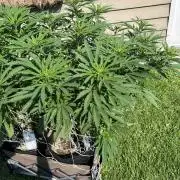
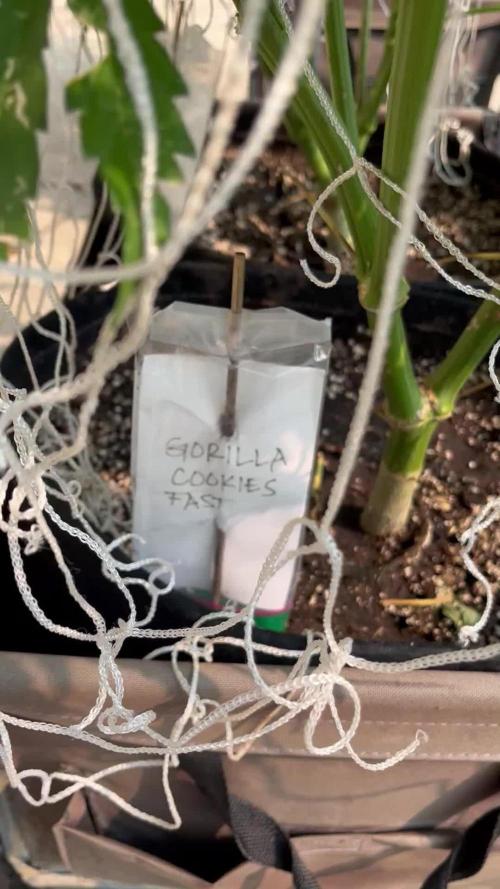
Another excellent easy to grow strain. Early on she developed what appeared to be rust spots on the bottom half fan leaves. I implemented calmag into her feeding. It didn't appear to reverse the impact but did delay it or slow it down. Not to mention the last month she and the others have been neglected due to my schedule. She has been very resilient throughout. She is in the drying phase currently so I will definitely update when I take her for a test drive.


@Northern_Ent
Volgen
July 25: she has recovered nicely from the hail storm teo weeks ago. Force flowering in garage at 9 pm, a few seconds of 730 nm far red light and then out of garage at 7 am. Works for me but adjust as needed for your latitude.
July 26: watered with lazy compost tea this morning. Looking good.

@thehood
Volgen
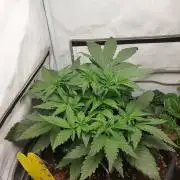
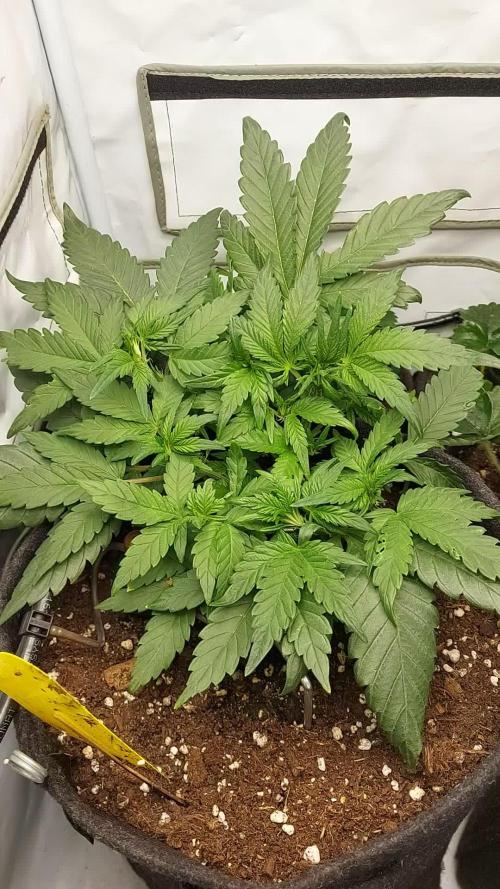
We're in the stretch phase now and you can almost watch the plant grow. I am trying to keep the branches apart and bring them to the same height. I removed overlapping leaves and smaller twigs. The smell is slowly getting stronger.


@GanjaReaper
Volgen
Day 56:
Like I said in the 2 weeks before this one, I was on vacation and a friend took care of my plants.
This is the last week he helped out, I will be taking care of them again in the upcomming week.
Well what can I say about this week;
- Weather/climate was still bad. Lots of rain and cold temps.
- They kind of failed with Low stress training, they went up and stretched without proper bending.
- One plant has already mature looking buds but still on the small size. Two/three of them are going well and one is falling behind flowering wise.
- They look nicely green tought.
Until next week.


@Cannabis_Sativa
Volgen
We are in late bloom colour of the buds are more coloured (pink/red/purpple) it is maturity simptoms so prepearing for harvest




@PotusArg
Volgen
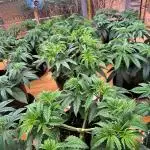
Week 3: The plants have adapted very well to the new pots and didn’t show any signs of stunted growth. I decided to do some main-lining so they grow evenly and maintain their height. I won’t lie, I was a bit nervous, but everything seems to be going smoothly. I’ve also added a new oscillating fan to improve air circulation.
Semana 3: Las plantas se adaptaron muy bien a las nuevas macetas y no mostraron signos de estancamiento en el crecimiento. Decidí hacerles main-lining para que crezcan de forma pareja y mantengan su altura. No voy a mentir, estaba nervioso, pero parece que todo va viento en popa. He incorporado un nuevo ventilador oscilante para mejorar la circulación del aire.
