


Likes
Comments
Share


@Ninjabuds
Follow
My Grand Turismo plant is looking amazing! The leaves are a really vibrant green, and they have this cool, almost waxy texture that makes them look super healthy. It's growing nice and bushy, and I'm loving the overall shape. This one's definitely a showstopper, and I can't wait to see how it blooms. Stay tuned for more updates on this beauty!
The weather has been absolutely gorgeous this past week! We've been hitting that sweet spot of 70 degrees during the day, perfect for getting outside and soaking up some sun. Then, it cools down to a comfy 50 degrees at night, which is ideal for sleeping with the windows open. I've been loving all the fresh air!
I finally got around to building that little wooden planter for my windowsill. It was a fun project, and now my regular plants have a nice new home. It really brightens up the room, and I'm thinking of adding some herbs to it soon. Maybe I'll even try growing some basil!

Likes
33
Share


@420DeepGrow
Follow
Gran cosecha de calidad gracias a Marshydro y XpertNutrients.
Una planta con distancia intermodal media y unos cogollos resinosos de un tamaño medio.
Su aroma esta muy conseguido, puro Zkittlez con un toque cítrico que recuerda a la mandarina.
Las manos se me impregnaban de resina al manicurar.

Likes
1
Share


@85IWinParlays
Follow
Week 4 of veg, for Apple Fritter from Royal Queen Seeds mother plant. Just gave her water every other day.
On January 31st, 2025, I decided to use some clips for some LST.

Likes
19
Share


@RDWCGrowing
Follow
7/27/2023- Prep
Tent and system are cleaned and ready to go from my last grow. I have submitted my Journa for the Diary of the Month Competition here is to hopeing for good resutls.
7/28/2023- Germination Day 0- Seed initiation
Well lets get this new Grow started.. So My Dad Sent me a custom Landrace Strain that he wanted me to grow out and Breed for him. The Strain is Called Black African Magic:
Black African Magic, Alson known as BAM, is a Sativa pure land race strain, It's classified under the Cannabis Sative species and its genetics come from Africa-the Ituri Forest in the Dmocratic Repoublic of Congo. The Effects are said to be Very Psychedelic, used for Stress managment and for better sleep and rest. This is my frist Land Race so we, will see how this goes together..
RO Water Used
Added Hydrogen Peroxided
8/1/2023- Germination Achieved G-Day1
Popped her head above the root riot today to say hello.. Woot first challenge when dealing with an unknown seed and a new Strain is getting the seed to pop and the lady to show life.
8/2/2023- Germination Day 2
Took the root riot out today and it was soaked not good plant drowing again. I am still having a hard time finding the right blance for where the water should be to keep the root riot moist and not soaked. I had to drain some of the water out of the root riot plug to help give a little oxygen. I also removed some of the water.
8/3/2023- Germination Day 3
Looking good stretching her leaves out to let in the lights
8/4/2023- Germination Day 4
Looking good a few days until I put them into the RDWC System and get this thing rocking and rolling.
8/5/2023- Germinaiton Day 5
Looking good will probably plant tomorrow if the roots are still looking good.
8/6/2023- Plant Day- Germination Day 6
Planted into the RDWC System today. Joy when they go into the system as long as we dial that in right this will now be a great grow.. Survived the hard part..
8/7/2023- Germination Day 7
Everything looks like it is going good, she is showing some damage on the lower leaves from the over watering in the cloning machine but right now I don't see any new damage.
8/8/2023- Germination Day 8
Added the first Nutes today, to help support root growth and to help give there first jump to growth.
TPS SILICA GOLD-.5mil/Gal
Root Drip- 1mil/Gal
GH FLoraMicro-1mil/Gal
GH FlroaGro-1mil/Gal
GH FLroaBloom-1Mil/Gal
ORCA-.5mil/Gal
8/9/2023 - Germination Day 9
Everything is looking good new growth looks like it is praying and they are looking happy. I will take off the damage leaves probably tomorrow.
8/10/2023- Germination Day 10
She looks like she is on track the roots are starting to come out of the basket very small but starting.
8/11/2023- Germination Day 11
Cleaned up the dead leaves... Day 1 VEG tomorrow.. Water Change Day and first real meal...
Likes
23
Share


@Wazowskid
Follow
Looking good so far with a 10€ Amazon full spectrum light and the cheapest soil I could get from Lidl. I'm using a closet wrapped with aluminium foil as grow tent.
Likes
5
Share


@CanarianGrow92
Follow
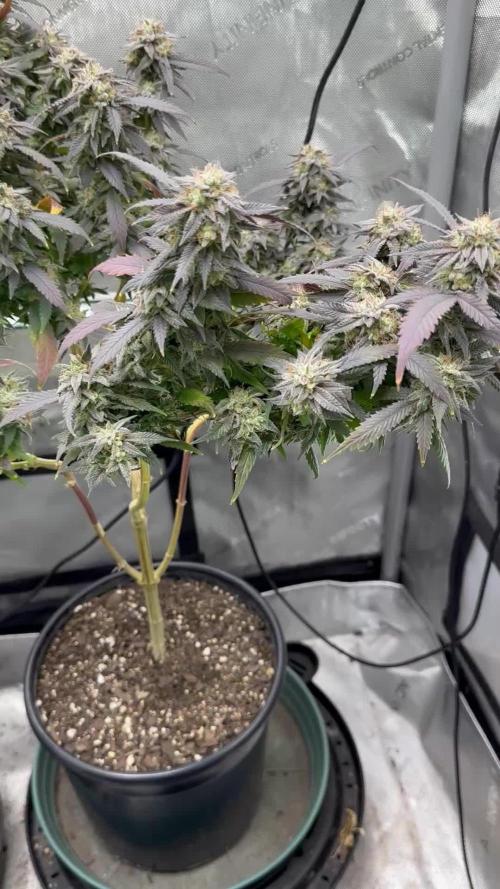
Week 3 for the gorilla cookies 🍪 from our favorite autoflower company, of course fastbuds 420!
All looks quite good at the moment.
This week we gave bloom, root, silica, calmag amino, sugar shot, sticky fingers and bloom booster all from xpert nutrients!


Likes
Comments
Share


@Sativ_420
Follow
Tuvieron dos dias de lluvia intensa y para prevenir plagas le hice una buena poda. Hasta el momento vienen creciendo sin carencias.


Likes
4
Share


@Budette_Botanics
Follow
She seems to responding well to the net, and defoliating. I have taken quite a few leaves from both this week. Hopefully it won’t stress her out too much, it was much needed. The leaves were shading nodes, and crowding each other. We will see how the week progresses. She has been very petite throughout, but this last week I have notice she is starting to have a growth spurt. I wasn’t convinced it would happen with this one, but she’s on it! She had a rough start, so how ever it goes I’m curious to see how she ends. No deficiencies to note (touch wood) she has been quite resilient in that sense, where as her neighbour s/b has been battling potassium deficiency. Fed the same, but they really are worlds apart.
Thank you for taking an interest 💚 Happy growing everyone 💚🌱


Likes
13
Share


@Blunt
Follow
28/03/22 - The plants are looking happy, which makes me happy hahaha loving this grow! The clones I took from these girls are very happy as well have been put into air pots.
29/03/22 - Feels like im just sitting back and watching the magic at this stage, plants are not really needing any attention from me
30/03/22 - flowers are looking good and the same, very happy now 😁
31/03/22 - Plants are healthy, no signs of stress or deficiencies. Thanks AMS for these quality seeds 👍
01/04/22 - getting frostier every week 💪
02/04/22 - getting more beautiful every week, I have been switching between PK spike and Massive Bloom every week and seems to be working well for these plants, no signs of them lacking anything.
03/04/22 - End of the week and the aroma is getting sweet, I am really enjoying growing this plant!

Likes
29
Share

@DE_BW
Follow
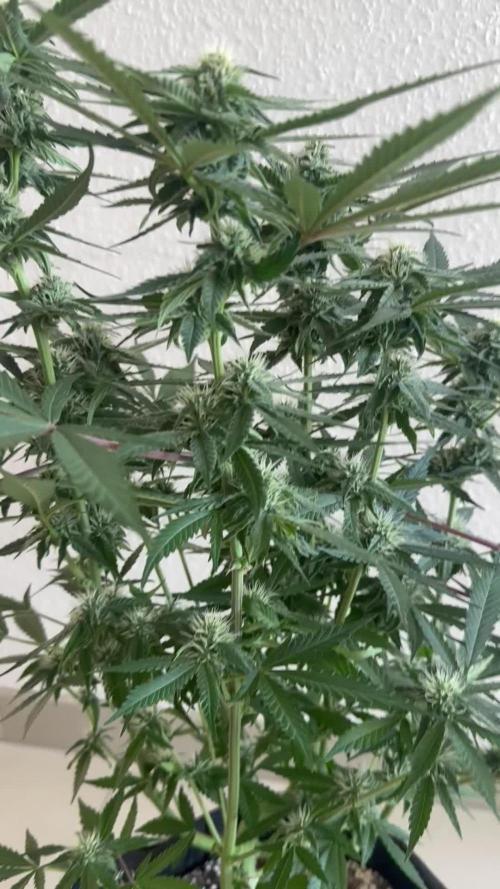
Mendo Frost is looking very promising now and is definitely living up to her name. Bud stacking has accelerated noticeably, with multiple sites already showing excellent frost production and strong flower development. I performed a moderate defoliation this week to improve light penetration and airflow through the canopy. At this point the structure is set, the plant is healthy, and the focus shifts to letting the buds bulk up over the coming weeks.


Likes
6
Share


@Drewseph
Follow
Crop King guarantees 80% germination rate... All 5 beans popped. 💪
When I was initially buying all of my equipment, I had not a f*cking clue what I was doing or what I would need. 😂
Swapped out the plastic pots for Vivosun 3 gal fabric pots, bought the 5 gal to transplant but decided against it later since all 5 plants were healthy and growing fast and my space was limited... Also didn't fully grasp the mechanics and procedures of Drain-To-Waste Hydroponics at the time but I'll post the automated build I added at the appropriate week of veg... And it wasn't until a couple weeks ago that I started doing the proper research into lights, spectrums, PPFD, PAR, etc... but these two lights (the blurple came with the tent, the other was from a brand called iSmile on Amazon; 130w and 105w actual wattage) were plenty to make it through veg and into preflower before I upgraded to the Sunraise QB2000...


Likes
2
Share


@Ultraviolet_
Follow
We become aware at such times of man's wonderful ability to bring seemingly unrelated elements into harmonic balance, and receive a glimpse into a world where everything exists in conscious sympathetic attunement to everything else. When we listen to a piece of music that seems to strike a beautiful chord somewhere inside us, or view a painting that simply glows with harmonic awareness well executed, we probably do not spare much time to contemplate the wonderfully intricate combination of vibrations that our sensors make it possible for us to perceive. We tend to appreciate the relationship between the parts of something by an awareness of the harmony or dissonance of the whole. This ability enables us to say "what a beautiful house!" instead of "analysis has proven that this collection of building materials exhibits certain elements of harmonic proportion." While this ability to instinctively appreciate the beauty of true harmony has an important role to play in evolution, a more analytical understanding of the laws involved can be most useful. This is especially so if we wish to create works of art where each part exists in true harmony, not only with the other part of that particular whole, but with the universe within which the creator and the created exist.
Everything vibrates. From the most dense matter to the most subtle cosmic rays, everything which our senses allow our thoughts to become aware of, can be specified in terms of wavelength or frequency of vibration. These two terms define the same thing, but from different points of view.
The following are the approximate wavelengths of various energy carriers:
Cosmic rays 0.000,000,001 mm
Gamma rays 0.000,000,1 mm
X rays 0.000,500 mm
Ultraviolet rays 0.003 mm
Visible light 0.006 mm
Infrared 0.01 mm
Sound waves 1 meter
Radio waves 300 meters
Violet light 400 nm to 450 nm
Blue light 450 nm to 500 nm
Green light 500 nm to 570 nm
Yellow light 570 nm to 590 nm
Orange light 590 nm to 610 nm
Red light 610 to 700 nm
1 nanometer (nm) = 0.000,000,1 cm = 1/10,000,000 cm
If a guitar string is plucked and we hear a sound, it is not too difficult for the human mind to associate this sound with the vibration of the guitar string. With color it is quite different. It is difficult for us to conceive that the color of a substance is not an inherent property of the substance itself, but an indication picked up by our senses of that substance's ability to absorb or reflect the light which happens to be shining on it at that moment. Neither the matter nor the light is colored. What happens is that the brain learns to differentiate between the frequencies reflected or transmitted by the substance the eyes are focused on. The same thing happens with sound. When we say "Oh! Listen, they're playing my favorite song," what we really mean is: "My brain has stored within it a particular pattern of frequencies. I have compared the new information being received with this stored pattern and have deduced the answer that the two patterns are similar within certain specified tolerances." The 'pleasure' involved could have something to do with our running the pre-recorded pattern at the same time, in 'sympathy' with the new pattern as it is received.
The word sympathy describes very well our ability to appreciate color and sound. It also describes the reason behind certain elements of harmony. For instance, if a substance vibrating at 100 cycles per second (tone 1) is in the proximity of another substance vibrating at 200 cycles per second (tone 2), we could perceive, if we had the right equipment, a certain sympathetic relationship between the two.
We will see from this that there is a uniform doubling of the first tone seen in the second. At various points along the waves, the two are the same in amplitude. At other points, they are at opposite poles to each other. This doubled frequency has more points of similarity to the original than any other frequency except the original itself. If the equipment we had available for measuring these two frequencies was a soundboard amplifier and a pair of ears, then we would hear what would sound to us like one tone. If we had the opportunity to hear one at a time, we would hear that although they sound the same, one is higher in pitch than the other. This characteristic of 'the same but different in pitch', musicians have called the octave. Any two tones produced where one has exactly doubled the frequency of the other is called an octave. Speaking in ratios, an octave would appear then as the ratio 2:1 or 1:2, depending on whether we are talking of an octave up or down.
A single note produced by almost any instrument will contain more than one wavelength or frequency. It will have a dominant frequency, the wavelength of which we would call the note's 'fundamental' or 1st harmonic. It will also have a varying number of upper harmonics, gradually fading in intensity into infinity or silence.
Natural harmonics always have the same pattern of intervals between them. The interval between the 1st and 2nd harmonic is a perfect octave; between the 2nd and 3rd a perfect fifth; between the 3rd and 4th a perfect 4th; and so on, the intervals becoming smaller and smaller until they lose any relationship with the western 12 tone scale as it exists at the moment. Just as an octave has certain elements of sympathy with its fundamental, so some intervals have been noted to be more perfectly in sympathy with the fundamental than others. The ratio of the 'perfect 5th' or interval of 7 semitones, as it occurs in the harmonic series, is 3:2 or 2:3, while that of the 'perfect fourth" is 4:3 or 3:4. All the tones in the western 12 tone scale can be expressed in terms of the ratio between the upper tone and its fundamental. This would seem to be an ideal way of generating a scale from any given fundamental and several attempts have been made to do this, the Pythagorean system being probably the most well known. Although when working with a single tone instrument playing on its own, the Pythagorean formula works wonderfully well, if we had several instruments tuned this way together and asked them to play almost any western music, we would find that at times they sounded quite out of tune to each other.
The lack of flexibility of the various scale systems based on the harmonic series has led to what is known as the 'tempered' scale. This uses as its primary unit of interval the ratio of the octave or 2:1. It then proceeds to divide the interval between any fundamental and its upper octave into 12 smaller intervals by applying the ratio: two to the one-twelfth power, to one (21/12:1). This equals 1.059463094, so by multiplying any frequency by this number, we will obtain the tempered semitone next up from our fundamental. We will also find that any tone twelve semitones up from any other tone, in a scale generated in this way, will have exactly double the frequency.
If we took the note middle C on a piano and halved the wavelength, we would have the note C one octave above. If we halved this, we would have the C above, and so on. However, within about 6 octaves, we would find that although a 'sound' was being produced, no human ear could perceive it. If we kept on going, halving and producing upper octaves of our fundamental C, we would proceed through the infrared band, into the visible light spectrum. If we happened to be outside during the day, we would, for one octave only, see the note C with our eyes. The next octave above would already be in the ultraviolet band, and outside the eye's sensitivity range. If we can think of color as being an indication of a substance's vibratory rate or wavelength, we may begin to see a relationship that could exist between the color and sound spectrums.
The logical extension of what has so far been said is that there exists a scale in the color spectrum that corresponds exactly to the scale in the sound spectrum, each color tone being an octave of the equivalent note in the sound range.
This is not the end of the story but only the beginning. If we can for the moment accept that any wavelength in one band has upper and lower octave stretching out to infinity, then the next question is 'fine, but what shall we use as our fundamental? A particular color? A particular sound frequency?' The musicians among us will probably say 'A 440'. This means that the note A should vibrate at 440 Hertz, or 440 times per second. They would tell us that this is standard pitch has been adopted by most orchestras around the world; pianos are tuned to it, instruments are constructed to formulas based on it, and so to them it would probably seem the most appropriate place to begin. Some of these musicians may know of the battle that is still raging with regards to this being the standard, but few would know why A = 440 Hz was chosen except that it worked when it was set to be a suitable compromise between the many different pitches in use at the time.
432 Hz is said to be mathematically consistent with the patterns of the universe. Studies reveal that 432 Hz tuning vibrates with the universe’s golden mean PHI and unifies the properties of light, time, space, matter, gravity, and magnetism with biology, the DNA code, and consciousness. When our atoms and DNA start to resonate in harmony with the spiraling pattern of nature, our sense of connection to nature is said to be magnified.
Another interesting factor to consider is that the A=432 Hz tuning correlates with the color spectrum, while the A=440 Hz is off. Audiophiles have also stated that A = 432 Hz music seems to be non-local and can fill an entire room, whereas A=440 Hz can be perceived as directional or linear in sound propagation.
Once you adopt the idea that sound (or vibration in general) can have an equalizing and harmonizing effect (as well as a disturbing effect), the science of harmony can be applied to bring greater harmony into one's life or tune to specific energies. There is a form of absolute and relative harmony. Absolute harmony can, for example, be determined by the tuning of an instrument. The ancients tuned their instruments at an A of 432 Hz instead of 440 Hz - and for a good reason. There are plenty of music examples on the internet that you can listen to in order to establish the difference for yourself.
Attuning the instrument to 432 Hz results in a more relaxing sound, while 440 Hz slightly tenses up the body. This is because 440 Hz is out of tune with both macro and micro cosmos. On the contrary, 432 Hz is in tune. To give an example of how this is manifested microcosmically: our breath (0,3 Hz) and our pulse (1,2 Hz) relate to the frequency of the lower octave of an A of 432 Hz (108 Hz) as 1:360 and 1:90.
It is interesting to note that 432 Hz was the standard pitch of many old instruments and that it was only recently (19th and 20th century) the standard pitch was increased. This was done in order to be able to play for bigger audiences. Bigger audiences (more bodies) absorb more of the lower frequencies, so the higher pitch was more likely to “cut through”. One of the oldest instruments of the world is the bell ensemble of Yi Zeng (dated 423 BC), tuned to a standard F4 of 345 Hz, which gives an A= 432 Hz. The frequency of 345 Hz is that of the platonic year! Similarly, many old organs are tuned in A=432 as well; for example, St. Peter’s Capella Gregoriana, St. Peter’s Capella Giulia, S. Maria Maggiore in Rome.
Maria Renold’s book “Intervals Scales Tones and the Concert Pitch C=128 Hz” claims conclusive evidence that 440 Hz and raising concert pitch above scientific “C” Prime=128 Hz (Concert A=432 Hz) disassociates the connection of consciousness to the body and creates anti-social conditions in humanity.
The difference between concert pitch A=440 Hz and Concert A=432 Hz is only 8 cycles per second, but it is a perceptible difference of awareness in the human consciousness experience of the dream we share called existence.
Likes
3
Share


@Abendkraut
Follow
3rd week of flowering started and for only 2 weeks of flowering these ladies have grown very well. I had to pull my lamps even higher which the plants definitely enjoyed. they all gained about 10cm height in less than a week.
I added some CalMag to my water just prevent deficiency. I usually do it around week 9-10
Likes
17
Share


@ILoVeThiSpLaNt
Follow
Non male quest'autofiorente. Praticamente 400gr da 6 piante con una che ha reso 118grammi e quasi 5 di battitura a120micron.Le sei piante sono tutte leggermente diverse. Quella che mi piace di più aprendo il barattolo dopo 1mese di concia sa di formaggio stagionato.Al prossimo diario e grazie a chi ha seguito, commentato e messo like grazie 🙏 ❤️
Likes
98
Share


@DogDoctorOfficial
Follow
I love growing its a big passion of mine , and the fact that GD exists makes everything so much better, one can interact with others and enjoy and learn from each others. Thank you all growers love and keep them green <3 <3 <3
