Likes
Comments
Share
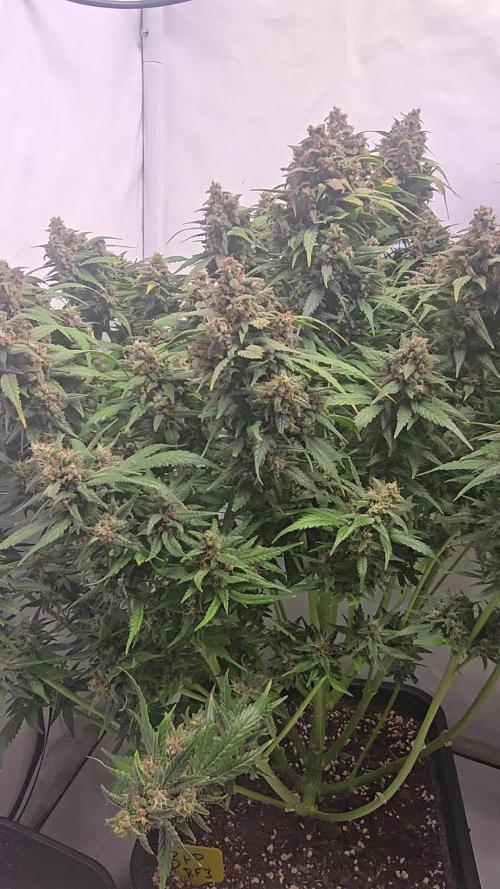
Im flushing now and hoping she will be ready to chop shortly , she has not been the quickest in flower but im hoping this strain will be great for my insomnia which is why i have chosen to grow this strain
Likes
2
Share
I trimmed her after 1 week of drying. A few days sooner than normal but shes at a spot I feel comfortable putting in jars and keeping close eye on so I can keep the flower on the moist end of the dry scale. I smoked some and already very flavorful but a tad harsh. After a week they should be at a decent smokable condition.
Likes
3
Share
Likes
27
Share
I've added a video review about this strain, and here's the information about Beary White from mephistogenetics.com: -Beary white is a medium sized variety, she doesn't veg for too long before rapidly entering the flowering phase. She has a nice balance of resin coverage on both leaves and flowers. Flowers grow nicely compact and the quality is great. She is a lovely all-rounder in many aspects. -Effect - Strong, Happy, relaxed, but not too inda-couch. -Medicinal Benefits - Great strain for pain and stress relief.
Likes
6
Share
This week I switched from feeding them the General Hydroponics MaxiBloom to KoolBloom. I kept the same pattern with feeding. I feed them the nutrients then just pH'd plain H20 the following day. I pH at 5.8-5.9. I also defoliate as I go so the plant doesn't get stressed out and stop focusing on flowering. These ladies are definitely starting to stink and get sticky!
Likes
19
Share
Day 8 - First official day of veg and both ladies are right on time for a small adjustment in lighting, PH and nutrients. 10ml of Hydro A & Hydro B were added to both buckets (10L of water in each bucket) and the Milwaukee PH controller was set to work. Starting at a PH of around 7.8, it slowly worked down to a perfect 6.0 over about 50minutes. The lights were readjusted to be 60cm from the seedlings who are all between 8-10cm tall and the intensity of the lights increased to about 70% brightness. Day 9 - Cheech is taking nicely to the adjustment in light and nutrients, but CG 1 is looking a little bit too perky. Going to give her 24 hours to adjust. Day 10 - We have finally renamed CG 1. Fellow enthusiasts, meet Venezia. Day 12 - The root systems are clearly visible in the ladies today Day 13 - The ladies are looking well today. Venezia seems to be showing some light signs of heat stress with slight curling of the leaves. The lights are due to be adjusted tomorrow to account for the seedlings growth over the last week.
Likes
89
Share
Tag 108 | Blütetag 64 Rocko's Terp Test featuring: Apokalypse Grow ☀️🔥 Das Wetter bleibt momentan der Chef. Um den sommerlichen Temperaturen entgegenzuwirken, wurde der komplette Lichtzyklus in dieser Woche auf die Nachtstunden von 20:00 bis 08:00 Uhr verlegt. Zusätzlich laufen die beiden XS1500 Pro nur noch mit 40 % Leistung. Ich habe sogar kurz überlegt, den Zyklus auf 21:00 bis 09:00 Uhr zu verschieben, um die größte Nachmittagshitze noch weiter zu umgehen. Vorerst bleibt es aber bei 20:00 bis 08:00 Uhr. In dieser Phase geht es nicht mehr darum, den letzten Ertrag herauszupressen, sondern die Pflanzen möglichst schonend ins Ziel zu bringen. Das Ziel bleibt klar: Fruchtbombe statt Hitzebombe. Das gesamte System läuft aktuell eher in einer warmen Suppe zwischen 26 und 31 °C, statt wie noch vor einigen Wochen zwischen kühl und heiß zu pendeln. Die Klimadaten lesen sich zunächst kritischer, als die Pflanzen tatsächlich aussehen. Trotz der schwülen Wetterlage zeigen die aktuellen Bilder ein erstaunlich stabiles Bild. Die Pflanzen zehren inzwischen sichtbar aus ihren Blattreserven, ohne dass die Blüten selbst deutliche Anzeichen von Hitzestress zeigen. Angesichts der sommerlichen Temperaturen unter dem Dach sind rund 30 bis 31 °C während der Lichtphase derzeit ein durchaus akzeptabler Kompromiss. Chicken & Waffles liefert in dieser Woche den wohl spektakulärsten Anblick. Die Zuckerblätter präsentieren sich inzwischen in tiefen Violetttönen bis hin zu nahezu Schwarz und zeigen stellenweise bordeauxfarbene Nuancen, die sich auf Fotos nur schwer einfangen lassen. Zusammen mit der massiven Harzschicht wirkt die Pflanze beinahe eingefroren. Die Spitze erinnert an mehrere kleine Zwiebelkirchtürme. Mit ihren organischen, leicht verdrehten Formen wirkt sie fast wie ein Bauwerk, das einem Hundertwasser-Entwurf entsprungen sein könnte. So eine Optik hatte ich bisher noch in keinem Grow. Fruit Bomb Punch zeigt in dieser Woche eindrucksvoll, welchen Einfluss das Training auf ihren Wuchs hatte. Durch das wiederholte Herunterclipsen während des Stretchs konnte sich keine klassische Hauptcola entwickeln. Stattdessen bildet die Topblüte aus der Draufsicht einen regelrechten Fünfender mit nahezu gleich hohen Spitzen. Von der Seite wirkt derselbe Bereich dagegen wie ein schlanker Turm aus übereinander gestapelten Blütensegmenten. Die übrigen, weniger beeinflussten Seitentriebe zeigen dagegen die sortentypische Blütenstruktur und machen den Einfluss des Trainings besonders deutlich. Strawberry AK bleibt ihrer Linie treu. Die klassische Kerzenform mit ihrer markanten Hauptcola ist bis heute erhalten geblieben. Gleichzeitig zeigt sie den deutlichsten Herbst-Fade und verwertet konsequent die letzten Reserven aus ihren Fächerblättern. Auch bei den Trichomen zeigen sich inzwischen Unterschiede. Chicken & Waffles liegt aktuell leicht vorn, Strawberry AK folgt überraschend dicht dahinter. Fruit Bomb Punch beginnt dagegen gerade erst sichtbar einzutrüben. Ob sie in der kommenden Woche aufschließen kann, werden die nächsten Makroaufnahmen zeigen. Am Ende entscheidet das Glas. 🍯🌱
Likes
38
Share
Na última semana os pistilos começaram a ficar alaranjados, os buds engordaram pouco, espero que nos próximos dias eles finalizem bem gordos! Darei a ela fertilizante por mais uma semana e depois flush por outra semana, creio que daqui uns 20-25 dias estarei colhendo!
Likes
36
Share
nice week , coming along great. put back the ones that went to rehab. they can flower and see what happens among the elite tent. nutrients this week i have added bio boost for flower. getting th winter air in at night as i want to see color as we develop here. hope everyone good
Likes
26
Share
@BigDaddyK
Follow
Onto flower nutrients last Friday - change reservoir fridays - this is A MONSTER.. This is insane - currently adding 14ml A+B a day to one on left Absolute beast mode engaged Friday - I thought about this alllast night , do I risk it ? So as you know me by now , I did , I’ve moved them into the 35 litre DWC I made , they are just drinking too fast out of the 19 litre, I have a 17 litre reservoir now , and on the ball ache scale ( my own invention ) it was as 4 where 5 is no ball ache and 1 is having to put up a new tent ⛺️ .. I was so careful with the beautiful white roots , fingers crossed 🤞 it will either work amazing or Fuck the whole thing up 😜
Processing
Likes
6
Share
A-M-A-Z-I-N-G! This alien gorilla is blowing me away maan, shit she stinks soo freaking strong, very spicy aroma very piney too, and woody, she's not sweet at all, at least this pheno but the strong spicy piney woody smell is just lovely, you fall in love instantly, the colas look like rockets 🚀🚀 very hard, dense and sticky as hell. I'm so in love with this genetic by the family of original sensible seeds man, what a crazy surprise, I need this girls in my garden every year. She's been 100% organic grown with FLO Living soil and guanokalong organic dry amendments. Hope I can make a big big xxl bush with this strain next season man💎🤤🦍👽🤞 peace everybody!
Processing
Likes
4
Share
Booom! Ya tenemos los cogollos formandose Farmers!! Ya casi no se nota la falta de magnesio por problema con el humidificador pero en breves ya empiezo lo buenoo!😜 espero que os guste farmers buen comienzo de semana!!💚
Likes
17
Share
@Elmobud
Follow
So from the off this strain really does give it what for as they grow big quick which is always a good sign. So getting into veg they carried on growing really well and big especially the fan leaves and loved the training that I did. So going into the flower stage they grew at some rate so be careful about when you switch them as they do nearly triple in size just bare that in mind and it's definitely a 12 week flower not 8 ☹️ but we'll worth the wait😁 So overall I would give this strain a 7 would of been 10 if had been a 8 week strain. Happy Times Happy Growing 😁 🌿
Likes
8
Share
Guava Runtz – Week 10 (Fast Buds Outdoor 2026) Weather was okay. Guava Runtz is nearly finished so the feeding has been reduced. She is fully in the flowering stage. The smell has become very intense. Some leaves show a light purple coloration. The latest trichome check shows a clear increase in milky heads. She is looking good overall and getting close to the finish line.
Likes
5
Share
26. Oktober Runtz keimt minimalistisch. Ähnlich wie bei beiden Cookies. Runtz ist jetzt im 11l Topf Beten wir dass es klappt Tropimango alles gut Cookies gelato alles gut. 28. Oktober Cookies gelato wächst nun deutlich schneller. Tropimango wird ebenfalls schneller. Wachstumphase hat begonnen. Habe das erste mal den Wurzel Dünger und den blattdünger angewandt. Runtz noch nicht sichtbar 29. Oktober Die runtz ist klein sichtbar Cookies gelato macht was es soll Tropimango auch 1. November Cookies Gelato ist nun 17 Tage alt und sieht tip top aus. Das sehr misslungene Umtopfen hat sie gut verkraftet. Tropimango ist nun 14 Tage alt. Sie ist deutlich kleiner und die Blätter haben eine interessante Färbung. Sie wächst deutlich langsamer (Genetik ist auch deutlich kleiner) aber wirkt sehr lebendig. Runtz ist nun 3 Tage alt und sieht gut aus.
Likes
4
Share
@Drobubba
Follow
Greetings family, week 7 in the books. These girls are booming.im currently doing a 12/12 lighting schedule @ 950 ppfd for a DLI of 42 (fingers crossed). Nothing crazy hasn't been happening as of yet. There're greedy and happy as far as how i see it. Not too bad for a wanna be lol. My stoke levels has increased.
Likes
11
Share
Week 16 - Day 103 08/16: Harvested Aaliyah on 08/15, Day 102 from soil and Day of flowering. After one week of pure water for Aaliyah, some of the trichomes have turned amber. I decided to harvest about 3/4 of the plant. Some of the lower buds didn’t receive enough light during the grow, so I’m hoping they can grow a little more before I bring the whole plant down. I also removed some of the dead and very young growth that was coming up. I didn’t have another spot to hang the buds because of the smell, so I tied them over the other plants. Now that she is mostly harvested, the smell has increased. I now have Annie on the side so she is getting less direct light. She already took some bleaching on her main colas. Alexis still has about a week left. I’ll check her trichomes before the next watering to see if I should start flushing. 08/18: Aaliyah’s harvested buds were getting close to being dry, so I decided to start cleaning up some of the sugar leaves. The smaller, less developed buds got chopped up and set aside for some dry ice hash. Since she was on the left side of the tent, a lot of her colas did not receive enough direct light. I hung up a few of the nicer looking ones that I’m keeping as flower to finish drying. [General notes: I still don’t have a scale to take note of the exact wet weight, but I’ll make sure to have one for the dry weight. And since all three plants are of the same strain, I’m going to wait till the last one is chopped up before posting the full harvesting results.]
Likes
2
Share
We become aware at such times of man's wonderful ability to bring seemingly unrelated elements into harmonic balance, and receive a glimpse into a world where everything exists in conscious sympathetic attunement to everything else. When we listen to a piece of music that seems to strike a beautiful chord somewhere inside us, or view a painting that simply glows with harmonic awareness well executed, we probably do not spare much time to contemplate the wonderfully intricate combination of vibrations that our sensors make it possible for us to perceive. We tend to appreciate the relationship between the parts of something by an awareness of the harmony or dissonance of the whole. This ability enables us to say "what a beautiful house!" instead of "analysis has proven that this collection of building materials exhibits certain elements of harmonic proportion." While this ability to instinctively appreciate the beauty of true harmony has an important role to play in evolution, a more analytical understanding of the laws involved can be most useful. This is especially so if we wish to create works of art where each part exists in true harmony, not only with the other part of that particular whole, but with the universe within which the creator and the created exist. Everything vibrates. From the most dense matter to the most subtle cosmic rays, everything which our senses allow our thoughts to become aware of, can be specified in terms of wavelength or frequency of vibration. These two terms define the same thing, but from different points of view. The following are the approximate wavelengths of various energy carriers: Cosmic rays 0.000,000,001 mm Gamma rays 0.000,000,1 mm X rays 0.000,500 mm Ultraviolet rays 0.003 mm Visible light 0.006 mm Infrared 0.01 mm Sound waves 1 meter Radio waves 300 meters Violet light 400 nm to 450 nm Blue light 450 nm to 500 nm Green light 500 nm to 570 nm Yellow light 570 nm to 590 nm Orange light 590 nm to 610 nm Red light 610 to 700 nm 1 nanometer (nm) = 0.000,000,1 cm = 1/10,000,000 cm If a guitar string is plucked and we hear a sound, it is not too difficult for the human mind to associate this sound with the vibration of the guitar string. With color it is quite different. It is difficult for us to conceive that the color of a substance is not an inherent property of the substance itself, but an indication picked up by our senses of that substance's ability to absorb or reflect the light which happens to be shining on it at that moment. Neither the matter nor the light is colored. What happens is that the brain learns to differentiate between the frequencies reflected or transmitted by the substance the eyes are focused on. The same thing happens with sound. When we say "Oh! Listen, they're playing my favorite song," what we really mean is: "My brain has stored within it a particular pattern of frequencies. I have compared the new information being received with this stored pattern and have deduced the answer that the two patterns are similar within certain specified tolerances." The 'pleasure' involved could have something to do with our running the pre-recorded pattern at the same time, in 'sympathy' with the new pattern as it is received. The word sympathy describes very well our ability to appreciate color and sound. It also describes the reason behind certain elements of harmony. For instance, if a substance vibrating at 100 cycles per second (tone 1) is in the proximity of another substance vibrating at 200 cycles per second (tone 2), we could perceive, if we had the right equipment, a certain sympathetic relationship between the two. We will see from this that there is a uniform doubling of the first tone seen in the second. At various points along the waves, the two are the same in amplitude. At other points, they are at opposite poles to each other. This doubled frequency has more points of similarity to the original than any other frequency except the original itself. If the equipment we had available for measuring these two frequencies was a soundboard amplifier and a pair of ears, then we would hear what would sound to us like one tone. If we had the opportunity to hear one at a time, we would hear that although they sound the same, one is higher in pitch than the other. This characteristic of 'the same but different in pitch', musicians have called the octave. Any two tones produced where one has exactly doubled the frequency of the other is called an octave. Speaking in ratios, an octave would appear then as the ratio 2:1 or 1:2, depending on whether we are talking of an octave up or down. A single note produced by almost any instrument will contain more than one wavelength or frequency. It will have a dominant frequency, the wavelength of which we would call the note's 'fundamental' or 1st harmonic. It will also have a varying number of upper harmonics, gradually fading in intensity into infinity or silence. Natural harmonics always have the same pattern of intervals between them. The interval between the 1st and 2nd harmonic is a perfect octave; between the 2nd and 3rd a perfect fifth; between the 3rd and 4th a perfect 4th; and so on, the intervals becoming smaller and smaller until they lose any relationship with the western 12 tone scale as it exists at the moment. Just as an octave has certain elements of sympathy with its fundamental, so some intervals have been noted to be more perfectly in sympathy with the fundamental than others. The ratio of the 'perfect 5th' or interval of 7 semitones, as it occurs in the harmonic series, is 3:2 or 2:3, while that of the 'perfect fourth" is 4:3 or 3:4. All the tones in the western 12 tone scale can be expressed in terms of the ratio between the upper tone and its fundamental. This would seem to be an ideal way of generating a scale from any given fundamental and several attempts have been made to do this, the Pythagorean system being probably the most well known. Although when working with a single tone instrument playing on its own, the Pythagorean formula works wonderfully well, if we had several instruments tuned this way together and asked them to play almost any western music, we would find that at times they sounded quite out of tune to each other. The lack of flexibility of the various scale systems based on the harmonic series has led to what is known as the 'tempered' scale. This uses as its primary unit of interval the ratio of the octave or 2:1. It then proceeds to divide the interval between any fundamental and its upper octave into 12 smaller intervals by applying the ratio: two to the one-twelfth power, to one (21/12:1). This equals 1.059463094, so by multiplying any frequency by this number, we will obtain the tempered semitone next up from our fundamental. We will also find that any tone twelve semitones up from any other tone, in a scale generated in this way, will have exactly double the frequency. If we took the note middle C on a piano and halved the wavelength, we would have the note C one octave above. If we halved this, we would have the C above, and so on. However, within about 6 octaves, we would find that although a 'sound' was being produced, no human ear could perceive it. If we kept on going, halving and producing upper octaves of our fundamental C, we would proceed through the infrared band, into the visible light spectrum. If we happened to be outside during the day, we would, for one octave only, see the note C with our eyes. The next octave above would already be in the ultraviolet band, and outside the eye's sensitivity range. If we can think of color as being an indication of a substance's vibratory rate or wavelength, we may begin to see a relationship that could exist between the color and sound spectrums. The logical extension of what has so far been said is that there exists a scale in the color spectrum that corresponds exactly to the scale in the sound spectrum, each color tone being an octave of the equivalent note in the sound range. This is not the end of the story but only the beginning. If we can for the moment accept that any wavelength in one band has upper and lower octave stretching out to infinity, then the next question is 'fine, but what shall we use as our fundamental? A particular color? A particular sound frequency?' The musicians among us will probably say 'A 440'. This means that the note A should vibrate at 440 Hertz, or 440 times per second. They would tell us that this is standard pitch has been adopted by most orchestras around the world; pianos are tuned to it, instruments are constructed to formulas based on it, and so to them it would probably seem the most appropriate place to begin. Some of these musicians may know of the battle that is still raging with regards to this being the standard, but few would know why A = 440 Hz was chosen except that it worked when it was set to be a suitable compromise between the many different pitches in use at the time. 432 Hz is said to be mathematically consistent with the patterns of the universe. Studies reveal that 432 Hz tuning vibrates with the universe’s golden mean PHI and unifies the properties of light, time, space, matter, gravity, and magnetism with biology, the DNA code, and consciousness. When our atoms and DNA start to resonate in harmony with the spiraling pattern of nature, our sense of connection to nature is said to be magnified. Another interesting factor to consider is that the A=432 Hz tuning correlates with the color spectrum, while the A=440 Hz is off. Audiophiles have also stated that A = 432 Hz music seems to be non-local and can fill an entire room, whereas A=440 Hz can be perceived as directional or linear in sound propagation. Once you adopt the idea that sound (or vibration in general) can have an equalizing and harmonizing effect (as well as a disturbing effect), the science of harmony can be applied to bring greater harmony into one's life or tune to specific energies. There is a form of absolute and relative harmony. Absolute harmony can, for example, be determined by the tuning of an instrument. The ancients tuned their instruments at an A of 432 Hz instead of 440 Hz - and for a good reason. There are plenty of music examples on the internet that you can listen to in order to establish the difference for yourself. Attuning the instrument to 432 Hz results in a more relaxing sound, while 440 Hz slightly tenses up the body. This is because 440 Hz is out of tune with both macro and micro cosmos. On the contrary, 432 Hz is in tune. To give an example of how this is manifested microcosmically: our breath (0,3 Hz) and our pulse (1,2 Hz) relate to the frequency of the lower octave of an A of 432 Hz (108 Hz) as 1:360 and 1:90. It is interesting to note that 432 Hz was the standard pitch of many old instruments and that it was only recently (19th and 20th century) the standard pitch was increased. This was done in order to be able to play for bigger audiences. Bigger audiences (more bodies) absorb more of the lower frequencies, so the higher pitch was more likely to “cut through”. One of the oldest instruments of the world is the bell ensemble of Yi Zeng (dated 423 BC), tuned to a standard F4 of 345 Hz, which gives an A= 432 Hz. The frequency of 345 Hz is that of the platonic year! Similarly, many old organs are tuned in A=432 as well; for example, St. Peter’s Capella Gregoriana, St. Peter’s Capella Giulia, S. Maria Maggiore in Rome. Maria Renold’s book “Intervals Scales Tones and the Concert Pitch C=128 Hz” claims conclusive evidence that 440 Hz and raising concert pitch above scientific “C” Prime=128 Hz (Concert A=432 Hz) disassociates the connection of consciousness to the body and creates anti-social conditions in humanity. The difference between concert pitch A=440 Hz and Concert A=432 Hz is only 8 cycles per second, but it is a perceptible difference of awareness in the human consciousness experience of the dream we share called existence.