


Likes
Comments
Share


@Chubbs
Follow
These beauties are shaping up nice. The frost on some of them is crazy how much there is on them. They're definitely getting close, I'd say a couple within the next few days. Looking forward to harvest some to make some rosin and hash. All in all Happy


Likes
1
Share


@Ultraviolet_
Follow
Turned off IR @ nights
Red wigglers (Eisenia fetida) are highly beneficial. They are considered an ideal choice for "no-till" or container-based organic growing because they live in the upper layers of soil, feeding on organic mulch rather than the plant's root system. Red wigglers accelerate the breakdown of organic amendments and produce high-quality, nutrient-dense worm castings directly in the root zone. Clover is another exceptional component of an organic rhizosphere, offering a sustainable, self-sustaining alternative to synthetic nitrogen fertilizers produced via the energy-intensive Haber-Bosch process. By forming a symbiotic relationship with Rhizobia bacteria, clover converts atmospheric nitrogen N2 into ammonium NH4, providing a steady, slow-release nutrient source that enhances soil health and reduces environmental impacts. Red clover offers superior nitrogen fixation and biomass production compared to white or yellow clover, making it the premier choice for maximum soil vitality, particularly for improving soil structure and providing a high-volume nitrogen credit for subsequent crops.
If it is fully functional and efficient soil, the rhizophagy cycle is far superior long-term than any synthetic delivery when it comes to preventing deficiencies, not because it's "better," per se. The medium will require a very high CEC to make it to harvest without re-fertilization. The rhizosphere acts as a dynamic, interactive exchange where plants and soil microbes trade resources based on immediate needs. When a plant lacks a specific nutrient, it changes its physiology and releases specialized chemical cocktails—root exudates—into the surrounding soil. These exudates, which include sugars, amino acids, and organic acids, serve as a "shopping list" to attract specific microorganisms, which in turn return higher levels of desired nutrients. There is nothing in comparison to synthetic delivery, which causes plants to stop producing exudates, effectively "starving" the beneficial soil life, over time turning the soil barren and void of microbial life. Responsible use, applying the right amount at the right time, can minimize these negative effects. Relying solely on synthetic fertilizers without replenishing organic matter is what typically leads to exhausted soil. The use of synthetic fertilizers can utilize the Cation Exchange Capacity (CEC) of the soil, but without a robust rhizosphere and active microorganisms, the efficiency of this process is significantly reduced. This makes synthetic growing more difficult to prevent deficiencies overall compared to an efficient organic living soil with a robust rhizophagy cycle, as there is no "one size, fits all" when it comes to different nutrient profiles of strains/genetics, making it trickier to "guess" and prevent creeping deficiencies.
CEC does not contribute towards EC. Add more CEC using biochar, problem solved. If you keep pH between 6.3 and 6.7, hydrogen is exudated to cycle the medium's CEC for its needs. Keeping the pH between 6.3 and 6.7 creates an environment where plants release H+ to displace positively charged nutrients (like Ca2+, Mg2+, K+ held on soil particles or within artificial media this cycle through nutrients via the medium's Cation Exchange Capacity (CEC)
Microorganisms generate a stable potential of approximately 0.5 V EC. The rhizosphere creates its own food, similarly to chelation, using 1000's of varying combinations to create its own food.
Start to finish, just add water. Eventually, more materials will need to be added at the beginning of each new grow, but very attainable to go from seed to harvest without ever fertilizing, regenerative cultivation.
ATP is king above all else when it comes to biomass accumulation. Cellular root respiration and cellular respiration are essentially the same biological process, the breakdown of glucose to create usable energy (ATP) in the presence of oxygen, just taking place in different parts of the plant. Synthetic (salt-based) grows have significantly lower levels of total rhizosphere respiration, often referred to as root-zone activity, compared to organic living soil grows. While the plant roots themselves may respire in both systems, the surrounding soil ecosystem in a living soil setup is vastly more active, teeming with bacteria, fungi, and beneficial microorganisms.
2 pools of ATP, it won't double in growth buuuut, but improving root respiration by ensuring high oxygen in the soil is crucial. Good aeration ensures roots can fully utilize glucose to generate the ATP necessary for nutrient uptake, leading to healthier and more productive plants, even if growth isn't exactly doubled. The ATP created using root respiration is dedicated to rootzone growth; the ATP created using regular cellular respiration in a synthetic system would have to dedicate a lot of ATP to the roots when there is little or no root respiration. It's true that there is less of an initial ATP cost in breakdown when nutrients are already in their final form (synthetic), but you lose a solid chunk of ATP when the entire plant is reliant on cellular respiration alone; a large portion of ATP is dedicated to root zones for "forced" (active) nutrient uptake. Making it overall less efficient, even if the initial cost of breakdown is higher. If that makes sense. Oxygen is of critical importance when growing in living soil compared to synthetic methods because it supports the metabolic needs of the microbial, fungal, and insect ecosystem, rather than just the root respiration required by the plant itself. While synthetic grows can survive in lower-oxygen environments with precise mineral feeding, living soil systems rely on aerobic microbes to decompose organic matter (microbial mineralization) to create plant-available nutrients, which is an oxygen-intensive process. While a specific fair percentage is difficult to guess, my experience points to a massive, compound difference between the two methods and the amount of oxygen required. All the ATP spared is used on more biomass, not only that, but the extra root respiration can achieve a much higher CO2 compensation point naturally than you could with synthetic and atmospheric CO2 alone.
As a plant grows faster and increases in size, its demand for nutrients to support that growth increases, requiring a higher rate of nutrient uptake. As plants enter phases of rapid vegetative/floral growth, their metabolic demand for nutrients increases exponentially. Without a robust buffer zone—whether in the soil (cation exchange capacity) or in a hydroponic reservoir—deficiencies will occur rapidly because the instantaneous demand for specific nutrients can quickly exceed the rate of supply.
A growing body of evidence suggests that organic living soil provides superior long-term soil health and environmental benefits compared to synthetic fertilizers, which are often criticized for promoting a cycle of dependency and degradation. While synthetic fertilizers offer short-term convenience and high yields, they often come at the expense of long-term soil health, sustainability, and increased corporate control over growers/ farmers. Organic living soil, while slower and requiring more care to establish, creates a sustainable, resilient, and, ultimately, more fertile environment.
We don't grow; we facilitate energy conversions.
Once all water is removed, approximately 95% to 97% of a plant’s dry matter consists of carbon, oxygen, and hydrogen. These three elements form the structural backbone of all plants. Corporate interest sells you the other 3-5% NPK & all the rest in RATIOS! Why not throw the 3-5% in a pot, and focus your energy on the other 95-97%?
Indigenous Amazonians created, or at least significantly enhanced, the fertile, dark soil known as Terra Preta de Índio (Portuguese for "Indian Black Earth") by incorporating biochar and other organic materials into the soil. This anthropogenic (human-made) soil technique, which dates back roughly 2,500 to 8,000 years, allowed ancient civilizations to flourish in regions with naturally poor, acidic, and nutrient-poor tropical soils.


Likes
20
Share


@Boomdrawfyah
Follow
Dia 76 desde la germinación y 48 dias después del trasplante se empieza a notar la robustez de las plantas ya miden bastante alto casi 2 M , y estan bastante ensanchadas, lo único que se puede notar la 1051 , sus ramas crecen muy rectas hacia arriba ,la white noise crece con las hojas un poco onduladas aunque no afecta a la planta. Pronto las amarraremos y ataremos con una estructura para que esten más cogidas y distribuidas las ramas y mas seguras contra viento y lluvias que empiezarán en septiembre

Likes
5
Share


@Happydays58
Follow
03/01 - Day 57
All the girls have their pistils changing colors, buds growing by the day, (B) has has very sweet aromas coming out, & (C) is more earthy and peppery.
Still losing some fan leaves here and there on (A) & (D) from the Cal/Mag & Phosphorus defiance but nothing like 2 weeks ago.
03/05 - Day 61
Enjoying the process and maintaining the environment. Buds on (B), (C), & (D) are starting to get heavy. Maybe some foxtails starting on (C)??

Likes
22
Share


@Fatnastyz
Follow
9-9
Recharge 750 ml
Removed first leaves, bud site not ready.
9-11
Day 17
She was getting kinda tall, so over she bends!
She was stubborn, but resistance is futile!
Bent the day before water.
9-12
Big water, around 2-2.5 liters. Brought soil to where it should be. Will try to maintain 45-55% on eco witt.
9-14
This thing is growing great!
Little sad I had to remove a top leaf. Just no way around it. Pistols for 3-4 days. Starting flower tomorrow and top dressing!
Lets go!
Leafs up!


Likes
1
Share


@Raddawg
Follow
Getting taller, getting bushier, very thirsty girls! Feeding nutrients every 2-3 days depending on moisture retention in the soil, follwed by flushing with ph balanced h2o every 2-3 days


Likes
15
Share


@FishTankGrow
Follow
Day 32 - Heater was blowing directly on a couple of the leaves that turned brown. Cut them off. Raised lights up again. I think my development is a little slower than others but I have had a lot of trial and error.
Day 33 - added tomato rack for LST. growing nicely.
Day 34 - Stopped nutes as I was getting a little leaf burn in lower leaves. Looks good otherwise. Lights are dialed in.
Day 35.- This is what too much light looks like.
Day 37 - Switched to the grow light. Moved the heater. Growing nicely.
Day 38 - Lights dialed in REDUCED water. Stopped watering for 2 days.
Day 39 - Full Lights on now. Put more holes in the pot. Draining nicely now.


Likes
9
Share

@Mimi420
Follow
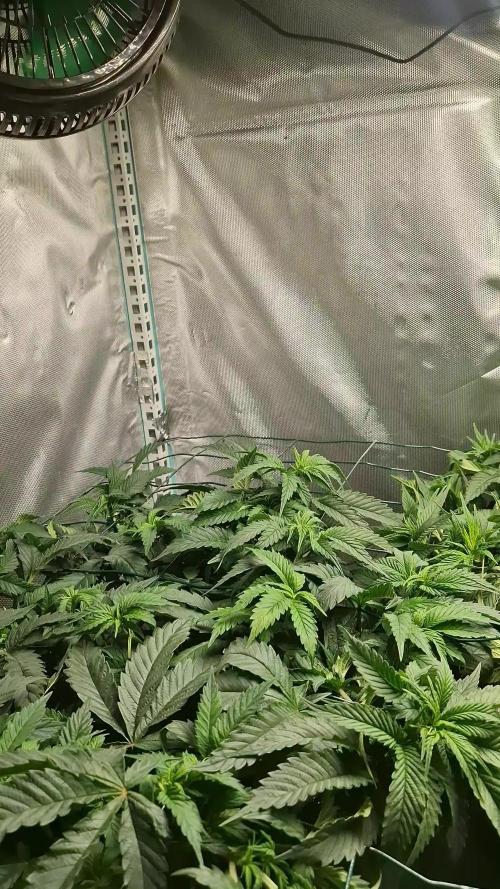
Day 51 from seed 🌱
The girls are getting really close to flip time now. The canopy is spreading nicely across the screen and the SCROG is starting to do its job. Over the last few days I've been tucking tops under the net and guiding branches into empty squares to create an even canopy before flowering.
I’m still feeding according to schedule with Bio-Grow and Bio-Heaven. The plants are drinking around 2.5-3L every 3-4 days. Current routine is two feedings with nutrients followed by one watering with plain water. They seem happy with the program and are showing strong, vigorous growth.
This week was mostly about canopy management. The screen is filling up fast and I think I'm only a few days away from flipping to 12/12. Before the switch I'll do a final cleanup underneath the net, removing weak lower growth and anything that won't make it to the canopy. Better airflow, better light penetration and more energy directed to the tops.
The structure is looking solid. The plants recovered well from all the LST and are pushing healthy new growth everywhere. One branch that was accidentally snapped earlier has been repaired and is still hanging in there like a champ. Cannabis never stops impressing me with how resilient it can be.
The goal for the next week is simple: keep tucking, finish filling the screen, clean up the undercarriage and then unleash the stretch. Flower season is right around the corner. 🔥🌿




Likes
5
Share


@Cookieandcream
Follow
Nicer weather, strange how different the two plants are. Girl scout cookie is very bushy, but no real flowers yet. Kush is tall and thin with much less foliage, but far more flowers.
Processing
Likes
9
Share


@Wiebechillin
Follow
Issues with the 5th seed growing into a funny "U" shape. Attempting to fix the issue by straightening and re-planting.

Likes
2
Share

@DaedalusGrow
Follow
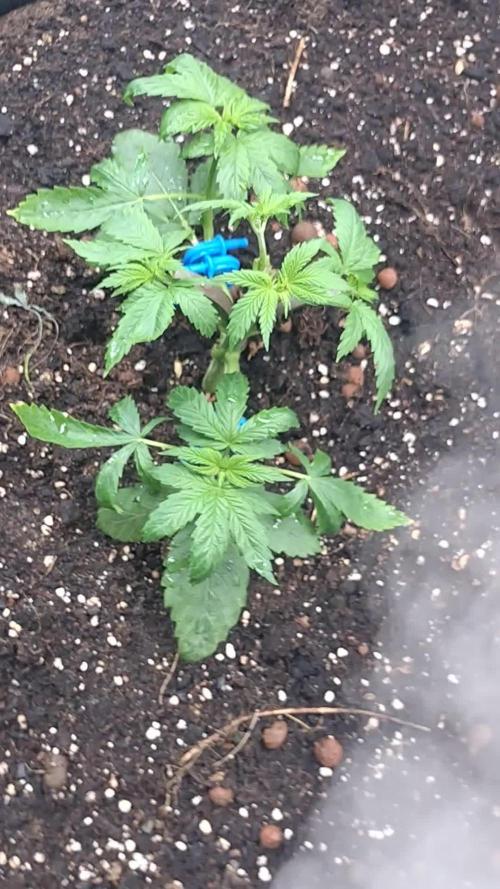
Schon schön Gewachsen die kleine!
Habe heute das Topping gemacht, mal sehen wir sich alles entwickelt 🌱✌️Etwas Topping+Training.
Likes
9
Share


@Strainguy
Follow
Ladies are getting heavier every day. Started to flush. 2 days using Canna flush and 7-10 days only water with ph adjusted.
Lights running 70%
Undercanopy 100%.
Likes
11
Share


@GorillaZativus
Follow
👑Actualización Jardin 21-22 días . Llenamos pan de raíz en 7 días.
⌛️Videos :
🎥pretransplante 21 días , con preventivo diatomeas espolvoreo.
🎥6 transplantes con su pan de raíz , great white premium@y granular , orca , mycochum , tierra de algas , phoskaya, kodama .
8 Litros : mycochum 3,5 ml , orca 1,5 para activar los microorganismos y riego post transplante en 2 litros .
🎥 22 días despertándose post aplicación de knactive + proactive.
🌱Solución foleo 2 litros :
knactive + proactive (4,0 ml ) y ( 0,8 de proactive ( melazas , quitina , etc ) Y sumamos foleo, antes que se de despertaran .
Ec : 0,5
Ph: 6,2
🌱metimos más amarres al y full lst .


Likes
6
Share


@KcKush
Follow
*Looks like I missed one week and didn’t even notice.
*Didn't feed for the last week.
*Chopped it down one week early. Could of gone for more but need the space.


