


Likes
Comments
Share


@Barzenegger
Follow
The journey continues, nothing much has changed. The Chem Beyond Diesel is taco-ing hard, probably due to the light being close, but since the NYC and BJ are the same height and are not taco-ing, this one might also just be a little more sensitive (?). The BJ and NYC are fox-tailing quite a bit, so the plants could also just be showing different reactions to the same stress?
Either way, there isn't much I can do at this point. The humidity is a bit high and I have defoliated some more to help bring it down. I might have to consider some other options, too.
I switched from Hesi Root Complex to Canna Rhizotonic now (because my bottle was empty and I wanted to try something new), and also added some D-Block to my reservoir to help prevent clogging.
The plants are supposed to be 8-9 weekers, but they look more like at least 11 right now.
I guess we will see.


Likes
46
Share


@Capo420
Follow
Week has had ups and downs🙃
Plants seem to be growing fine 🙂 But there is yellowing and spotting still that I cannot resolve.🙄
Day 22- Still having some kind of deficiency/issue. They are growing well, don't really seem to be stunted. I think I may have burnt them with nutes.🤧 Flushing may help. 🤷♂️😅
Run-off pH is at 6.08, PPM 266
I have flushed them, lowered feeding... I'm driving myself crazy. Hahaha
Update 119 Day 23- Things are looking better. I definitely have been overfeeding them.😅
They are responding well to half nutes.🙌
Issues seem to be getting much better.
Happy Growing!
🤙💚💪🌱😎🌱💪💚🤙

Likes
23
Share


Likes
3
Share


@Chubbs
Follow
Weekly update for these gorgeous girls. They've definitely started taking off and doubled in size over the past week. I started feeding nutes at 5ml/gal of Athena Calmag,Grow A & Grow B. Ppfd still at 350-400 at the canopy level and watered 250-500ml daily. All in all Happy Growing
Likes
5
Share

@xTaps
Follow
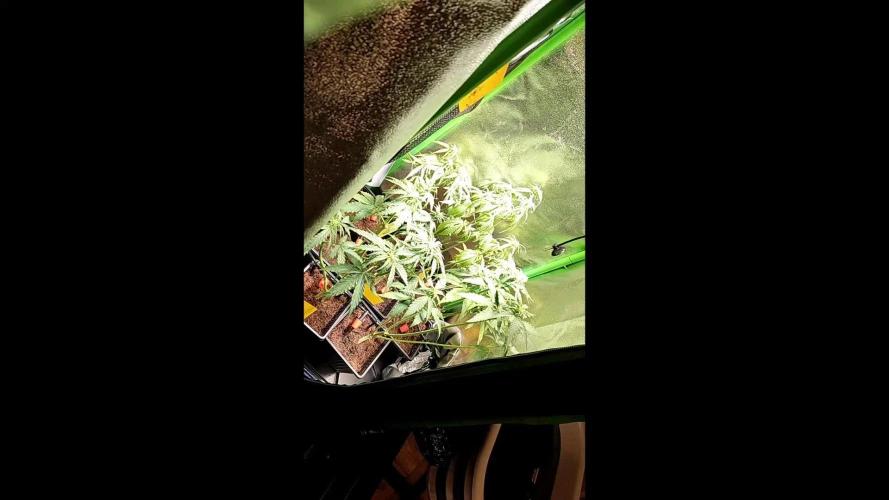
23.08
The Drainmaster moved into the tent to control the drain.
Defoliated and lollipopped them.
25.08
First run with the drain system.
Nutrient Solution (Tank):
Volume: 8.5 L
EC: 3.05
pH: 5.5
Nutrients: Advanced Nutrients Micro/Grow/Bloom + CalMag
Irrigation Run:
Pump time: 30 minutes
Total Drain: 5.0 L (≈ 60%)
Drain EC: 2.6
Drain pH: 6.0
🔎 Observations
Drain volume was far too high (target is ~20%).
Drain EC lower than input EC → medium was relatively “empty”, plants absorbed nutrients quickly.
pH drift from 5.5 → 6.0 shows some buffering effect left in the reused substrate, but limited.
Substrate behaves more like coco than soil now (low buffer, fast response).
💡 Insight / Lesson Learned
30 minutes pump time is way too long → resulted in 60% runoff instead of 20%.
For 8 × 1 L pots, a single irrigation event should be ~1.0–1.2 L total, with ~200–250 ml runoff.
Solution: shorten pump time to ~5 minutes and re-test runoff.
Better approach: run shorter, more frequent irrigations (daily) with a lower EC (2.0–2.2), instead of heavy feedings (EC 3.0) only 3× per week.
This will keep EC more stable in the root zone and prevent salt buildup in the tiny 1 L pots.
27.08
Adjusted the pump timer to 5 minutes, gave the first dose of PK13/14.


Processing
Likes
10
Share


@Leeyum
Follow
We have reached Day 70 and she is still going very strong. Her smell has mellowed out from stinky feet/ rotting meat to a more cannabis like smell haha. I think the flush is helping get rid of some of that chlorophyll. She'll be flushed for the remainder of her life, should be getting a hint of some colors next week.
Likes
87
Share


@Roberts
Follow
Banana kush autoflower was a okay grow. She was very hungry and threw my ph off several times. So she had some leaf damage through flowering. She had more potential then I got out of her. Still a good grow and lots of sweet flower. Thank you Medic Grow, and Athena nutrition. 🤜🏻🤛🏻🌱🌱🌱
Thank you grow diaries community for the 👇likes👇, follows, comments, and subscriptions on my YouTube channel👇. ❄️🌱🍻
Happy Growing 🌱🌱🌱
https://youtube.com/channel/UCAhN7yRzWLpcaRHhMIQ7X4g

Likes
57
Share


@BudBoutique
Follow
! this is my current status, gonna upload my last veg weeks within the next week - got a bit busy around Spannabis - thank you for your understanding! 💚
Welcome to Bud Boutique Grow Diary - really appreciate all your love and support :)
Dont forget to check out my other current grows!
🗓️ This Week:
- Day 24: attaching once a week APTUS Foliar with Regulator & Nutrispray with the amazing CannaFogger by Petra Grow
- Day 28: bud development is super beautiful on each pheno #1 and #2
Thank you for still staying with me 💚
___________________________________________
--- 🌱 Strain (Sponsor) 🌱 ---
🏷️ PEACH GIRL by Art Genetix
https://www.artgenetix.world/product-page/peach-girl
--- 🥗 Nutrients and Feeding (Sponsor) - (APTUS Ambassador) ---
🍸 APTUS: full nutrient schedule extreme
-- Regulator, N-Boost, P-Boost, CaMg-Boost, K-Boost, Allin1 Liquid, Startbooster, Topbooster, Enzym+ every feeding
-- Fulvic-Blast, NutriSpray as Foliar each once a week
🔗 https://aptus-holland.com/
--- ♻️ Grow Control (Sponsor) ---
TROLMASTER: TENT-X + LM14 Light Adapter to dim/sunrise/sunset lights + Temp & rH Sensor all remote on App
🔗 https://www.trolmaster.eu/
--- 🚿 PetraGrow (Sponsor) ---
CannaFogger Foliar Spray
🔗 https://www.petratools.com/product/petragrow-cannafogger-atomizer-new-mini-fogger
--- 🏭 Grow Setup ---
💡LUMATEK Zeus Pro 600
* 🏠🌿 Indoor: Homebox 120x120x200cm (4x4)
* 📐🌀 PrimaKlima exhausting Fan 1180m3/h (running on 60-80%)
* 🌀 Can Light Filter 800m3/h & 1x Fanbox 1x Dyson fan for Air circulation
🔗 https://lumatek-lighting.com/zeus-600w-pro-29/
🔗 https://primaklima.com/de/shop/ventilatoren-de/ec-ventilatoren/pk160ec-tc/
🔗 https://canfilters.com/products/filters/
All Likes and comments are highly appreciated!!!
👨🌾 don't forget to check out my Instagram for daily educational content: budboutiquee
- Bud Boutique


Likes
17
Share


@HowtoBubatz
Follow
It’s week 5 of flowering, and things are looking fantastic!
The adjusted nutrients for the coco substrate have clearly made a difference, as both plants are thriving and continue to develop thick layers of trichomes. ✨
Interestingly, the non-LST plant is starting to show some unique color variations, which is surprising given that both are from the same strain.
This unexpected twist adds a bit of excitement, and I’m curious to see how it will develop over the next few weeks.
When it comes to scent, the differences are striking! The LST variant has a bold and distinct Lemon Haze aroma—zesty and citrusy 🍋💨
while the non-LST plant gives off a fruity-sweet smell that’s incredibly rich and inviting. 🍓🍭
Unfortunately, my camera broke this week, and now I’m dealing with some low-quality pictures. 📷😔
While it’s frustrating not to capture the plants in their full glory, I’ll do my best to document their progress as clearly as possible.
Overall, both plants are doing great, and I’m looking forward to seeing how they turn out in the final stretch! 💚


Likes
5
Share


@Autower
Follow
This was the untopped gorilla cookies not positive that topping made much difference this time but then again who knows still 480g wet weight is good for me has a very pine and cookies smell very sticky can’t wait to try all these fat bud strains will update dry weights I due time thanks for viewing and onto the next
Likes
Comments
Share

@gz420G
Follow
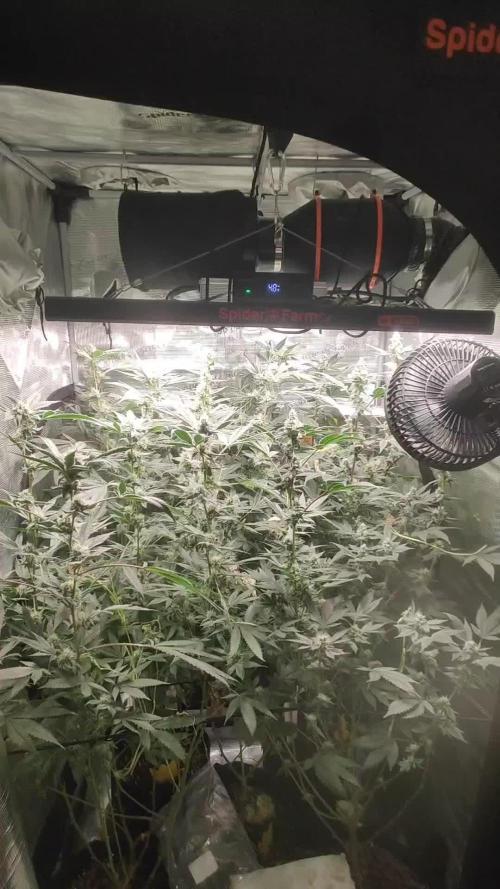
Blütewoche 7
Der Grow geht langsam in die Zielgerade. Die Capjunky zeigt sich aktuell von ihrer schönsten Seite – mit ihren dicht harzbedeckten Blättern sehen die beiden Pflanzen wunderschön aus und übertreffen die Orange Bud und die Tangerine Dream in Bezug auf Blütenstruktur und Geruch deutlich.
Ab sofort erhalten die Pflanzen nur noch pH-reguliertes Wasser.
Ausserdem kämpfe ich leider noch immer mit den Temperaturen (Schnitt 26,5 °C, Spitzen bis 28,5 °C), was für die 7. Blütewoche eigentlich zu warm ist. Ich beobachte die Blüten täglich und habe mir einen zweiten Ventilator ins Zelt gestellt um das um das Risiko für Schimmel zu minimieren.

Likes
67
Share


@Hashy
Follow
Grow diary 11 Stage 3
Days 21-30
Day 22 removed lowest nodes. I'm also thinking i may be overwatering.
Day 24 eventually found my humidifier.
Day 26 topped both colas.
Day 30 training.
The last 9 days have been fairly bad, around day 22 I thought the grow looked a little overwatered. This time I am using a home made ring to flood the pots, i didn't take into account that this ring lets out about 10 times the amount of water then the blue drippers. I cut the watering down and the she started to recover. She isn't the worst looking one out the 4 strains maybe the best looking one out of the 4, she is small but the overwatering hasn't effected her as much as the others.
TEMP
Max 27.5
Avg 25.0
Min 20.9
Humid
Max 76.5%
Avg 55.3%
Min 45.3%
VPD
Max 1.99
Avg 1.43
Min 0.75
Processing
Likes
29
Share


@CANNASIM
Follow
—SETUP—
.BOSSLED LED 1800W full spectrum, real power consumption is +-250W.
.Grow space 60X100X200(a simple shower box.
.AN nutes and other simple additives.
.Grow medium is 60% peat, 30% perlite, 10% organic correction(worm castings), 5 gallon fabric pots(18l).
—BRIEF—
Hi there, I have tried already done this genetic outdoors, in poor lighting and a general purpose nute from Neudorff, yielded 25g dry, in 3gallon pots same medium.
So this is a good experiment, lets see indoors how she will compare.
—GERMINATION—
My germination process always start by scarifying the seeds, i created a little tool for that. I just a little container with sandpaper walls. Shake gently for about 60 secs+, this allows for the water to penetrate better in the seed shell, once you soak. Then i soak overnight from 12 to 20 hours max.
From there i either plant straight or use the paper towel method to see the tap root before. If you are a bit on the impatient side seen the tap root is advisable so you see some movement before planting. Lol!
—ROYAL QUEEN SEEDS . QUICK ONE . INFO —
Chose this strain because is basic and I have to travel for a month soon, and someone else is going to take care for this time. :)
Quick One is a fast-growing autoflowering strain. This was one of the first autoflowering strains developed. When it was first released, it was one of the quickest growing strains on the planet.
THC: 13%
CBD: Low
Yield Indoor : 275 - 325 gr/m2
Yield Outdoor: 100 - 150 gr/plant
Height Indoor: 50 - 60 cm
Height Outdoor: 60 - 100 cm
Flowering: 5 - 6 Weeks
Harvest month: 8-9 weeks after sprouting
Genetic Background: Strong Indica x Ruderalis
Type: Sa 10% In 60% Ru 30%
Effect: Physical
Climate: Mild
—RQS QUICK ONE GERMINATION UPDATE—
My mood said to me to plant straight, so scarify > soak 18 hours +- > plant straight.
Seedlings look a bit odd, with a yellow center, let's give her some days in and see what happens next.


Likes
7
Share


@Minuteman_Organics
Follow
Another boring week in flower. One of the indigo childs is fading to yellow. Checked the trichomes and I'm starting to see some ambers. Will probably wait till 7.5 week. The rest of the indigos will probably go 8-8.5 weeks.
The medipak needs a lot more time. Not a resinous as I would have liked to see at this point. But I have a feeling that it might be my fault with not providing them proper environment for a sativa. I also suspect there might have been a fungal issue from the medipak tent as one suddenly died. Classic fusarium. We shall see with the others.

Likes
10
Share


@Mo_Powers
Follow
she tolerated the move from indoor to outdoor very well. she likes the sun very much and she shows that she wants to grow. i am very happy with her performance.