







@Lvnsource
Volgen
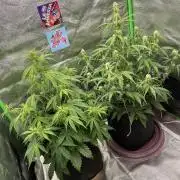
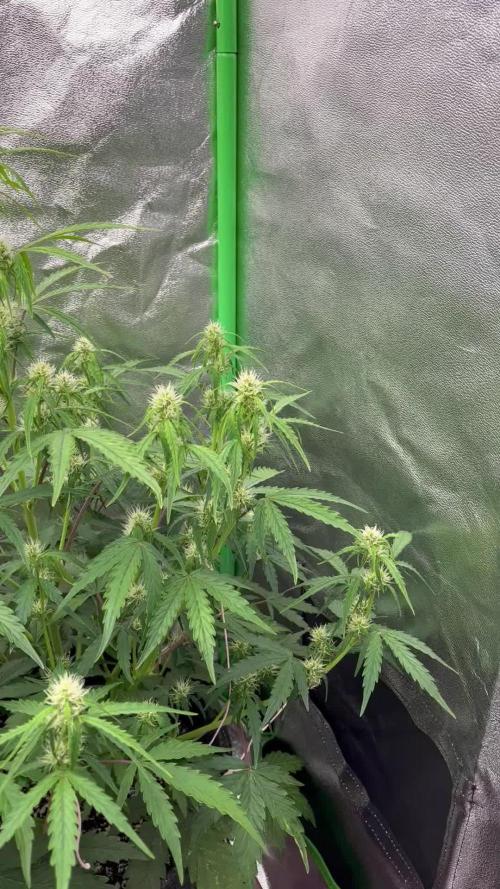
Was dealing with some minor salt build up, caught it early. #2 is 12 days into flower , I reckon she might still be stretching. #1 has just recently started to begin her stretch phase


@Fat_Olsh_Farms
Volgen
Day 36 (Bettis). Just starting to flower. Doing some minor defoliation and supercropping. Very satisfied with her progress.
Day 41. Continuing with minor defoliation and supercropping.


@InnerCityGardens
Volgen
This is the final week in Veg, just tucking the tips down to maintain an even canopy. Coming along nicely. #FloodAndDrain #RecycledSystem #PeyoteCookies #Cinderella99 #BlueGelato41 #GorillaZkittlez #BarneysFarm #HerbiesSeeds #FreeSeeds #GrowTent #MeizhiLED #Meizhi300 #CustomLED #UkGrown #TheUKGrowsToo #CannabisCommunity 🇬🇧


@NanoLeaf
Volgen
End of Week 8 (First week of flower)
Increased the CO2 to 1200ppm and the ladies love it, already started stretching within the first 3 days of flower which shows that CO2 definitely boosts the grow cycle of cannabis.
The main top-sites are popping up everywhere and everything looks evenly spread out. I defoliated again because the fan leaves are growing so fast and blocking bud sites. I also did one last lower canopy maintenance and removed small and stalky bud sites and stems below the trellis net to make sure I get maximum energy distribution to the main colas.
I also added some GHF BioEnhancer to make sure the soil-microbes are happy and that the plants reach their maximum potential.
Pest Report: EXTERMINATED!
Thrips VS Ladybugs VS Neem Oil...
I decided to fight fire with fire - I purchased Swirski-Mites from Koppert (They are beneficial insects that feed on the eggs and larvae of thrips and other unwanted pests). As for the adult thrips - I got very lucky and found about 10 Ladybugs in my garden and decided to introduce them into my grow room as they will feed on adult thrips and any other unwanted pests.
Then to be extra sure I know that neem oil hinders the life cycle of pests like thrips causing them to stop colonising in my grow room. So I sprayed the ladies every day during the dark period to make sure there are no pests that I or the Ladybugs have missed.
Mission accomplished. No more wilting and definitely no more thrips.

shorts_status_processing


@TupSkyWalker
Volgen
Empezamos la segunda semana.
Ayer día 5 de Febrero se realizo un trasplante de las 9 plantas con mejor aspecto a tiestos de 6-7 L que tenia por casa que he decidido aprovechar. Son las 9 que quedan en el armario y con las que trabajare, de las 13 con las que empecé.
En cuanto a la iluminación la semana pasada la acabamos con 50W, para esta semana en adelante y durante todo el crecimiento la dejaremos en 100W. Ciclos de 18 horas de luz y 6 horas apagado.
Pocos riegos de momento solo con Rhizotonic ñ, 0,5 ml por litro. Empezaremos a añadir Plagron Alga Grow durante esta semana y pulverizaremos con Plagron Vita Race.
Las 4 plantas restantes han ido a exterior veremos como responden.
Disfruten y buenos humos.
Gracias por leer.
Tupskywalker


@Kickdrum
Volgen
Came home from vacation to gorgeous ladies and their light fragrances. More to follow soon.


shorts_status_processing


@Ogbangbang2981
Volgen
I never thought I'd say it but i think when it comes to my indoor C4 vs my outdoor C4 Indoor takes the prize, I mean that's only for now lets see what happens in the upcoming weeks. I'm sticking to my bat turd mix and all sun, I shift her around during the heavy showers, yea it rains out here. I don't feed no store bought nutrients all from nature same goes for my indoor ... if you look closely you'll see that I lst her it's only because of her mutation.



@Lord_Ninnyhammer
Volgen
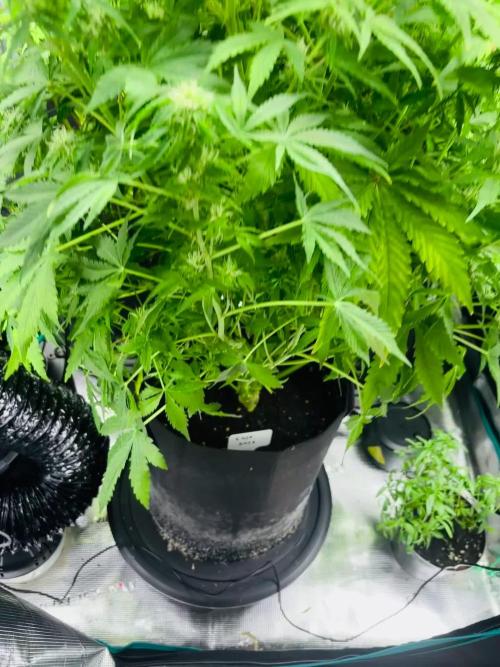
Unfortunately, I realized quite late that the plants – or rather the tap water – were causing major pH issues. This became noticeable through dry leaf tips as well as light green and yellowing leaves. I’ve never had pH problems before, so I didn’t think to measure it again. After checking, the pH was around 8.5, which I have now lowered to 6 using a pH down solution.
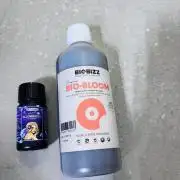
In addition to my usual BioBizz Bloom, I’ve now added Bloombastic and I’m hoping to report positive progress soon. The plant on the left is the most affected, even though it germinated at the same time as the one on the right. Of course, the damaged leaves can’t be saved, but the plant is still developing well, and I believe I’ll be able to harvest it without major issues.
Both Sweet Gelato plants smell incredibly good and sweet, and the Afghan is growing nicely—robust and compact.


@Meksi2790
Volgen
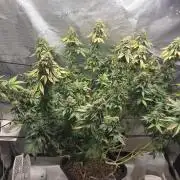
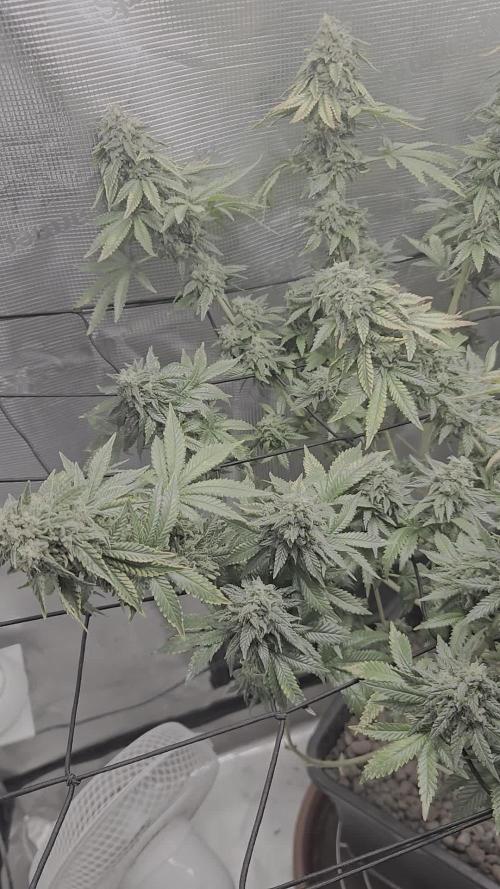
buds starting to swell and the colours coming through will add some over drive from advanced nutrients to really swell them up cruise control from here





@k0nz1
Volgen
Already there
5 days till harvest
No more watering - let them dry out in the pot
Hervested after 10 weeks bloom



@Ultraviolet
Volgen
Heyókȟa
I desire naught but the study of nature, to find my way back home.
12x12=144, A dodecahedron is a polyhedron with 12 faces, and in coordination chemistry, it refers to a geometry where ligands surround a central metal atom (in this case, Magnesium) in a specific, 8-coordinate arrangement. Dodecahedrane is a hydrocarbon, meaning it's composed solely of carbon and hydrogen atoms. The carbon atoms are arranged at the corners of a dodecahedron, a 3D shape with 12 pentagonal faces. The water molecules in the dodecahedron form hydrogen bonds that are individually slightly weaker than in either the dimer or the tetramer. However, because three-quarters of the O -H groups in the dodecahedron form hydrogen bonds, it has a more negative energy per molecule than has either the dimer or the tetramer. Magnesium (Mg2+) is the essential, central metal ion in the chlorophyll molecule, crucial for photosynthesis by enabling light absorption and energy transfer. It is chelated by four nitrogen atoms within the porphyrin (or chlorin) ring structure. Chlorophyll appears green because it reflects light in the green region of the visible spectrum, specifically between 490 and 570 nm. The main resonance electronic frequency of a neutral Magnesium (Mg) atom corresponds to the transition from the ground state to the first excited state. Resonance Line Wavelength of Mg2+: 285.1nm (UVB light). The central atom of the chlorophyll molecule is Magnesium (Mg2+), which is coordinated within a porphyrin ring. The electronic "resonance frequency" of this central atom—meaning the frequency at which its electrons absorb energy—is primarily driven by the electronic transitions (ETR) of the surrounding conjugated chlorin ring structure, rather than a discrete atomic transition of the Magnesium atom itself. The resonant electronic frequencies of the chlorophyll porphyrin (technically, a chlorin) ring are determined by the energy required to promote π-electrons within its conjugated system, primarily appearing in the blue and red regions of the visible spectrum.
In standard physics, Chloryphyll b has peak absorption at 460nm (Blue). If we take the peak wavelength 460nm and a UV-B, UVR8 peak absorption wavelength 285nm Tryptophan-285 (W285) Sensing protein. 460/285=1.618 Φ, "natural harmony" and the "structure of light". The cryptochrome photoreceptor (CRY) is a UV-A/blue light receptor that shares this dual sensitivity with several other biological structures and functions, including significant sequence similarity and a common evolutionary ancestor with DNA photolyase enzymes. These are light-activated enzymes that use blue/UV-A light to repair DNA damage caused by UV-B radiation in plants.
Dodecahedrane (C20H20) is a hydrocarbon with a cage-like structure where carbon atoms form 12 pentagonal faces (a regular dodecahedron). It is highly symmetric (icosahedral), contains no delocalized electrons (no aromaticity), and has minimal angle strain, but significant torsional strain. Water Dodecahedron (H2O) forms hydrogen-bonded cages. While individual hydrogen bonds in this structure are weaker than in the linear dimer or tetramer, it has a more negative total energy per molecule. This is because three-quarters (75%) of the groups are involved in hydrogen bonding, creating a very stable, closed-shell configuration. a 3D carbon hydrocarbon (C20H20) to stable water clusters in hydrate, while the Magnesium ion acts as the central activator within a conjugated ring in biological systems, with its electronic absorption dominated by the ring, not the atom itself.
Effective quantum efficiency of photosystem II, often denoted as ΦPSII
In horticultural lighting, adding 730 nm (far-red) LEDs alongside standard red/blue lights has been shown to increase canopy photosynthesis by 20–30% in several crops by acting synergistically with shorter wavelengths. However, the limitation is that excessive, pure IR/Far-red light (without accompanying red light) can trigger the "shade avoidance response," causing plants to grow tall, weak, and spindly rather than robust. Knowing is half the battle however, engineering or utilizing infrared light (specifically the 700-750 nm far-red range) is a viable method to boost photosynthetic efficiency. It acts as a bridge to allow PSII to utilize a broader spectrum of light, breaking the traditional 700 nm barrier.
Extend, then multiply.
UVR8-mediated signaling (often in conjunction with CRY proteins) triggers protective mechanisms that maintain the stability of the photosynthetic apparatus (including LHCII and reaction center proteins), thus ensuring that the efficiency of Photosystem II remains higher in UV-B-exposed plants compared to plants lacking this receptor. ΦPSII indictates the rate of electron transfer from water to plastoquinone, which drives the production of ATP and NADPH. There is a close link between ΦPSII and the true rate of CO2 fixation (Φ*co2), particularly in C4 plants.
Effective quantum efficiency of photosystem II, often denoted as ΦPSII, represents the proportion of light absorbed by Photosystem II (ΦPSII) that is actually used in photosynthetic electron transport. It is a key indicator of how efficiently a plant is using light for photosynthesis, as opposed to losing it as heat or fluorescence. ΦPSII (effective quantum yield of photosystem II) functions primarily as a "multiplier" (a coefficient of efficiency) rather than an additive factor when estimating the overall photosynthetic electron transport rate (ETR). Multipliers are considered far more beneficial than additions because they generate exponential growth, leverage existing resources to their full potential, and create sustainable, self-multiplying capacity, rather than just incremental, linear increases.
Humans, and most other mammals, rely on other mechanisms, such as nucleotide excision repair, to manage and repair UV-induced DNA damage. As such, humans do not have the direct, light-driven repair mechanism that photolyase offers in plants.





@SlickCityOrganics
Volgen
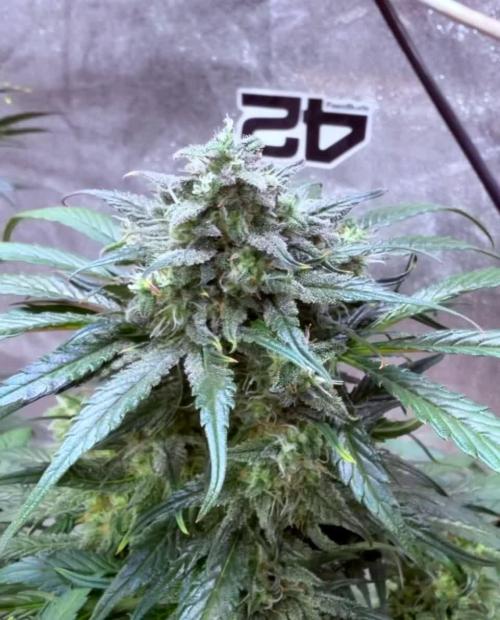
Black Strap and Peach Crescendo getting close. I see they will get cut way before the Fat Bastard. Fat Bastard must have a long flowering period. But branch structure is thick. I will get a heavy yield from it. Peach Crescendo has so much frost on it. Ethos fkn rocks! Black Strap smells like baked cookies and gas.


