


Likes
Comments
Share


@SmokeAndChill
Follow
Blue Zushi S1
Harvest on Flowerday 70!
Currently Drying in the Wine Fridge at 55% RH and 12°


Likes
80
Share


@Ganjagrandaddy
Follow
Day 42 Flowering: Hi all. These girls are motoring along so nicely now and using every available lumen that this wicked little beast of a light can throw out.
The Northern lights #1 has spent the week putting new pistils out to join the nice fresh ones from the previous week. There are only one or two pistils that are turning orange so a long way off her final flush of flowers and ripening. This is a good sign of possible things to come. With a longer flowering period , we get a bigger bud !!. Lol There are numerous mains that have now become long bud spikes so should produce a nice yield too. Still sparkling white and a slight tackiness if touched. Smell is just beginning to be evident with a slight hint of sweetness.
Grandaddys mimosa is beginning to colour up all over now and her bids are looking more developed in ripeness than the other last too. She does have a lot of leaf to bid it seems but as she swells , this should look less compacted. She is only a small lady in height with around 7 mains developing as spikes. Her smell is a nice juicy fruit aroma so far and I can feel her sticky thc when I rub the stems.
They are really developing well now and I am so pleased with the performance of the XS1500. A great light .
The other surrogates that are elsewhere are all going well too with the 2 Gorilla cookies really pushing some nice bud sizes out. Nice sized ,stacked colas are all over their structure of both plants and even the lowers are beginning to look good. The #2 Northern lights ( mutant) is catching up with her sister and friends now but is about a week behind in size development. She is a long limbed lady with cluster buds so a lot less productive looking than her sister but she looks nice and healthy with it.. I am noticing a slight mottling on the leaves of a few plants now so I will be adding calmag to the next feed to stop this getting too far and losing energy from photosynthesis. I expect a little yellowing off of older leaves to begin showing now too but the use of coco and L.E.D usually includes adding calmag as they both leech mg from the soil and plants. Hopefully I can catch it before it gets an issue.
Temps are more reasonable now the heatwaves are done here so any extra co2 from the exhale bag can now be used as a booster and not to survive.
Another good week for the ladies and the xs1500. Keep smiling growmies. The deception is falling apart now !!


Likes
7
Share


@Lazuli
Follow
5 days before the pictures i started overdrive and dropped the floranova to 1ml
Likes
35
Share


@Paulolo03
Follow
Day 80, harvested 1 plant, she didn't really look good, the buds are very smelly and dense though. Some trichomes were brown so decided to chop her (the smallest buds only had milky trichomes, even not even milky for some). It wasn't one of the biggest so I hope for bigger yields for the other plants !
Now drying, got 145g after the wet manucure.
The rest of the plants are still in the grow box, they're healthier and they'll be ready in few days, I thought I would harvest before but mother nature is the boss.. will keep you guys updated !

Likes
1
Share


@Barcelona_Farmers710
Follow
Buenas farmers!! Después de pasarnos tres dias con sólo agua volveremos con la mitad de nutrientes durante los próximos dos riegos, ya empezamos a prepar nuestras plantas para la fase final ! Cada cogollo huele diferente 👌🏻Espero que os guste buenos humos family!💚


Processing
Likes
6
Share


@Silverback_Guerilla
Follow
TUESDAY 9/3:
She's still branching out and budding up.👍
WEDNESDAY:
I was out at the property for awhile today, hosed off the horsies and cleaned their hooves really well. I was there long enough that I was able to move the plants into direct sunshine for an extra couple hours. I fed her with a half-gallon of water including bembe, terpinator, tiger bloom, beastie bloomz, armor si, and big bloom...just enough to wet her whistle.
THURSDAY, FRIDAY, SATURDAY, SUNDAY:
I was sick as a dog . 2-day stomach virus, followed by an acute pancreatitis attack...
😷
MONDAY:
I gave her about a half-gallon of aquarium water with some bembe, beastie bloomz, and tiger bloom.

Likes
19
Share

@J4kpvp
Follow
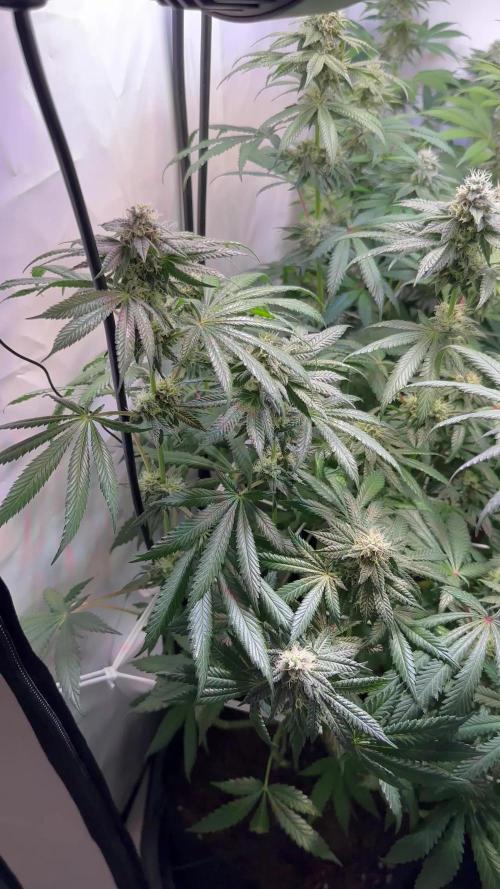
Hello:) great week again, they fatten up nicely. A few more weeks and we’re done:) adding nematodes was a real game changer this time around:)

Likes
19
Share


@Chi_K24
Follow
Alrighty guys, Day 35ish check the ladies out! Dam! They starting to pack on weight! The main stem is thick as my pinky finger but they are currently short plants. Hoping they will stretch as they develop through the flower phase.
Also added fabric pot risers to promote airflow under the pots to help even out the pot drying patterns.
Note: I have now learned that my original formula used for the pre soil mix with organic amendments was a bit too hot. I do see dark green leaves with clawing only on one plant. I'm going to dial back the premix to 2-3tbs/gal of media @50/50 mix of the 284 and 444, rather than 4tbs. I may even push for 2tbs and add regular light feeding of calmag for the next grow to help with the heavy coco coir mix soil from promix hgcc line. Lesson learnt, so let's keep pushing hard to get these ladies finished!
Also I picked up a bottle of beneficial enzymes to help with root rot for the one droopy plants, however I'm going to apply it to all my plants just for the benefits of a strong root system into flowering.
Shouts outside to @LaBOSSANOVA for the quick tips. I'll keep you all updated on ms droppy and the gang.
Happy growing freints!

Likes
42
Share

@wolfvb
Follow
🌿 Week 14 Update: Khalifa Kush - Preventative Strikes & Airflow! 🛡️✂️
Let's go! Welcome to the new week for the Khalifa Kush. She is absolutely loving the balcony life, but after the recent battles indoors, I had to make some tactical moves this week to keep her safe and thriving.
📈 The Details / Progress Report:
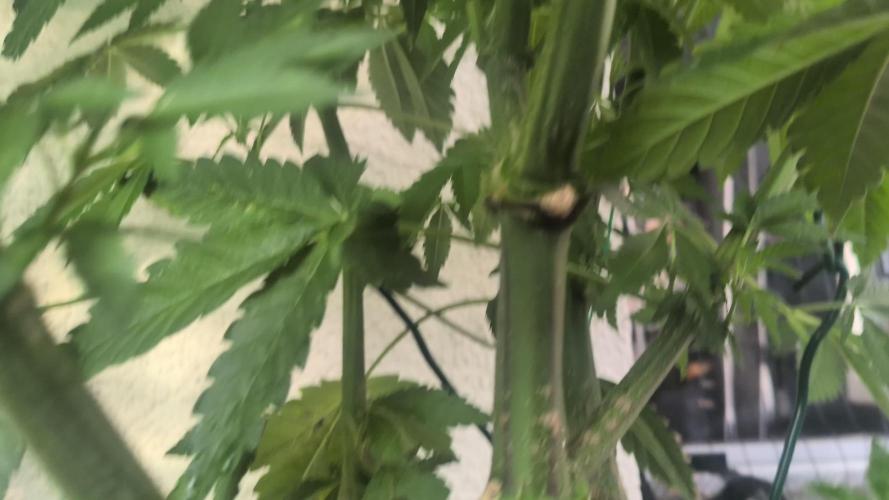
Preventative Warfare: After dealing with that brutal thrips infestation inside the tent, I am taking absolutely zero chances out here! I had to bring out the neem oil and give her a thorough foliar spray just in case. I definitely don't want what happened to the indoor girls to happen to this massive bush. You can actually see the fresh oil and water droplets resting on the lush green foliage in the close-up shots! 💦🌿
Opening Her Up: To go hand-in-hand with the pest prevention, I got in there and did some much-needed defoliation. She was getting incredibly dense, so taking off some of those larger, light-blocking fan leaves really helped open her up a bit. It drastically improves the airflow through the center of the plant and makes sure the neem spray can actually penetrate the whole canopy. ✂️🌬️
Vibrant Health: She took the pruning and the spray perfectly. As you can see from the overhead shots, the leaves are rocking that deep, rich, leathery green, and the structure is looking incredibly strong. She is looking super lush and happy!
💧 Next Steps:
With her canopy opened up and a protective layer of neem oil applied, we are in a fantastic spot. The main goal now is to just keep her well-fed, monitor the leaves to ensure no pests try to bypass our defenses, and let her keep building that massive frame in the sun.
Let's keep it growing! 🌱💨
Processing
Likes
13
Share


@Cheesefarmer420
Follow
Week #9 of flowering is done, great week this week, still inching closer and closer to harvest day, all of the ladies except for the largest will start their flush today, I’d like to push that out to atleast 10-14 days if possible, this will insure I get a beautiful fade into harvest as well as mouth watering tastes and aromas coming off this flower, however with using final phase I’ve learned I can execute a proper and tasty flush in just 7 days if needed. Everyday I feel the smells are getting more and more intense becoming a hassle for my 4” carbon filter to keep up. Hopefully we continue to finish strong this last week or two! It will be exciting 😍


Likes
46
Share


@Mrs_Larimar
Follow
January 1st.
HAPPY NEW YEAR!!!
New Year , new Challenges 😄
Seedlings were showing up very fast, but Iam taking today as Day 1
Its alot of fun with those cute Vessels
And iam really hoping to keep them Happy
Thy for Visiting this lil Grow.
#420 Worldwide


Processing
Likes
6
Share


@El3vated
Follow
This week I transplanted directly into a 5 gallon pot. There were no signs of stress after transplanting. So far, it is looking short, stacked and healthy.


Likes
17
Share


Likes
35
Share


@Rap_a_cap
Follow
This is exactly the 🇲🇦 morroccan 🇲🇦 way of sifting resin from kief. Traditionally, apart the hand rubbing method, dry sifting through a mesh is the most used way to obtain resin, from 🇦🇫 Afghanistan 🇦🇫 or 🇳🇵Nepalese 🇳🇵 Mountains to 🇲🇦 Morocc 🇲🇦 Rif passing through Bekaa valley in 🇱🇧Lebanon 🇱🇧. The average size of meshes used vary from 90 to 180 microns and are mostly made by silk and for this reason uneven.
I think the most productive ways to sift are Dry Ice and rotating pollinator + CO2, I've tried a DIY pollinator built by a friend and it can reach up to 20/25% of resin extracted at 120 microns and 15% at 90 microns. But smell and taste don't reach that traditionally extracted but this is another story.
Morroccan way is good compromise between a stashbox or more evolute methods.
It requires less than 10 dollar of expenses.
You need:
a basin or pot without handles
a heavy-duty plastic bag that contains the basin
a pair of chopsticks
a good 120 microns net
an elastic band
tape
Kif or trim q.s.
Here is the link where I buy my meshes. Very high quality, customable size and material (steel or nylon) and length and very kind vendor on AliExpress
https://a.aliexpress.com/_uwfQzq
Drum for 3 minutes.
.....perhaps you will find that you have an innate talent as a drummer, throw the shit away and put your head right......
Likes
241
Share


@Tropicannibis_Todd
Follow
💩Holy Crap We Are Back💩
Well i took the summer off to do some outdoor but thats all done so , we are back indoors and at it again 😁
So super happy to be trying this one out , can't wait😝 .....I'm really interested to see what kind of terps and colors we may get ..👍
We are 7 days from seed and everything is good to go .. 👌
Lights being readjusted and chart updated .........👍rain water to be used entire growth👈
👉I used NutriNPK for nutrients for my grows and welcome anyone to give them a try .👈
👉 www.nutrinpk.com 👈
NutriNPK Cal MAG 14-0-14
NutriNPK Grow 28-14-14
NutriNPK Bloom 8-20-30
NutriNPK Bloom Booster 0-52-34
I GOT MULTIPLE DIARIES ON THE GO 😱 please check them out 😎
👉THANKS FOR TAKING THE TIME TO GO OVER MY DIARIES 👈