


Likes
Comments
Share


@GermGrowFox
Follow
29. März.
7 Tag sind nun rum seit dem ich die Samen zum keimen gelegt habe.
Alle drei Pflanzen sind nun aus der Erde geschlüpft. Die erste Spargelt ein bisschen.
Die living Soil sieht Mega eklig aus, wie als würde die Erde schimmeln. Zum Glück wissen wir es besser :)
31. März
Jaaaaaaapp. Es wird Spargel.

Likes
29
Share


@Prilyfe13
Follow
April 19, 2024 Day 64
We are coming up on the 10 week mark soon enough. I'm expecting both of these ladies to start swelling buds any day. So another 2 weeks before harvest. Probably 3 to 4 more weeks.
Tropicana Cookies is actually 31" tall while Tropicana C is 28" tall. However, due to the highest points being so tall, I have those tops as far on the outside of the light footprint as I can. I managed to get the DLI down to 50 mol/m²/d for each plant. While the rest of the canopy is happily at 45 mol/m²/d.
No watering today. Maybe tomorrow. The water intake has increased a bit over the past couple of days, so I may be topping off tomorrow or early morning the day after. I'm also getting some nutrient burn from what I believe is the Overdrive. I have it at full dose and honestly think it's too much. So I'm cutting it in half as well as Bud Candy. That's also at full dose and I don't think it's needed. So cutting that in half as well.
The light will be staying the same for the next 2 weeks now that the plants have hit their final height. I'm guessing that's how much longer it will be before flushing. I'll drop the light power at the same time as flush. The flush should be about a week.
The environment is giving me a hard time today. The temp is high at 78° with the humidity high as well at 56%. Not really sure what's causing it, but I'll turn my damn AC on if I have to. Anyway, I'm still having trouble keeping it at 50% humidity, so getting to 45% seems unrealistic. So I'll work with 50% and just make sure to check for any signs of mold or anything. I don't think I'll get anything like that, but you never know.
Grow System Environment:
Temp: 74.2°
RH: 53.3%
VPD: 1.31 kPa
April 20, 2024 Happy 420!!!
Not much going on today with these 2. They will both need watering tomorrow. So they are finally at a half gallon a day. The 2 other plants in the tent are also at a half gallon a day, but they are on the opposite schedule. It works for me. Gives me something to do everyday, but not sitting there for a half hour mixing nutrients. (I use 1 gallon jugs for each plant)
Tropicana Cookies looks great! Her buds are starting to swell and stack. They are just about ready to start swelling up. I can tell they will be super tight as well. There are a couple places where the pistils are orange and shriveled up. The bud is super dense. However, that could be seeds. I'm not too sure at this point. It's a high possibility.
Tropicana C also has a couple tops with the same type of super dense buds. Again, these two are identical in every way. I wouldn't be surprised if it was the same top doing the same thing. Anyway, looking super good. Buds from top to bottom. They aren't big and fat yet, but there still a good 2 to 3 weeks left. Hopefully less though. I have 4 more plants I have to start today for a contest. Unfortunately those plants will be stuck ina. 2x2 until these ones are out of the tent.
The lighting hasn't changed whatsoever and won't for the next 2 weeks.
The environment is looking great now. It's steadily climbing up from 68° last night and is at about 75° now and will definitely be at 76° in about an hour. The humidity is great at 51%. As I said yesterday, I don't think I'll be able to drop it down any further.
Grow System Environment:
Temp: 73.4°
RH: 52.3%
VPD: 1.30 kPa
April 21, 2024
Watering day. Both ladies got watered today. Not much else going on though.
Tropicana Cookies was nearly dry, but not quite. Unfortunately, Tropicana C was bone dry. I don't like it getting dry. The wick system gets messed up. But it did give me a chance to quickly wipe down the basin.
Both plants have nutrient burn from what I assume was the dose of Overdrive. So today I left it out. Just to allow the nutrients to even out. Next watering I'll be doing 4 ml of it. I also dropped the Bud Candy down to 4 ml. Just Incase it was partly that as well.
The lighting was, of course, not changed at all.
The power will be dropped in the next week or so.
This strain should have a 6 week flowering stage. 45 days is the estimate. So there's about 3 weeks left. Much longer than I was expecting. Honestly it's from the 5 week veg period. I find it strange that I didn't get any massive plants in 5 weeks. At the end of the grow, we will be hitting just under 12 weeks. No clue why I can't get my plants to grow at the suggested time frame. The earliest I have ever harvested was 11 weeks. Or maybe 12. Strange. I'll have to figure that out.
The environment is looking good today. The temp is leveled out at 75° and the humidity is happily at 49%. The VPD is a little low at 1.39 kPa, but it will fix soon enough.
Grow System Environment:
Temp: 73.4°
RH: 49.7%
VPD: 1.39 kPa
April 22, 2024
Definitely nothing going on today. Tropicana C had a couple leaves popped off today. Just a couple that were covering some bud sites and encroaching on other tops.
Tropicana Cookies looks great! I will say her buds aren't fat like I was expecting. They seem more like sativa buds. It's strange. They are thin and small and look super airy. I'm not sure if this is the deal, but both plants look like this. Only time will tell.
Tropicana C also looks quite good, with the same bud swelling issues, but we shall see as I said. She got 2 leaves removed. They were being crushed by the wall and in turn were overcrowding other bud sites.
The lighting is staying the same of course. I believe an a week or 2, I'll have to drop the intensity.
The environment is once again looking great! 75° and 50% humidity. The overnight temp is still at 68°. I'd much rather it be at 66°. Maybe I'll cool my room off earlier in the evening to allow the tent to cool faster at night, so the temp drops to the average of 66°. I'll start that next week.
Grow System Environment:
Temp: 73.8°
RH: 49.2%
VPD: 1.41 kPa
April 23, 2024
Nothing going on today. Just the daily inspection.
What I've discovered has me a bit confused. Both plants have tons of orange pistils with some being so shriveled up you can't see them. Those buds are super tight, but I have a feeling those couple tops like that are seeded. I'll find out soon enough. Honestly, I can't tell. Don't really know what I'm looking for.
The problem I'm confused about is the size of the buds. They're tiny, wispy and look underdeveloped. Maybe they are. Who knows. Maybe this strain gets early orange pistils. We shall see. I hope they swell up. Like a lot. As it stands now, it looks like an oz of smalls. Which of course is unacceptable. However, both plants are doing it, so it has to be the strain. Something I probably shouldn't be all that concerned with.
I'm leaving the light where it is for the next week or so. With the pistils already turning orange, I'm thinking I should prepare for the final stage of flower. I would expect it to be done in the next 2 to 3 weeks, but it may be less time. Anyway, I'll see what they are doing next week and work from there.
The environment is actually looking really good. I managed to get the temp up significantly earlier today by cranking my heat to 88°. It brought the tent temp up to 78° and the humidity just below 50%. Looking good. Now all I have to do is drop the temp a little bit to get to that perfect 75°. Also, my dehumidifier wasn't on. I must of have it off from the other day. So I should see lower humidity by the end of the day. Especially after I adjust the temp. Looking good.
Update: I've been thinking about how the buds are so small. I wonder if I took the Big Bud out too early and added the overdrive too soon. I can't go back to Big Bud, but that could be the cause. Still, another 2 to 3 weeks left. So we shall see. But an interesting thought.
Grow System Environment:
Temp: 73.7°
RH: 49.0%
VPD: 1.42 kPa
April 24, 2024
Both ladies got a reservoir refill today. Tropicana C was dried out. So I need to keep a better eye on the water levels. Tropicana Cookies wasn't dried out yet though, very close but not yet.
Tropicana Cookies looks great! Her buds are finally starting to swell and if there's another 2 weeks, I can expect them to get huge. We shall see.
Tropicana C has the same boost in bud production and has swelling buds now. Everything else looks good with her.
Speaking of swelling buds and production, both ladies are completely covered in trichomes. Not quite "frosty" yet, but getting there. I'll start with trichome pics next week. That way we have some good specimens to work with.
On another note, the aroma these two are putting off is intense now. I'll have to change the smell setting to STRONG next week. It's a sickly sweet smell, but crispy. Not too heavy, but definitely has a gassy undertone. Very nice.
I won't be moving the light at all for the rest of the grow. However, I may drop the power down to 80% next week and bring the DLI down to 40 mol/m²/d. But maybe not. I'm waiting for the flushing period. I'm not sure when that will be. Maybe 2 weeks? I can't tell with this strain. So many orange pistils and she looks like she is nearly done, but definitely not. They still have a good two weeks left. We shall see.
The environment is a bit off today. It's raining, so the humidity is hanging out around 52%. The temp is fine at around 75° to 76°. I'm not too worried about the environment today. Just thought I would note the difference.
Grow System Environment:
Temp: 74.6°
RH: 50.9%
VPD: 1.41 kPa
April 25, 2024
So today is the last day of week 9 and also going into the first day of late flower. Things will most likely be changing up in the next week. Nutrients, lighting and environment.
Not much to do today. No watering needed and no maintenance.
I checked out both plants and as I was saying yesterday, the trichomes are looking great and will start getting pics starting tomorrow. Everything looks good for both ladies.
The lighting of course wasn't messed with today. That will be changing at some point next week.
The environment is shaping up to be great for the start of late flower. I got the temp down to 65° last night and the humidity down to 48°.
Today I have had it around 76° with the humidity around 49%.
Grow System Environment:
Temp: 74.1°
RH: 49.3%
VPD: 1.43 kPa

Likes
20
Share


@weedacouple
Follow
This one has been the second easiest harvest we ever did (back to the Purple Punch), the plant lost many leaves by herself, still pretty easy. she has a strong flavour and we literally cant wait to smoke her.
Likes
18
Share


@Pokan187
Follow
The trichomes on the Runtz are all milky and I'm getting some amber on the sugar leaves, I think the end is near 😁
The G13 is looking great and smelling wonderful, the buds are getting heavier and same for the GDP


Likes
4
Share


@MasterKush714
Follow
06/18/2024 WEEK 4 FROM CLONES!!! LETS GET IN ITT!!!!
Added a Humidifier for the tent, 2 gallon version, workin great so far,
only using very minimal nutrients and runclean will keep updating as
the weeks go on thanks!

Processing
Likes
26
Share


@LongJohn420
Follow
Lots of pics not much to report. Flushing and starting to yellowing nicely. Trichomes are in check so I plugged light out and left these two girls in darkness for 36-48h. These yielded clearly most in this round. Nice job Barney's with this one 👌 Can't wait to smoke this one out once cured couple weeks 👊😍

Likes
157
Share


@StarLorr
Follow
Welcome to my Gorilla Melon 🦍🍉Diary.
In this Diary:
Seeds: Fast Buds (from contest)thanks
___________________________
Feeding:
Thu 24Apr: 3L Flawless Finish pH'd 6.5
Mon 28Apr: 3L Flawless Finish pH'd 6.5
___________________________
Final Lap🏁🏁🏁
Trichomes are milky with a few ambers,
By the end of this week, probably Friday the El Chopo will occur😋😋
_________________________
All sweetie fruity, can't wait to try it out🍉😙💨💨💨💨
_________________________
Thanks for stopping by, likes and comments are appreciated!👊🏻😎
Keep on growin!
Keep on tokin!!!
😙💨💨💨💨💨
Likes
17
Share


@RDWCGrowing
Follow
Week 1 Day 1 - 8/12/2023
1st Water change Day! Such a special time it is when you remove the little bit of Nutes that you gave them as an appetizer and you give them their first real meal.
Added
39 Gallons of Water to my system
SILICA= .5mil/Gal = 19.5 = 20mil
Root Drip = 1mil/Gal = 39mil
Cal Mag= .25mil/Gal = 9.75 = 10mil
FLoraMicro= 3.0mil/Gal = 114mil
FloraGro = 2.0mil/Gal = 78mil
FloraBloom = 2.0mil/Gal =78mil
ORCA= .5mil/Gal = 19.5 = 20mil
Week 1 Day 2 - 8/13/2023
Everything is looking good the roots are making their way to the water and the new grow is looking nice and green.
Week 1 Day 3- 8/14/2023
Everything is right on track, they are looking beautiful and in the praying position all leaves happily lifting towards the light.
Week 1 Day 4- 8/15/2023
A little worried today her birth Twin the BA I am growing out is looking great and is raised towards the light and this one is just slightly under.. Will keep an eye on Her.
Week 1 Day 5- 8/16/2023
Walked in and the humidity was under 60.... ohh noooooo.. So I added 2 humidifiers to the tent and attached them to my InkBird controller which is set to 62.
Also looking at the roots and she has some poking out the bottom but just not in the water yet.. Luckily we are set for 14 days before next water change so the system will stay stable and her sister already has roots in the water so she should only be a day or two behind.. we will just keep tracking but she is delayed.
Week 1 Day 6- 8/17/2023
Roots in the Water!!! Huston, we have a successful launch. This grow is on!
Humidity was a little low this morning so I refilled the humidifiers. Other than that the temp looks great, the PH looks good, the PPM looks good the plant is in the praying position and all damage from the little drowning from over filling the cloning machine seems to have been fixed. Happy Happy.
Week 1 Day 7- 8/18/2023
Yay.. week 1 in the books, roots in the water growth has started. Everything for growth and environment is looking good and on track, there are a couple of mutations with this Lady will keep an eye on those leaves.
IMO this grow is going A lot during this week 1 then week 1 of the last grow when I had them drowning.
Really excited on how this grow is going to come out.
Likes
2
Share


@BemaGwaai
Follow
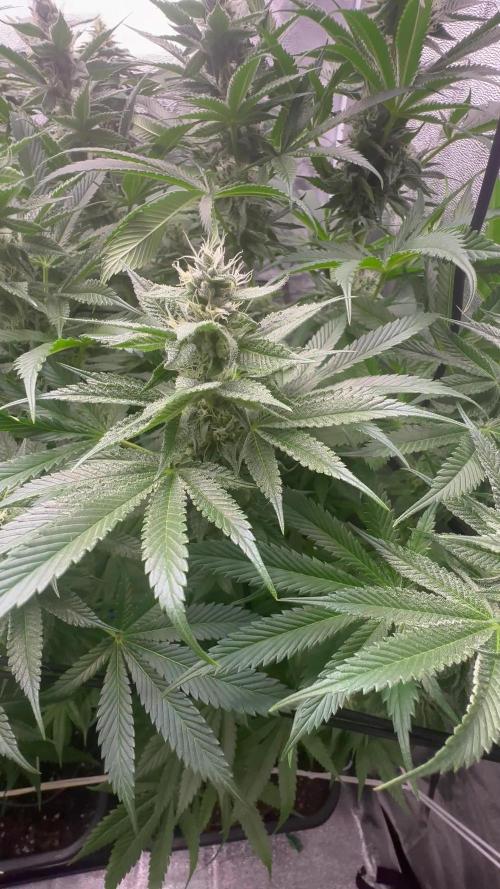
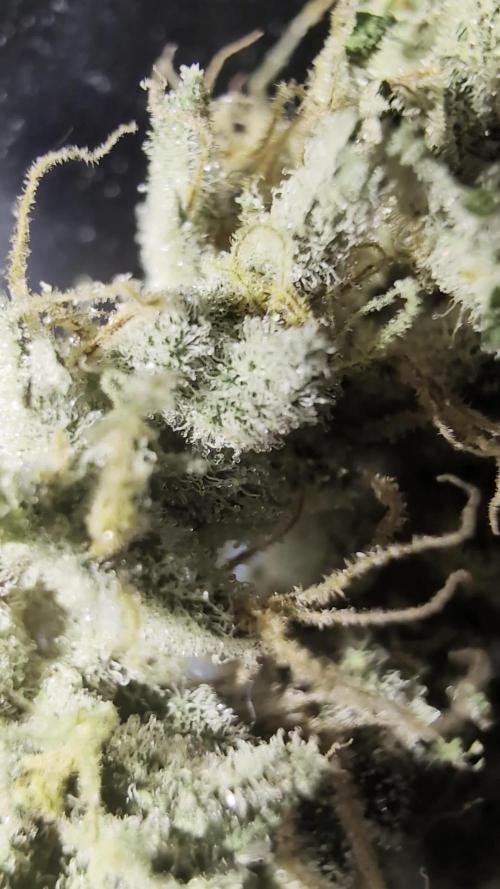
Growing well and have not added nutrients. The lights have been modified, 216w per 2ft light fitting and three units in the grow room. A total of 648w for 15sqft.





Likes
19
Share


@hooolian
Follow
03/01/22: All main colas and smaller colas have an abundance of white trichmomes - looking very well and are sticky. Defoliated for the final time and Lollipopped removing all of the bottom veg to promote bud growth. Pistils are still hairy - just waiting for them to flatten down. only a very few pistils throughout are turning brown - hopefully this will increase within the next few weeks. Overall I am happy with the way things are going - and should only be 2-3 weeks more til harvest.

Likes
14
Share


@Cannabot
Follow
Getting there,glad to see the one pheno seems to be side branching decently.Will just carry on tieing down side branches and main.Weathers been great but definitely getting cooler.Looking foward to their first fully saturated fertigation to runoff during the week if the good weather persists.

Likes
5
Share


@Ninjabuds
Follow
The snow is really coming down out there. Big fat flakes are piling up on the ground, and it doesn't look like it's going to stop anytime soon. I guess that means no outdoor plans for today. Might be the perfect day to get cozy inside with a warm drink and a good book
The pound cake auto plant is growing like crazy! I'm so happy to see all the progress we've made. Yesterday, I finally got around to tying it down – it's amazing how much more stable it feels now. I can't wait to see what this plant looks like in a few more weeks.
Likes
3
Share


@DieGrowerAG
Follow
02.04.2025 Tropicana Poison F1 DWC
The plants are looking great the tipps of the colas at starting to get purple 💜
I need to invest in to another clip fan because of the humidity on the stem I will never grow in will blocks again ther are going to get reals nasty
Hoping for a good harvest
Processing
Likes
18
Share


@DjDaveAtHome
Follow
Oct 26, 2019
Orange Juice (1) – Day 29 Veg/Day 0 Flower
(30% Indica/70% Sativa)
(63-70 days)
Blueberry Headband (2) – Day 29 Veg/Day 0 Flower
(70% Indica/30% Sativa)
(65-70 days)
Cheese (1) – Day 29 Veg/Day 0 Flower
(60% Indica/40% Sativa)
(50-60 days)
Several issues have been corrected in the last 48 hours. Also, a new LST technique I’m trying.
First, am PHing everything. The RO water that I use is 7 or above. Not ideal and has caused some nutrient lockout.
Second, lowered the light Much closer. At 100% power, my light is best for veg at 24” and for flower at 18”. The light was at around 36” or more from the canopy.
Third, I put a weakass fan drawing air down a 2 1/2“ pipe from the top of the grow closet to about 6-8” above the floor. Meant to recycle some of the warm air.
Have seen instant results. It is actually easier keeping the environment consistent. My overnight temp is now 20-22C and daytime is 27-25C. Only a 5 degree difference.
Have started making tea from Gaia fertilizer, seaweed extract, Epsom salts and Molasses. PH 6.2-6.8. Feeding every second watering.


Likes
7
Share


@Mr_nugs_lover_David
Follow
This 5 plants are absolutely gorgeous, they're supper similar to each to each other beautiful leafs and structure, looks like this lady is gonna provide us with beautiful citrussy buds!! Stay tuned everybody! Great autoflowering strain by SPLIFF SEEDS!

Likes
55
Share


Processing
Likes
51
Share


@Silverback_Guerilla
Follow
11/24:
Looks like the Emerson Effect/14 hour photoperiod is working...stretching has commenced.👍
11/25:
Had to raise the lights 5 inches today. The big Sucrose Overdose and a Zkittlez are really stretching.
I'm using platforms of varying heights for the shorter plants to keep the canopy level.
11/27:
Raised the lights another 5 inches and fed today.
11/28:
Raised the lights another couple inches this morning...now, I'm thinking I should have topped them...that's a foot in about 3 days...doh!😏
They're already starting to show signs of budding up, so I'll just have to do some supercropping and tie down the taller mains.
11/29:
Raised the lights a couple more inches and supercropped the tallest Sucrose Overdose.

Processing
Likes
7
Share


@vertex8
Follow
Going well, they are all drinking consistent, feeding them a pretty high dose at the moment, around 2.2ec, signs of burning and spotting int he leaves, think that might be few issues with
A
