


Likes
Comments
Share


@MarcoP
Follow
Before drying, she smelled a little spicy, after drying, she just smells sweet & creamy, amazing smell.
Her taste while smoking is insane, it really tastes like you took a spoon of some berry-orange type of ice cream, no spicyness, just bare candy terps. The buds are rock solid and she is covered in frost. Opening the jars is like sticking your nose in a bag of candy.
Her effects are relaxing, she really makes you stoned, beautiful night time smoke


Likes
2
Share


@SpartacaZ
Follow
L unica che mi piace sto giro sono la gorilla e la runtz....le piramidi non piacciono...


Likes
11
Share


@Jays_Not_Here_Man
Follow
She was super easy to grow. After figuring out she loved to feed, I began mixing her own nutrients separately and within a week had any deficiencies in check. She kept to a regular cycle of regular feed, light feed, then straight ph’d water. This kept her healthy all throughout. No signs of disease or pests, she performed
Like a champ and ended up giving me a little over 6 oz of dense gassy buds. She took a full 10 weeks, and I probably could have given her a few more days, but she is already a very potent smoke, something that is great in the day time for me. For the price of these beans, $45 for 5 feminized seeds, I would highly recommend the 34 street seed Pink Kush strain 🇨🇦👊❤️

Likes
30
Share


@SirSmokeALot333
Follow
Week 14 - Day 93
Still need some time Updates coming😊
Day 95 this gonna be the last one in the tent so in Europe it's 5 pm now I gonna wait for midnight then she gonna get 48h darkperiod and then harvested. Most of the thrichromes started to get amber. I got 75% cloudy and some clear maybe 5% the rest is amber. This was a long run never expected this but I think she gonna be the strongest and yield the most. Smell is very very strong Diesel, Mint, Citrus. This smells like pure haze but don't know its my first Girls Scout cookies. We will see, so that's all so far I gonna do the full upgrade when she's dried and rdy to cure.✌️


Likes
19
Share


@Ctrellis90
Follow
So we're going into the 2nd week of flower and everything is looking good and healthy.
Definitely ready to see what the flower looks like on this cross.
My diary won't be complete in time for the contest but I'm still stoked for this grow.

Likes
18
Share


@GreenAutoConsumo
Follow
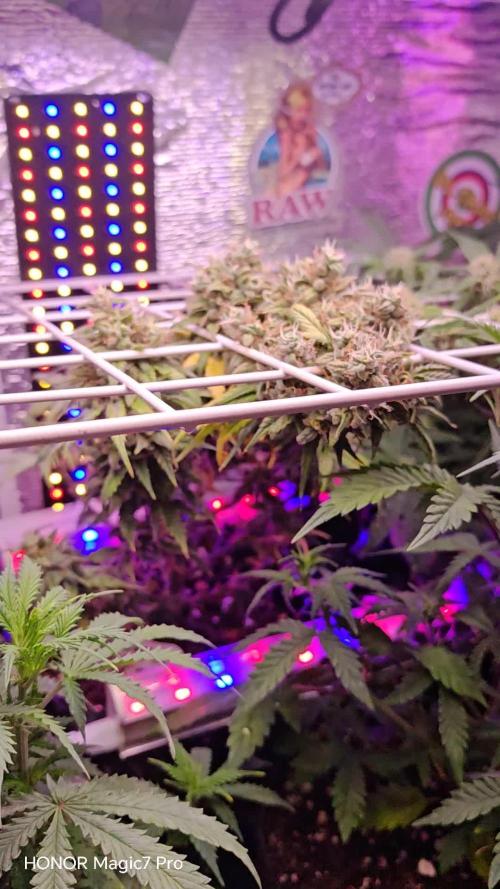
Muy buenas amigoooos!! Aquí dejo una nueva publicación de otro par de las matas de mi amigo que como podéis ver para colmo después de todos los problemas que an pasado.. Para colmo cogieron araña algunas de ellas, como podéis ver la Royal Domina a sido la más afectada pero hemos podido sobrellevar el cultivo y finalizarlo a pesar de esta plaga tan temida, la hemos combatido con aplicaciones foliar es de agua muy fría y mucho aire para que no se reproducieran más y las que estuvieran se fuesen y la verdad que a resultado bueno a podido cosechar algunas ya. Solo le quedan tres ejemplares en vida que lo iremos viendo estos días, lo dicho.. Espero que os guste!!
Buen día y buena semana!



Likes
18
Share


@GYOweed
Follow
Trainwreck and Brucey now in flower room 5 gals going 15/9.
Need to feed the TW or color is ok for sativa?
The greenpoint OBS was fimmed and recovering. Same for the strawberry sorbet going way better.


Likes
2
Share


@Fireproof
Follow
Mo. 25.11.24 (Tag 36/Blütewoche 2)
Lampe auf 100% Dimmung
Extraktor auf 25° / 40% / 100 m3/h
"7-12 days for 1Pot 15L für System Activation AutoPot" - Habe mich für 11 Tage entschieden
Prüfung of Pflanze gut angewurzelt hat, wie? — „If heavy plenty of moisture remains to be absorbed by developing roots, if light switch on.“
AutoPot System aktiviert. Initial mit 30l (insgesamt 47l, d.h zu ca. 2/3 voll) Wasser gefüllt, d.h. 3 x 10 l Eimer voll mit lauwarmen Wasser
Merke: „Always raise your reservoir to a minimum of 150mm above the highest AQUAvalve and re-fill the reservoir
when there is approximately a 1/3 (ca. 15l) of the solution left - NEVER ALLOW THE RESERVOIR TO RUN EMPTY.“
Di. 26.11.24 (Tag 37/Blütewoche 2)
21:45 Uhr | Restvolumen = (33,6/ 61,5) * 47 = 25,7l
Mi. 27.11.24
Cola gebogen. Mesh dazu etwas niedriger auf 17cm über Erde geändert.
Do. 28.11.24 (Tag 39/Blütewoche 2)
29.11.24 10:50 Uhr | Restvolumen = (33,5/ 61,5) * 47 = 25,602 l
Wie in https://www.growmart.de/mediafiles/Sonstiges/AutoPot/autopot-growers-guide-complete-en.pdf anegeben, die Pflanze mit der „Organics - Pot Feeding Technique“ mit 10ml/L BioTabs PK 5-8 gedüngt
1. 08:00 Hahnen geschlossen um Wasserzufuhr zu stoppen
2. 22:40 Nach ca. 14h geprüft ob das Modul trocken war — Noch ein bisschen Wasser im Modul.
3. 23:00 Düngelösung neben das AQUAValve geleert und bis auf Höhe Schlauch gefüllt - ca. 250 ml
4. Gewartet bis die Düngelösung von der Pflanze aufgenommen wurde und Vorgang einige Male wiederholt
Sa. 30.11.24 (Tag 41/Blütewoche 2)
1l Düngelösung war ca. 21:00 Uhr verbraucht. AquaPot wieder aktiviert.
So. 01.12.24 (Tag 42/Blütewoche 2)
In nur 1 Woche extrem viele Blätter entwickelt
Ich zähle mindestens 11 Blüten die nächste Woche im Netz sein werden
In Blütewoche 2 hat die Pflanze einen ganz schönen Stretch gemacht
23:15 Uhr | Restvolumen = (31,5cm/ 61,5) * 47 = 24,1 l
Verbrauch seit Aktivierung Aquapot ca. 30l - 24,1l = 5,9 l -250ml welche sich im Pot befinden = 5,6 l, davon ca. 2 Tage Dünger und AquaPot aus - 5,6/5 Tage ca. 1,1l pro Tag

Likes
18
Share


@Mr_weed_pt
Follow
One more week..the buds are looking great and the smell is really sweet…


Likes
14
Share


@Esoteric_growing
Follow
Swelling up and right on track for a good result, still showing signs I pushed them a little hard with the tip burn but nothing I can do about that now
Likes
23
Share


@Tmasm
Follow
Zamnesia, obrigado por fornecer a genéticas para testes.
Entrega segura, dentro do prazo e muito discreta, como você pode ver nas fotos.
Experiência para possível plantio em massa, dependendo dos resolvidos.
1 BISCOTTI (ZAMNESIA SEEDS) FEMINIZED
Já germinada
1 JEALOUSY (ZAMNESIA SEEDS)
Já germinada
1 SUNSET SHERBET AUTOMATIC (ZAMNESIA SEEDS) FEMINIZED
Será germinada no próximo mês, devido temperatura elevadas, temos dias chegar 40c⁰, não quero automática stressada, logo ao início.
O diário será atualizado toda semana, espero que gostem (eu também).
Likes
14
Share


@BoboLacetti
Follow
It's slowly coming to an end. I check the trichomes every 3 days. Most are still glassy. I think the first two plants that are ready to harvest will be RedHotCookies #2 and Ayahauscapurple #1
The buds are slowly getting thicker^^
I got an upgrade. The AC Infinity fan. Great impression so far. In the future I will get the complete AC infity set. Exhaust air, controller, humidifier so that I can set the VPD correctly in the future.
Likes
7
Share


@Genussmittel420
Follow
day 3 - hulkberry forms first pollen sac.... might play with the fire and try to get rid of it if it is the only one. not too sadisfyed with RQS automatics yet tbh. :(
day 5 - the other flowers seem to be female, as you can see on the hulkberry picture from today.
Likes
21
Share


@ButterfliesLittleFarm
Follow
Hello Diary.
The second week of flowering is over, as seen in the photos, Mimosa # 2 flew into the sky. She has grown 45cm in a week which is twice her size since last week.
Both plants look good and healthy. The color of the leaves is dark green and they shine as if they were varnished. Both have stretched quite a bit, especially Mimosa # 2, to whom defoliation has obviously come in handy.
Also after I put the bending clips, I directed the branches away from the plant to get as much light as possible.
We’ll see how the flowers continue to form and fill in, but for now, all is well.
Watering is now every two days, I added CalMg preventively twice and added one Easy Bloom Booster tablet.
Conditions at the "Farm" are not ideal, the temperature is around 29 degrees which is expected given the summer months.
Here’s what it looked like last week.
14/06/2021 - Day 30.
Watering. I always prepare about 8 liters of water, I regulated p.H. at 6.5, added 1.5 ml / lit CalMg and one Easy Bloom Booster tablet. With that, I watered all three plants evenly.
Temp / Humidity on the farm - 27.6 degrees and 40% humidity.
16/06/2021 - Day 32.
Watering. I lowered the p.H to 6.2 and added 1.5 ml / lit CalMg.
Temp / Humidity on the farm - 29 degrees and 50% humidity.
18/06/2021 - Day 34.
Watering. This time I didn't add any extras, I just lowered the p.H to 6.4.
Temp / Humidity on the farm - 29 degrees and 50% humidity.
19/06/2021 - Day 35.
Photography and height measurement.
Mimosa # 1 - 104 cm
Mimosa # 2 - 90 cm
That’s all for this week, see you soon.
Likes
2
Share


@RawCare
Follow
Removed some fan leafs and the buds starting to explode. This lush young plant stands proud with vibrant green leaves, a testament to its great genetics. The plant is thriving under optimal nutrient uptake, its buds already beginning to form and swell with promise of a bountiful harvest of top-quality buds. This young lady is growing with a blissful ease and a resilient growth. Ample space to improve on my next run 🙏
Likes
1
Share


@BushDoctor740
Follow
These 3 beautiful plants are doing fantastic and took off like a 🚀.I spread them open by tieing down all the branches to get that light deeper and widen them out.I currently have 3 autos that a previous grow from fast buds produced seeds which look amazing in the 5x5 with them that will finish around the time I want to flip to flower :).Light intensity has been increased to 60 percent power and they are taking it well.Ive been giving recharge tea and some cal mag they were top dressed with Gaia green 4,4,4 and doing fine.It definitely smells very strong in the tent which I thought it was the autos but the short photo I’ll start naming plant #2 is very strong skunky smelling early on no flower yet.My goal will be to remove the autos and fill the 5x5 with these 3 healthy photos.
Likes
9
Share


@russrahl
Follow
Everything went as good as it could the last week. I definitely realize now that the light was too much for them once they stretched up from the lack of knowledge using my light mover. I’m still trying to figure them out but I believe I have the rite combination now for speed and pause times, but sadly to late for this crop. My other tent just going into flower with the same setup will be run drastically differently this time for a lot of things to compensate for my intense 1000w HPS. I’ve grown massive Buds before under this light in smaller tents and I’ll be dam’d if I’m gonna let this light rail defeat me! Lol so we are gonna start flush now because we are just about 8 weeks in and although we do have a ton of bud in this tent and I would have like to push her a bit more, we are gonna take what we got and move on! Lol there are a lot of medium size buds absolutely everywhere, and solid. Even below the top screen, between the 2 screens every node has a solid bud sticking out. Still gonna be a nice yield I think all things considered. Ph pretty much stayed constant in the reservoir at 6.0 as well as the EC was sitting around 1.5 all week. Wish I could get my light up more but I’m having a hard time finding the attachment for my light rail mover to add a bar instead of ropes to suspend it. I can’t justify $100 to import it from USA though...lol so I’m gonna experiment with some other diy one once I get these girls cut down, dont wanna mess around above them and risk dropping the heavy light on my girls. That’s it for this week. Gonna start out flush in the next day or so and ill report back in a week or so! Cheers💨

Likes
10
Share

@Organic_G
Follow
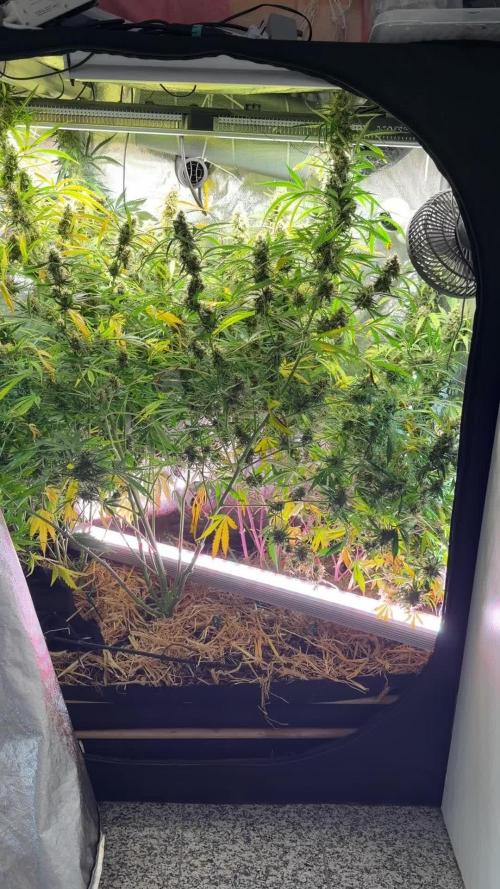
Wachsen und reifen ganz gut, überlege bereits eine zu cutten aber denke warte noch ne Woche oder so
Good Things Take time ;)
Ansonsten Terps sind jut