Likes
Comments
Share
@Ageddd
Follow
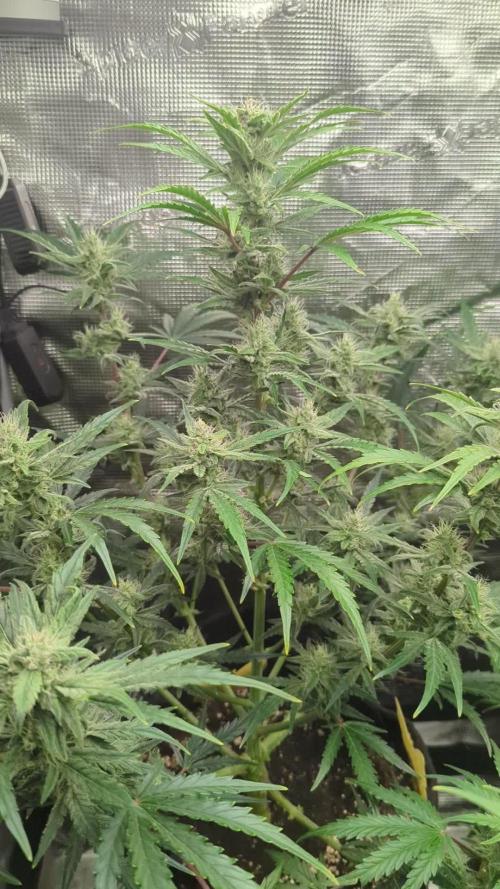
Another freezing cold week !! Before having this plant, i thought that a plant would never survive with this temperatures... but this Afghan Kush proved im wrong, whats amazing because this plants strenght is remarkable, the buds i noticed, are not developing as fast as in September/October, basic grower logic but we are having between 8-14 ºC during the day and 2-5ºC at night.. Wider range of colours, i spot like Purple, Deep green, and even shades of Violet and blue, its incredible :D Last feedings, finished like in the middle of this week and the buds developement degree is telling me, its flush time ... Spotted a few white aphids, but only on the leaves, so not a problem.. Having in mind the temperatures they are not lasting so much hahaha its the good thing Last weeks of life, and i suppose she will be yellowing more during the next week. THe photos are progresive, so the first photos were taken at the beginning of the week and so ... Have a Nice Week Guys :D
Likes
22
Share
@BruWeed
Follow
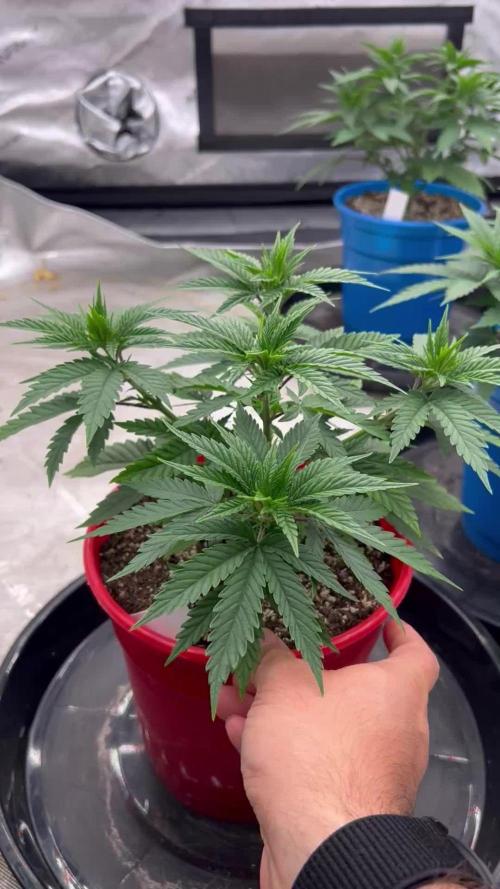
☘️04/11 - Empieza su tercera semana en Etapa de crecimiento. ☘️Su crecimiento es muy notorio de una semana a otra, esta creciendo fuerte y su desarrollo es muy bueno. Esta creciendo de forma correcta sin ningún problema. ☘️Este diario es para participar en el sorteo de "Best Rarest & Smallest Pot by seedman". ☘️Esta es su última semana en Etapa de crecimiento, ya el 09/11 comienza en Floración. ☘️Estos días seguiré subiendo más imágenes de como viene.
Likes
65
Share
@3lementa1
Follow
She's growing so fast. I was just watering the rockwool cube whenever it dried out but I put it in the net pot today and covered it in LECA clay pellets. I topped her yesterday as well. PH and ppm look good. I'm just going to plug in the dripper every once in a while until the roots start growing through the net pot. I don't want the rock wool to be submerged. The top is covered with clay now so shouldn't be susceptible to mold from the light reaching it. Looking at my last grow (CBD Blue Shark / Wedding Cake) I didn't provide enough light or nutrients at the start and wasn't able to top until week 6. Growing in peat/rockwool instead of paper towel/soil, adding nutrients right away, and using the HID grow light from the start instead of a smaller cloning light seem to have made a big difference.
Likes
Comments
Share
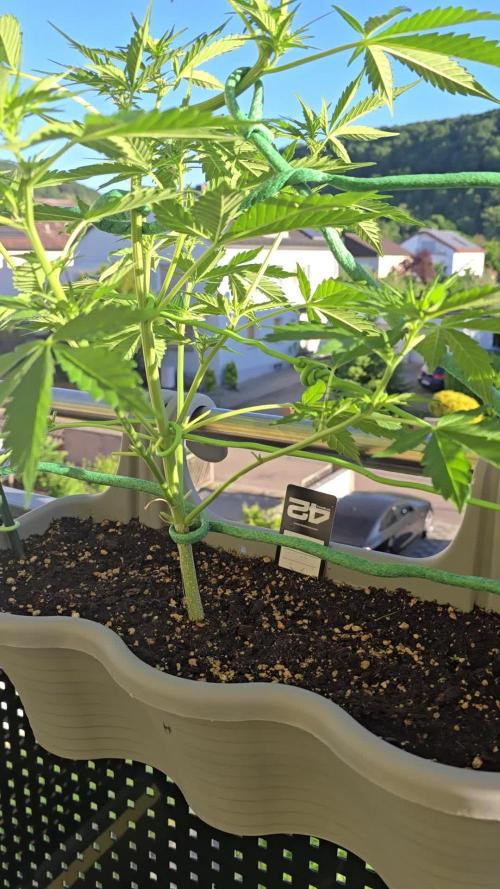
Die Pflanzen haben ihren Stretch voll eingesetzt – das Höhenwachstum ist deutlich sichtbar. • Wuchs: Die Triebe sind stark nach oben geschossen und beginnen, die Blütepositionen zu bilden. Das Netz hilft dabei, die Struktur offen und gleichmäßig zu halten. • Farbe: Leuchtend grünes, gesundes Laub ohne Anzeichen von Stress oder Mangel. • Form & Struktur: Gleichmäßiger Aufbau mit stabilen Haupttrieben – ideale Vorbereitung auf die Blüte. • Gesamtzustand: Vital, stark und optimal im Übergang zwischen Veg- und Flower-Phase.
Likes
2
Share
Looking quite nice on this one ✌️
Likes
14
Share
Dear Growers , Welcome to Week 9 or Flower week 6/Harvest of Blimburn Plushberry Auto. Project Setup & Conditions: • Brand/Manufacturer: Blimburn Seeds • Tent: 222cmx150cmx150cm • Light: 2x 720 Watt Full Spectrum • Humidity: 50% • Soil: Narcos Organix Mix • Nutrients: Narcos Products • pH Value: 6 Get Your Epic Blimburn Seeds Genetics or Explore the whole seeds/headshop or Merchandise from This Amazing Breeder. Just Take a look with some time in your pockets with this Link [https://blimburnseeds.com/?blb=dstp8dm] Get another 10% Discount using the code [DSTP8DM] at the checkout. If you want Germinitation results like mine , check out Kannabia Seeds with my link [https://www.kannabia.com/de?ref=61966] and grab the germination device or the strains I used . Trust me – it’s worth it for sure ! Get another 20% Discount at all products using the code [GGD] at the Checkout . Stay curious and keep up Growing —we look forward to welcoming you back for the next Projects soon! Smoke Report Follow .
Likes
2
Share
@Reaper
Follow
The plant got harvested at day 56 of flowering. too early bit was my first grow and had no idea about the harvest window.
Likes
1
Share
Week 9 for Strawberry gorilla by fast buds Shes getting so close to the end 😍 I had to remove a little bit of bud rot at the start of the week, but ever since haven't been able to find anymore developing 😇 Quite surprising how little water these girls drink... still only got fed once this week with a bit of (WCA) Water Soluble Calcium & (FFJ) Fermented fruit juice for its last few weeks of life now. Really excepted her to drink more with this hot hot weather.
Likes
8
Share
@Smev1337
Follow
this is the end again! the 2 ladys gave me some big buds which i really liked and for the rest of the plant i will probably turn it into rosin and fill it into vapes or for some rosin for joints else this grow was really easy to handle! 😎
Likes
13
Share
*****Week 9 - September 14 to 20, 2020 - Days 57 to 63 from germination****** They were feeding well this week and took the higher more consistent amount of nutes well this week. Had to make a decision at the end of the week and I took out the small full spectrum light to put in the photo tent. They are in flower now and I held off as long as I can. These girls are closer to the end and I will keep the intensity focussed on LAK3 and GSC and let the other two live in the shadows and ripen😎 Not my first choice but everything is a trade off in life unfortunately☹️ Not an issue outdoor growers deal with👍 Little more detail: Sept 14/20 - Day 57 - Massive @ 3ml, Terpinator @ 2ml, Vitathrive & Liquid Weight & Rezin & Dual Fuel @ 1.5ml - 1,000ppm and 5.8pH - Feed for only LAK1......other girls area going to dry out another night. Sept 15/20 - Day 58 - Overdrive & Rezin @ 2ml, Liquid Weight & Vitathrive @ 1.5ml, Dual Fuel @ 1ml - 650ppm and 5.6pH - 2L given to each girl Sept 17/20 - Day 60 - Overdrive & Rezin @ 1.5ml - 200ppm and 5.3pH - 2L each given to the girls. - Just a bit to help with swelling. Sept 18/20 - Day 61 - Massive @ 3ml, Terpinator @ 2ml, Vitathrive & Liquid Weight & Rezin & Dual Fuel @ 1.5ml - 1165ppm and 5.2pH - LAK1 - 4L, LAK2 - 2.5L, LAK3 - 3L Sept 20/20 - Day 63 - Terpinator @ 3ml, Overdrive @ 2ml, Sensyzime & Vitathrive & Liquid Weight & Rezin & Dual Fuel @ 1.5ml - 1045ppm and 5.3pH Wrapping up week 9 and heading into week 10........the days ahead are going to be the guessing ones......is she done yet???? To be honest I have not even looked close at trichome yet🧐 I fully expect to see day 74 with LAK1.......not sure LAK2 will make it that long???? LAK3 will still be a couple of weeks yet but she is roughly a week younger. Cheers Growmies and have a great week ahead🙏😃😃😃
Likes
6
Share
@jollychap
Follow
Mon, 22 July Ok everything is coming along swimmingly except for the fact that that plant #3 had to meet the executioners block. Because he was dried out at a young stage he never bounced back properly but that's ok because I now have a holding tank for when I'm working on the other plants thus plant #6 is now plant #3. With the inclusion of my new humidifier I must say my operation is looking quite sophistimakated. Trying to get RH around 60% and I keep looking into my co2 generation options. Note to self a good rule to remember for light to plant distance is that if you put your hand near the highest point of your plants for 30 seconds and it's starts to burn, then your lights too close
Likes
7
Share
@Daw33d41
Follow
🇺🇸 We’re in the finals. Just 3 more days without water and then it’s harvest time. Buds are nicely swollen, resin everywhere and the smell is insane. Can’t wait to chop her down. 🇨🇿 Jsme ve finále. Teď už jen 3 dny bez vody a pak jde na řadu sekyro. Palice jsou krásné, pryskyřice všude a vůně brutální. Už se těším, jak to dopadne 🤠
Likes
3
Share
She had few leaves removed as had to battle RH but looking happy as ever so lets goooooo of to 12/12
Likes
14
Share
Seed was sown today ✨ 10/11 🇨🇦 Helmet on the rise 13/11 Good luck everyone! Edit 24/11: I pulled the trapped seedling and sowed a new seed today... It's now a Seedsman freebie- critical+ 2.0 auto 🤙
Likes
21
Share
@MG2009
Follow
02/10/2022 Got some pics of #6 in regular light did some defoliating and took some late clones from lower branches soaking up some water. Ps. This week is two days early so my other diary's can be spaced out more.
Likes
2
Share
The nighttime VPD does not need to mirror the daytime VPD. Daytime VPD dictates the pull of water and nutrients, while nighttime VPD acts mostly as a prevention tool. A high nighttime VPD increases the risk of the leaf temperature dropping below the dew point, which can trigger bud rot and powdery mildew. Switched down to 12's hours of light mid-week, changed spectrum, increased light intensity from 840umol up to 1150umol at current height. Overnight from 800ppm to 1500ppm, morning compensation point (microorganisms) 46-47 days from germination, she fills the canopy herself, once the apical dominance is broken. Measuring a plant's overnight CO2 emissions provides an accurate estimate of its dark respiration rate. Because photosynthesis stops in the dark, you are isolating the respiration process, which allows you to gauge how much stored energy (glucose) the plant has consumed and estimate the scale of oxidative phosphorylation. Oxidative phosphorylation is the final stage of respiration that generates the bulk of the plant's ATP (90%) and relies directly on the oxidation of these respiratory substrates NADH and FADH2 along with the consumption of oxygen. From a thermodynamic standpoint. Growth is an energy-capturing process, and the rate of that growth is bound by the available free energy (Gibbs free energy) and the First Law of Thermodynamics. While the ceiling or upper limit is dictated by free energy (such as photosynthetically active radiation), the actual amount of growth relies on how the plant balances that energy with other limiting factors. These are often described as the nine cardinal parameters of plant growth. 4 Above, 5 Below. If any one of the 9 becomes bottlenecked, the entire plant's cycle is restricted. Operating an 80F+ environment at night to force rapid carbon conversion comes with major drawbacks, as the biochemical processes work differently than the deductive logic suggests. While raising nighttime temperatures to 80F indeed accelerates respiration and speeds up the conversion of captured sugars (sink activity), doing so also radically increases the plant's overall metabolic baseline. If the plant's metabolic rate is artificially forced too high via heat, it can actually "burn" through more energy than it managed to assimilate during the day. This leads to carbohydrate starvation, stretching, and a net loss in final biomass yield. 400 ppm is near the standard ambient level; the plant's stomatal intake is the primary limiting factor, not the dark-reaction enzymes. To push 45 DLI without burning out the plant. Trying to force the conversion of a massive daylight DLI in a compressed time frame (12 hours) becomes highly inefficient because the Rubisco enzyme simply hits a saturation limit. To successfully convert a 45 DLI into dense, productive mass, the ambient CO2 generally needs to be elevated to the 1000 to 1200ppm range. This creates a steeper concentration gradient, driving the stomata to inhale CO2 fast enough to match the high photon energy. It's not all about the amount of light, but the ratio too, as this will dictate growth through the ratio of phytohormones. In order for correct bud development, there needs to be a correct ratio of RGB. Different wavelengths have different penetration depths. When one grows using top-down lighting, only the entire canopy is limited to 2-3 layers of leaf, meaning there will only be correct bud development in those layers, regardless of getting 45DLI. The biomass potential of a plant is linked to root mass. Generally, when a plant reaches its maximum biomass, you can help to chop off parts of the plant that are in less than efficient areas of the plant (low light) so that it can create new biomass growing towards the light. Strength is the maximum potential, and power is the rate of conversion. You can have the biggest veg period of 18 weeks, and it means nothing, as soon as you start flowering, the chronological clock starts ticking, the only metric that matters to bud size is how much energy you convert each cycle, not by how long it took you to build the framework, it helps a lot nonetheless. Not saying anyone should not defoliate for a reason, only that you should have one, and at the right time. Don't defoliate 30+% on autoflowers or 4 weeks into the flower period and expect an increase in yields; it doesn't work like that. There is room for dictating growth patterns and clearing out overcrowded nodes, but it needs to be done in veg because once that timer starts and buds start growing, it's all just energy conversion. One barely needs to defoliate at all in a 4x4 because with side lighting, turning a 2d canopy penetration into a 3d, even lower buds are 90% the quality and density of top ones. The rate of photosynthesis and the ultimate density of lower buds aren't just about the sheer number of photons PPFD. The specific ratio of R:G:B dictates canopy penetration and drives different photochemical reactions. The Electron Transport Rate (ETR) measures the speed at which electrons are driven through Photosystem II (PSII) during photosynthesis. The ratio of Red, Green, and Blue (RGB) light heavily dictates this rate. Plant leaves continuously perform cellular respiration regardless of the time of day, using energy and oxygen to fuel essential metabolic maintenance. If you over-defoliate, the remaining canopy may be unable to produce enough net sugars during the day to offset the constant respiratory demands of the plant. Must balance fixation with assimilation; there's no point in capturing 45 DLI if you only convert 20% every cycle due to an extreme lack of respiratory capacity to perform cellular oxidative phosphorylation. You can have a 4x4 canopy or a 4x4x4 canopy, yes, we know that side lights are not as effective at absorption from the sides or underneath, but it's not about DLI, it's never been just about efficiency, it's about the penetration ratios of RGB that drive ETR of/photosynthesis and trigger correct bud development. The size of each bud is its own ability to perform the ETR required for its own personal growth, and bud development is dictated by the ratio of RGB. It drives localised growth and acts as a regulatory switch for that development. Turgor pressure is another very important factor in understanding if you want big buds, for it is the "steam engine" that dictates the rate of bud expansion. Simply, a lot harder to achieve metabolically at ambient 75F than at say 86F Because buds have less chlorophyll, they do not suffer from the same photosynthetic shutdown that over-exposed, light-stressed leaves do. They can soak up direct light energy to swell in density and size. Their tolerance to intense light is heavily limited by the temperature and humidity, but if you can control those temps and keep the rot away, buds have a much, much higher tolerance to high light than leaves. Beneficial to hammer with high light before trichomes appear. Balancing this with trichome maturity is key for rich terpene and flavonoid profiles, want it just right, somewhere in the middle, not too much, not too little. Find cannabis plants can defoliate themselves come harvest, given the right signals. Every last ounce of potential is recycled into buds by the plant itself (senseceance), given you can keep the level of conversion high enough to prompt a need to do so. Get the canopy @ optimal PPFD range, 45-55DLI, then let the plant "stretch" the stems into a "PPFD range much higher, one that leaves don't like to grow in, but buds thrive in. What is optimal for a bud is different from what is optimal for a leaf photosynthetically. Genes provide the blueprint, but the environment dictates how, when, and if those genes are expressed. Must first signal the condition to increase the expression you want to exist through stress and response, cause and effect. A well-buffered CEC medium prevents extreme nutrient swings, allowing plants to maximise their dedicated genetic expression. A plant is either genetically expressing "growing" or "recycling" genes based on its nutrient starvation level in the medium. Constantly toggling between "growing" and "recycling" hormonal states creates a futile cycle that wastes valuable metabolic energy. Plants rely on sophisticated biochemical switches to manage this trade-off and prevent rapid fluctuations that disrupt that balance. This energy inefficiency is a recognised biological challenge. Plants avoid this costly "flip-flopping" by using hierarchical master regulators (like the TOR and SnRK1 protein kinases) that act as strict molecular switches. These networks enforce cellular commitment to either growth or survival, preventing mixed signals. This is something that was missing from previous grows. Under nutrient-rich conditions, TOR promotes protein synthesis, cell division, and structural expansion. Under starvation, TOR is inhibited, and SnRK1 is activated. This triggers autophagy—where the plant breaks down old macromolecules and organelles to scavenge and reallocate essential nutrients to critical sinks. "What's the point in flushing?" The core idea behind a PK booster is to deliver a massive, concentrated surge of P&K exactly when buds are swelling in conjunction with a N starvation. Because these are short, targeted windows, the nutrients must be highly bioavailable so the plant can process them immediately. As soon as you go "organic," that's out the window. Much slower release, uncontrolled, very difficult to "spike". to cause the ratio that will initiate a response. High-volume PK spikes rely strictly on the immediate uptake capabilities of mineral fertilisers. Making it far less efficient in organic/living soil setups. When you use organic nutrients, it changes the dynamic with which the plant delivers and trades its nutrients; organic is always releasing new nutrients into the immediate EC. This prevents a lot of autophagic responses from occurring due to a constant stream of new nutrients into the immediate medium's EC. This can prevent nutrient starvation from being signalled. PK boost is essentially just N starvation, triggering an autophagic response. Concentrated ratio of P&K while tapering off the Nitrogen base. To the plant, the sudden drop in Nitrogen registers as a severe environmental stressor—essentially, the beginning of starvation protocols. She aggressively strips nutrients and proteins from older leaves and vegetative structures and shuttles them directly to the developing flowers and fruit. Ta daaa. Call it a PK booster and sell it. Nothing to do with the P and K itself, it's the ratio immediately available in the medium triggering a nutrient recycling mechanism within the plant itself; all the "booster" sells is the trigger to the signal. PK BOOST with 50% ammoniacal N signals floral maturation. PK BOOST with N starvation signals nutrient recycling/sinking. Very difficult to initiate a response when organic nutes are doing their thing. It takes 4x5x more water significantly to leach or wash ammonia out than it does nitrates. This can prevent triggering N starvation from having its normal impact. Manipulating the C:N ratio in the medium. One autophagic response has multiple potential signal triggers. Nutrient starvation is not an option.
Likes
4
Share
@Krusty13
Follow
All photos are from the last day of week 3. This week we had some problems with the temperatures, not to mention the broken fan. We solved the problem by removing the power supply from the Lumatek ats 300w pro lamp and taking it outside the tent. Everything seems to be fine even if there are some yellowish leaves.
Likes
24
Share
Die Pink Rozay bestätigt diese Woche endgültig, dass sie ein echtes Sommerkind ist. Kaum kratzen die Temperaturen an der 30 Grad Marke, drückt sie aufs Gas und wächst gefühlt direkt Richtung Mond. Das Höhenwachstum ist beeindruckend, aber mindestens genauso schön sind ihre riesigen Sonnensegel. Die Blätter wirken gesund, kräftig und sehen fast so aus, als wollten sie möglichst viel Sommer auf einmal einsammeln. Die Vorblüte zeigt sich mittlerweile sehr deutlich und damit war es Zeit für den Wechsel auf Green House BioBloom nach Düngeplan. Jetzt hoffen wir, dass die Dame ihre Energie langsam etwas weniger in die Höhe und dafür mehr in die kommende Blütenproduktion investiert. Wobei wir sie mittlerweile gut genug kennen, um zu wissen: Das es auf jeden Fall gut wird. . Das warme Wetter sorgt außerdem für ordentlich Durst. Aktuell verschwinden rund 2,5 Liter Wasser pro Tag, was zeigt, wie aktiv sie gerade arbeitet. Insgesamt präsentiert sich die Rozay wieder einmal als robuste, vitale Pflanze mit starker Genetik. Sie sieht hervorragend aus und macht genau das, was man sich von einer Outdoor-Dame im Hochsommer wünscht. 😘
Likes
25
Share
@MrJoint
Follow
✌️🎃Thank you for checking my cultivation.