


Likes
Comments
Share


@420DeepGrow
Follow
Gracias al equipo de Anesia Seeds, Marshydro y XpertNutrients sin ellos esto no seria posible.
💐🍁 Captain Future:
Nuestros criadores en Anesia Seeds están siempre en busca de nuevas dimensiones en la genética del cannabis y están comprometidos a ayudar a dar forma al futuro de la cría de cannabis. Después de que nuestra Future # 1 fuera probada varias veces por encima del 37% de THC y se convirtiera en un éxito entre los dispensarios, teníamos claro que el viaje no podía terminar aquí. Después de numerosos intentos, encontramos el socio ideal para mantener o aumentar la potencia y llevar la experiencia de sabor al extremo.
Esta variedad Premium puede cultivarse tanto en interior como en exterior. En el interior, las plantas tienen un tiempo de floración de 10 a 11 semanas y deliever rendimientos de 500-600g por metro cuadrado, al aire libre una planta puede producir hasta 800g
🚀 Consigue aqui tus semillas:
https://anesiaseeds.com/es/product/captain-future/
💡FC6500: Eficiencia líder en el mercado: la lámpara de cultivo LED FC-E6500, que ostenta un estatus líder en el mercado, es una solución rentable con un PPE de 2,8 µmol/J y un rendimiento máximo de 2,5 g/vatio. Ofrece un PPF alto de 2026 umol/S y es adecuada para una cobertura de vegetación de 1,50 m x 1,50 m y una cobertura de flores de 1,20 m x 1,20 m.
Iluminación versátil y uniforme.
https://marshydro.eu/products/mars-hydro-fc-e-6500-730w-commercial-led-grow-light/?gad_source=1&gclid=Cj0KCQjw1qO0BhDwARIsANfnkv9IIrYSbmJqz8PqpJOIyWwJfp5bc3SGJgUV68USLQ4tjmXDYwoBuAsaAue3EALw_wcB
🚥 MarsHydro ADLITE UV/IR/RED:
Para lograr un crecimiento óptimo de las plantas y maximizar los rendimientos es un arte simple que depende en gran medida de las condiciones ambientales adecuadas. Reconociendo las limitaciones de la iluminación natural y las soluciones de iluminación tradicionales para satisfacer estas necesidades únicas, lanzamos ADLITE. Estas luces especiales UV, IR y roja están diseñadas para llenar áreas del espectro, proporcionando las altas longitudes de onda que las plantas necesitan para un crecimiento y desarrollo óptimos.
🚀 Consigue aqui tu Adlite:
https://marshydro.eu/collections/adlite-supplemental-lights/
🏠 : Marshydro 1.50 x 1.50 x 1.80, carpa 100% estanca con ventanas laterales para llegar a todos los lugares durante el grow
https://marshydro.eu/products/diy-150x150x200cm-grow-tent-kit
🌬️💨 Marshydro 6inch + filtro carbon para evitar olores indeseables.
https://marshydro.eu/products/ifresh-smart-6inch-filter-kits/
🍣🍦🌴 Xpert Nutrients es una empresa especializada en la producción y comercialización de fertilizantes líquidos y tierras, que garantizan excelentes cosechas y un crecimiento activo para sus plantas durante todas las fases de cultivo.
Consigue aqui tus Nutrientes:
https://xpertnutrients.com/es/shop/
📆 Semana 12:
Última semana de engorde de este precioso micrófono antes de lavar raices, el aroma es increíble y la cantidad de resina se acumula por momentos.

Likes
9
Share


@AlekZombie
Follow
Hey sry the delay, this tuesday started the 5th week
Watering:
07/7: 1l with 0.5ml bacteria/mycorrhizae each + 1 ml bio boost/flores
CO2:
Reaktor is using their phase 2 which it supose to give us 800 ppm

Likes
10
Share


@JBOrganix
Follow
Super burnt lol. Ooops I'll still finish her off and hope for the best. Should still be some decent smoke 👌

Likes
92
Share


@Roberts
Follow
Sweet Zenzation or Zkittles grew great under the Unit Farm UF4000, and UF2000 lights. The UF2000 was added during flowering. She was part if a 5 plant grow. I will try to add a harvest video here once I cut it down. She has a nice color morph from the fade as well. Great frost, and smell. Thank you Sweet Seeds, and Unit Farm. 🍻❄️🌱
Thank you grow diaries community for the likes, follows, comments, and subscriptions on my YouTube channel. 🍻🌱👍 Happy Growing 🌱
https://youtube.com/channel/UCAhN7yRzWLpcaRHhMIQ7X4g

Likes
6
Share


@Ninjabuds
Follow
It's a nice change of pace to have these warmer temperatures, even if it's not quite spring yet. Low 40s during the day is a lot more comfortable than what we've been dealing with lately. Hopefully, this is a sign that spring's around the corner.
It's crazy how much my permanent marker plants have grown! They've really taken off. One's got these super cool purple stems, and the other's covered in buds – it's gonna be beautiful when they bloom.

Likes
34
Share


@rhodes68
Follow
10/24 Week 10 Third of Flower
Clones building daily stretch looks very manageable on target for 36 inches or less.
Leaving nuets as is
From what I am seeing I could grow 8 plants a grow using 3 gal pots. This would give a much better canopy and use of the lights
10/28
Increased PK slightly
10/29 Pics all is well new light is holding down the right side real well making another for the left, 120 watts @3000k out of her, can go as high as 160 watts if I like.

Likes
13
Share


@FUH20
Follow
Technically this is veg week 2, currently still going. Had some cal mag issue so I started to put nutes flush with pH 6 then fooliage spray with cal mag 1 ml per 300 ml. Also nutes at 550 general hydroponics trio.
So ending of this week 2 veg about 21 days since I planted the seeds, had issues with nute burn I gave double ppm by mistake thinking it would help the cal mag issue but ended up burning some baby leafs, so far looks like it grew out of it but I'm guessing yield will be effected greatly. Lesson learned


Likes
6
Share


@mc_plantz
Follow
Zum Start der 2. Woche wurde getoppt.
Mal schauen, wie die Damen es verkraften.
Läuft es wie geplant, wird nächstes Wochenende umgetopft.


Likes
6
Share


@IamCy
Follow
Here we are. Week 2. On the Day 8 video, I give my method on how I produce nearly zero larf and huge buds. It's easier than most think 😉
Likes
38
Share


@GanjaGecko
Follow
WEEK 7/4F // D43/22F - D49/28F
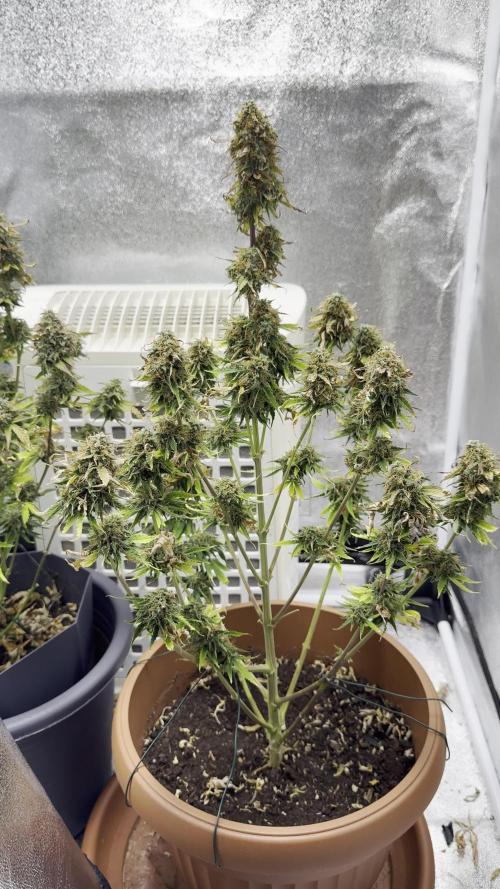
Dafür das Lady#2 mit der Blüte ein paar Tage hinterher ist, ist sie mittlerweile aber größer als Lady#1 und ist definitiv stabiler was die Seitentriebe angeht. Beide Ladys werden ordentlich voll sein. Jeweils die unteren vier Seitentriebe wurden mit Bindedraht an der Stange in der Mitte befestigt das die Triebe und dicker werdenden Buds bei starkem Wind etwas gestützt sind.
Gegossen wurde an Tag 43/22F, an Tag44/23F, an Tag45/24F, an Tag48/27F und an Tag49/28F.
An den Tagen gab es jeweils ca 1L-1.2L.
Die Töpfe werden vor dem gießen leicht angehoben um zu abzuschätzen wie viel jede Lady benötigt.
Temperatur
Tag: 22-28°C
Nacht: 13-19°
Höhe
#1 94cm
#2 106cm
Likes
4
Share


@pzwags420
Follow
Week 2 starting with gsc putting out begging of pistils with others shortly behind I'm sure as it is day 10 since 12/12. on day 11 flower pistis are visable on blueberry and girlscout cookies. On day 13 OG Kush has pre flowers just waiting on blueberry muffin which were planted more recently than the others.


Likes
4
Share


@GrapevineGrower2
Follow
NOTE 1: Afgooey Auto pheno #3 turns out it's a MALE. Resembled nothing like her two sisters ran at the same time. In fact, I had to move her to the 12/12 tent to initiate flowering. Little did I know or expect She would be a He. Lola by the Kinks is rattling round my brain about now ;)
FEEL FREE TO HIT THE LIKE BUTTON IF YOU LIKE WHAT YOU SEE ;)
2x4 French Macaron - at the time of this posting, FM is heading into week 8 flower. Second extensive flushing w/fresh rain water due to acidic conditions (ph >5). Been struggling with ph the entire flowering. I speculate ph issues due to over feeding. Ph is roughly 5.8 to 6.0 after flushing. At this point, flushing with plain RO water until harvest.
NOTE 2: I've introduced two 5 gallon bubble buckets into the 2x4 grow tent. Both buckets have medium air stones running from a 125 gph air pump. Given French Macaron isn't scheduled for harvest until mid-January, I might not have cutting ready. First grow may have to be from seed. Update later.
3x3 Afgooey Autos and clones from previous grow - Afgooey #1 and #2 are firing on all cylinders. #2 running a bit acidic (>5), so flushed back to neutral with roughly 7-8 gallons of fresh rain water ph at 7.0 to 7.2. Same with clones (i.e., ph very low). Flushed with fresh rain water too. A couple days later plants look so much better. Wait till plants nearly dry before next watering. Trimmed and cleaned up three of the clones growing weird. Felt a bit like trimming a bonzai tree. Let's see how they respond.


Processing
Likes
9
Share


@HollowSource
Follow
This burd is nice and phat! She also smells absolutely amazing. She is close to being my favourite in the tent. She is still suffering from some calmag issues. Either than or it's something I can't identify or possible rust. She is so close to the end that I'm not overly worried about rectifying it. She is covered in trichomes and looks to be developing well.

Likes
1
Share


Likes
106
Share


@Natrona
Follow
Sponsored grow 👉WeedSeedsExpress👈
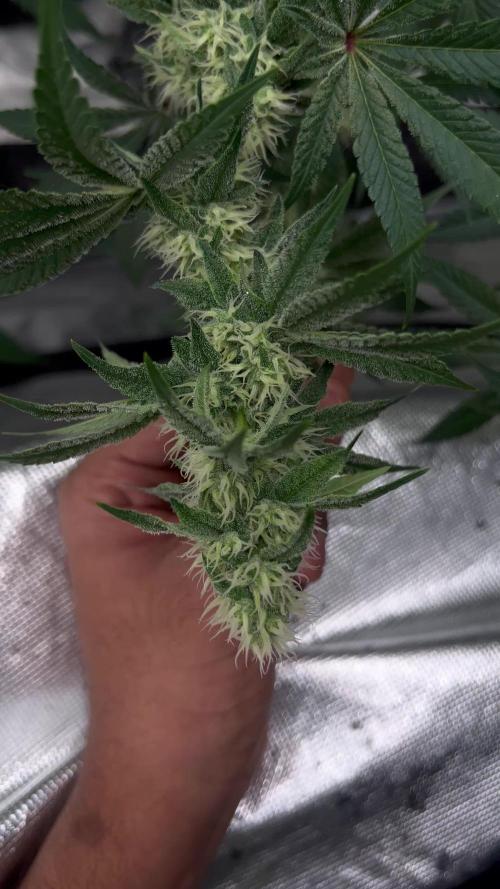
Week 14 flower 10 Love Potion is in her last week. I am watering with ph 6.5 water with no nutrients and I have lowered the lights to 20%. I plan on putting her in the dark on Thursday for chopping on Saturday. Trichomes remain mostly milky. I saw a few ambers in 1 pic taken on 4/6. Last peek pictures on 4/11.
Your likes and comments are appreciated. Thanks for stopping by.
Thank you @WeedSeedsExpress for this opportunity to grow your strains.
Growers love 💚🌿
💫Natrona💫

Likes
178
Share


@NuggetPawn
Follow
Nutrients remain the same and will so now until the ripening stage. I don’t really know exactly when she will be ready, I assume she has another 5 weeks in her or so. Only the trichomes will tell 😊
Buds are starting to bulk nicely now and from the photo lapse it’s evident that some of the colas are starting to lean.
Girl at the front is still rather ugly and the bud formation on her is not uniform like the rest. Just goes to show how different each seed can be even when growing the same pheno in the same conditions.
I think they’re due a complete water change out tomorrow for the first time since the flowers started to form around F14. The PH is starting to swing over the course of 1-2 days which is usually the signal I pay attention to and force myself to stop being lazy 😊
Likes
6
Share

@Salokin
Follow
Week 4 | Jealousy Marker
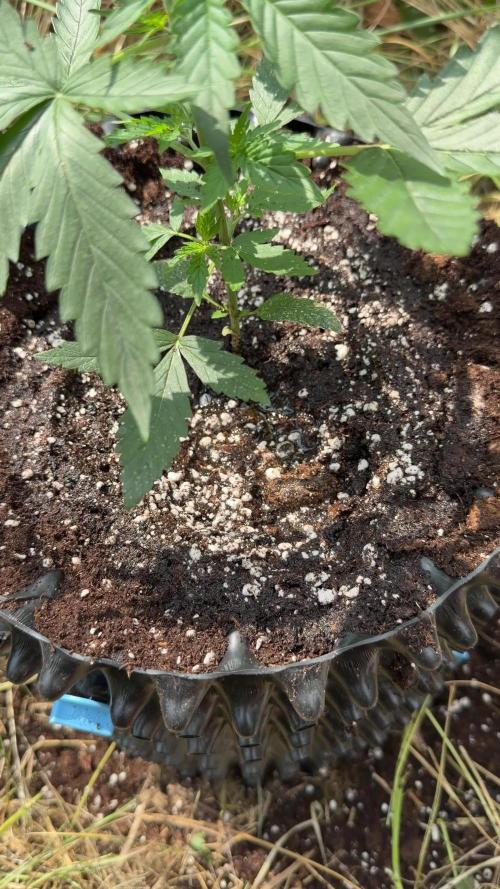
Decision made. After the comparison period, one plant clearly outperformed her two siblings in vigour, structure and overall development. The other two have been discarded, and the winner has now moved outside — straight into a 5L airpot, bottomless, set in the garden next to the 46 Kush. Ran short on the bigger pots this time around, so she's starting outdoors a size down from the others — being bottomless though, roots can push down into the native soil below as she grows, so the smaller pot footprint isn't a hard limit.
**RootX** was applied again at this transplant, delivering mycorrhiza (*Glomus intraradices*), *Trichoderma harzianum*, 13 strains of *Bacillus spp.*, humic acids, amino acids and vitamins straight into the new root zone — giving her the same strong start outdoors that got her through the indoor selection phase.
Last recorded indoors before the move: Week 4, height 15cm, light schedule at 17 hours, EC 1.5 mS/cm, pH 6.2. Now she's outside and adjusting to natural light and the elements.
Updates every Sunday. Stay tuned.

Likes
1
Share


