


Likes
Comments
Share


@ScouseCityLX
Follow
Week 6 of flower and once again, some excellent bulking going on here, I was happy with it.

Likes
14
Share


@BushDoctor740
Follow
Last of the 5 Papaya Cookies still going strong.Ive given her just plain water when the pot is dry.She is still showing some signs of new growth and has more time to develop.cut the last Papaya down trichomes were cloudy. I’m going to dry her a little differently than the rest.Im going to hang in small branches on hangers as I’m trying to avoid any molding on the big center cola.Drying at 67 degree and 62 percent humidity and she smells amazing.

Likes
19
Share


@HeavyHead
Follow
First week of flower :)
Did some final touches on some LST and a very light de leaf of some shading leaves. Pulling down the room temp slightly and will add some pre flowering nutrients towards the end of this week or early next week.
Likes
15
Share


@IsseyBukkake
Follow
We've made it to week 3! (10/12/20)
I'm very happy with how the girls are going, they have definitely put in a HUGE amount of work over the past 7 days.
Plants 3 & 8 are very similar(extremely fat leaves & extra bushy)
Plants 1 & 5 are similar (smaller phenos reacting to nutes slightly differently)
& Plants 2, 4, 6 & 7 seem to be a cross between the previously mentioned phenos(not too small and not too big/bushy & reacting to nutes fine)
Feel free to compare Week 1, 2 & 3 to see the differences.
Nutes are staying the same this week, although I will be spacing feedings out a little bit further(18 hours-ish), as well as feeding straight PH'd water once a fortnight.
I am contemplating hooking my simple drip-to-waste irrigation system up, although the girls are pretty close to the medium still and the halos sit 5-10cm above the medium, meaning fan leaves would be drooping onto the wet halos, so I'll give it another week and see how they're doing :)
Update 11/12/20 - day 22
The girls have beefed up quite a bit over the last 24 hours, I'm really looking forward to seeing a stretch soon :)
No feeding today & will water plain ph'd water tomorrow.
Update 12/12/20 - day 23
Gave the girls straight ph'd water today with little run off.
Veg growth is really starting to boom now, looking forward to seeing where this grow goes!
I'm gladly accepting any tips or tricks, as I'm still only a beginner to indoors.
Update 13/12/20 - day 24
Girls are looking great today, not much to report.
They didn't get a feed or watering today as the medium was still wet after a pure watering yesterday.
Update 14/12/20 - day 25
There's been a big increase in growth over the past 24 hours.
All the girls besides the 2 smaller phenos look 100% happy, the smaller ones have looked a little weird since day 1(Weird as in colour of the fan leaves look deficient of something, but I'm not sure what.
The girls will be getting a full feeding today.
There's still no signs of sex but they are feminised seeds.
Update 15/12/20 - day 26
Girls are looking happy today.
Temps are back to normal after a heat wave in my city(its only going to get hotter from here on out).
No feeding/watering today, pots are heavy/wet enough.
Started using iphone for photos now, my only lens for my DSLR is useless for most grow related photos.
I will upgrade my lens before next grow.
I received my new silenced fan today! I couldnt be any happier :)
It is a silenced Sigilventus SE-A150J, which I have set-up with a brand new Can-lite carbon filter.
I went from a rocket loud eBay fan to a completely silent inline EC fan :D
I hope the girls like the silence!
Update 16/12/20 - day 27
The girls are continuing to boom! and I'm over the moon about it :D
I gave them a full feeding today.
I have seen white pistils coming out of calyx's on most of the girls, so i'm hoping they start to flower soon.
I'm having weird issues with my humidity, it seems to be fine at 40-50% for 70% of the day, but the remaing 30% of the day it goes up to 60-65%.
Temps stay the same in the 5x5 tent, I have ducted air-con in the house which is on most of the day.
Thanks for viewing! :)

Likes
17
Share


Likes
179
Share

@yan402
Follow
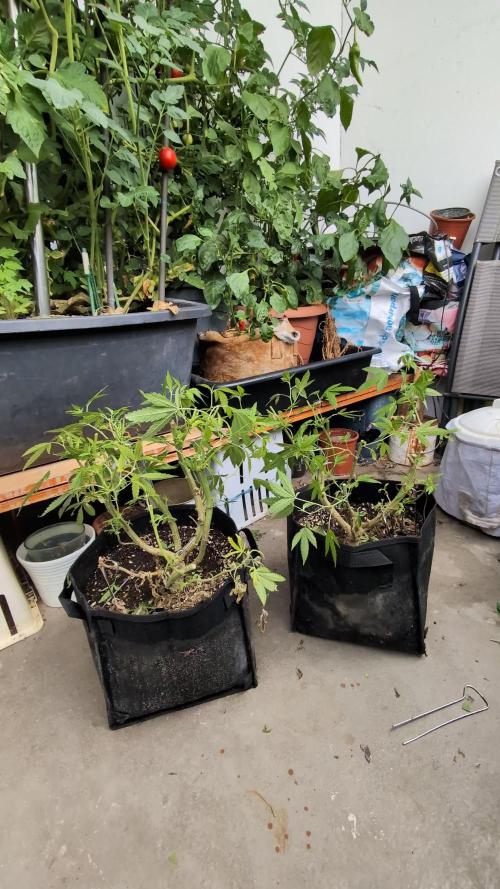
Still just runnof, the rest is in the video, I'll be doing another when they are indoors and settled, still cleaning the tent from harvesting apple fritter....
I'll be updating the comment layout as well in the same style like the rest I have going.
Likes
14
Share


@KannaKullektiv
Follow
Aloha Freunde der Sonne 😊
Die Tage vergehen und die Damen wachsen prächtig vor sich hin.
Immer noch die Höhe der Mädels angleichen auch wenn mal was abbricht 😅
Viel Spaß

Likes
63
Share


@Chubbs
Follow
420Fastbuds
StrawberryGorillaAuto
Week 4
What up grow fam. Weekly update on these 3 wonderful ladies. This week I did introduce some nutes and the plants seem to respond amazing. Starting to see little pistols so guessing this will be the last week of veg before the transition into flower. All in all Happy Growing
Likes
233
Share


@StarLorr
Follow
Welcome to my Pablø Ęscøbar diary.
In this diary:
Seeds: sponsored by Ðivine Șeeds
Media: Promix HP
Nutrients: Advanced Nutrients, Diablo Nutrients, Gaia Green Power Bloom.
Light and Weather: Şun☀️and Mother Earth.🌎
___________________________
Wet Weight: 1237 grams
___________________________
Wet Trimming with my trimming bowl was a humongous time saver!!
______________________________
I discarded a branch that was on the left side facing north with some Bud rot.. no biggy i got plenty more😉
Past mornings with thick dew didn't helps.
______________________________
I wanna Thanks Ðivine Seeðs for the Opportunity to grow and smøke your Ðivine Plants👊🏼😉
______________________________
Thanks for stopping by, likes and comments are appreciated!👊🏻😎
Keep on growin!
Keep on tokin!!!
😙💨💨💨💨💨

Likes
18
Share


@balansa
Follow
she is starting to flower she has firs signs so i am starting an experiment. cutting off all the fan leaves she has lets see how will she respond wish me luck <3

Likes
28
Share


@DudeGrowsWeed
Follow
Hello GD Crew!!!
I’m glad to finally be back with a new diary. A LOT has happened since my last diary. The large room I was using back then got infested with spider mites. For a while I thought I had them beat, but they came back with a vengeance. So I thoroughly cleaned my 2x4 tent and set it up in the opposite side of the house. However, that part of the house is also now my new man cave and was under construction until a few months ago (its still not completely done yet, but close enough).
I have also switched back to LED lighting. I’m using a pair of Spider Farmer SF1000’s (100w) LED’s. I was using a 315w CMH fixture but felt I was getting better results with my old blurple ViparSpectra’s (both of which have died). Also, it was getting too hot in the tent with the CMH. To be completely honest the best weed I’ve ever grown was using a 1000w HPS, but that could possible melt a 2x4 tent and I’d be tripping circuit breakers all the time again. After a lot of research it looked like the Spider Farmer SF1000’s were the best bang for the buck in the LED market these days. They have the right components (Samsung LM301B diodes and MeanWell drivers) and have great specs. I was able to purchase them on Amazon Prime Day for $129/each (USD).
For soil I’m using Coast of Main Stonington Blend Grower’s Mix. I had been previously trying to amend and reuse old soil or mix old soil 50/50 with new soil and in retrospect that was a mistake. The PH was totally unpredictable as were what nutrients were available or deficient. I felt like I was always trying to fix soil problems and one thing would lead to another. So, from now on its fresh soil in every pot. I’m using 3 gallon pots with self watering reservoirs at the bottom. In addition to the Coast of Main Stonington Blend I’m also using Sungro Black Gold Seedling Mix. I filled the 3 gallon pots with the Coast of Main Stonington Blend first, then dig out a hole in the middle about the size of a grapefruit and filled that hole with the Sungro Black Gold Seedling Mix. Then I planted the seeds about knuckle deep in the middle of the Seedling Mix. This seemed to work great, both pots had small seedlings appear in 5 days.
This diary will focus primarily on FastBuds BlackBerry, but I am also growing a DinaFem Critical+ Auto at the same time. I’ve grown both of these strains a few times in the past with mixed results. But, I’m hoping this grow will be far greater than those in the past. My plan is to allow the Coast of Main Stonington Blend act as the ‘super soil’ it is supposed to be and not add any additional nutrients. I will however be adding RealGrowers Recharge on a regular basis (I love that stuff, it really makes a difference) and will probably also add some CalMag once in a while. But that’s all.
Additionally, I do not plan on doing much training with these girls. I will LST bend them over at a 45 degree angle around the time they hit their flowering stretch, but that’s all. Bending at a 45 degree angle gives better exposure to lower branches and allows those lower branches to produce larger tops.
Hoping for the best!!! Please feel free to comment and follow. I’ll be updating this diary weekly and will be doing videos in the future.
Here’s a breakdown of the equipment:
1 - 2x4x6 tent
2- Spider Farmer SF1000 LED fixtures (100w/ea)
1- Carbon filter
2- 3 gallon pots w/self watering reservoirs
Coast of Main Stonington Blend Grower’s Mix
Sungro Black Gold Seedling Mix
RealGrowers Recharge
Also, here’s what Coast of Main says about their Stonington Blend:
“Coast of Maine Organic Products Stonington Blend Grower’s Mix is a complex “super soil” designed for high performance container growing. It works well with tomatoes, and, where growing cannabis and medical marijuana is legal, growers have reported tremendous results. This soil incorporates mycorrhizal fungi, kelp, fish bone and alfalfa meal, as well as worm castings, peat, coir and lobster compost.”
Here are the specs on the Spider Farmer SF1000’s:
Materials: Samsung LM301B diodes and MeanWell Drivers
Power Draw: 100w
PPFD: 922 umols/s @ 12”
PPF: 250 umol/m2/s
PPE: 2.5 umol/J
Yield: 2.5g/W
Spectrum: 660-665nm,3000K,5000K, IR 760nm
LED: 218 pcs

Likes
12
Share


@BeHappyNtoke
Follow
This week is going good for the beach ball I noticed some nice growth coming in and started LST for the mini pot growth is not as vigorous will most like start feeding next week just to prolong it a little longer this is definitely a experience can’t wait for the next week!
Likes
6
Share


@nijuana
Follow
Beautiful
The sleepy Joe is outside in the greenhouse :) fresh transplantation

Likes
19
Share


@Sergio_721
Follow
So far it seems to be fine even if the high humidity worries me even if the temperatures are still high then they have stopped growing and will finally focus on the flowers and slowly we recover these small deficiencies
Likes
Comments
Share

@PurpleBeen
Follow
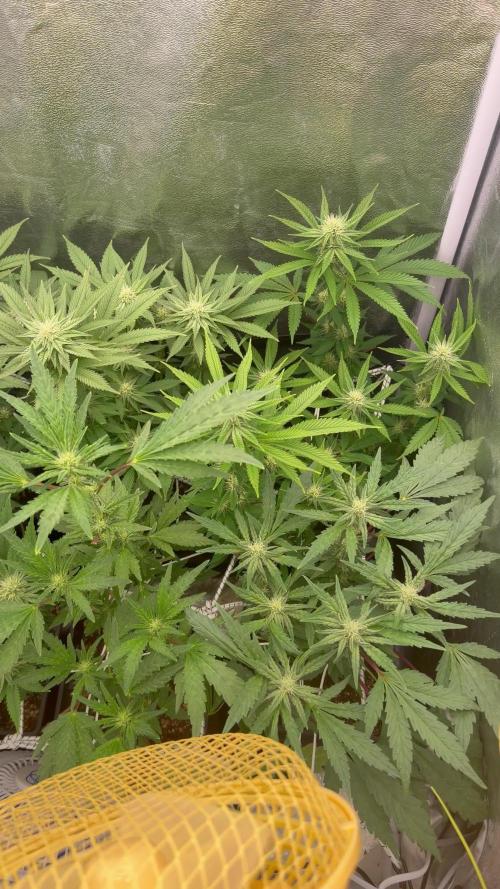
Week 3 / Flowering
Everything is going well at the beginning of the third week. All the main colas are growing at about the same pace. As for the two plants at the front, they’re doing well too, just a little more slowly.
I’ve started feeding them, and by the end of this week or sometime next week I’ll begin using Monster PK at a very light dose. The light is now at 100%, so we’ll need to be careful not to keep it too close to avoid the risk of light stress or overexposure.
12/12 switches : 12/06/2026
Back: Frosted Grape
Front left: Purple Cookie
Front right: Stick Berry
Watering remains moderate: ~600 mL for the larger plants and ~500mL for the smaller ones, with 1 L being the maximum applied so far.

Likes
54
Share


@DogDoctorOfficial
Follow
And the time to defoliate this Mama as arrived, i finally manage to get my hands dirty and manage to get some air and light Going true this beast, i mean just look at the size of this auto, she is huge , and getting her fruits on the way, notice that she was needy so wen changing the water on the autopot reservoir i top feed her with some extra P and K just in case, i will repeat this if i fell needed <3<3<3
Biut for now just look at these beast and ho she is evolving so fast now that she is in full flower mode, heheh i know they say dont defoliate autos, but i also know me and i just love to try out what ever. They say its not possible to do and see for my self if is or is not possible, these time was defoliating autoflowers and i will fast know if was a good thing or not heheh lets see hihihi
Haded a mini video from me defoliating her and the rest of the sisters dividing room with her <3 <3 <3
As always thank you all for stoping by, for the love you guys put in the community, in to growing and it all, i am blessed to walk among all of you and am blessed with it all.
Genetics :
AUTO SOMANGO GLUE @ ADVANCED SEEDS
All info and full product details can be find in can find @
https://aptus-holland.com/
https://advancedseeds.com/
https://autopot.co.uk/
https://lumatek-lighting.com/
#aptus #aptusplanttech #aptusgang #aptusfamily #aptustrueplantscience #inbalancewithnature #trueplantscience #growerslove #dogdoctoofficial
With true love comes happiness <3 <3 <3 Always believe in your self and always do things expecting nothing in return and with an open heart , be a giver and the universe will give back to you in ways you could not even imagine so <3 <3 <3
More info and updates @
https://growdiaries.com/grower/dogdoctor
https://instagram.com/dogdoctorofficial
https://youtube.com/channel/UCR7ta4DKLFMg2xxTMr2cpIg
<3 <3 <3 Growers love to you all <3 <3 <3

Likes
18
Share


@RakonGrow
Follow
5 Tage Zelt , aber ich glaub ich trenn da noch einige dinge . alles recht fett geworden .
So vom 4 Tag im Trockenzelt mal Photos gemacht. DAs ist also die aktuelle Budgröße .
Eine sehr fluffige Sorte !!!
Es ist endlich Zeit fakten zu schaffen . Die Ernte hat glatt ein 5 Liter Messbecher gefüllt und hat dabei 145 Gramm erbracht. Die Buds sind eher fluffig als fest . Ein gutes Beispiel dafür das die Buds zwar riesig aussehen , aber eigentlich nichts wiegen. Obwohl das optisch mein Größter Grow war, ist die Erntemenge doch weit aus geringer ausgefallen . Geschmack ist kräftig würzig mit einer Methol Note . Die Trichome sind von einem Sidebud genommen. So wirklich gut getroffen hab ich den Erntezeitpunkt nicht . Aber es klebt und klebt und klebt . Einfach perfekt fürs Vapen durch meine Wasserpfeife .

Likes
64
Share


@MadeInGermany
Follow
Hey everyone 🤗
It's getting full of buds 😍.
When you open the tent, an extreme smell of Blue Gelato wafts through the room 😍.
They develop super fast, look beautiful and hardly stop :-).
Next week I'll go down a bit with the Ec.
I wish you a lot fun with the update, stay healthy and let it grow 🌱👌
You can buy this Strain at :
https://www.barneysfarm.com
Strain :
Blue gelato 41 clone from mother (Barney's Farm)
☝️
Genetics:
Blueberry x Thin Mint Girl Scout Cookies x Sunset Sherbert
👍
Vega lamp:
2 x
Todogrow LED HLG Quantum Board 100 W ( 200 W )
💡
Flower lamp:
2x Todogrow LED CXB3590 205 W = ( 410 W )
💡 ☝️
Soil : Canna Terra Professional +
☝️
Fertilizer:
Canna Terra Vega , Canna Terra Flores , Rizotonic, Cannazym, CANNA Boost, Pk 13/14, Canna Cal / Mag, Canna Ph - Grow, Canna Ph-Bloom
☝️🌱
Water:
Osmosis water mixed with normal water (24 hours stale that the chlorine evaporates) to 0.2 EG. Add Cal / Mag to 0.4 Ec Ph with Ph - to 6.0 - 6.3
💦 💧
Likes
12
Share


@Willy_Balls
Follow
All good. Ripening process. I think they’ll need 60-63 days.
Blue Zushi has amazing terps but the stability is very poor. 3 beans , 3 completely different phenos and completely different terpene profiles.
Have 3 more growing in nursery. But wouldn’t recommend a big run with these. But there could be a winner to be hunted.


Likes
3
Share

@Dottgreenthumb
Follow
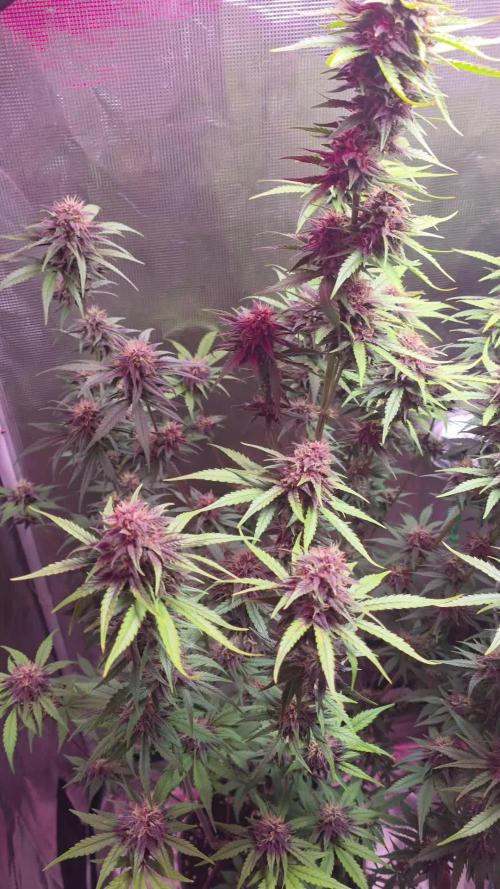
i colori e odori fantastici questa sarà l l'ultima irrigazione dalla prossima settimana si inizia il flush
run off 2.1
Ph 6.0
Likes
22
Share


@Slobasian
Follow
You walk outside and it’s a variety of flavors hitting you all at once. Cloned everything but the white rhino didn’t take so I’ll have 3 of the better out door strains for next out door season to continue learning this strain

