


Processing
Likes
Comments
Share


@Cannibalgardens
Follow
I love the genetics at seedstockers these girls I hit from then have been doing amazing taking the life I have given them . The growth has boomed since I put them into bigger pots now I'm looking forward to next week and how the growth continues on ..The training has been going so dam good ...cheers canna fam .


Likes
47
Share


@Ultraviolet
Follow
All content on this diary is for inspirational and educational purposes only. The ideas shared are not a substitute for professional advice. This diary/account is not officially affiliated with Alan Watts or his estate. All materials are used under the principles of fair use. I honor the legacy of Alan Watts by sharing his wisdom respectfully and with the intention of inspiring awareness and self-understanding.
2nd net is up. Early bud formations are promising. holding up to the extremes pretty well, some leaves taking minor damage, but overall, she is holding up, gave her 1 night at 50F see how she would react, stressful. Not advised as it messes with her metabolism, but I want to see if it triggers any anthocyanin response. Love to see her purp up but no signs yet. Remember, For every molecule of glucose produced during photosynthesis, a plant needs to split six molecules of water. This process provides the hydrogen needed for synthesizing glucose and other organic compounds, while oxygen is released as a byproduct.
Homework.
If Rubisco activity is impaired and it cannot properly function or regenerate its substrate, the plant's leaves are likely to turn a pale green or lime green, a condition known as chlorosis. Essentially, Rubisco activity is highly regulated and susceptible to various environmental and metabolic factors that can cause it to become inhibited, leading to an apparent failure in RuBP regeneration due to a lack of consumption.
Rubisco regeneration is intrinsically linked to nitrogen supply because Rubisco is a major sink for nitrogen in plants, typically accounting for 15% to over 25% of total leaf nitrogen. The regeneration phase itself consumes nitrogen through the synthesis of the Rubisco enzyme and associated proteins (like Rubisco activase), and overall nitrogen status heavily influences the efficiency of RuBP regeneration. RuBisCO is a very large enzyme that constitutes a significant proportion (up to 50%) of leaf soluble protein and requires large investments in nitrogen. Insufficient nitrogen supply limits the plant's ability to produce adequate amounts of RuBisCO, thereby limiting the overall capacity for photosynthesis and carbon fixation. Maintaining the optimal, slightly alkaline pH is crucial for the proper function and regeneration of Rubisco. Deviations in either direction (too high or too low) disrupt the enzyme's structure, activation state, and interaction with its substrates, leading to decreased activity and impaired RuBP regeneration. (Lime/yellowing)
Structural Component: Nitrogen is an essential building block for all proteins, and the sheer abundance of the Rubisco protein makes it the single largest storage of nitrogen in the leaf.
Synthesis and Activity: Adequate nitrogen supply is crucial for the synthesis and maintenance of sufficient Rubisco enzyme and Rubisco activase (Rca), the regulatory protein responsible for maintaining Rubisco's active state. Nitrogen deficiency leads to a decrease in the content and activity of both Rubisco and Rca, which in turn limits the maximum carboxylation rate, Vmax, and the rate of RuBP regeneration Jmax, thus reducing overall photosynthetic capacity.
Nitrogen Storage and Remobilization: Rubisco can act as a temporary nitrogen storage protein, which is degraded to remobilize nitrogen to other growing parts of the plant, especially under conditions of nitrogen deficiency or senescence.
Nitrogen Use Efficiency (NUE): The allocation of nitrogen to Rubisco is a key determinant of a plant's photosynthetic nitrogen use efficiency (PNUE). In high-nitrogen conditions, plants may accumulate a surplus of Rubisco, which may not be fully activated, leading to a lower PNUE. Optimizing the amount and activity of Rubisco relative to nitrogen availability is a target for improving crop NUE.
Photorespiration and Nitrogen Metabolism: Nitrogen metabolism is also linked to the photorespiration pathway (which competes with carboxylation at the Rubisco active site), particularly in the reassimilation of ammonia released during the process.
To increase RuBisCO regeneration, which refers to the process of forming the CO2 acceptor molecule Ribulose-1,5-bisphosphate (RuBP) during photosynthesis, the primary methods involve optimizing the levels and activity of Rubisco activase (Rca) and enhancing the performance of other Calvin-Benson-Bassham (CBB) cycle enzymes.
Biochemical and Environmental Approaches:
Optimize Rubisco Activase (Rca) activity: Rca is a crucial chaperone protein that removes inhibitory sugar phosphates, such as CA1P (2-carboxy-D-arabinitol 1-phosphate), from the Rubisco active site, thus maintaining its catalytic competence.
•Ensure optimal light conditions: Rca is light-activated via the chloroplast's redox status. Adequate light intensity ensures Rca can effectively maintain Rubisco in its active, carbamylated state.
•Maintain optimal temperature: Rca is highly temperature-sensitive and can become unstable at moderately high temperatures (e.g., above 35°C/95F° in many C3 plants), which decreases its ability to activate Rubisco. Maintaining temperatures within the optimal range for a specific plant species is important.
•Optimize Mg2+ concentration: Mg2+ is a key cofactor for both Rubisco carbamylation and Rca activity. In the light, Mg2+ concentration in the chloroplast stroma increases, promoting activation.
•Manage ATP/ADP ratio: Rca activity depends on ATP hydrolysis and is inhibited by ADP. Conditions that maintain a high ATP/ADP ratio in the chloroplast stroma favor Rca activity.
Enhance Calvin-Benson-Bassham (CBB) cycle enzyme activity: The overall rate of RuBP regeneration can be limited by other enzymes in the cycle.
•Increase SBPase activity: Sedoheptulose-1,7-bisphosphatase (SBPase) is a key regulatory enzyme in the regeneration pathway, and increasing its activity can enhance RuBP regeneration and overall photosynthesis.
•Optimize other enzymes: Overexpression of other CBB cycle enzymes such as fructose-1,6-bisphosphate aldolase (FBA) and triose phosphate isomerase (TPI) can also help to balance the metabolic flux and improve RuBP regeneration capacity.
Magnesium ions, Mg2+, are specifically required for Rubisco activation because the cation plays a critical structural and chemical role in forming the active site: A specific lysine residue in the active site must be carbamylated by a CO2 molecule to activate the enzyme. The resulting negatively charged carbamyl group then facilitates the binding of the positively charged Mg2+ion. While other divalent metal ions like Mn2+ can bind to Rubisco, they alter the enzyme's substrate specificity and lead to dramatically lower activity or a higher rate of the non-productive oxygenation reaction compared to Mg2+, making them biologically unfavorable in the context of efficient carbon fixation. The concentration of Mg2+ in the chloroplast stroma naturally increases in the light due to ion potential balancing during ATP synthesis, providing a physiological mechanism to ensure the enzyme is activated when photosynthesis is possible. At the center of the porphyrin ring, nestled within its nitrogen atoms, is a Magnesium ion (Mg2+). This magnesium ion is crucial for the function of chlorophyll, and without it, the pigment cannot effectively capture and transfer light energy.
Mg acts as a cofactor: Mg2+ binds to Rubisco after an activator CO2 molecule, forming a catalytically competent complex (Enzyme-CO2-Mg2+). High light + CO2) increases demand: Under high light (60 DLI is a very high intensity, potentially saturating) and high CO2, the plant's capacity for photosynthesis is high, and thus the demand for activated Rubisco and the necessary Mg2+ cofactor increases. Mg deficiency becomes limiting: If Mg2+ is deficient under these conditions, the higher levels of Rubisco and Rubisco activase produced cannot be fully activated, leading to lower photosynthetic rates and potential photo-oxidative damage.
Optimal range: Studies show that adequate Mg2+ application can enhance Rubisco activation and stabilize net photosynthetic rates under stress conditions, but the required concentration is specific to the experimental setup.
Monitoring is key: The most effective approach in a controlled environment is to monitor the plant's physiological responses e.g., leaf Mg2+ concentration, photosynthetic rate, Rubisco activation state, and adjust the nutrient solution/fertilizer to maintain adequate levels, rather than supplementing a fixed "extra" amount.
In practice, this means ensuring that Mg2+ is not a limiting factor in the plant's standard nutrient solution when pushing the limits with high light and CO2.
Applying Mg2+ through foliar spray is beneficial to Rubisco regeneration, particularly in alleviating the negative effects of magnesium (Mg) deficiency and high-temperature stress (HTS). While Mg can be leached from soil, within the plant it is considered a mobile nutrient, particularly in the phloem. Foliar-applied Mg is quickly absorbed by the leaves and can be translocate to other plant parts, including new growth and sink organs.
Foliar application of: NATURES VERY OWN MgSO4 @ 15.0g L-1 in a spray bottle. For those high-intensity workouts when 1 meal a day is just not enough!
Foliar sprays are often recommended as a rapid rescue measure for existing deficiencies or as a supplement during critical growth stages, when demand for Mg is high. Application in the early morning or late evening can improve absorption and prevent leaf burn. The plant was getting a little limey yellow in the centre. Shortly thereafter, she was back in business, green mostly regenerated. The starting point [of creativity] is curiosity: pondering why the default exists in the first place. We’re driven to question defaults when we experience vuja de, the opposite of déjà vu. Déjà vu occurs when we encounter something new, but it feels as if we’ve seen it before. Vuja de is the reverse—we face something familiar, but we see it with a fresh perspective that enables us to gain new insights into old problems.
Confidence is evidence... nothing more. You are confident because you have driven 10,000 times, you are confident because you have spoken 10,000 times. People think confidence is a feeling, but it's not. If you want more confidence, then you need to create evidence, take more shots, collect more data, build more experiences, take more risks; fail, confidence doesn't come first; it is the reward you get for doing the work. no one else wants to do.
Likes
9
Share


@DaddyPrime2
Follow
10/29
fighting off spidermites on some of the smaller plants
10/30 using spinosad and safer brand insecticidal soap
11/01 the mainlined plant is finally starting to grow upwards. other plants seem to have deficiency. then plant 2 and 3 need to be transplantwd from their 1 gal

Likes
101
Share


@Mrs_Larimar
Follow
Saturday, Feb.20th
After final training, and recovering,
Girls went into a larger Growspace called "big Floweringtent"
its a 4x4 Growtent, and soon some Companions will be added.
Girls are sitting into final Pots ( 11l), filled with My Soilmix
amended with "Living Organics" and EASY BOOST ORGANIC NUTRITION
waterings with Benefical stuff from Green Buzz Liquids
So we had a busy Day Yesterday in setting up the Tent
that means lots of cleaning transplanting and so on
Thank you A.R. for Setting up the Tent 😘

Likes
13
Share

@Borberad
Follow
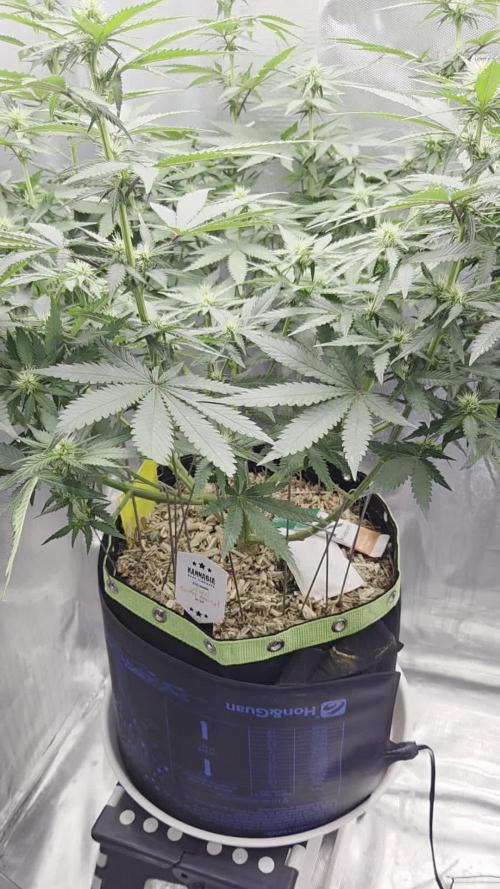
Woche 9
Mal gespannt wie weit sie noch nach oben will. Licht wurde entsprechend angepasst Blütenspitzen auf knapp 900 ppfd, im Zentrum 820ppfd. Müssen nun aufpassen, sobald die Spitzen heller werden, wird die Beleuchtung etwas reduziert um Ausbleichen und Foxtailing zu vermeiden.

Likes
7
Share

@NSABND
Follow
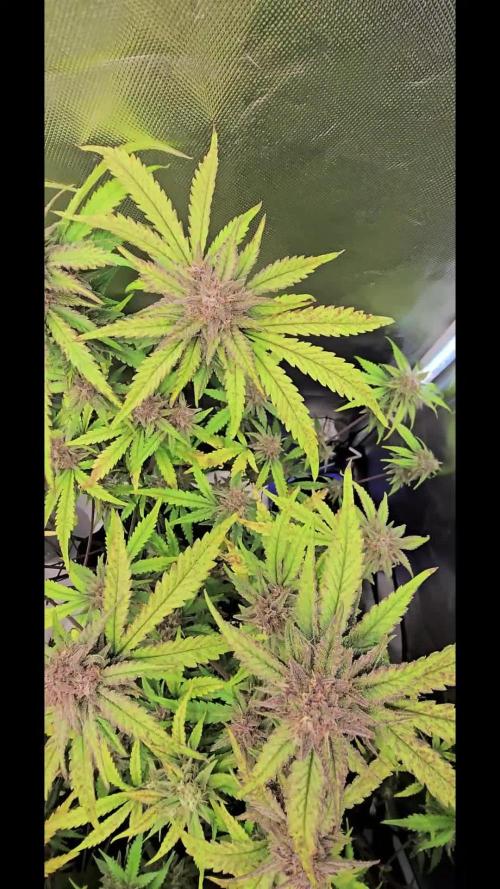
Day 64 the queens got some fertilizer 💪😃👍
Day 65 that massive smell and these juicy buds 😃👌
Day 66 that massive smell 😍👌
Day 67 i think the results are near 😍👍
Day 68 final countdown 😎👌
Day 69 only a few days more 😍👌
Day 70 a few more days till final results 😃👌
Processing
Likes
87
Share


@ThrashedTV_BakedByGlaze
Follow
Week 4 - 01/22 to 01/28 2021
Pictures from Days 25 + 26
TRANSPLANTED! Might have waited too long but hopefully the transplant and LST stress might slow the plant down since i think it's already flipping to flower like the other @SweetSeeds Dark Devil Auto and the Purple Lemonade from @FastBuds. I think the Red Poison might have been the first one I noticed to flip but at least this one will be quick.
More and more reasons to go back to a photoperiod grow after this for more control/really test out the new lights 🙌
Ended up more 50/50 ratio of Destiny Organic's Dark Matter Living Soil + ProMixHP since I had to make the Destiny last. Apparently they went out of business just after I decided it was my favourite/new soil :( Would rather stay away from Ocean Floor since I haven't had the best experiences with it (bugs/rust fungus etc) Feel free to drop some recommendations other than Fox Farms below 👍
The Red Poison Auto is going strong other wise, keeping the LST basic to see if I can still get the screen in the tent but it wouldn't be practical at this point.
I raised the @ViparSpectraLED P1500 another eight inches after transplant and started basic LST. I really wanted to get these four under a ScrOG but if 3/4 are already flipping and the LSD is still runty I might have to wait it out again.
Just like the Dark Devil in my other Sweet Seeds diary, there is a solid smell on the fingers after adjusting it/when the fan hit it just right 😍
I have the @MarsHydroLED TSL2000 set up and ready to go once the girls settle into their new pots. Have the new surge protector/heavy duty power cords/power tool grade timers as mentioned in Week 3. Some of it shown in the pictures.
Threw some videos in this week as well with some Queen's Radio GaGa, Beastie Boys' Brass Monkey, and a little hint of Arkells ....COME TO LIGHT on the short @ViparSpectraLED ..GET IT.. 😓
I thought the Red Poison had the streaks in the leaves but turns out it was the Purple Lemonade, My Chocolate Mint OG Auto just finished curing so I must have made that update during the test session 😎
Chocolate Mint OG Auto Diary:
https://growdiaries.com/diaries/77696-humboldt-seeds-chocolate-mint-og-auto-grow-journal-by-glazedgrow
--
Thanks for checking in! Throw down a like and/or follow so I can return the favour 🙌
Check out my Diary of the Year 2020 Entry for my Original Auto Sour Diesel: https://growdiaries.com/diaries/54258-fastbuds-original-auto-sour-diesel-grow-journal-by-glazedgrow
IG: @GlazedGrow
CannaBuzz: @GlazedGrow

Likes
114
Share


@Natrona
Follow
Week 10
6/9-15 Lemon ladies love the outside. Both are showing yellowing leaves so everyone is getting nutrients with feedings.
6/13 heavy defoliation and limb removal for lemon cake since she's now in flower. Repositioned the scrog after defoliation so the thicker limbs are in the mesh. Drizzle, got light defoliation mostly yellowing fans. Before and after pics and vids.
I saw a Japanese beetle on my Lemon Cake and some small holes in the leaves so I added 1/2 tsp neem to the feed solution 6/12. Also started using fish & kelp.
I'm still watering 1 gal per plant when I feed. With the heat and humidity, I water daily.

Likes
3
Share

@ChubbyBudBros
Follow
-
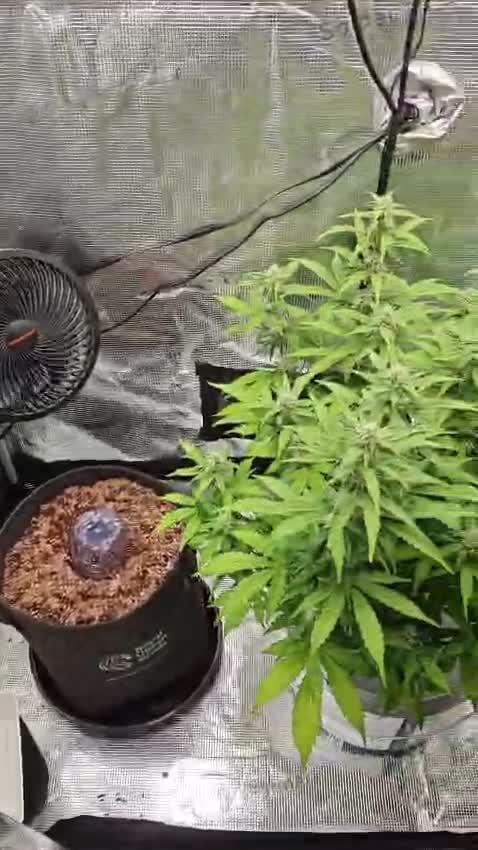
Day 57
Noticed quite a dramatic drop in pH today, went from 6.0 to 5.3 in one day. I noticed one of my bubblers was blocked, put in a new one and it's fixed now, hope the issue was due to that. the plant is doing good otherwise. Brought the pH back up to 6.2 now.
Day 58
Was happy to see today that the pH drift has been fixed! Seems like the broken bubbler was the problem. pH only dropped down to 6.1 today.
I topped the reservoir up with some 6.1 pH water to keep it there. Happy this is fixed now .
Day 59
Sadly the water bubbler was not the issue :/. pH dropped down again from 6.1 to 5.3. I fear that she is just drinking so much compared to how small the water reservoir is, which makes the nutrient concentration very strong, brining down the pH. I did a res change today, Let's see what it looks like tomorrow.
Day 60
pH went up to 6.5 today after the water res change, which seems to be how it always goes. It goes up the first 1-2 days then it drops hard the next days after. I gave it 6.1pH water today topped the res up more than usual because I will be gone for 2 days, hopefully the pH will stay somewhat stable until I get back.
Day 62
Back from my long weekend! The reservoir still had about 1 liter in it, she been drinking a lot. Came home and immediately refilled the reservoir. Noticed pH had also dropped so 5.1!! With the newly added water now it's sitting at 5.9 now. Seems like she is doing well however. Some of the of lower fan leaves yellowed a lot more but that is probably due to all the flowers developing right now.
Day 63
Water topped up again with 1.5 liters of pH 6.6 water, which brought the pH back up to 6.1.


Likes
45
Share


@GreenHouseLab
Follow
I tend to forget about her as im mesmerized by others, she’s the one with the best perfume currently in the room. It’s very possible she starts busting late flower, trellis is up show me what you got girl. Coated top down she is some sticky icky oooooh weee!
Yep hydro still in Veg Ive topped for a second round shit will be bonkers and going in the flower tent after this round. Will most likely initiate flowering in aboit 2 weeks or until she blows the top off this tent.
Stay Safe Stay Fresh
GHL
Likes
20
Share


@apmcfly76
Follow
Wait on a Bigger tent set up that should be anytime this weekend upgrading to a 3x3 to give them more space to breathe and to grow one more 😜🤪
Likes
41
Share

@gr3g4l
Follow
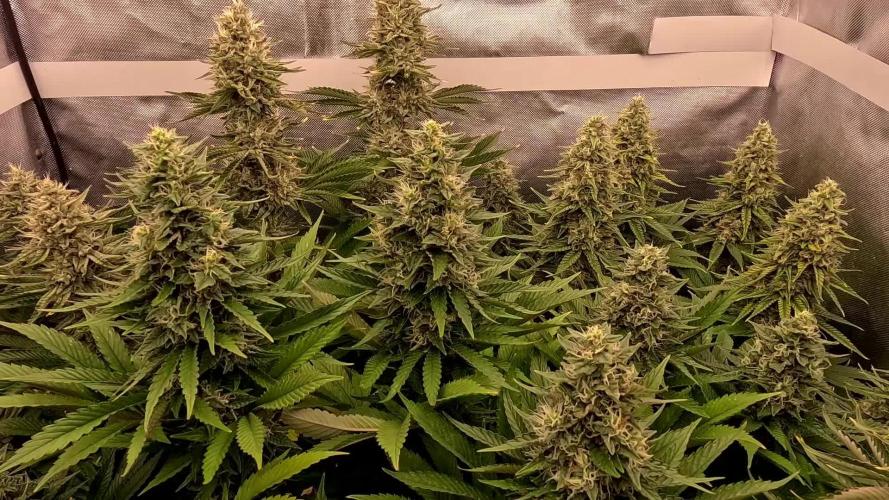
Last week, and it seems they've perked up a bit.
Root flush with reverse osmosis water, between three and four waterings.
I had to remove part of the apical bud from plant number 5 due to botrytis. Even after adding a dehumidifier last week, it wasn't enough to lower the humidity further. Sometimes it spikes to over 80%.
And that concludes after 70 days. A little longer than expected, but less than it should have been. I understand they could mature and fatten up a bit more, but my fear of botrytis is stronger, so I'm ending the monitoring.
Última semana, y parece que han espabilado un poco.
Lavado de raices con agua de osmosis , entre tres y cuatro riegos.
De la nº5 tuve que deshacerme de parte de un apical por culpa de la botritis, aun habiendo añadido la semana pasada un deshumidificador no fue suficiente para lograr bajar aun más la humedad. en ocasiones se dispara a más del 80%
Y esto termina con 70 dias. Algo más de lo esperado pero menos de lo que deberia. Entiendo que podrían madurar y engordar algo más pero el miedo que le tengo a la botritis es superior asñi que doy por finalizado el seguimiento.

Likes
14
Share


@GrowBuv
Follow
This will be the second time I start this strain, it’s gone great so far so let’s do it again!
Started off with 24 hours in a glass of water then into a paper towel,then once the taproot was about half an inch I transferred her into a coco pellet. Once she’s broken the soil it’ll be into the tent.
Day 3
Looks like it’s time to up pot her and get her under the light.
Likes
4
Share


@Infiltrator
Follow
so, it is in the middle of week 7, it‘s flowering and seems to be doing well, despite some mistakes made.. indeed, having wanted to perform a lst, I accidentally broke one of the main branches, which implies less buds at harvest, but hey I am already satisfied with the situation. I noticed some brown spots and yellowing of some leaves, so I fed the plant with 1 ml of biobizz-biobloom. I'll let you know how it's evolving.
Likes
Comments
Share

@DaddyPrime2
Follow
7/4 she's taking well to the training
7/5 its so hot out here its 105F and 19%
7/7 5ml grow 5ml


Likes
33
Share

@valiotoro
Follow
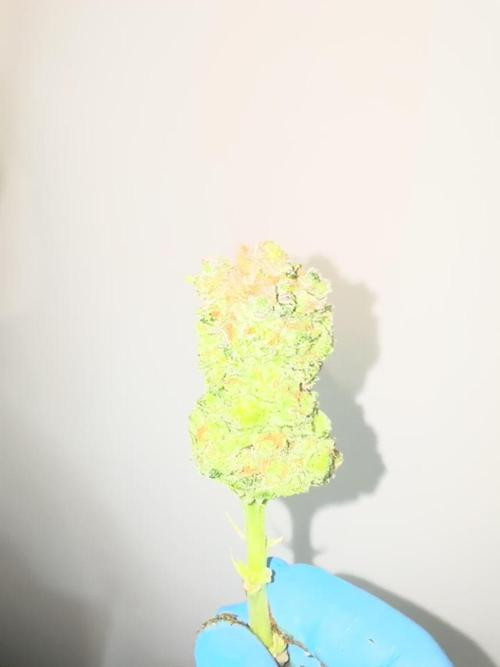
Rock-hard buds, insanely sticky, with a truly sublime aroma… couldn’t ask for more 🔥
