





Likes
Comments
Share

@smoking_hills9
Follow
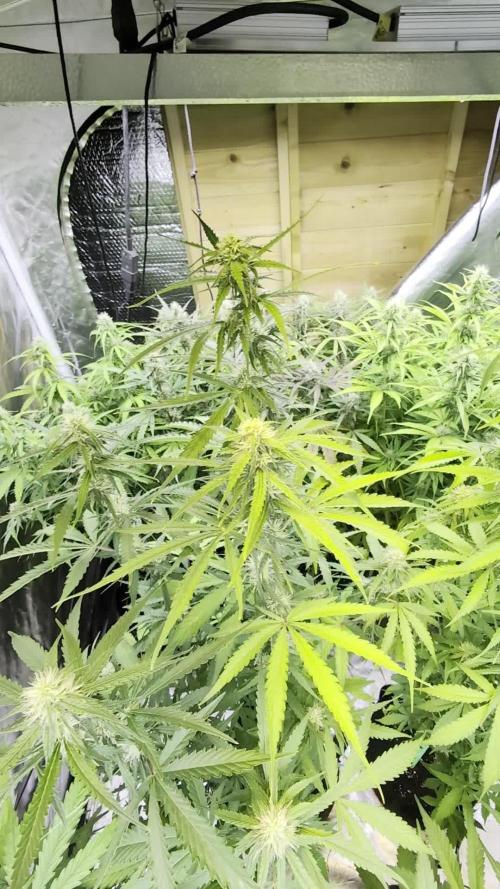
Approaching finish line, looks like some be ready in 2 weeks definitely. Big frosty plants with great smell.

Likes
5
Share


@84ruk
Follow
Primera semana en un sustrato malo del cual fue trasplantada la siguiente semana

Likes
10
Share


@FrulaFrulaki
Follow
The thrips infection is gone but there’re still a lot of damaged leafs as you can see in the photos/videos, but the growth hasn’t slowed down which is good.
Anyway after I did some research into the big bang strain I found out that the company that sells this strain recommends “flushing” for a few days every other week starting from day 16 of flowering. This is meant to speed up bud development and I think it really did something here as the buds got twice as big. But I didn’t exactly follow their recommendations as it calls for watering the plants with large amounts of water and letting the soil dry for a few days and I don’t feel comfortable with that, so I watered them every day but made sure the soil was dry.
Likes
14
Share


@MadeInGermany
Follow
Info:
Unfortunately, I had to find out that my account is used for fake pages in social media.
I am only active here on growdiaries.
I am not on facebook instagram twitter etc All accounts except this one are fake.
Flowering day 31
since time change
to 12/12 h.
Hi everyone .
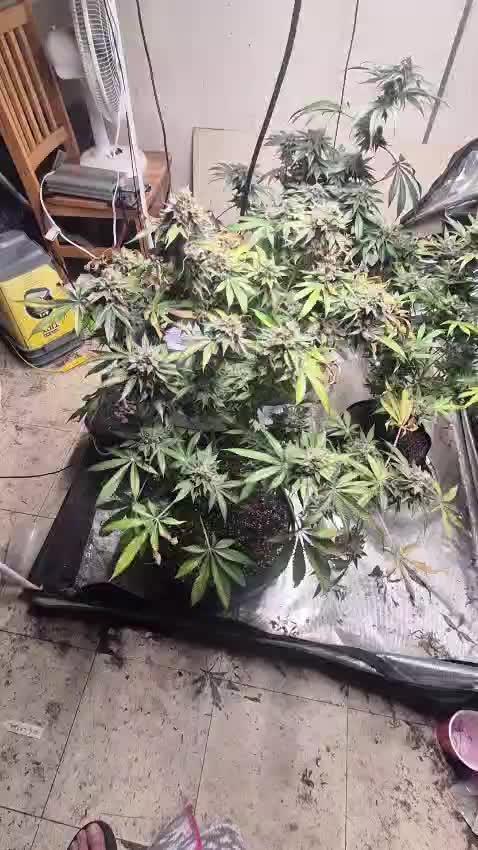
The lady is developing beautifully :-).
The buds start to get thicker and it smells better and better :-).
I added another 1 g GHSC Bio Bloom per l coco.
That should be enough for the remaining weeks.
Otherwise everything was checked and cleaned as usual.
Have fun with the update and stay healthy 🙏🏻
You can buy this Strain at
https://www.amsterdamgenetics.com/product/super-silver-haze/
Type:
Super Silver Haze
☝️🏼
Genetics:
Haze x Skunk #1 x Northern Lights
Type:
70% Sativa – 30% Indica
👍
Vega lamp:
2 x Todogrow Led
Quantum Board 100 W
💡
Bloom Lamp :
2 x Todogrow Led
Cxb 3590 COB 3500 K 205W
💡💡☝️🏼
Soil :
Canna Coco Professional +
☝️🏼
Fertilizer:
Green House Powder Feeding
☝️🏼🌱
Water:
Osmosis water mixed with normal water (24 hours stale that the chlorine evaporates) to 0.2 EC. Add Cal / Mag to 0.4 Ec Ph with Organic Ph - to 5.5 - 5.8



Likes
5
Share


@CityFarmer
Follow
Hello everyone,
Well its getting kinda packed in the greenhouse so all i have for you guys is a little video,
See you guys next week... 🤘🤘🤙🤙

Likes
9
Share


@Cogollo_eu
Follow
**Encontrarás la traducción a español al final de la descripción**
From/Desde: 16/09/19 || To/Hasta: 22/09/19
From day/Desde día: 15 || To day/Hasta día: 21
Ocean Grown Cookies Diary / Diario de las Ocean Grown Cookies:
https://growdiaries.com/diaries/38831-oceangrown-cookies-blues-sisters
If you like this week, please hit a like, it costs you nothing! 👊. Thanks in advance 😉!
-----IMAGES & VIDEOS-----
From the next week i will start to record a timelapse video of the tent. Cheers!!
-----WEEK SUMMARY-----
I'm so sorry for the delay this last weeks, hard work times are very bad for my updates. This week is obvious how after remove them from the cheap chinese light, they're growing at high speeds. I'm going to top them the next week, I don't have very clear what I'm going to do, because I'm really without time this las weeks, and that is terrible for the plants, as this are very important weeks if I want to train them in a good way, and i can't, I'm praying to the goods of weed instead expending my time.
Ok ok ok, let's talk about the plants. For me, it's impressive the speed at how are they growing this 3rd week, they are already at about 15 cm tall, and for the next the 20 cm rule it not going to be enough to measure them.
All leaves are very green and I don't see any weird sympthoms, but if any better eye than mine sees something i would be very greatful with him/her if made a comment.
-----WATERING CALENDAR-----
16/09/19 DAY 15 - 1 l with all week nutrients (Organic Grow Half dosed) @ (0.9 EC | PH 6.1 | 25.7ºc)
22/09/18 DAY 21 - 1.5 l with all week nutrients -(Silica Power & Pro Active) @ (1.2 EC | PH 6.1 | 25.7ºc)
*****ESPAÑOL*****
Por favor, si te gusta esta semana dale un like, no te cuesta nada 👊. ¡Gracias por adelantado 😉!
-----IMÁGENES & VÍDEOS-----
A partir de la semana que viene empezaré a graba un timelapse del armario.
-----SUMARIO SEMANAL-----
Siento mucho el retraso sufrido esta semana y la que viene, los tiempo de mucho trabajo son muy perjudiciales para mis updates. Esta semana es obvio como después de haberlas quitado de la luz china malísima se han puesto a crecer a mucha más velocidad. La semana que viene las realizare el topping, no tengo muy claro qué ni cuanto puedo hacer esta vez, por que realmente tengo absorbido el 95% de mi tiempo estas últimas semanas y esto es malísimo para las plantas, ya que estas semanas son muy muy importantes para poder realizar un buen entrenamiento en las plantas y no me está siendo posible. Así que estoy rezando a los dioses de la hierba en vez de gastar el tiempo que no tengo para que todo vaya bien.
Ok ok, hablemos de las plantas. Para mi realmente es impresionante la velocidad a la que están creciendo esta tercera semana, ya están a 15 cm de altura y la semana que viene la regla de 20 cm ya no va a ser suficiente para medirlas.
A mis ojos todas las hojas se ven verdes y sin síntomas raros, estaría muy agradecido si algún ojo más experto que el mío ve algo y deja un comentario.
-----CALENDARIO DE RIEGO-----
16/09/19 DÍA 15 - 1 l Con todos los nutrientes semanales (Organic Grow mitad de la dosis) @ (0,9 EC | PH 6,1 | 25,7ºc)
22/09/18 DÍA 21 - 1,5 l Con todos los nutrientes semanales -(Silica Power y Pro Active) @ (1,2 EC | PH 6,1 | 25,7ºc)

Likes
27
Share


@Major
Follow
hahahahah that's it it will be the last week of vegetation the plants are in very good shape after a slight defoliation the new leaves are there. I plan a last repotting in the Plagron Bat Mix for the flowering to come. trying not to put too much fertilizer and achieve a beautiful flowering 🙏🙏🙏🙏😃

Likes
Comments
Share


@eldruida_lamota
Follow
Vamos familia, actualizamos la primera semana de floración de estas Granny’s Home de Seedstockers, salieron las 2 de 3, 66% ratio éxito.
Aplicamos varios productos de Agrobeta, que son increíbles para aportar una buena alimentación a las plantas.
Temperatura y humedad dentro de los rangos correctos dentro de la etapa de crecimiento.
La tierra utilizada es al mix top crop, por cambiar.
De 2 ejemplares me quede con los 2 para completar el indoor, también cambie el fotoperiodo a 12/12 y aplique una poda de bajos, se ven bien sanas las plantas, tienen un buen color progresan a muy buen ritmo por el momento, marcaron preflores.
Agrobeta:
https://www.agrobeta.com/agrobetatiendaonline/36-abonos-canamo
Hasta aquí todo, Buenos humos 💨💨💨


Likes
7
Share


@fabialien
Follow
Lunes 11 de marzo 7 am de 2024:
Se dejaran hidratando las semillas por 24 hrs.
Martes 12 de marzo 7 am de 2024: pasamos a papel dejamos por 24 hrs.
Miércoles 13 de marzo 10 am de 2024: revisamos las semillas y vamos preparando macetas pequeñas para transplante.
Miercoles 13 de Marzo 3:30 pm se traspasa a tierra.
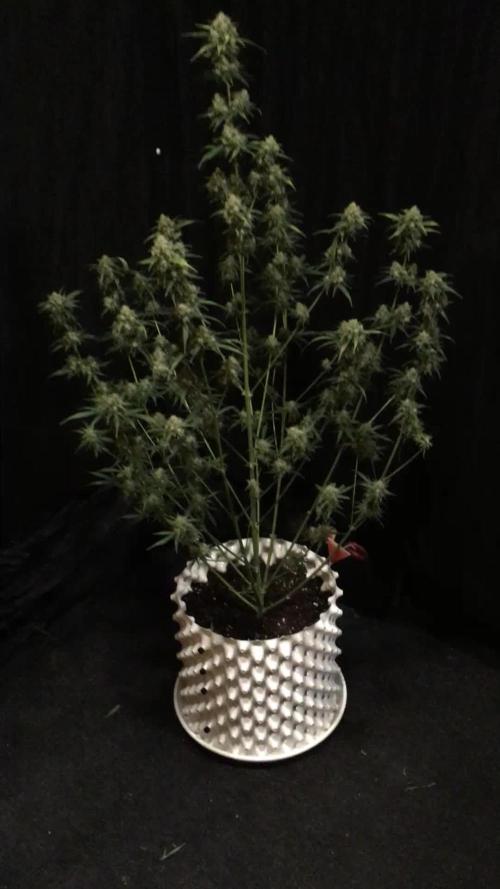
Viernes 15 de marzo 11:47 pm 2024, ya que abrieron bien se pone bajo lámpara 100w a 30 cm de distancia, tienen domo protector! El lunes en la nueva semana subimos el avance, hasta el Lunes...
Sábado 16 de marzo 2024, de las 3 semillas la 1 ya abrió completamente, 2 y 3 están por abrir completamente.
Likes
19
Share


@Vegetoo420
Follow
This plant is ready and I flush it RN, pretty pink dress with a lotta tricomes makes her beautiful
Not a big girl so I really hope buds will be good, tasty like the smell she has

Likes
9
Share


@STAYINGONMYMAINCBATORUNTWO
Follow
I’ll start by saying I’m NOT using both bud blood and bud ignitor in one solution, I am using bud blood on the rear runt plant and bud ignitor on the front one to test the outcome of them individually to see the best results! I tied down and defoliated twice in the week and have switched to 12-12 yesterday so they’re transitioning now and should be in bloom by week 7! I made some extract them made some gummies successfully I might add and added the photos in the diary!


Likes
39
Share


@Randyb4
Follow
Day 49 I super cropped all the plants for the first time on the first day of the week. They had all recovered by the next morning. I've been doing some hand bending down too to keep them short as possible. No wires at all. Still havnt watered since day 46.
Day 51. I watered and feed this morning with the nutrients listed in the diary. They took 4 gal of water untill they had runoff. Ph was 6.1 @ 71°F. Also defoliated plants B and D a tiny bit for the first time. I came back to the tent around 4pm and noticed plant B was 22 inches from the light again. (I raise the light about every 3 days to maintain 24" above canopy) So instead of raising the light again I supercroped plant B to match the hight of the other 3 plants. Later in the evening I checked on them and plant B had bent back up towards the light, mostly even with the rest of the plants now.
Day 52. Plants looks good. Plant B recovered well again from the HST but plant C (the strongest plant so far) is starting to curl up on the edges of the leaves. I'm pretty sure it's over watering. I'll keep an eye on it.
Day 53 Plants look really good so I tired the light up 5 more percent to 35% still lat 24", above canopy. Tonight I put the trellis net down on them and spreaded them out more.
Day 55 Plants were starting to droop so I watered Plants A and C with just water and molasses pHed to 6.0 @ 71°F, and watered Plants B and D with half strength general hydroponics (late veg). Let the runoff sit in the pans for 3 hrs or so then I vacuumed the runoff out. While I was watering I defoliated plants A and C at the base ( leaves wernt getting any light).

Likes
20
Share


@GrowmieDeLaStreet
Follow
A lot has been going on this week.
I performed a slurry test at the start of the week to get updates on the soil. pH is way too low and it's starting to miss nutrients, so I started feeding again once a week at low dosage.
I noticed that the new leaves are slowly yellowing probably because of the low pH. I plan a curative flush at high pH to reset it. The runoff should give better readings on what's going on than the slurry test. I built an elevated platform made from metal trays I found at the dollar store to collect it more easily. Game changer really.
LST has begun. Stems are chunky and already hard to bend but the job was easy with the new floral wire I use. I used to have a very thin one that I couldn't stick in the ground.
The irrigation system Is fully working now and all automatic. I still need to adjust the time it's on and off to get the perfect watering. The algae problem is solved and I didn't have to use any algaecide or filtration system. I simply put 0,5ml/L of 29% H2O2 in my reservoir. Hydrogen peroxide is antibacterial and it also helps with the oxygen levels of the water. With continuous aeration, protection from light and H2O2, the water in the tank is good for at least 5 days. 7 in fact if I count the 2 days for chlorine evaporation.
I also now have a 3000L/h water pump and the sprinklers can respectfully be called by their real name. The video shows what it was before with an 800L/h pump. I didn't had the chance to record with the new system.

Likes
5
Share


@Tony_Montana84
Follow
So jetzt habe Ich meine erste Ernte hinter mir. Das Ergebnis hat mich überrascht. Mit so einem kleinen Setup und eigentlich Keine professionelle LED Lampe, Habe ich solches fertig bekommen. Nach dem groben befreien der Blätter habe ich auf der Waage 577 g nass. Ich bin gespannt wie viel es circa trocken sein werden. Ich denke mit 100 g kann ich wohl rechnen. Sobald sie trocken sind werde ich mich noch mal melden.
Likes
8
Share


@GrownwithLED
Follow
Both plants have almost stopped growing in heigth now and are in full flowering mode now. Barbarian (=AK-47 x Barbara Bud) Plant #1 is 15 cm shorter than plant #2, but a little bushier. Both have grown very well and are strong and healthy. They get more and more flower clusters now and start to fill up all branches. Trichomes start to appear all over...the plants start to get sticky and develop a weak sweet aroma now. Its time to take off the biggest fan leaves now for defoliation, I took a round of pics before and after.
Likes
13
Share


@Lazuli
Follow
Using Ripen for a week now, 3 more days or so and then flush for 3 days
Then harvest will be at day 56

Likes
17
Share


