Likes
Comments
Share
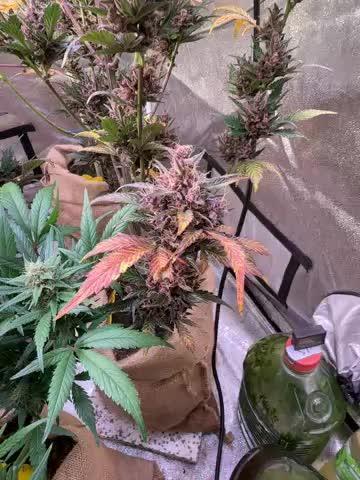
(Controlled Environment Agriculture): My Synganic living grow room, a closed-loop bioengineering-logic system. (MOP). Lights are 58 inches from the main source to the top of the pot and the soil surface. If I added up all the lights in the tent, it would be 1100w-1200w total across 12-14 lights. Using them all at once is far too much for a plant and incredibly difficult to deal with environmentally. The lights are fixed in position; side lights have dimmers, allowing for pinpoint precision of PPF. Fixed at 58 inches, cannot move them closer to increase intensity. Instead, you achieve the PPF by distributing smaller wattages across a massive, multi-fixture matrix. Triggering specific plant defenses without melting your environment or frying your canopy. What's the point/blah blah wattage? Never really go above 600W at any one time. Lights come on in the east of the tent and set in the west. At sunrise and sunset, the red-to-far-red R:FR light ratio drops because the sun's low angle scatters red light more than far-red light. This shift reduces active Pfr and increases inactive Pr, mimicking Mother Nature herself. Deployed a lighting system featuring extra 660 nm deep-red and extending the spectrum up to 780 nm achieves the full Emerson Enhancement Effect by simultaneously balancing Photosystem II (PSII) and Photosystem I (PSI) to maximize quantum yield. By pairing deep-red photons with far-red photons, you trigger a synergistic biological response where the resulting photosynthetic rate is higher than the sum of both wavelengths used individually. This practice directly leverages the updated extended Photosynthetically Active Radiation (ePAR) framework. The Emerson effect accelerates plant metabolism and heat capture; you must proactively scale up your ambient room temperature, nutrient delivery, and CO₂ supplementation to prevent the light from stalling out your cannabis plant. UVA stays high all day from morning to night, but UVB peaks at solar noon (middle of 18-hour days) when the sun is peak. Morning color starts at 2k-3k; by noon it goes to 5k- 6k and back to 2-3k for sunset, with differing P:FR at light off. The extra-blue light is to assist with photoreactivation of UVB damage. No more yield loss for me. Using extra blue light for photoreactivation is what I do. Blue/UVA light activates photolyase enzymes, which directly repair DNA damage caused by UVB radiation. But what's the point if it's not for yield? Ultraviolet (UV) radiation—specifically UVA (315–400 nm) and UVB (280–315 nm)—acts as a critical environmental signal that programs a plant's photoprotective genes to unlock its true photosynthetic potential. When growers push crops to their absolute photosynthetic maximum via high-intensity light and elevated carbon dioxide, the photosynthetic machinery easily becomes overwhelmed. Emerging photobiology research demonstrates that UV radiation prevents this limiting bottleneck; it triggers specific transcription factors and signalling networks that fortify the plant's cellular defenses, allowing it to process extreme light levels without sustaining structural damage. I've known this for years. Big middle finger to everyone for all the ridicule through the years. You know who you are. 8 Rules of plant growth: When carbon dioxide becomes the 9th limiting factor of plant growth, it shifts the growth curve from exponential to linear. The next restriction is photoprotection against reactive oxygen species (ROS), managed via non-photochemical quenching (NPQ) and the xanthophyll cycle, which bridges into precise hydrogen and redox dosing. UV radiation, particularly UVA, and the synthesis of zeaxanthin are critical for the xanthophyll cycle to function. It's not chasing purple strains... i've been chasing the limits of growth, trying to make the linear exponential, just like mathematics prefers. To do that, must control every environmental variable to compound the plant’s metabolic rate. True exponential growth means the rate of increase matches the current mass at every stage, requiring a closed-loop system where light, CO2, and nutrition lock into a synchronized upward curve. First, you must understand what restricts it. Precise hydrogen and redox dosing. Nature mathematically optimizes quantum energy transfer and light absorption efficiency within the photosynthetic machinery, as it naturally dictates energy scaling hierarchies and resonance dynamics. Most won't even understand that; once you do, it changes everything. Constructive interference occurs when two or more overlapping waves meet in phase, meaning their crests and troughs perfectly align. Their amplitudes add together, creating a new, amplified wave with greater intensity than the individual components. Constructive interference is the foundational mechanism that establishes a resonance hierarchy across physical, structural, and acoustic systems. Chromophore spacing is tuned to sub-nanometer precision to match the wavelengths of absorbed light, forcing constructive interference. Light-harvesting proteins form geometric rings and lattices. These shapes act as physical resonators, trapping and focusing the wave energy. This same principle dictates how opera singers shatter glass, how musical instruments resonate, and how bridges withstand structural vibrations.Nature uses the exact same math to harvest a photon as an engineer uses to design a concert hall. When you push high PPFD and elevated CO₂, you create a metabolic bottleneck. The plant cannot process the energy fast enough, leading to electron backup, light-induced damage, and a collapse from exponential growth into a flat, linear rate. UV light acts as the regulatory valve that prevents this collapse. In standard agronomy, Liebig's Law of the Minimum dictates that growth is limited by the scarcest resource. When you maximize water, nutrients, light, temperature, and CO₂, the bottleneck shifts to metabolic processing speed and photoprotection. By controlling the Redox state of the plant using UV, the xanthophyll cycle, and managing ROS, you can prevent the plant from hitting a hard photosynthetic ceiling. Instead of the growth curve flattening out (linear or plateauing due to photoinhibition), the plant continues to compound its metabolic rate efficiently. You are forcing the plant to operate at peak thermodynamic efficiency. By matching the UVB peak with sustained UVA and shifting Kelvin temperatures (2K to 6K), you are damaging the plant just enough to trigger defensive genes, while simultaneously providing the exact light energy needed to repair that damage instantly. UVA radiation and specific blue wavelengths accelerate this enzymatic conversion. Zeaxanthin acts as a structural sponge that absorbs excess excitation energy from chlorophyll and dissipates it safely, preventing ROS formation. Without UV signaling, the xanthophyll cycle cannot keep pace with extreme light, leading to dynamic photoinhibition (yield loss). The addition of Spirulina is primarily for zeaxanthin, as it contains a lot. But on top of that, Hawaiian Spirulina is cultivated in open ponds using a combination of 100% fresh potable water from Hawaiian aquifers and ultra-pure, deep ocean water containing all 94 trace minerals & elements. It is then gently dried using patented Ocean Chill Drying technology and cold-pressed to ensure maximum nutrient levels. Spirulina, a blue-green alga, is rich in nitrogen, phosphorus, and potassium (NPK), making it an excellent source of nutrients for plant growth. Studies have shown that Spirulina can be used as a biofertilizer, effectively replacing chemical fertilizers, especially for nitrogen, with a whopping NPK of 10% (N), 20% (P), and 20% (K). Rich in proteins, amino acids, trace minerals, and plant growth-promoting compounds. Zeaxanthin is a vital plant pigment that accumulates under intense light to drive non-photochemical quenching (NPQ), acting via thermal energy dissipation, direct singlet oxygen scavenging, and thylakoid membrane stabilization. The violaxanthin cycle (or xanthophyll cycle) reversibly converts violaxanthin to zeaxanthin via antheraxanthin to protect plants from photooxidation. Understanding this interconversion is next-level vital for optimizing non-photochemical quenching (NPQ) and pushing photosynthetic limits under high-light stress. Ascorbic acid (vitamin C) is a natural antioxidant that plants produce internally to neutralize harmful reactive oxygen species caused by photosynthesis and high light stress. Acts as a co-factor for enzymes like violaxanthin de-epoxidase in the xanthophyll cycle, which safely dissipates excess light energy. 1g ascorbic acid will neutralize 100% of chlorine in upwards of 30 gallons of tap water. If your local tap water uses chloramines (chlorine bonded with ammonia) instead of free chlorine, you will need roughly 20% to 30% more ascorbic acid to completely break the tougher chemical bond. Molecular hydrogen and hydrogen-rich water act as selective antioxidants that help lower oxidative stress. They neutralize toxic reactive oxygen species like hydroxyl radicals and boost natural antioxidant defense systems in biological and plant systems exposed to high-intensity light or abiotic stress. UVA and UVB act as stress signals that upregulate the plant's secondary metabolism. It forces the plant to build an internal "sunscreen" (flavonoids and anthocyanins) and fortify its cellular defenses before the peak solar noon crisis. This keeps the metabolic highway open. Know the precise ratio of UVA to UVB needed to maximize zeaxanthin accumulation without triggering permanent stunting. Balancing Far-Red (FR) light at "light-off" to manage the phytochrome photo-equilibrium (Pfr to Pr conversion) in tandem with the UV schedule. Omg, the logic. Hydrogen concentration and redox signaling as secondary messengers in this high-intensity loop. From here on, it gets Quantum.
Likes
9
Share
They all are getting close to harvest except Gorilla Glue which decided to out grow tent. Had to open vent and add light for top cola. Ugh
Likes
14
Share
Sorry for the late update been busy with life. Out of the 5 seeds planted only 2 were female. Im almost at 2 weeks of flowering. Loving the structure didnt top plants at all, every one of em bushed out, did do some super cropping before flip to try and open up the canopy more. Getting a nice fuel smell on these girls even in veg. Some very interesting leaf variegation and sawtooth edges on 4 out of the 5 plants. Gonna do a big defoil in week 3 and try n open her up more
Likes
24
Share
Cette semaine les plantes grossissent, il y a de beau sujet. 💚J'ai encore un peu de difficulté pendant la germination et cela se voit. J'ai installé l'ensemble des lumières pour la dernière semaine de végétation.🌱 Attention aux tubes d'irrigation ils peuvent se boucher, nettoyer les buses.👨‍🌾🏼
Likes
8
Share
@Tricom
Follow
Voila ! Je croix c est bon ils sont arrivé à terme …. Je les mets 48 h dans le noir total … variété facile a cultivé résistante d’une manière générale ( parasite, excès, carence et ph )..avec un bon rendement idéal pour cultivateur novice … très très forte Odeur de skunk a l orange 🍊avec des têtes bien lourd … franchement le hgl rspec 100 w sa envoie du lourd Hezi aussi fait de super produits ..
Processing
Likes
26
Share
Here we are guys in the middle of week 4 for some and week 3 for the rest!! Alot of them are going into pre flowering. All 12 confirmed females:) amazing rapid growth they are loving these autocobs:). All smiles everyday gg4 and tangie are stretching so amazing. Lights 24/7 in less then two weeks they will all being going into a 4x8 !
Likes
17
Share
Day 35 da seme. Sweet zkittlez portata outdoor vediamo se resiste agli insetti 😊
Likes
23
Share
Sep 21: fall is here and Cheese is looking great with nice fat buds and great purple colouring. Couple or three more weeks ideally, but it will likely be forced by weather. Sep 24: snow in forecast for late next week so it will be time to harvest soon. Likely four more days of good weather and they’ll it will be time.
Likes
23
Share
@Kynareth
Follow
day 27 - Defoliation of big and first low leaves and start of LST. The plant hava some nutrient problem but nothing too serious, lets see how it recovers the defoliation and respond to lst
Likes
24
Share
Due to prolonged bad weather, I decided to harvest them to avoid mold and other damage. There were three of us, and it took around 6 hours to trim about 80% of both plants. I ended up with a yield of 205 grams dry per plant. I'm more than satisfied with the plants. For my first grow, I couldn't be happier.
Likes
11
Share
Week 3 Watered Plants Ph Water 6 Used 2.5 Ml Of Recharge Still Using Living Soil 18/6 Hour Light INTRODUCE LST TO PLANT Noticed Plants Growing At Different Rates Idk Why All Sprouted Same Day Weird
Likes
8
Share
Been busy you guys sorry about the updates.but yeah started showing preflower signs...
Likes
8
Share
Fade is coming through nicely. Regretting trimming up some leaves early. Thought id be chopping it down a few days back. Ec has rocketed up to 1.0 after being a bit more thorough with my watering technique. Guessing the plant had a fair bit of salt build up throughout the grow that had really set in. Gonna have to just keep watering like this until that ec really drops off and the leaves all yellow out. Starting to get some solid ambers, lots of cloudy trichomes. Shes definitely almost ready
Likes
6
Share
58 days of flowering: I started cutting the most mature apicals 42/57. I will wait for the remaining 7-14 days. first 42: 370.5g
Likes
5
Share
@GrowBalu
Follow
Sie wächst gut habe sie heute getoppt Werde sie Ende nächster Woche auf 12 12 umstellen