


Likes
Comments
Share


@FrecheOma60
Follow
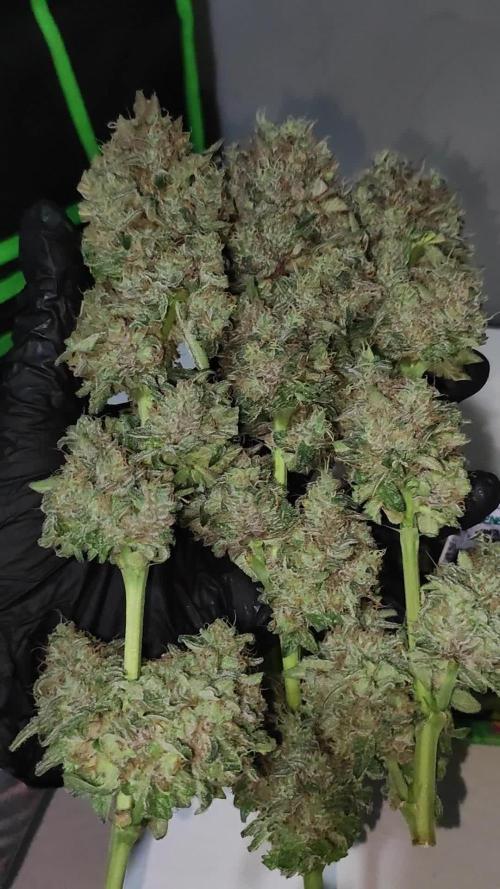
Insane color, insane structure, insane sugar and some very intense smell.
They are nearly ready its only about some days maybe 3-4 days until harvest i guess.
Only watering with plain rain water, dont actually flush but put the clear water into my tent so they take a bath.
My next update is when they are dry

Likes
17
Share

@Bncgrower
Follow
Harvested last night, truly strong smell, cultivation was absolutely perfect from start to finish. Very happy with the result, anxious for the drying and curing process! Thank you for following along.. 🤜🤛🌱🌿🌲


Likes
23
Share


@adam_pawloski87
Follow
This grow was pretty simple ! They went a total of 103 days from seed! Very trichomy dense buds with the smell of Berries vanilla and skunk ! This is a must try for you all Fastbuds has the greats!!!
Likes
58
Share


@AsNoriu
Follow
Day 48. They look as sad as pitty UK summer. Days are in low 20, nights as low as 11.... constant rain ....
Have doubts about that strain, but #1 is getting somewhere ;))))) others in shade and dont grow as big as they should by now. Picky strain in my mind. My friend has last bean in greenhouse and she is weakest from 3 strains he tries . #1 lost two sets of bottom branches , #2 and #3 lost three sets each. They needed good clearing from worthless sides.
Cleared all garden from fresh grow, aerated soil, put slug pellets and thats it.
Came late so leaves are droopy.
Plus i think heavily represent overwatering ;))) but with such air .....
I see some preflowers, so count this as last veg week.
Will visit in two weeks to top up with PK boost.
Have some crazy person in city , look what he does to one post box ;)))
Happy Growing !!!

Likes
2
Share


@Ultraviolet_
Follow
We become aware at such times of man's wonderful ability to bring seemingly unrelated elements into harmonic balance, and receive a glimpse into a world where everything exists in conscious sympathetic attunement to everything else. When we listen to a piece of music that seems to strike a beautiful chord somewhere inside us, or view a painting that simply glows with harmonic awareness well executed, we probably do not spare much time to contemplate the wonderfully intricate combination of vibrations that our sensors make it possible for us to perceive. We tend to appreciate the relationship between the parts of something by an awareness of the harmony or dissonance of the whole. This ability enables us to say "what a beautiful house!" instead of "analysis has proven that this collection of building materials exhibits certain elements of harmonic proportion." While this ability to instinctively appreciate the beauty of true harmony has an important role to play in evolution, a more analytical understanding of the laws involved can be most useful. This is especially so if we wish to create works of art where each part exists in true harmony, not only with the other part of that particular whole, but with the universe within which the creator and the created exist.
Everything vibrates. From the most dense matter to the most subtle cosmic rays, everything which our senses allow our thoughts to become aware of, can be specified in terms of wavelength or frequency of vibration. These two terms define the same thing, but from different points of view.
The following are the approximate wavelengths of various energy carriers:
Cosmic rays 0.000,000,001 mm
Gamma rays 0.000,000,1 mm
X rays 0.000,500 mm
Ultraviolet rays 0.003 mm
Visible light 0.006 mm
Infrared 0.01 mm
Sound waves 1 meter
Radio waves 300 meters
Violet light 400 nm to 450 nm
Blue light 450 nm to 500 nm
Green light 500 nm to 570 nm
Yellow light 570 nm to 590 nm
Orange light 590 nm to 610 nm
Red light 610 to 700 nm
1 nanometer (nm) = 0.000,000,1 cm = 1/10,000,000 cm
If a guitar string is plucked and we hear a sound, it is not too difficult for the human mind to associate this sound with the vibration of the guitar string. With color it is quite different. It is difficult for us to conceive that the color of a substance is not an inherent property of the substance itself, but an indication picked up by our senses of that substance's ability to absorb or reflect the light which happens to be shining on it at that moment. Neither the matter nor the light is colored. What happens is that the brain learns to differentiate between the frequencies reflected or transmitted by the substance the eyes are focused on. The same thing happens with sound. When we say "Oh! Listen, they're playing my favorite song," what we really mean is: "My brain has stored within it a particular pattern of frequencies. I have compared the new information being received with this stored pattern and have deduced the answer that the two patterns are similar within certain specified tolerances." The 'pleasure' involved could have something to do with our running the pre-recorded pattern at the same time, in 'sympathy' with the new pattern as it is received.
The word sympathy describes very well our ability to appreciate color and sound. It also describes the reason behind certain elements of harmony. For instance, if a substance vibrating at 100 cycles per second (tone 1) is in the proximity of another substance vibrating at 200 cycles per second (tone 2), we could perceive, if we had the right equipment, a certain sympathetic relationship between the two.
We will see from this that there is a uniform doubling of the first tone seen in the second. At various points along the waves, the two are the same in amplitude. At other points, they are at opposite poles to each other. This doubled frequency has more points of similarity to the original than any other frequency except the original itself. If the equipment we had available for measuring these two frequencies was a soundboard amplifier and a pair of ears, then we would hear what would sound to us like one tone. If we had the opportunity to hear one at a time, we would hear that although they sound the same, one is higher in pitch than the other. This characteristic of 'the same but different in pitch', musicians have called the octave. Any two tones produced where one has exactly doubled the frequency of the other is called an octave. Speaking in ratios, an octave would appear then as the ratio 2:1 or 1:2, depending on whether we are talking of an octave up or down.
A single note produced by almost any instrument will contain more than one wavelength or frequency. It will have a dominant frequency, the wavelength of which we would call the note's 'fundamental' or 1st harmonic. It will also have a varying number of upper harmonics, gradually fading in intensity into infinity or silence.
Natural harmonics always have the same pattern of intervals between them. The interval between the 1st and 2nd harmonic is a perfect octave; between the 2nd and 3rd a perfect fifth; between the 3rd and 4th a perfect 4th; and so on, the intervals becoming smaller and smaller until they lose any relationship with the western 12 tone scale as it exists at the moment. Just as an octave has certain elements of sympathy with its fundamental, so some intervals have been noted to be more perfectly in sympathy with the fundamental than others. The ratio of the 'perfect 5th' or interval of 7 semitones, as it occurs in the harmonic series, is 3:2 or 2:3, while that of the 'perfect fourth" is 4:3 or 3:4. All the tones in the western 12 tone scale can be expressed in terms of the ratio between the upper tone and its fundamental. This would seem to be an ideal way of generating a scale from any given fundamental and several attempts have been made to do this, the Pythagorean system being probably the most well known. Although when working with a single tone instrument playing on its own, the Pythagorean formula works wonderfully well, if we had several instruments tuned this way together and asked them to play almost any western music, we would find that at times they sounded quite out of tune to each other.
The lack of flexibility of the various scale systems based on the harmonic series has led to what is known as the 'tempered' scale. This uses as its primary unit of interval the ratio of the octave or 2:1. It then proceeds to divide the interval between any fundamental and its upper octave into 12 smaller intervals by applying the ratio: two to the one-twelfth power, to one (21/12:1). This equals 1.059463094, so by multiplying any frequency by this number, we will obtain the tempered semitone next up from our fundamental. We will also find that any tone twelve semitones up from any other tone, in a scale generated in this way, will have exactly double the frequency.
If we took the note middle C on a piano and halved the wavelength, we would have the note C one octave above. If we halved this, we would have the C above, and so on. However, within about 6 octaves, we would find that although a 'sound' was being produced, no human ear could perceive it. If we kept on going, halving and producing upper octaves of our fundamental C, we would proceed through the infrared band, into the visible light spectrum. If we happened to be outside during the day, we would, for one octave only, see the note C with our eyes. The next octave above would already be in the ultraviolet band, and outside the eye's sensitivity range. If we can think of color as being an indication of a substance's vibratory rate or wavelength, we may begin to see a relationship that could exist between the color and sound spectrums.
The logical extension of what has so far been said is that there exists a scale in the color spectrum that corresponds exactly to the scale in the sound spectrum, each color tone being an octave of the equivalent note in the sound range.
This is not the end of the story but only the beginning. If we can for the moment accept that any wavelength in one band has upper and lower octave stretching out to infinity, then the next question is 'fine, but what shall we use as our fundamental? A particular color? A particular sound frequency?' The musicians among us will probably say 'A 440'. This means that the note A should vibrate at 440 Hertz, or 440 times per second. They would tell us that this is standard pitch has been adopted by most orchestras around the world; pianos are tuned to it, instruments are constructed to formulas based on it, and so to them it would probably seem the most appropriate place to begin. Some of these musicians may know of the battle that is still raging with regards to this being the standard, but few would know why A = 440 Hz was chosen except that it worked when it was set to be a suitable compromise between the many different pitches in use at the time.
432 Hz is said to be mathematically consistent with the patterns of the universe. Studies reveal that 432 Hz tuning vibrates with the universe’s golden mean PHI and unifies the properties of light, time, space, matter, gravity, and magnetism with biology, the DNA code, and consciousness. When our atoms and DNA start to resonate in harmony with the spiraling pattern of nature, our sense of connection to nature is said to be magnified.
Another interesting factor to consider is that the A=432 Hz tuning correlates with the color spectrum, while the A=440 Hz is off. Audiophiles have also stated that A = 432 Hz music seems to be non-local and can fill an entire room, whereas A=440 Hz can be perceived as directional or linear in sound propagation.
Once you adopt the idea that sound (or vibration in general) can have an equalizing and harmonizing effect (as well as a disturbing effect), the science of harmony can be applied to bring greater harmony into one's life or tune to specific energies. There is a form of absolute and relative harmony. Absolute harmony can, for example, be determined by the tuning of an instrument. The ancients tuned their instruments at an A of 432 Hz instead of 440 Hz - and for a good reason. There are plenty of music examples on the internet that you can listen to in order to establish the difference for yourself.
Attuning the instrument to 432 Hz results in a more relaxing sound, while 440 Hz slightly tenses up the body. This is because 440 Hz is out of tune with both macro and micro cosmos. On the contrary, 432 Hz is in tune. To give an example of how this is manifested microcosmically: our breath (0,3 Hz) and our pulse (1,2 Hz) relate to the frequency of the lower octave of an A of 432 Hz (108 Hz) as 1:360 and 1:90.
It is interesting to note that 432 Hz was the standard pitch of many old instruments and that it was only recently (19th and 20th century) the standard pitch was increased. This was done in order to be able to play for bigger audiences. Bigger audiences (more bodies) absorb more of the lower frequencies, so the higher pitch was more likely to “cut through”. One of the oldest instruments of the world is the bell ensemble of Yi Zeng (dated 423 BC), tuned to a standard F4 of 345 Hz, which gives an A= 432 Hz. The frequency of 345 Hz is that of the platonic year! Similarly, many old organs are tuned in A=432 as well; for example, St. Peter’s Capella Gregoriana, St. Peter’s Capella Giulia, S. Maria Maggiore in Rome.
Maria Renold’s book “Intervals Scales Tones and the Concert Pitch C=128 Hz” claims conclusive evidence that 440 Hz and raising concert pitch above scientific “C” Prime=128 Hz (Concert A=432 Hz) disassociates the connection of consciousness to the body and creates anti-social conditions in humanity.
The difference between concert pitch A=440 Hz and Concert A=432 Hz is only 8 cycles per second, but it is a perceptible difference of awareness in the human consciousness experience of the dream we share called existence.
Likes
18
Share


@GreenCasual
Follow
Starting to LST this week. It’s my first time ... and this is so scary !
Likes
12
Share


@russrahl
Follow
Plants continued to stretch last week, I had to weave a couple branches through the top screen as well to keep them level with the canopy. Overall it’s going good, I did a defoliation again a few days ago to try and open up as many budding sites as possible to the light. I noticed some nutrient burn on my leaf tips at the end of last week so I diluted the reservoir water with 3 gal of fresh water. My HPS light is still turned down to 750w as the light output at the top of the canopy exceeds 75 000 lux directly under the light even turned down. I have a light mover moving my light though so it’s not always in one spot. This is only my second crop using this light mover though so I’m still adjusting its speed and pause time and doing some experimenting with it...lol smell is normal still, not strong but it’s noticeable when you open up the tent. I will be updating more pictures and videos throughout the week as well. Cheers 💨

Likes
33
Share


@bildo
Follow
This was my first ever grow and I am extremely proud of it. The nugs are dense and smell fantastic. The phenotypes on each of my plants were very unique, and each has its own smell. This did make it a little harder to care for the plants, but it ended up working out fine. I opted for a dry trim and did a tight manicure on the nugs. I plan on turning the trim into cannabutter using a sous vide machine.

Likes
10
Share


@caliEskimo5
Follow
Busted out a new soil analyzer, used it on another plants pot that has been having issues, 7PH. Last weeks transplant and used of PHd 7 water worked and cleared my calcium/magnesium lockout but now causing autoflowers and bagseed to grow a bit more slowly. As far as this SD plant, it's still seeing 6.0-.6.15 steady and that's why this plant is bangin' through early vegetation quickly. I've also caught this problem early with this plant and have gone way down on ferts and water amounts. Each afternoon when this plants fan leaves start to look a bit drab, one full cup of straight RO with a quarter tsp. Maxigrow, let that dissolve, fizzle the water and turn pp yellow, 1.5mL Sweet Raw and 2mL Hydrogurad, stir and add by feeder syringe.
I'm pretty sure soil is fine too as bot lh my soil readers show 6 and 7 respectively on all pots(should be, same soil, same nutes) but you can literally see plants that I've overfed, this SD plantbis not one of them so soil is well buffered. I'm also scrambling to raise the lights to get all 5 plants good top coverage but the more I raise the lights, the more I see nodes and lateral braching stretch. Definitely not an auto or Indica Dominant.
Bought some #2 2.6Gal pots today, will sterilize and coat with copper sulfate and mix up some Ocean Forest with a bit of silica sand, tiny bit of Oak wood ash and also new, Dr. Earths Blood Meal with whats left of my Tree and Nut dry amendments from same company. Have had alot of good results with these mix in or too dress fertilizers, buds are much more dank than when using chemical ferts! I will most likely cut out the maxigro, start using Brier Rabbit Blackstrap Molasses, keep using Floralicious Plus and the Botanicaire line and back with the Alaska Fish Fertilizer, all just in much lighter amounts!! Blood Meal will make this plant HUGE and FAT...just remember...be super skimpy on the amounts used!
Likes
12
Share


@CampaCavallo
Follow
Buongiorno e buona SPANNABIS a tutti gli amici amanti della CampaCavallo 🍀💐💚🍀🍺🥦🎉🎉🎉
Vediamo la mitica CRITICAL LEMON ⚡🍋 gonfiare i suoi bei bud sotto il solito vigile controllo di TENT-X 🤖 by TROLMASTER 🔝
L'alba ed il tramonto impostate tramite Tent-X Sembrano proprio piacere alla giovane ragazza.💚🌞

Likes
44
Share


@Ukfarmer420
Follow
Easy grow, nice pretty plant, kept it small and performed lst early on, nice dense hard buds, wish I had space to run them all. I will be running the rest of my seeds very soon.


Likes
4
Share


@Ibgrowing
Follow
First week of flowering!
I chose to also do some lst on this lady, a bit of a different approach. She survived a couple of very warm days(32°C). The lower leaves started to die off so I used some more nutes.
Watered with 2l(nutes), 1,5l(no nutes) and 2l(nutes).
She is starting to smell a bit also, looking forward to seeing the buds!
Likes
21
Share


@kushh
Follow
Hello friends. I have 1 problem
Could you help ?
[seed , genetic, manufacturer company, I do not know.]
day 37 flower started. day 65 low flower.
Likes
2
Share

@Wondrej
Follow
One love Growmies 💚🇯🇲
Week 3 hitting around.
26.11.2025-Day 16(Week 3)
November 25th, officially kicked off Week 3 of Vegetation.
That means our girls are today
16 days into the active veg. cycle (measured from the first cotyledons on 10.11) so we are going to make some photos of these beautiful ladies.
The Morning Droop Mystery Solved: 💧
You'll notice the leaves in the photos are a bit droopy/downcast. Don't worry, this isn't stress or a deficiency—it's just a routine event:
1. Night-Time 🌕 Application: I hit them for the first time with their foliar spray (PPM) right before lights out yesterday.
Foliar feeds must be applied in the dark to prevent light burn.
2. Lights-On shock⚡️ : The pictures were snapped right after the tent lights came on.
After a long night, and with the spray still on the leaves, it takes them a little while to "wake up" and lift their “solar panels” back up. They'll be fully standing and stretching within the hour!
A Quick Note on Size vs. Time:
Some people might look at Week 3 and expect bigger plants, but here’s a tip for anyone running an organic system: Don't panic about size in the early stages!
In Living Soil, the plant spends these first few weeks building a massive, resilient root system and linking up with the soil’s microbial life.** 🐛
QUICK UPDATE WITH PHOTOS FROM MID OF WEEK 3-
27.11.2025: Tonight the plants look very strong, so the first training session took place.
The girls were topped and bent for the first time.
I hope both of my toppings were successful and I don’t stressed my ladies too much to stop them. Fingers crossed for week 4.
🤲🏻🤲🏻🐛
Likes
9
Share


@SeseGrows
Follow
Home Interior 90x90//
Do Si Dos 33 - Barneys Farm + Sour Diesel + Roadawg
//Semana 8 // FLORACIÓN
- Grotek Nutrients.
- Lumatek LEC 315w+ 💎 .
Likes
3
Share

@The_Doctor_Green
Follow
Hola a todos!!
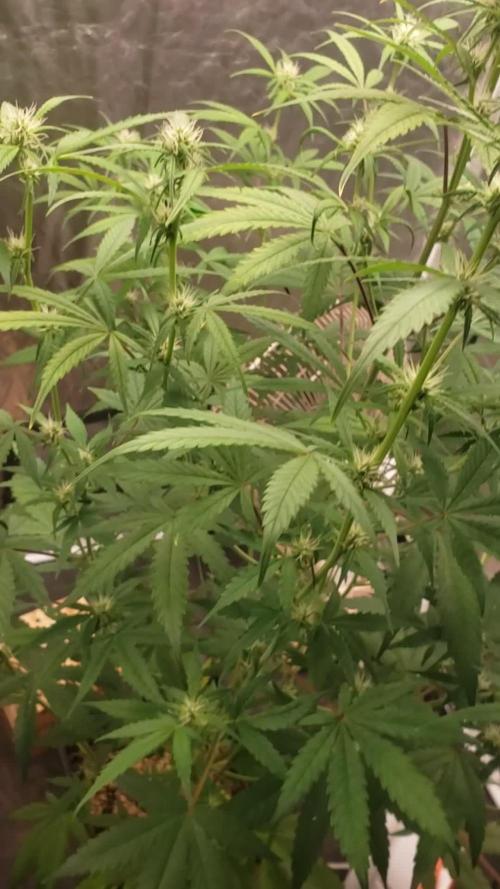
Esta semana prácticamente no he fertilizado, ya que luego de un breve lavado note que los valores de ppm aun seguía siendo alto..(1700...1800), entonces segui regando solo con agua, con bajas ppm 500 ppm aprox.
Recien ayer logre bajar las ppm , no asi el ph, del drenaje, me viene dando 7.2, pero a pesar de todos estos inconvenientes, a la planta se la ve bien.
En esta semana se estiro 20 cms, pero los cogollos aun están flacos y sin resina, pero en características generales esta bien.
El lavado lo hice el día 44 con 7 litros de agua con ph 6 y ppm 500, luego de un buen rato de drenaje medi y en ese entonces parecían haberse corregidos, pero al siguiente riego dia 46( lo hice con 2lts de agua) me volvió a dar valores altos. Para no generar un mal ambiente para la planta, la deja descansar 2 días, y ayer (dia48) volvi a regar y al fin las ppm han bajado a 900, el ph aun sigue dando alto, pero como mencione antes la planta demuestra que cualquier inexperto la puede cultivar, porque se aguanta todo ese stress😅😅 .
El video corresponde al día 49(01/10).


Likes
3
Share


@Vincentsta7
Follow
Super sour grape(small it was stunned early )
Bruce strawberry Fumes
Watermelon Zkittles Fumes
Likes
3
Share


@Krautbauern
Follow
The seeds germinated after 1-3 days, 1x runtz unfortunately did not germinate.
3 Days after the germination the plants were growing too quickly so I repot them them in deeper and increased the light intensity to 50% = 100 watts.
When repotting in biobizz light mix, the plants were also given a load of Mykorrizah from Great white premium.

Likes
30
Share


@Silverback_Guerilla
Follow
10/23:
Fed today with One, sweet & sticky, signal, beastie bloomz, silica, and a little Ca/Mg
10/27:
Fed today with one, signal, sweet & sticky, silica, beastie bloomz, kangaroots, and humic acid.
Lowered the lights to no more than a foot from any cola..most are 7-9" away.
