Likes
Comments
Share


@Ultraviolet
Follow
Carotenoids absorb light in blue-green region of the visible spectrum, complementing chlorophyll's absorption in the red region. They safeguard the photosynthetic machinery from excessive light by activating singlet oxygen, a oxidant formed during photosynthesis. Carotenoids also quench triplet chloryphyll, which can negatively affect photosynthesis, and scavenge reactive oxygen species (ROS) that can damage cellular proteins. Additionally carotenoid derivatives signal plant development and responses to environmental cues. They serve as precursors for the biosynthesis of phytohormones such as abscisic acid () and strigolactones (SLs). These pigments are responsible for the orange, red, and yellow hues of fruits and vegetables, while acting as free scavengers to protect plants during photos.
Beta-carotene is most prevalent provitamin A carotenoid, commonly found in orange and yellow fruits and such as carrots, sweet potatoes, and mangos. Additional carotenoids include lycopene, lutein, and zeaxanthin, which possess antioxidant and photoprotective properties. In, Vitamin A exists in the form of carotenoids, are pigments responsible for. Vitamin A is classified as a soluble vitamin.
Vitamin B plays a crucial role in plant growth and development, serving as a coenzyme in numerous metabolic reactions underpin plant growth and maintenance. It aids in metabolizing essential nutrients for growth and development and enhances their responses to biotic and abiotic stress. Vitamin B supports root development, reducing transplant shock, and promotes shoot growth, particularly in slow-growing plants
Vitamin B1, also as thiamine diphosate, is integral to pathways such as glycolysis and the tricarboxylic acid cycle. Vitamin B3, or nicotinamide/niacin, acts as a biostimulant, improving growth and. Vitamin B6 functions as an antioxidant and cofactor, playing a significant role in plant.
Vitamin C, referred to as ascorbic acid is another vital nutrient for plants, aiding in growth and offering protection against excessive light. It serves as a red buffer, crucial for regulating synthesis. Vitamin C assists enzymes involved in photosynthesis, hormone production, and the regeneration of antioxidants. Furthermore, it acts as coenzyme in the xanthophyll cycle, converting energy into heat to protect plants light-induced damage.
RAW GROW is a thoroughly tested blend all RAW Soluble plant nutrients essential elements, and supplements as an optimal all base "Grow" horticultural fertilizer. It is utilized throughout the entire vegetative stage. Its composition includes plant protein hydrolysate, mono potassium phosphate, potassium sulfate, cane molasses, sodium borate, copper sulfate, iron DTPA, magnesium sulfate, manganese sulfate sulfate, and azomite. Additionally, it contains non- food ingredients such as humic acids derived from leonardite and peat, kelp (Ascophyllumosum silicon dioxide derived diatomite, and yucca extract. Seedlings or young plants can be fed with 200-400PpM, teenage plants with maturing root zone can be given 350-550 PPM, and mature plants require 600-1000 PPM. By closely monitoring plant growth and adjusting feeding levels, one can an understanding of the quantity to provide When starting, it is advisable to err on the side of caution and adopt a "less is more" approach.
One-thousandth of a gram is one milligram, and 1000 ml is one liter, so 1 ppm = 1 mg per liter = mg/Liter. PPM is derived from the fact that the density of water is taken as 1kg/L = 1,000,000 mg/L, and 1mg/L is 1mg/1,000,000mg or one part in one million. One-thousandth of a gram is one milligram, and 1000 ml is one liter, so 1 ppm = 1 mg per liter = mg/Liter. PPM is derived from the fact that the density of water is taken as 1kg/L = 1,000,000 mg/L, and 1mg/L is 1mg/1,000,000mg or one part in one million.

Likes
44
Share


@Natrona
Follow
OG Kush, aka Olga was easy to grow. She was the tallest at 31 inches and had strong stems to support her buds. However, being the tallest, she suffered the most heat stress and was the first to show cal-mag deficiency.
Og Kush aka Olga, was my first diary, initially planned to combine all my plants in one until I found out that for contests, you have to have single strain. So I jumped in feet first and ran 3 separate diaries. This was a bit much for me. I am totally inexperienced on growing cannabis, much less track the grow with all the nuances on an unfamiliar platform. I really intended to enter Olga in the Newbie contest, but I woke up one morning and Bam, I was an apprentice. With 3 failed germinations, 3 new diaries and no harvest surely was not deserving at that time. Because I'm running 3 diaries, when growmies visited, they checked out all of them and my likes increased significantly. 3 diaries 15 weeks,=45. easy to see the math.
So here I am.
First, I want to thank Andrew @LegacyMarketFarms for introducing himself to me my first week here.
He invited me to his tutorial videos on Youtube. Every Sunday I watched one or two weeks at a time while I folded the laundry. I watched some over and over, taking notes along the way finding tips for that weeks progress. While I could understand many of the concepts, I never quite achieved them. I struggled with VPD in many forms: from not enough humidity during Veg to too much RH during flower. It's a world turned upside down. I was happy when he was recognized as a Guru 👏. Congrats again Andrew.
Secondly, Warm thanks to @Ex_Alchemist and @StarLorr for helping me with platform technology problems. After emails to GD went unanswered, they offered suggestions for me to try and fix. When I kept getting blocked, they listened to me express my frustrations and anxiety this was giving me. They kept encouraging me to hang in there. I was ready to quit but I know I need to be here.
My apologies to all that got blocked for 7 hours because you visited my diaries. Thanks for sticking around anyway. And my apologies to those that I did not chat with following a visit or comment because I was blocked. It is a two-way street.
A big thanks to @m0use. Your comment on Premium Cultivars, made my light bulb click on for what was causing my continued 7 hour punishments. I had links in my diary comments to other cannabis sites, electroculture, recipe sites. etc. Since I've cleaned up the links, I haven't been blocked😊👏.
Thanks to all the growmies that responded to my grow questions. Particularly my medical question as that is why I'm here. You shared with me your personal journeys and health issues and what works for you and what might be good strains for me to start with. I won't name names; you know who you are. My prayers 🙏 and blessings to each of you
For all of my questions, I had a difficult time choosing the best answer. Know that I have learned from al of you.
I'm here to learn to grow and have fun doing it. I entered some contests but no luck.
My curiosity got the better of me and I went looking at the champions DreamIt @Ju_Bps, @gottagrowsometime, @love_2_grow, @ZombieKushAddicted and so many more diaries with contest wins. I saw beautiful plants, perfectly grown, but also fun presentations using technology. There's that word again. My extra special thanks 😘 to @DreamIt who has spent hours tutoring me in video technology. How to make a video, add music and add an avatar. I have a few short videos but while the music i selected was perfect for the theme, the music has copyrights and doesn't upload. I'll keep trying.
In closing this diary OG Kush (Olga) and grow cycle with Purple Chill (Penny) and Gorilla Glue (Gigi). My thanks go out to all of you for assisting on those diaries as well.
My sincere thanks to all that visited, liked, commented and/ or followed me. Happy growing and have fun.
Likes
21
Share


@gr3g4l
Follow
la semana empiezan mostrando un estado muy bonito y gozan de humidificador nuevo.
Primeras comprobaciones de temperatura y humedad con el humidificador al mínimo, como puede verse en la foto del dia antes, dia 15, apenas no ha cosumido nada de agua por lo que aumentaremos el caudal y tiempo en el temporizador analógico. Así aumentaremos también un poco más la humedad sin tantos altos y bajos
Pasados unos 5 dias volví a podar dejando únicamente un nudo por planta y un doblado de ramitas.
A los 21 dias volví a podar del primer nudo de cada rama, hojas y yemas.

Likes
30
Share


@TerpyTears
Follow
What happened in the box?
The Icc is doing well and is now in bloom. I gave bio bloom 5g/l and increased cal/mag to 0.3 ml/l.
The clones have already taken root went really fast 😊👌💚
Thank you for your time and let's grow 💚.
‐-----------------------------------------------------------------
For seeds I recommend www.alchimiaweb.com.
With the code 🌱LETSGROW 🌱
you get 10% discount on seeds
also on reduced Seeds
5 on equipment and fertilizer 🌞

Likes
32
Share


@Arcadium
Follow
Still not a drop of rain for the last 3 weeks, 26C daily, full sun, really exploding in growth these days. Gave her another soak of some local Kelp / Fish mix, also been spraying with Aloe / Neem / Kelp mix twice weekly. Responding well to very little nutes / water.
Catepillers seem to have peaced out, this warm weather caused their population to explode, lettuce and other veg was also hurt, not normal.
FIM recovery was very quick, I'll be fimming 3 top nodes this weekend, need to keep this height under control at this rate of growth.

Processing
Likes
7
Share


Processing
Likes
3
Share


@Dico29
Follow
Day 128 it’s good smells sweet and every time I walk into my room it smells like gas
Even though quantity is lower then I expected, the trichomes are crazy


Likes
8
Share

@MindFlowers68
Follow
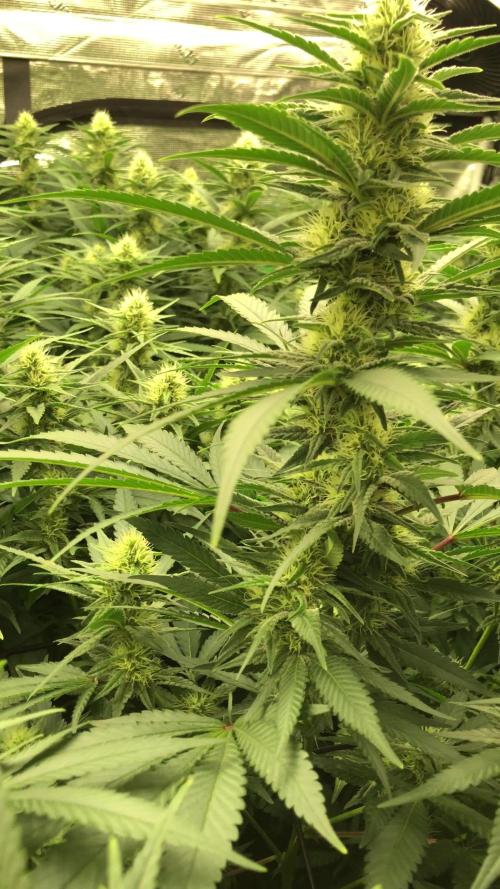
Mainly just monitoring things this week and watering and on humidity control. Got a deal on a large 20 inch fan and added it to the gorilla tent. and a deal on a Honeywell oscillating fan i added to the other flowering tent. Nighttime humidity has been hard to control even with my dehumidifier running while lights are off in the lung room. I want to run it during lights on but running into wattage issues on certain circuits i don't want to overload i only have 15 amp breakers. At was at least able to convince the "roomates" to let me set the nighttime house ac down to 73, so that was able to help me get tent temps down from high 80's to the low 80's during their "daytime" while having the light 100 percent. Vivosun tent is doing a little better with the humidity. I have a little more wattage in the lights and the canopy is a little more manageable so not transpiring as much. Towards the end of the week they hit a wall at their drinking and noticed a little more run-off than usual which is little to about a quart. out of 6-8 gallons in each time. One of the waterings this week included some microbe and fungal inoculant to give the rootzone an extra boost now that the plants are going to focus more on feeding themselves. adding a little bit of azomite to the water in the hopes theirs trace amounts of soluble silica in it. I want to start using a water soluble silica specific feed but I haven't found anything that's completely organic and soluble so that's why i opted to add some silica fixing microbes to fill any gaps the boogie brew may not be filling.

Likes
Comments
Share


@Squaregrouper
Follow
Getting stronger and sturdier the bud sites will be very plentiful

Processing
Likes
5
Share


@Mr_nugs_lover_David
Follow
Very good looking just like her sister, powerful citric and sweet aroma, very good strain, and starting to smell seriously at the start of 2nd week I'm noticing the same thing on both plants! Awesome strain

Likes
7
Share


@russrahl
Follow
Alien tech is coming along nicely, she is scrog’d with 3 other Ayahuasca Purple and seems to be doing beautifully. She didn’t stretch as much as the Ayahuasca, but I was able to keep the Ayahuasca lower by spreading it more then the Alien Technology. Screen is not perfectly even, but there all within the sweet spot for my 1000w HPS so things should start ramping up soon! Not much else to say this week, just been checking the ph levels and adding 8 gals or so of water/nutrients every 2-3 days to the main reservoir feeding all 4 plants. So far they are good with the same nutrients so that is good! Lol cheers 💨
Likes
11
Share


@LiamF
Follow
Day 29 : removed the LST (later note - BIG MISTAKE)
Day 29: First signs of flowering😍
800ml water with nutes on day 31
1L water with nutes on day 33
1L water with nutes on day 35

Likes
27
Share


@iLoveGoodWeed
Follow
The Gorilla strawberry is now harvest and drying.
Gorilla glue is just cover in buds from bottom to the top.
Gorilla cookies will be getting fat in next 2 weeks.

Likes
13
Share


@K_MoK
Follow
Finally some bud development...
The kriticals are not enjoying the high EC level... but that's life...😏
Been difficult to low the Hr level, too much moister in the air by here! Living beside the sea in winter its not easy!
Just hope to get things straight...🙏
Likes
1
Share


@walterwhiteee
Follow
Starting to flower so I put out the trellis net
Feeding of Gia Greens General Purpose and Flowering Power Bloom


Likes
4
Share

@Yamamoto420
Follow
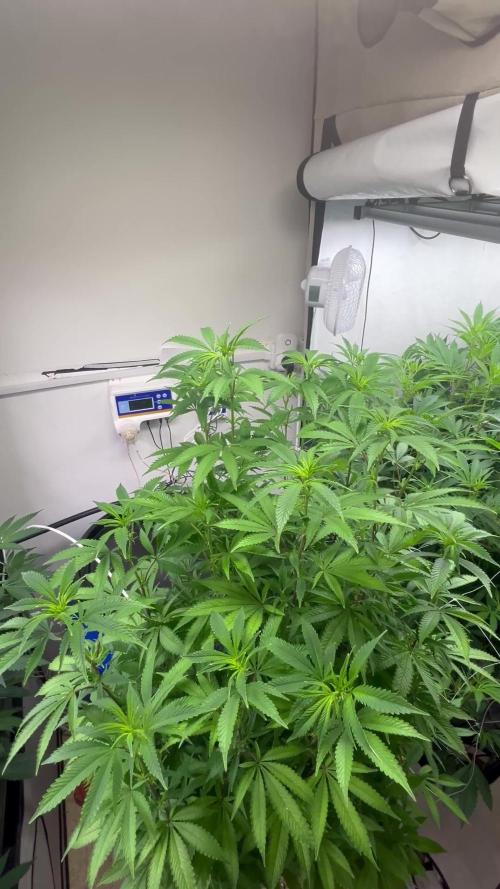
Week 2 flower (day 9) the plants looks healthy and they straching everyday more and more its going to continue stretching till 3 from my experience. I added second trellis net (scrog) and raised the CO2 enrichment to around 1200 PPM, lights is on arouned 1000-1100 PPFD, I raised the nutrients EC to 2.0, so far so good. I noticed that the plants want more water they’re always hungry the want more and more. I never grow plant that drinks that much of water. Hehe.
*update:
Week 2 flower day 12 the ladies are starching alot every day, I keep an eye on them and I lift the lights every day. Don’t want to burn the them, I raise the EC to 2.1 2.2 .

Likes
9
Share


@FarmZOG
Follow
Day 66
Tops harvesting day, I will not hit the harvest button now cause my harvast its in phases, so I cut the tops first, bottoms and main colas base keep ripening for one more week.
The video (with sound) its a density test I invent after smoke this scissor hash hahaha (STFU) 😂😎