





Likes
11
Share


@Budking420
Follow
Shes a monster! She grows super duper fast I'm sure you agree! I'm very content with her already shes spread greatly. I haven't had tons of time to really mess with her and she seems to like it when I leave her be for a few days between training and defoliation. I included some ac infinity charts however I havent focused on VPD due to leaf temp differential and I believe it isnt as accurate as it should be. Unfortunately AC infinity has made the app mostly for iphone and I'm stuck on android. I will do my best to show you my averages and high and low. I hope that you enjoy the garden as much as I do! Check back next week to see just how fast she grows & remember its 4:20 somewhere!!!!
Likes
11
Share


@goeser
Follow
More details and photos are coming when all buds are dried in about 6-7 days00
Likes
17
Share


@HowtoBubatz
Follow
It’s week 5 of flowering, and things are looking fantastic!
The adjusted nutrients for the coco substrate have clearly made a difference, as both plants are thriving and continue to develop thick layers of trichomes. ✨
Interestingly, the non-LST plant is starting to show some unique color variations, which is surprising given that both are from the same strain.
This unexpected twist adds a bit of excitement, and I’m curious to see how it will develop over the next few weeks.
When it comes to scent, the differences are striking! The LST variant has a bold and distinct Lemon Haze aroma—zesty and citrusy 🍋💨
while the non-LST plant gives off a fruity-sweet smell that’s incredibly rich and inviting. 🍓🍭
Unfortunately, my camera broke this week, and now I’m dealing with some low-quality pictures. 📷😔
While it’s frustrating not to capture the plants in their full glory, I’ll do my best to document their progress as clearly as possible.
Overall, both plants are doing great, and I’m looking forward to seeing how they turn out in the final stretch! 💚
Likes
12
Share


@Big0zGrower420
Follow
Hey there
Just chilling now and letting them do their thing. Been pretty chill so far, dechlorinated water and top dressing. Going to give some more microbe life as well and maybe make an SST sometime this week.
Likes
126
Share


@Ju_Bps
Follow
Hello growmies 👩🌾👨🌾🌲🌲,
👋 We're on the last week,
Temperature are very high since few weeks and the girls didn't really appreciate....
I try to down the power of lamp to 80%, but changing nothing...
Trichromes ready, no watering.
Harvest tomorrow 🌲✂️
💡Mars Hydro - SP 3000
80% 43 cm.
🔥 Thanks community for follow, likes, comments, always a pleasure 👩🌾👨🌾💚🌲.
Mars Hydro - SP 3000 💡💡
https://www.mars-hydro.com/sp-3000-samsung-lm301b-greenhouse-led-grow-light
Zamnesia - Frosted Guava Auto🌲🌲
Discount code -20% with GROWITGD code 🔥🔥
https://www.zamnesia.com/7679-zamnesia-seeds-frosted-guava-automatic.html

Likes
21
Share


@Siriuz
Follow
Day 37
We started with nutes today
Then all day long outdoors
From 6AM to 6PM
Plus CFL afterwards
They rest for 3 hours and then CFL again
Btw accidentally snapped one part of one big leave but that okay
Since we don't do defoliation on her
We guessing it's okay she will recover soon
Day 38
Since she's such a queen we wanted to upload a video showing how she starts flowering for the record, thanks a lot
You can Always follow me at Instagram
@cannagrowersiriuz
Also don't forget to add your comment below, it is important to us!
We want to learn, any tips, suggestion, more than welcome my friends
Happy Growing
Day 39 Some mins before installing ScroG
Day 40 Wonderful, she's out of there already so huge, full of buds
Day 41 she's actually doing great full of buds but those 2 first leaves are a little bit sad looking weird plus those black dots idk and it's turning yellow in between I decided to remove it and well, I'm hoping she's doing well what else I could think of guys any help or concerns?
At the end of the day, she's overall healthy and strong
Day 42 Time to feed the babies, so we added 900PPM (300ml) floranova grow
Followed by 1590ppm (300ml) flora nova bloom to make sure she's got all nutrients balanced well, also added 400ml of plain water after that so they could get a nice run off.
I think they're happy and we gonna check on them in a couple days to see how they go, Ph is around 6.2
which is great
Temp outdoors from 7-@
1pm around 25C to 36C
Then back indoors
Temp is 28C and drop to 22 at night and dawn so they're good and comfortable
Keeping humidity lvls around 40/65% top
Nice AC and Fan for air circulation
Thank you all for your support

Likes
4
Share

@xipo86
Follow
Day 69
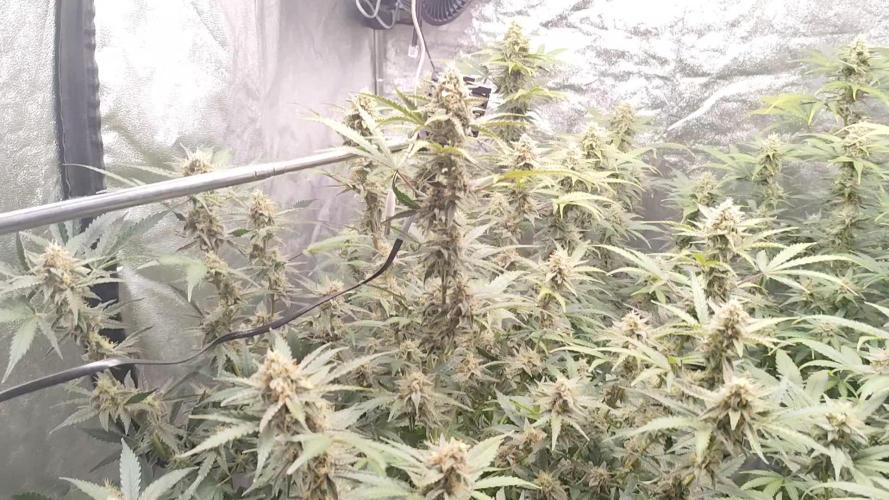
Buds gettin heavy by the day. it's only a matter of waiting now.
frost from apolo haze is crazy. Super boof is gettin there now but apolo.... will be a frosty one


Likes
30
Share


@GrowInger420
Follow
Week was good, nice purple color and frosty af because i let her at 13 degrees celsius at noght. Have a nice week✌️
Likes
33
Share


@AshBrand
Follow
6/20/21 - They look great! On track and the stretch has stopped completely. See pics and video from today…
6/21/21 - Day 30 of flower! Half way there :) They’ve been drinking water without any runoff coming out of the pots. Also the stretch has stopped and they look good.
6/22/21 - On track. Good size buds and a good smell. Excited for harvest! The room is filling up with flowers.
6/23/21 - I am still feeding with the nutrients listed above which is Week 9 on the schedule.
6/24/21 - We are very happy with the growth and bud size. They look and smell great!
6/25/21 - They are doing well. Just flowering away. I’ll post pics soon. Other than feeding them I am just letting the plants flower. No techniques being used.
6/26/21 - I missed a week on the feeding schedule and gave it straight water. I’m going to run Week 9 again and go from there.
Likes
2
Share


@Yiyis_Grow
Follow
Lámpara: Bestva Quantum Board LED LM301B
Sustrato: 2 Jiffy fino : 1 Floragard
Especies: Charlotte Dream CBD - Auto Dark Purple - Purple Kush - Triping 25 - Gelato Ice
Acontecimientos :
1. Las automáticas que me enviaron de regalía empezaron a florar muy pronto y van a dar muy poca producción. No vuelvo a poner automáticas gratis en mis indoor.
2. Las Charlotte Dream han crecido de forma brutal comparadas con las demás.
3. Se está empezando a hacer LST a algunas de las plantas, otras se quedaron al natural.
4. Luz 20h/día, nutriente y viento.
Buenos humos


Likes
5
Share


@Sunstonedherbs
Follow
Week start:
ScarJo has taken really well to the mainline and will need to be topped again later this week. Berry however is still behind. I'm sure she'll bounce back soon, but I've learned my lesson on too much stress too soon.
Day 4:
All of the girls got some LST done, with ScarJo getting defoliated and topped once more to finish the MainLine. now we'll be topping her every few nodes until flower. Baskin bounced back well from super crop, though is still recovering. Merry Berry is almost ready to be topped again in a day or two. Supercropped her tops like I did for ScarJo so we should be seeing some more bud sites the grow goes. Miguel had two side branches at 3 nodes and I topped them. LST was done to spread the branches out more. I'll do more have defoliation on Miguel once they've bushed up again. Goldilocks had their top leaves defoliated. Janet because she is so bushy actually had no training outside if 2 leaves being snipped. I'll do more defoliation and lollipopping on on Janet and Baskin (the two autos) once they start preflowers.
I also switched to using the Green Gro nutrients as a top dress. Topdressing is going to be done on Saturday (day 3) or Sunday (day 4).


Likes
5
Share

@PhinolaGreen
Follow
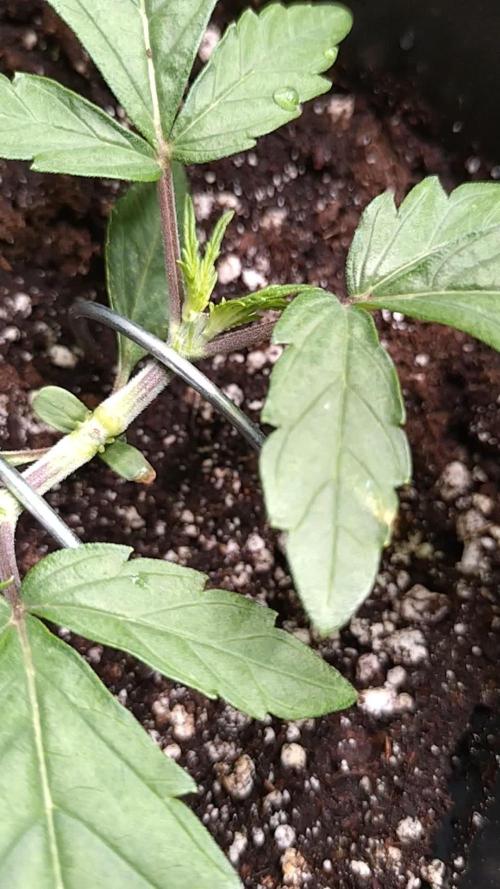
Week 3.
All is going well, she makes an effort and i like it.
Actually she progressing the second Topping and keep it last Cut end of the week maybe 😁

Likes
7
Share


@Do_it_Dan
Follow
This week hasn't really done much, recon it's the week it focuses on root system, hopefully get alot of vegetation over next few weeks.
Likes
18
Share


@berlinbeginner
Follow
High temperatures and nutrient burn. At this point i have no idea what i am doing. Every now and then SD2 and SD3 release typical weed smell but apart from that no other smell. The stems upon rubbing and touching smell like cinammon,cloves and orange zest.It reminds me of fanta drink.


Likes
2
Share


@420Hunter
Follow
Ernte nach 64Tagen. Für den falschen ph wert ganz akzeptabel. Auch erst mein 1ter richtiger grow. Hat spaß gemacht. Nächstes mal wird einiges besser. Wenn die blpten fertig sind gibts noch mehr bilder.


Likes
20
Share


@Dingle_Dangle
Follow
02/01/2022 - Day 77 - First day of the 12th week.
Yoooo, anybody still here?
First of all Happy New Year to everyone!
And after this, we back after 4 weeks of silence and...
...the girls are still on the grind! ahah
Especially one, slowly slowly, is doing her stuff, NO FEAR!
Winter? No problem (almost) ahahah
Wish me good luck and let's hope in sunny mild days 🤞☀️
- DD
