


Likes
Comments
Share


@LetsGrowSome
Follow
The Holidays caused a little headache this past week. Was a few hours late on water schedule due to holiday commitments. Found the middle plant had sucked all the water out and went into underwater stage. A few of the giant fan leaves took a hit, but not too bad. Didn't change anything other than water schedule to every day now and the leaves had no further damage/discoloration. All leaves still praying and doing good. Trichromes starting to pick up on all the plants now. Had a situation in my other tent with a plant that shouldn't have been saved, that i saved, and seems to have slightly hermied and I didn't catch it. Not terrible, as out of a 6 oz plant, I found 42 seeds. Hoping that tent doesn't effect this room, but it's possible it has. Just gonna ride it out now and see how it goes.

Likes
376
Share


@Metatronix
Follow
Good day to all my friends and visitors here on GD.
Decided to finally finish this diary so that on New Year eve I'm not opening the year with unfinished business.
Now we cut the second Tropicanna XL auto plant, the first cut you can find in week 17. The plant from week 17 weighted 2.6 kilo wet, this one finished at 2.1kg. wet.
The girls where autoflower but thanks to me starting this grow in cold day temps (14 degree Celsius) the started flower really late and grew and grew :)
I enjoyed growing this strain immensely, smells so sweet and fruity, she has the most intense and most delicious aroma ever
She brunches off like crazy, gave me a ton of big and dense bud.
They were the biggest plants I have ever grown and to top that this cultivar rewarded me with one of the most tasteful buds, fit even for a picky connesour.
--------------------------------------------------------------------------------------------------
SE7000 done it's magic with this grow as with all my other grow ops.
For anyone who is interested in obtaining this efficient and affordable light fixture ($ to gram) here's the link:
https://spider-farmer.com/products/spider-farmer-upgraded-se7000-730w-commercial-led-grow-light/
A shout out to Sweet Seeds for the gift of this fenomenal genetics: https://sweetseeds.es/en/
Thank you all for your companionship on this voyage, I hope you enjoyed it at least as much as I did.
Also thank you for this awesome year together here.
Together with my little family we want to wish you all a Merry Christmas and a happy slide into the New Year, we love you all.

Likes
2
Share


@Ultraviolet_
Follow
We become aware at such times of man's wonderful ability to bring seemingly unrelated elements into harmonic balance, and receive a glimpse into a world where everything exists in conscious sympathetic attunement to everything else. When we listen to a piece of music that seems to strike a beautiful chord somewhere inside us, or view a painting that simply glows with harmonic awareness well executed, we probably do not spare much time to contemplate the wonderfully intricate combination of vibrations that our sensors make it possible for us to perceive. We tend to appreciate the relationship between the parts of something by an awareness of the harmony or dissonance of the whole. This ability enables us to say "what a beautiful house!" instead of "analysis has proven that this collection of building materials exhibits certain elements of harmonic proportion." While this ability to instinctively appreciate the beauty of true harmony has an important role to play in evolution, a more analytical understanding of the laws involved can be most useful. This is especially so if we wish to create works of art where each part exists in true harmony, not only with the other part of that particular whole, but with the universe within which the creator and the created exist.
Everything vibrates. From the most dense matter to the most subtle cosmic rays, everything which our senses allow our thoughts to become aware of, can be specified in terms of wavelength or frequency of vibration. These two terms define the same thing, but from different points of view.
The following are the approximate wavelengths of various energy carriers:
Cosmic rays 0.000,000,001 mm
Gamma rays 0.000,000,1 mm
X rays 0.000,500 mm
Ultraviolet rays 0.003 mm
Visible light 0.006 mm
Infrared 0.01 mm
Sound waves 1 meter
Radio waves 300 meters
Violet light 400 nm to 450 nm
Blue light 450 nm to 500 nm
Green light 500 nm to 570 nm
Yellow light 570 nm to 590 nm
Orange light 590 nm to 610 nm
Red light 610 to 700 nm
1 nanometer (nm) = 0.000,000,1 cm = 1/10,000,000 cm
If a guitar string is plucked and we hear a sound, it is not too difficult for the human mind to associate this sound with the vibration of the guitar string. With color it is quite different. It is difficult for us to conceive that the color of a substance is not an inherent property of the substance itself, but an indication picked up by our senses of that substance's ability to absorb or reflect the light which happens to be shining on it at that moment. Neither the matter nor the light is colored. What happens is that the brain learns to differentiate between the frequencies reflected or transmitted by the substance the eyes are focused on. The same thing happens with sound. When we say "Oh! Listen, they're playing my favorite song," what we really mean is: "My brain has stored within it a particular pattern of frequencies. I have compared the new information being received with this stored pattern and have deduced the answer that the two patterns are similar within certain specified tolerances." The 'pleasure' involved could have something to do with our running the pre-recorded pattern at the same time, in 'sympathy' with the new pattern as it is received.
The word sympathy describes very well our ability to appreciate color and sound. It also describes the reason behind certain elements of harmony. For instance, if a substance vibrating at 100 cycles per second (tone 1) is in the proximity of another substance vibrating at 200 cycles per second (tone 2), we could perceive, if we had the right equipment, a certain sympathetic relationship between the two.
We will see from this that there is a uniform doubling of the first tone seen in the second. At various points along the waves, the two are the same in amplitude. At other points, they are at opposite poles to each other. This doubled frequency has more points of similarity to the original than any other frequency except the original itself. If the equipment we had available for measuring these two frequencies was a soundboard amplifier and a pair of ears, then we would hear what would sound to us like one tone. If we had the opportunity to hear one at a time, we would hear that although they sound the same, one is higher in pitch than the other. This characteristic of 'the same but different in pitch', musicians have called the octave. Any two tones produced where one has exactly doubled the frequency of the other is called an octave. Speaking in ratios, an octave would appear then as the ratio 2:1 or 1:2, depending on whether we are talking of an octave up or down.
A single note produced by almost any instrument will contain more than one wavelength or frequency. It will have a dominant frequency, the wavelength of which we would call the note's 'fundamental' or 1st harmonic. It will also have a varying number of upper harmonics, gradually fading in intensity into infinity or silence.
Natural harmonics always have the same pattern of intervals between them. The interval between the 1st and 2nd harmonic is a perfect octave; between the 2nd and 3rd a perfect fifth; between the 3rd and 4th a perfect 4th; and so on, the intervals becoming smaller and smaller until they lose any relationship with the western 12 tone scale as it exists at the moment. Just as an octave has certain elements of sympathy with its fundamental, so some intervals have been noted to be more perfectly in sympathy with the fundamental than others. The ratio of the 'perfect 5th' or interval of 7 semitones, as it occurs in the harmonic series, is 3:2 or 2:3, while that of the 'perfect fourth" is 4:3 or 3:4. All the tones in the western 12 tone scale can be expressed in terms of the ratio between the upper tone and its fundamental. This would seem to be an ideal way of generating a scale from any given fundamental and several attempts have been made to do this, the Pythagorean system being probably the most well known. Although when working with a single tone instrument playing on its own, the Pythagorean formula works wonderfully well, if we had several instruments tuned this way together and asked them to play almost any western music, we would find that at times they sounded quite out of tune to each other.
The lack of flexibility of the various scale systems based on the harmonic series has led to what is known as the 'tempered' scale. This uses as its primary unit of interval the ratio of the octave or 2:1. It then proceeds to divide the interval between any fundamental and its upper octave into 12 smaller intervals by applying the ratio: two to the one-twelfth power, to one (21/12:1). This equals 1.059463094, so by multiplying any frequency by this number, we will obtain the tempered semitone next up from our fundamental. We will also find that any tone twelve semitones up from any other tone, in a scale generated in this way, will have exactly double the frequency.
If we took the note middle C on a piano and halved the wavelength, we would have the note C one octave above. If we halved this, we would have the C above, and so on. However, within about 6 octaves, we would find that although a 'sound' was being produced, no human ear could perceive it. If we kept on going, halving and producing upper octaves of our fundamental C, we would proceed through the infrared band, into the visible light spectrum. If we happened to be outside during the day, we would, for one octave only, see the note C with our eyes. The next octave above would already be in the ultraviolet band, and outside the eye's sensitivity range. If we can think of color as being an indication of a substance's vibratory rate or wavelength, we may begin to see a relationship that could exist between the color and sound spectrums.
The logical extension of what has so far been said is that there exists a scale in the color spectrum that corresponds exactly to the scale in the sound spectrum, each color tone being an octave of the equivalent note in the sound range.
This is not the end of the story but only the beginning. If we can for the moment accept that any wavelength in one band has upper and lower octave stretching out to infinity, then the next question is 'fine, but what shall we use as our fundamental? A particular color? A particular sound frequency?' The musicians among us will probably say 'A 440'. This means that the note A should vibrate at 440 Hertz, or 440 times per second. They would tell us that this is standard pitch has been adopted by most orchestras around the world; pianos are tuned to it, instruments are constructed to formulas based on it, and so to them it would probably seem the most appropriate place to begin. Some of these musicians may know of the battle that is still raging with regards to this being the standard, but few would know why A = 440 Hz was chosen except that it worked when it was set to be a suitable compromise between the many different pitches in use at the time.
432 Hz is said to be mathematically consistent with the patterns of the universe. Studies reveal that 432 Hz tuning vibrates with the universe’s golden mean PHI and unifies the properties of light, time, space, matter, gravity, and magnetism with biology, the DNA code, and consciousness. When our atoms and DNA start to resonate in harmony with the spiraling pattern of nature, our sense of connection to nature is said to be magnified.
Another interesting factor to consider is that the A=432 Hz tuning correlates with the color spectrum, while the A=440 Hz is off. Audiophiles have also stated that A = 432 Hz music seems to be non-local and can fill an entire room, whereas A=440 Hz can be perceived as directional or linear in sound propagation.
Once you adopt the idea that sound (or vibration in general) can have an equalizing and harmonizing effect (as well as a disturbing effect), the science of harmony can be applied to bring greater harmony into one's life or tune to specific energies. There is a form of absolute and relative harmony. Absolute harmony can, for example, be determined by the tuning of an instrument. The ancients tuned their instruments at an A of 432 Hz instead of 440 Hz - and for a good reason. There are plenty of music examples on the internet that you can listen to in order to establish the difference for yourself.
Attuning the instrument to 432 Hz results in a more relaxing sound, while 440 Hz slightly tenses up the body. This is because 440 Hz is out of tune with both macro and micro cosmos. On the contrary, 432 Hz is in tune. To give an example of how this is manifested microcosmically: our breath (0,3 Hz) and our pulse (1,2 Hz) relate to the frequency of the lower octave of an A of 432 Hz (108 Hz) as 1:360 and 1:90.
It is interesting to note that 432 Hz was the standard pitch of many old instruments and that it was only recently (19th and 20th century) the standard pitch was increased. This was done in order to be able to play for bigger audiences. Bigger audiences (more bodies) absorb more of the lower frequencies, so the higher pitch was more likely to “cut through”. One of the oldest instruments of the world is the bell ensemble of Yi Zeng (dated 423 BC), tuned to a standard F4 of 345 Hz, which gives an A= 432 Hz. The frequency of 345 Hz is that of the platonic year! Similarly, many old organs are tuned in A=432 as well; for example, St. Peter’s Capella Gregoriana, St. Peter’s Capella Giulia, S. Maria Maggiore in Rome.
Maria Renold’s book “Intervals Scales Tones and the Concert Pitch C=128 Hz” claims conclusive evidence that 440 Hz and raising concert pitch above scientific “C” Prime=128 Hz (Concert A=432 Hz) disassociates the connection of consciousness to the body and creates anti-social conditions in humanity.
The difference between concert pitch A=440 Hz and Concert A=432 Hz is only 8 cycles per second, but it is a perceptible difference of awareness in the human consciousness experience of the dream we share called existence.
Likes
9
Share

@Grow_Outside
Follow
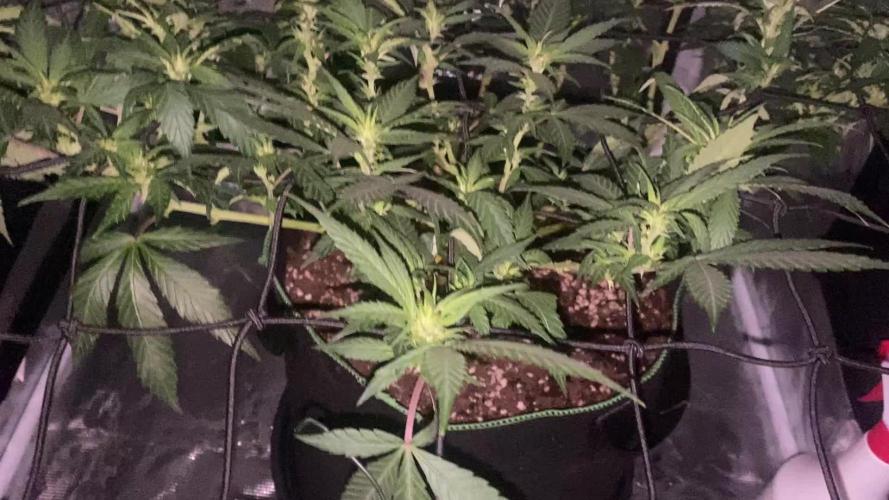
Die "kleine“ Dame macht sich hervorragend, sie bildet überall Knospen aus und steht sehr vital und fit da. Ich bin mal gespannt wie es weiter geht
Aktuell bekommt sie 12 Stunden lang 650-700 PPFD am Tag (über der pflanze verteilt)
Sie bekommt den Green Power 5in 1 Dünger der eigentlich super ihr bekommt 💚 bald geht’s richtig zur Sache
Infos:
Gießwasser: 1L in 24 Stunden
PH-Wert: 6.2
Nährstoffe/Dünger: S&R Organics 5in1 4ml/1L
Luftfeuchtigkeit: 55-60%
Temperatur im Zelt: 20-23Grad
Lichtdauer: 12 Stunden
PPFD: 650-700
EQUIPMENT:
Licht🌞: Marshydro TSW2000 300watt ✅️
Rohrventilator💨: S&P TD 350 silent.✅️
Aktivkohlefilter💢: Can-lite 300
Zelt⛺️: Marshydro 80x80x160 ✅
Luftbefeuchter: Spider Farmer 6L. ✅️

Likes
17
Share


@HIAZ_urbanbudfarmer
Follow
She is going well, topped main & secondary branches ( 2nd topping) & performed some l.s.t. training & mainline training. Thanks to Fast Buds for the cool apparel & FF seeds, my prize for being 1 of 10 winners for November diary of the month 👍
Likes
1
Share


@GrowMoSapien
Follow
Stems are getting top heavy, more weight packed on and they are starting to lean, I don't have room for a scrog net. Pistils are turning amber, only about 10% so far on day one. I hand plucked off the small larfy, sucker buds. I let some go too long and the large majority are worth keeping. Next time I will have the courage to defoliate properly! I get so scared after weeks or months of growing and then removing growth.
Final day of week and these colas are stacking on so much weight they are bending over. Noticed nutrient deficiencies and tried to adjust accordingly. Hoping the problem doesn't get exacerbated.

Likes
15
Share


@SirBudAlotts
Follow
Week 0: Germinated her the old-school way...two paper towels, between 2 saucers..
Fastbuds: I was so impressed with the packaging ..even though I was not able to get the original packaging (Discreet)..
Week 1: just sprinkled H20 on her.. Midweek she sprouted.
Week 2: Added some AgriSil K50 for her root development..She showed her first true leafs like yesterday..
Likes
144
Share


@TOTEM
Follow
Everything good except a bit of salt buildup caused by a poor runoff over the last weeks. You can see this by looking at almost every tip of the leaves.
Last week Amazon had some problems delivering new ferts, so from day 97 to 101 I gave just 1ml/L of Bud Factor X and no Bud Candy and Sensizym at all. On day 101 I made a new nutes mix, and it’s the one you can see on GD. No more Bud Factor X because it’s very expensive and I don’t think I’ll need it for just two more weeks. I used 1ml/L of Cal Mag Xtra because I ended my Connoisseur Bloom Part A too. Lol, it’s been a problem.
I ordered some Sensi Bloom Coco A+B and another Bud Candy for the last two weeks by the way.
Flowers are now enlarging since the first day I added Overdrive. Very very good, I like this Silver Haze.

Likes
21
Share


@Big0zGrower420
Follow
Not much going on, just keeping things going and staying on track. Just been watering and checking up on them daily. Getting closer on the cookies.

Likes
1
Share


@CannabisKhan
Follow
Plants were watered on day 4 of week 9, as follows:
Lucy: 1 gallon water, pH: 6.27, Height: 22 in.
Herbert: 1.25 gallons water, pH: 5.77, Height: 24.5 in.
***Both fed nutrients - 5 ml/.5 gal BioVega (3% N, 1% Phosphate, 5% Soluble Potash), 7 ml/.5 gal BioBoost (1% Phosphate), and 1 ml/.5 gal BioRhizotonic (0.6% Soluble Potash)
Plants were watered on day 5 of week 9, as follows:
Thin Mint Sr: 1 gallon water, pH: 6.76, Height: 20 in.
Thin Mint Jr: 1 gallon water, pH: 6.50, Height: 19.5 in
Notes: Thin Mint Jr has nutrient burn and so was NOT fed nutrients today. Thin Mint Sr was fed nutrients at 50% strength 2.5 ml/.5 gal BioVega (3% N, 1% Phosphate, 5% Soluble Potash), 4 ml/.5 gal BioBoost (1% Phosphate), and 0.5 ml/.5 gal BioRhizotonic (0.6% Soluble Potash) (both plants still in nutrient distress - in process of recovery but have some new growth that is greener so improvement is being observed; slowly but surely!)
***Plants ideally would have been transitioned to the flowering phase this week, but due to nutrient deficiencies and nutrient burn on Thin Mint Jr., we are holding off on this transition for 1 week to give the plants a chance to recover from stress.

Likes
13
Share


@MotherNaturesSon
Follow
grew well despite some kind of immobile nutrient deficiency in the growth cycle. yield is good. Responds very well to some LST. My experience with this strain suggests a longer curing time to temper the unique sweetness of this strain.

Likes
25
Share


@Kush_queen
Follow
Well this week I had to give the girls a fairly big trim they were beautifully bushy but they were struggling for space so I cut back the heavy shade leaves that were covering bud sites
I am also adding bloom to there feed from now but they are doing really well and the smell in the tent is devine.
💚🙏🌱🙏💚🙏🌱🙏💚


Likes
79
Share


@JUNGLE_B4RNS
Follow
6 weeks in soil, everything is doing great, genetics are good and did respond well to topping !
Gonna clean them a bit ( after taking the pictures), by plugging off the inner leaves and lollipopping the 2 lowest sides shoots .
Watering with some BIO 8-2-2 , plants will break down this source of Nitrogen quicker than breaking down the one available in BIO Soil. As these ladies are eating like monsters I don’t want them to run out of anything if possible.
Another last week before putting everyone under a trellis and start scrogging. I will be able to start to see which lowers shoots are going to reach to top !
( I’m looking for a job in the Cannabis industry as Master Grower, Mineralogist, Quality Control 🐞 )
Likes
43
Share


@Sabac
Follow
Semana 4 de flora están a full mis plantitas. Creciendo cada día más y más.
Sanitas.

Likes
19
Share


@willertex
Follow
📅 D65 - 04/01
📜 Flush made. New Res lowe EC. Lamp raised up. Thx community, thx guys 🙏 @cheeba-inu @myxomatoz
✍️ 1.5 EC
♒ 5.4 pH
🌊 10 L
📏 50 cm
📅 D74 - 13/01
📜 Flush made. Big issues. Ask to Community
✍️ 0,1 EC
♒ 5.4 pH
🌊 10 L
📏 50 cm
Likes
1
Share

@Userbosco
Follow
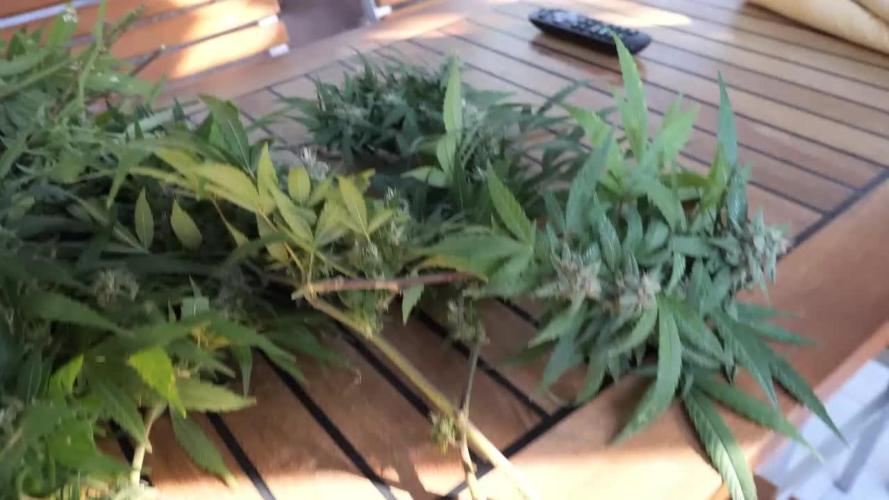
14 oz dry. Harvested a little early because bud rot showed up. 😡 Lost one entire branch 😞 Terps were not fully developed and had extra popcorn. Gave away about 1/3 my harvest to a neighbor because I'm too lazy to clean that small stuff.


Likes
31
Share


@Kim_Jong_High
Follow
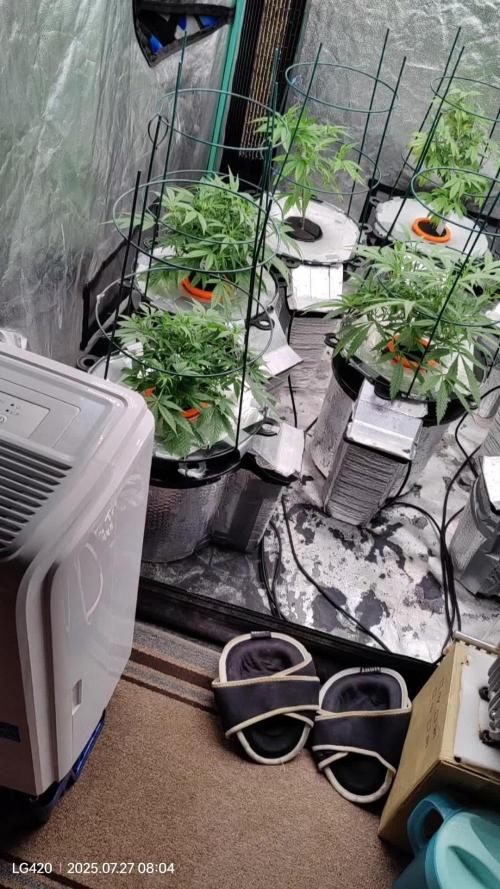
Week three and new space is set up. Much more room for activities! Decided to go with 6 plants and get rid of the two stressed ones, but going to wanted to grow them out in veg just to see what they'd turn out like...
Likes
39
Share


@SamDo
Follow
Hello,, nous à somme a la fin de la semaine 12, floraison 6. Tout vas pour le mieux. Les buds on prient encore un peu en volume. Pour la critical+2.0 il reste 2 semaines avant la récolte. J’ai donc arrosé une dernière fois avec engrais avant de passer au flushing. Pour la gorilla, il y aura encore un peu de délai. Mais les 2 se portent très bien.
Une odeur bien distincte se dégage des 2 variétés,, les buds sont très collantes, ce qui me semble très prometteur!!
Voilà pour cette semaine. Rien de spéciale à ajouter.
Happy grow...😎

Likes
15
Share


@Antony_mow
Follow
Нам уже мало места, много новых стволов после lst, жду на днях новый гроубокс и лампу, так же через 2 дня начну вводить GHE nutriens

Processing
Likes
Comments
Share


@WhizbangWheelhouse
Follow
Had to do some trimming on the one plant, however it is coming back strong. trying to get my watering schedule down.
I guess I wont complain too much, they are still alive.